

Welsh live captions and productivity tool for job interviews
For deaf and hard of hearing people.
Download for free


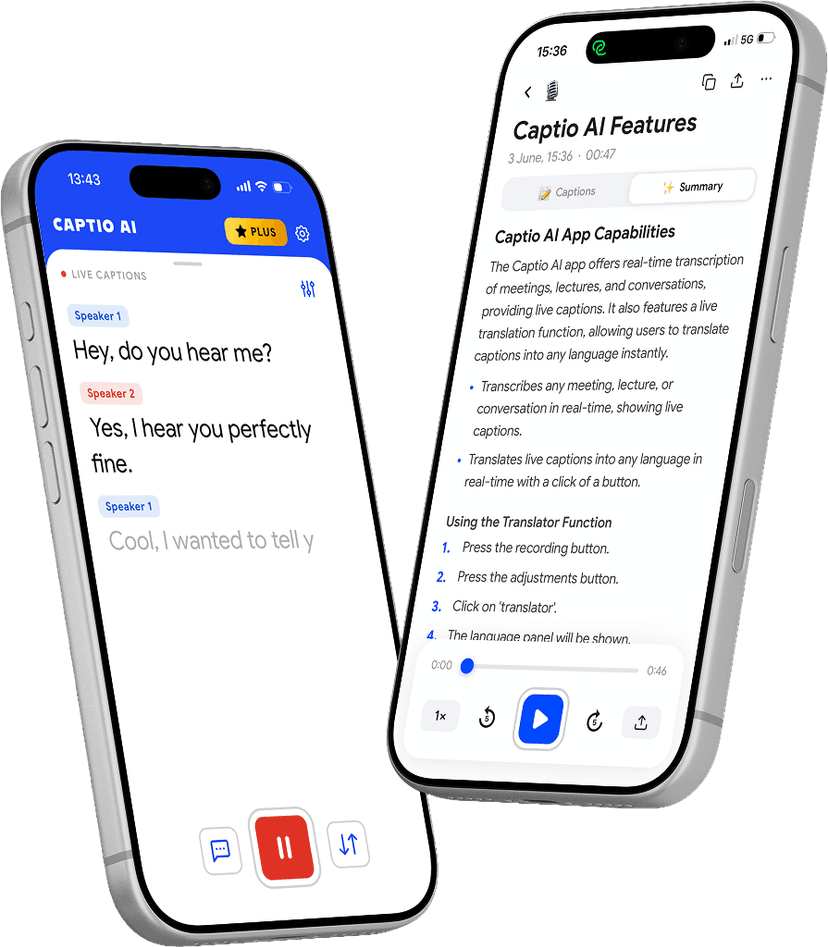
Everything you need to follow Welsh job interviews
Four tools built for deaf and hard of hearing Welsh speakers.
Read the question before you answer
- Every word appears in real time as the interviewer speaks
- Works in person, on video calls, and on the phone
- Discreet — runs quietly on your phone
- No asking for repeats
For interviews in another language
- Captions and translates in real time
- For international employers or roles abroad
- 60+ languages, no setup
- Follow every question in the language you think in
Review the interview afterwards
- Record and transcribe to revisit questions and your answers
- Useful for preparing for follow-up rounds
- Identify what you want to clarify in a second interview
- Works on any recording
Key topics and questions extracted
- Main themes and questions pulled from any interview transcript
- Useful for post-interview reflection and follow-up
- Organised into sections
- Works on any saved recording
Download for free
Every situation covered
Designed for the real moments that matter — not just quiet controlled environments.
Welsh-medium job interviews are increasingly common across Welsh public sector, education, and media organisations. Captio AI captions the interviewer's Welsh in real time so you can focus on answering, not on tracking mutations.
Video interviews over Teams or Zoom are standard at Welsh employers and bilingual organisations. Captio AI captions Welsh or English in real time over any compressed call.
Phone screens at Welsh-medium organisations are often conducted in Welsh. Captio AI captions the recruiter's speech live without a video feed.
Panel interviews at bilingual Welsh employers may include speakers from different dialect regions — Gwynedd and Cardiff sound very different. Captio AI handles both varieties in the same room.
Many Welsh-medium interviews switch to English for technical discussion or when a panelist is not a first-language Welsh speaker. Captio AI covers both Welsh and English in the same session without any change.
Group assessment exercises at Welsh employers may be conducted in Welsh or bilingually. Captio AI helps you follow every speaker and every instruction across the group.
Most accurate and fastest models
word accuracy
independent benchmark, 2025
real-time captions
first word appears as you speak
Download for free
Built for the room where a missed word has real consequences
Read the full question before you answer
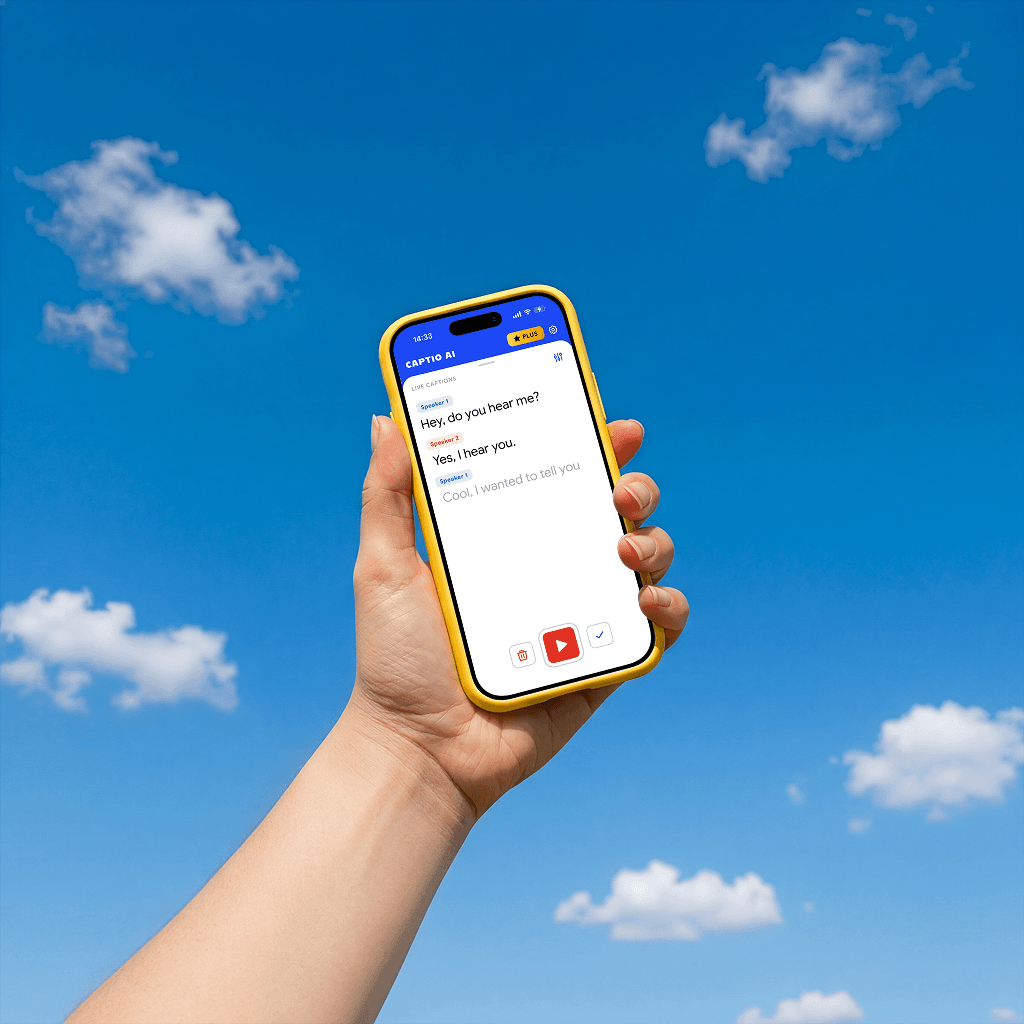
Every word appears on screen as the interviewer speaks. You read the question completely before responding — nothing guessed, nothing reconstructed.
Works in person and on any call format
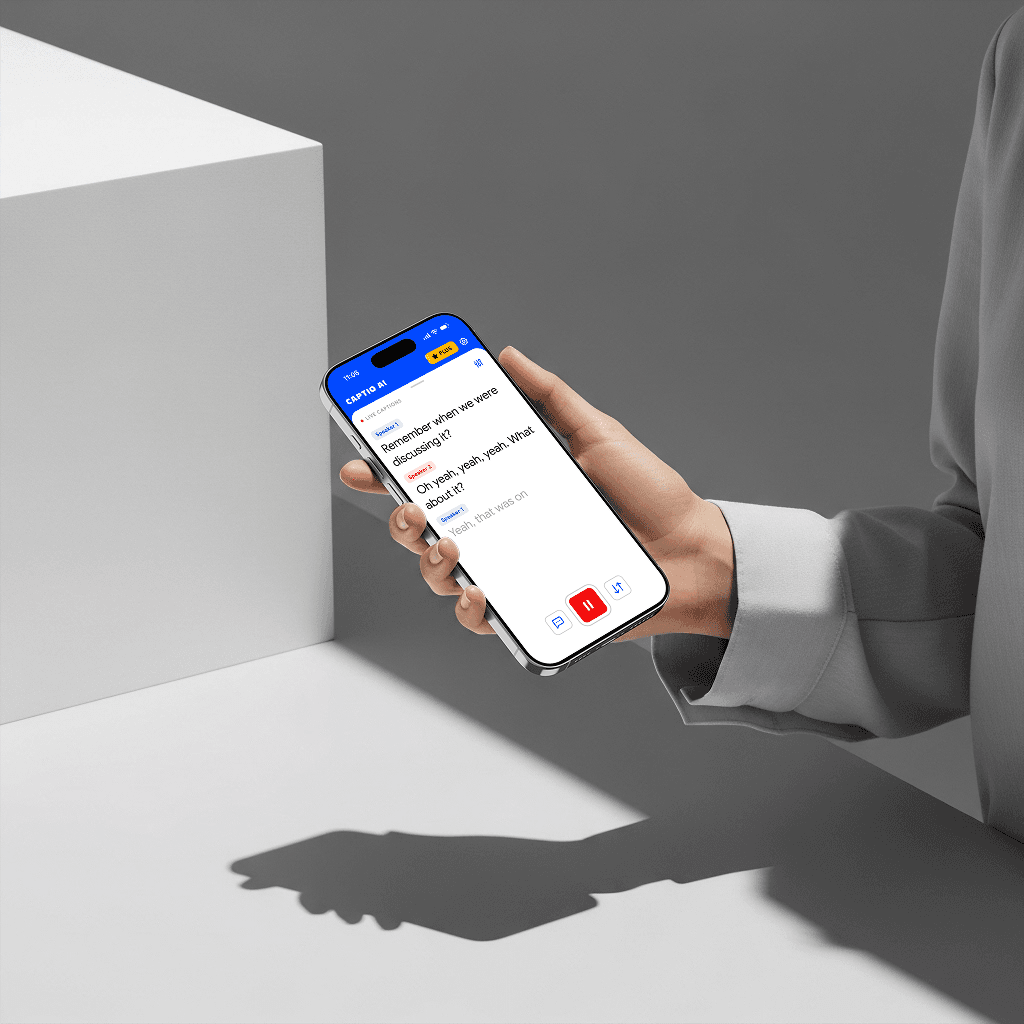
In-person interviews, video calls, phone screens. Place the phone on the table or point it toward the audio — Captio AI handles every format.
Discreet by design
The app runs quietly on your phone. Place it on the table or hold it naturally. No explanation needed, no drawing attention to the accommodation.
No asking for repeats
Asking an interviewer to repeat a question signals uncertainty. Captio AI means you never need to — you read it in real time and answer with confidence.
Any language
For international roles, multilingual panels, or interviews conducted in a second language. Live Translator captions and translates in real time so language is never the barrier.
Private by default
Interview conversations are sensitive. Captio AI processes audio in real time and discards it immediately — nothing is stored, nothing is shared.
Why Welsh is hard to understand
Initial consonant mutations
- The same word starts differently every time
- Welsh has three classes of initial consonant mutation — soft, nasal, and aspirate — that change the first consonant of a word depending on grammatical context. A word that begins with P can appear as B, Ph, or Mh depending on what precedes it. The word looks and sounds completely different each time, making visual pattern-matching across forms nearly impossible.
Voiceless lateral fricative (LL)
- A sound that exists in almost no other language
- Welsh ll (/ɬ/) is a voiceless lateral fricative produced by placing the tongue against the upper teeth and blowing air around the sides. It has no equivalent in English and produces a distinctive but visually minimal shape — experienced deaf lip-readers familiar only with English or European languages may have no reference frame for it.
North–South Welsh divergence
- Two very different spoken varieties
- Northern Welsh (dialects of Gwynedd and Anglesey) and Southern Welsh (South Wales valleys and Swansea) differ substantially in pronunciation, vocabulary, and grammar. An interviewer from Bangor and an interviewer from Cardiff sound different enough that a reader calibrated on one variety may struggle in the other.
Welsh–English code-switching
- Two languages in one Welsh interview
- Welsh speakers routinely switch between Welsh and English mid-sentence — especially in professional settings where English technical vocabulary is common. Both language streams run in the same conversation and must both be tracked in real time.
Voiceless nasals and unusual consonants
- Sounds without English equivalents
- Welsh has voiceless nasals (/m̥/, /n̥/, /ŋ̊/) alongside its usual voiced counterparts. These sounds are produced with the same articulatory shape as their voiced equivalents but without voicing — a distinction that is invisible at the lips and completely indetectable in lip-reading.
Download for free
Hearing loss and employment in Wales
RNID data shows that only 37% of people who report British Sign Language as their primary language are in employment, compared with 77% of non-disabled people — an employment gap of 40 percentage points. In Wales specifically, an estimated 4% of the working-age population wear hearing aids or are profoundly deaf or have severe hearing loss, and Wales has more disabled people per capita than other UK nations, with correspondingly higher rates of disabled unemployment. People with hearing loss in the UK earn on average £2,000 less per year than the general population.
A report published by the Welsh Government in 2019 — 'Able, ready to work... and deaf' — captured the lived experience of deaf people across Wales, documenting that job interviews represented one of the most consistently difficult experiences for deaf candidates: rapid speech, unfamiliar accents, background noise, and the absence of captioning combined to make equal participation effectively impossible without accommodation that was rarely proactively offered.
The Welsh Government published a written statement in December 2025 on improving care for people with hearing loss, signalling ongoing policy attention. Yet the gap between policy intention and interview-room reality for deaf Welsh job seekers remains substantial. Captio AI gives deaf and hard of hearing candidates in Cardiff, Swansea, and Gwynedd a way to follow every word of a Welsh or English interview in real time — without an interpreter, without advance notice, and without changing the interview format.
Download for free
What you hear stays with you.
Gone the moment it ends
Captio AI processes your audio in real time and discards it immediately. Nothing is recorded. Nothing is kept.
Not a product
Your conversations are not something Captio AI sells, shares, or monetizes — to anyone, for any reason.
Not used to train anything
What you say in a doctor's appointment or a job interview never ends up in a training dataset. Not ours. Not anyone else's.

Private by default
Captio AI supports 60+ languages
Download for free
Frequently asked questions
Hear every question in Welsh.
Captio AI is free to start
Download for free