

Chinese live captions and productivity tool for job interviews
For deaf and hard of hearing people.
Download for free


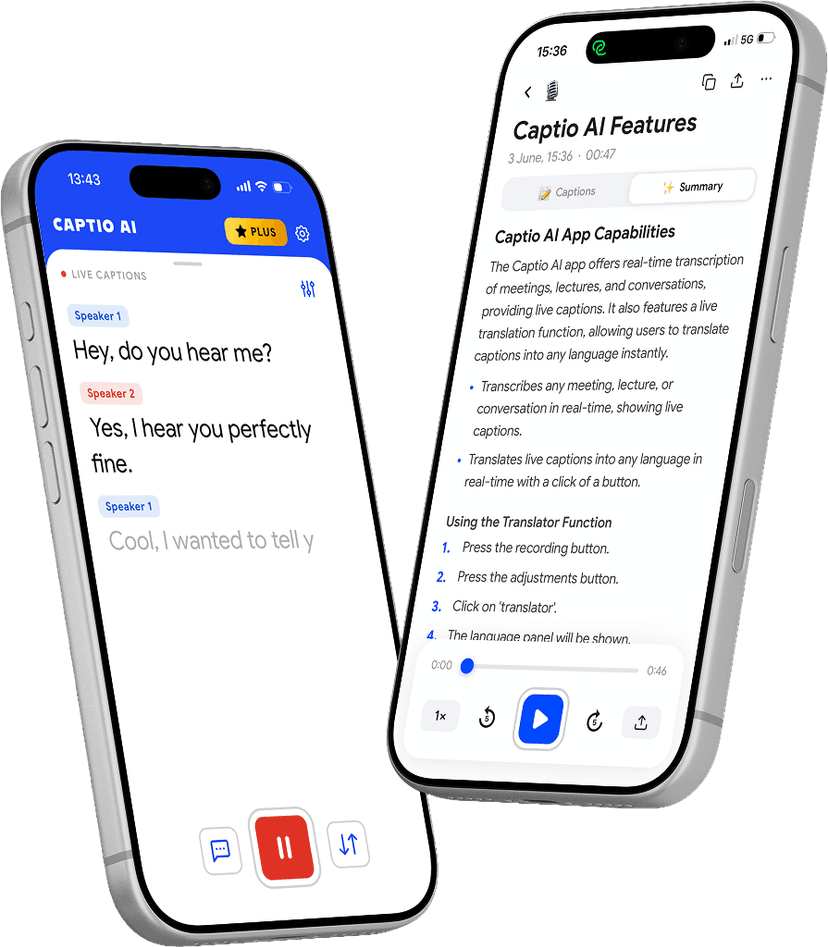
Everything you need to follow Chinese job interviews
Four tools built for deaf and hard of hearing Chinese speakers.
Read the question before you answer
- Every word appears in real time as the interviewer speaks
- Works in person, on video calls, and on the phone
- Discreet — runs quietly on your phone
- No asking for repeats
For interviews in another language
- Captions and translates in real time
- For international employers or roles abroad
- 60+ languages, no setup
- Follow every question in the language you think in
Review the interview afterwards
- Record and transcribe to revisit questions and your answers
- Useful for preparing for follow-up rounds
- Identify what you want to clarify in a second interview
- Works on any recording
Key topics and questions extracted
- Main themes and questions pulled from any interview transcript
- Useful for post-interview reflection and follow-up
- Organised into sections
- Works on any saved recording
Download for free
Every situation covered
Designed for the real moments that matter — not just quiet controlled environments.
In a Shanghai, Beijing, or Shenzhen office — across a desk from an interviewer speaking at boardroom pace. Captio AI captions every Mandarin question as it is asked, so you read the full sentence before you respond.
On DingTalk, Tencent Meeting, or Zoom — the platforms Chinese companies use for remote first rounds. Put the call on speaker, let Captio AI caption in real time, and follow every question without asking for repeats.
The initial HR screening call in fast Putonghua over a mobile line. Captio AI captions every word from the recruiter in real time, so the phone connection does not become the barrier.
Structured panel interviews are common in Chinese state-owned enterprises and major tech companies. Captio AI follows each panelist as they speak, so you know which question came from which interviewer.
For roles at multinational firms in China where questions switch between Mandarin and English mid-interview. Live Translator handles both languages in the same session without any manual switching.
Group discussion rounds and written case presentations — common in Chinese graduate hiring schemes. Captio AI covers evaluator briefings, group discussions, and feedback sessions throughout the day.
Most accurate and fastest models
character accuracy
independent benchmark, 2025
real-time captions
first word appears as you speak
Download for free

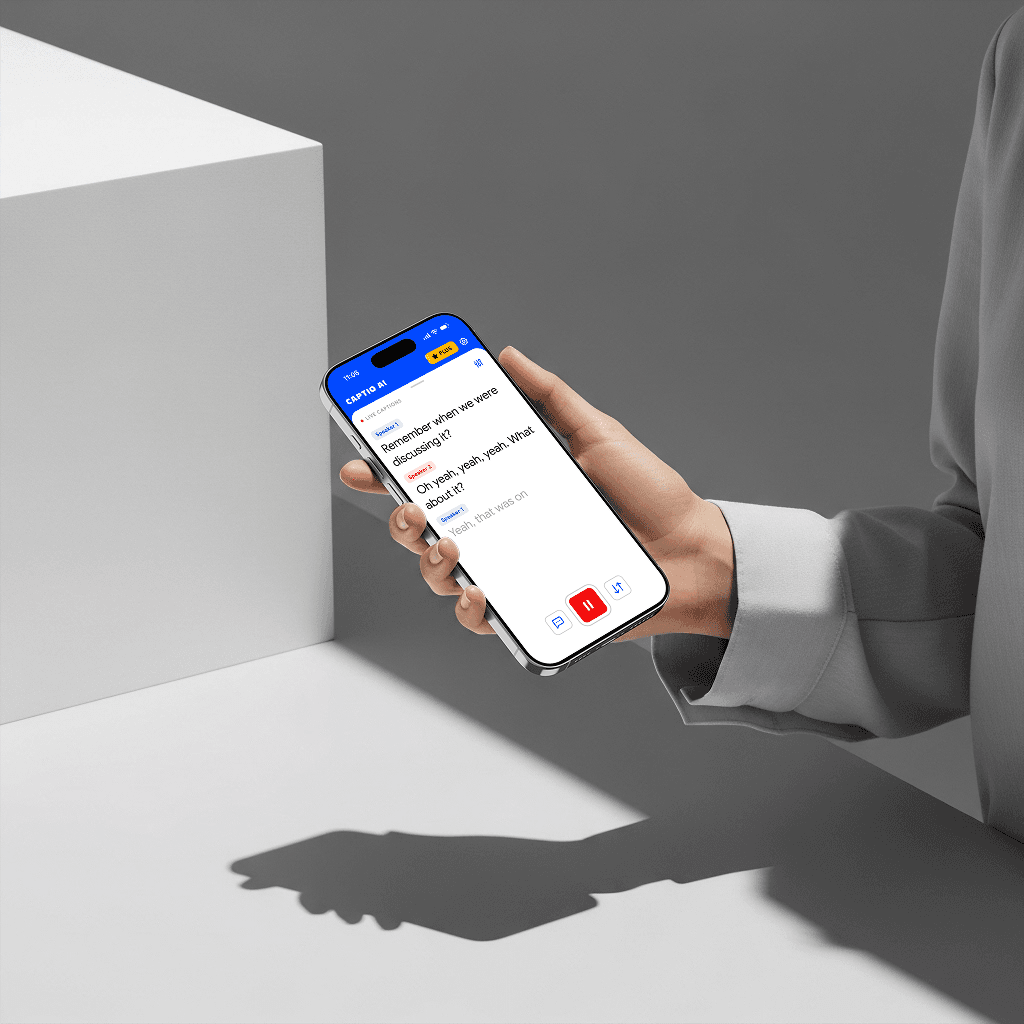
Built for the room where a missed word has real consequences
Read the full question before you answer
Every word appears on screen as the interviewer speaks. You read the question completely before responding — nothing guessed, nothing reconstructed.
Works in person and on any call format
In-person interviews, video calls, phone screens. Place the phone on the table or point it toward the audio — Captio AI handles every format.
Discreet by design
The app runs quietly on your phone. Place it on the table or hold it naturally. No explanation needed, no drawing attention to the accommodation.
No asking for repeats
Asking an interviewer to repeat a question signals uncertainty. Captio AI means you never need to — you read it in real time and answer with confidence.
Any language
For international roles, multilingual panels, or interviews conducted in a second language. Live Translator captions and translates in real time so language is never the barrier.
Private by default
Interview conversations are sensitive. Captio AI processes audio in real time and discards it immediately — nothing is stored, nothing is shared.
Why Chinese is hard to understand
Tonal invisibility
- Four tones, zero visible difference
- Mandarin's four tones change the meaning of every syllable — but pitch contours are produced in the throat, not on the lips. In a fast interview question, a deaf candidate watching an interviewer's mouth cannot tell whether a syllable is rising, falling, high, or dipping. Research estimates only around 5% of deaf Mandarin speakers can lip-read effectively, compared to 25% for English.
Retroflex-alveolar collapse
- zh/ch/sh look identical to z/c/s
- Mandarin distinguishes retroflex zh/ch/sh from alveolar z/c/s — a distinction that is acoustic, not visible. Both sets produce near-identical lip shapes in normal interview speech. A question using 知道 versus 资格 can look the same on the lips even though the words are completely different.
Fast formal register
- Boardroom Mandarin clips every syllable
- Corporate Putonghua moves quickly, with minimal inter-word pausing. Interviewers in Shanghai, Beijing, and Shenzhen offices do not slow down or enunciate more clearly in formal contexts — if anything, formal register increases the density of four-character compounds that compress meaning into rapid bursts.
Regional accent gap
- Cantonese-influenced Mandarin in Hong Kong and Guangdong
- Hong Kong and southern Chinese interviewers often speak Mandarin with Cantonese phonological influence — tones shift, finals change, and loanwords from Cantonese enter the conversation. A deaf candidate trained on standard Putonghua is watching a different phonological system than the one on the interviewer's lips.
No cued speech system
- No visual support system exists for Mandarin
- English and French have standardized cued speech systems that supplement lip-reading. Mandarin has none — the phoneme inventory and tonal system make one extremely difficult to build. Deaf Mandarin speakers in an interview room have no supplementary visual system to fall back on.
Download for free
27 million people navigating China's job market without hearing
An estimated 27.8 million people in China have disabling hearing loss, and a further 115 million have moderate-to-complete hearing loss across the country's 31 provinces — roughly 8.4% of the population as of 2015, a figure projected to reach 242 million by 2060 as the population ages. Despite these numbers, China lacks a coherent anti-discrimination legal framework for deaf and hard of hearing workers. The Law on Protection of Persons with Disabilities (1990, amended 2008) establishes general employment provisions, but without enforceable reasonable accommodation requirements or discrimination remedies comparable to the ADA or Equality Act.
The practical consequence is felt most acutely at the hiring stage. Deaf and hard of hearing job candidates in China face interview formats — in-person panels at major corporations, phone screenings run by HR — that assume full auditory access. No legal mechanism requires an employer to provide a sign language interpreter or captioning service for an interview. A new Law on Construction of Barrier-Free Environments was passed in June 2023, marking incremental progress, but the United Nations disability programme has noted that the effects of China's disability policies depend on strong enforcement and meaningful engagement of deaf people in their design — neither of which has been consistently present.
The employment gap is compounded by educational barriers upstream. Deaf children in China have historically been educated in segregated schools using Signed Chinese rather than the natural Chinese Sign Language (CSL) used by the deaf community, creating a split between school-acquired signing and community communication that affects educational outcomes and, in turn, employment readiness. By the time a deaf or hard of hearing candidate reaches a job interview in Shenzhen or Beijing, they have navigated a system that provided limited captioning, limited accommodation, and limited preparation for the acoustic demands of a professional interview. Captio AI places a real-time Mandarin caption feed directly in their hand — no employer arrangement required — so the interview can be what it was always supposed to be: a test of ability, not hearing.
Download for free
What you hear stays with you.
Gone the moment it ends
Captio AI processes your audio in real time and discards it immediately. Nothing is recorded. Nothing is kept.
Not a product
Your conversations are not something Captio AI sells, shares, or monetizes — to anyone, for any reason.
Not used to train anything
What you say in a doctor's appointment or a job interview never ends up in a training dataset. Not ours. Not anyone else's.

Private by default
Captio AI supports 60+ languages
Download for free
Frequently asked questions
Hear every question in Chinese.
Captio AI is free to start
Download for free