

Swahili live captions and productivity tool for job interviews
For deaf and hard of hearing people.
Download for free


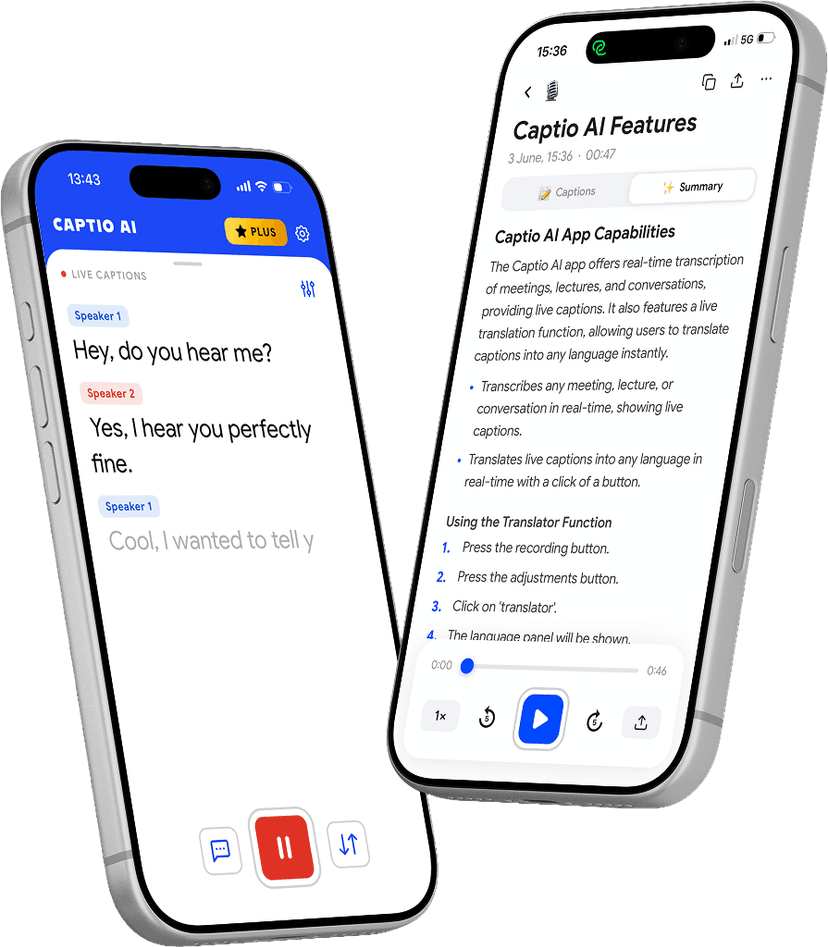
Everything you need to follow Swahili job interviews
Four tools built for deaf and hard of hearing Swahili speakers.
Read the question before you answer
- Every word appears in real time as the interviewer speaks
- Works in person, on video calls, and on the phone
- Discreet — runs quietly on your phone
- No asking for repeats
For interviews in another language
- Captions and translates in real time
- For international employers or roles abroad
- 60+ languages, no setup
- Follow every question in the language you think in
Review the interview afterwards
- Record and transcribe to revisit questions and your answers
- Useful for preparing for follow-up rounds
- Identify what you want to clarify in a second interview
- Works on any recording
Key topics and questions extracted
- Main themes and questions pulled from any interview transcript
- Useful for post-interview reflection and follow-up
- Organised into sections
- Works on any saved recording
Download for free
Every situation covered
Designed for the real moments that matter — not just quiet controlled environments.
In a Nairobi, Dar es Salaam, or Kampala office — an interviewer speaking Swahili at professional pace with regional phonological colouring. Captio AI captions every question in real time.
Video calls on Zoom or Google Meet — standard for remote rounds at East African companies and international NGOs. Put the call on speaker and follow every question in real time.
The initial HR screening call in Swahili — fast, formal, over a mobile line. Captio AI captions the recruiter's voice in real time so compressed audio does not cost you the interview.
Panel interviews at large Kenyan, Tanzanian, or East African multinationals and NGOs. Captio AI follows each panelist in real time, even when they switch between Swahili and English.
For roles at international NGOs or multinationals where interviews shift between Swahili and English. Live Translator handles both languages in the same session without any manual switching.
Group exercises and competency assessments — used at major East African banks, telecoms, and international development organisations. Captio AI covers facilitator instructions and group discussion.
Most accurate and fastest models
word accuracy
independent benchmark, 2025
real-time captions
first word appears as you speak
Download for free
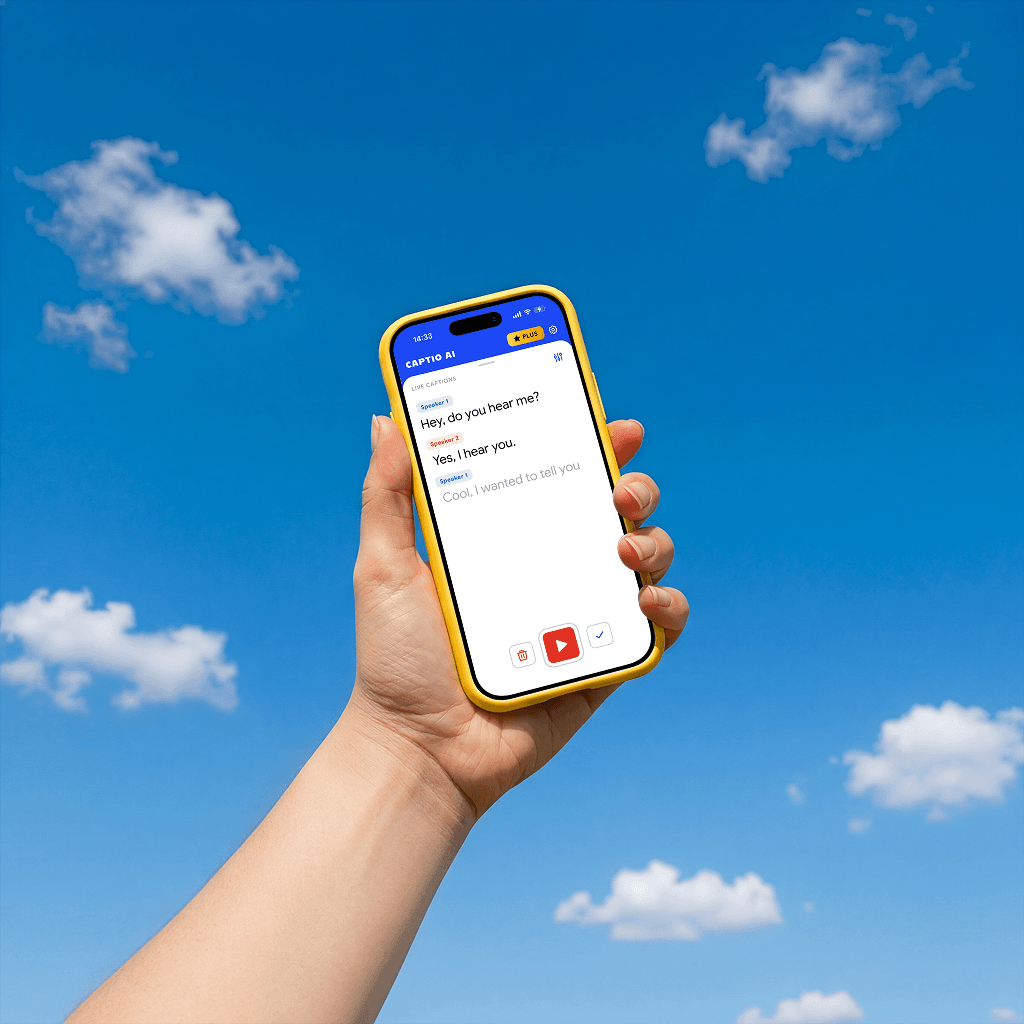
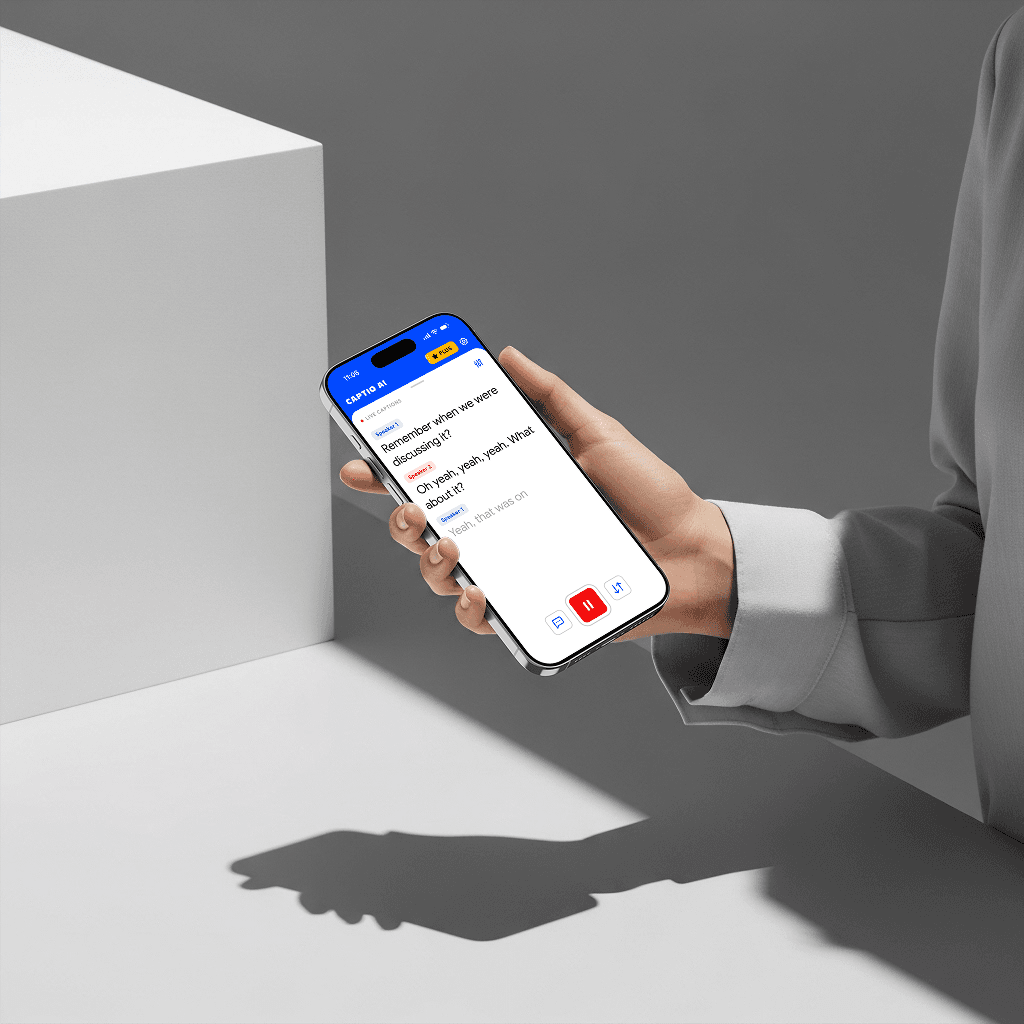
Built for the room where a missed word has real consequences
Read the full question before you answer
Every word appears on screen as the interviewer speaks. You read the question completely before responding — nothing guessed, nothing reconstructed.
Works in person and on any call format
In-person interviews, video calls, phone screens. Place the phone on the table or point it toward the audio — Captio AI handles every format.
Discreet by design
The app runs quietly on your phone. Place it on the table or hold it naturally. No explanation needed, no drawing attention to the accommodation.
No asking for repeats
Asking an interviewer to repeat a question signals uncertainty. Captio AI means you never need to — you read it in real time and answer with confidence.
Any language
For international roles, multilingual panels, or interviews conducted in a second language. Live Translator captions and translates in real time so language is never the barrier.
Private by default
Interview conversations are sensitive. Captio AI processes audio in real time and discards it immediately — nothing is stored, nothing is shared.
Why Swahili is hard to understand
Regional variety gap
- Tanzanian, Kenyan, and Ugandan Swahili sound different in a boardroom
- Standard Swahili (Kiswahili Sanifu, based on Dar es Salaam Swahili) differs phonologically from Kenyan Swahili and Ugandan varieties in vowel quality, consonant strength, and prosodic patterns. In a Nairobi or Kampala office, the interviewer's Swahili is coloured by regional phonological influence. A deaf candidate who lip-reads standard Tanzanian Swahili faces different lip shapes for the same words from a Kenyan interviewer.
Noun class prefixes
- Swahili's 8 noun classes change how words begin on the lips
- Swahili's extensive noun class system adds different prefixes to the same root depending on the class, which also triggers agreement prefixes on verbs and adjectives. In an interview question, the opening consonant and vowel of each word shifts according to noun class — the same concept produces different lip shapes depending on grammatical context, making visual word recognition unstable.
Arabic loanword density
- Business Swahili uses Arabic-derived vocabulary in formal contexts
- Standard Swahili has extensive Arabic loanwords in business, formal, and official vocabulary — biashara (business), hesabu (accounts), shukrani (thanks), mshahara (salary). In a formal job interview, this vocabulary appears frequently. A deaf candidate who primarily lip-reads everyday conversational Swahili may not recognize these Arabic-derived formal terms visually.
Swahili-English switching
- East African corporate interviews mix Swahili and English mid-sentence
- In Nairobi and Dar es Salaam multinational and NGO interviews, Swahili and English are routinely mixed within the same sentence — 'tutahitaji candidate ambaye ana experience ya miaka mitatu' is typical. A deaf candidate tracking Swahili is suddenly watching English words, with no visible signal of the switch.
Agglutinative word length
- Long agglutinated Swahili words compress into rapid sequences
- Swahili builds long words by agglutinating tense, subject, object, and verb into a single unit — 'nitakusaidia' (I will help you), 'wameniambia' (they have told me). In a fast interview question, these long agglutinated words produce rapid syllable sequences where individual morphemes must be tracked in quick succession.
Download for free
153,000 deaf people in Kenya — and disability employment quotas met by fewer than 4% of public institutions
Kenya's 2019 National Population Census recorded 153,381 deaf people aged above five years. Kenya has a legal mandate requiring public institutions to reserve 5% of employment for persons with disabilities. A 2022 government audit found that only 35% of public institutions had employed any persons with disabilities at all, and only 4% met the 5% target. Persons with disabilities in Kenya are disproportionately unemployed and more likely to live in poverty than non-disabled Kenyans, according to the Kenya National Bureau of Statistics 2019 Disability Report.
In Tanzania, disability employment data is less systematically reported, but the broader pattern across East Africa — including Uganda, Rwanda, and Ethiopia — reflects similar structural gaps: disability legislation that sets employment targets, and enforcement mechanisms that are too weak to move the numbers. In the NGO sector, which is a major employer across East Africa and a common career path for educated Swahili speakers, disability accommodation at the interview stage is inconsistent. Asking for an interpreter or captioning service in advance is not a standard expectation and can expose the candidate to bias.
The linguistic and social barriers reinforce each other. A deaf Swahili-speaking candidate attending a job interview in Nairobi or Dar es Salaam faces an interview format — panel discussions, competency questions, fast code-switched Swahili and English — that was not designed for them, in a labour market that gives them limited legal recourse if they are disadvantaged by it. Captio AI requires no advance arrangement: open the app, place the phone on the desk, and every Swahili sentence is available in real time — including the formal vocabulary, agglutinated verb forms, and mid-sentence English switches that characterise East African professional speech.
Download for free
What you hear stays with you.
Gone the moment it ends
Captio AI processes your audio in real time and discards it immediately. Nothing is recorded. Nothing is kept.
Not a product
Your conversations are not something Captio AI sells, shares, or monetizes — to anyone, for any reason.
Not used to train anything
What you say in a doctor's appointment or a job interview never ends up in a training dataset. Not ours. Not anyone else's.

Private by default
Captio AI supports 60+ languages
Download for free
Frequently asked questions
Hear every question in Swahili.
Captio AI is free to start
Download for free