

German live captions and productivity tool for job interviews
For deaf and hard of hearing people.
Download for free


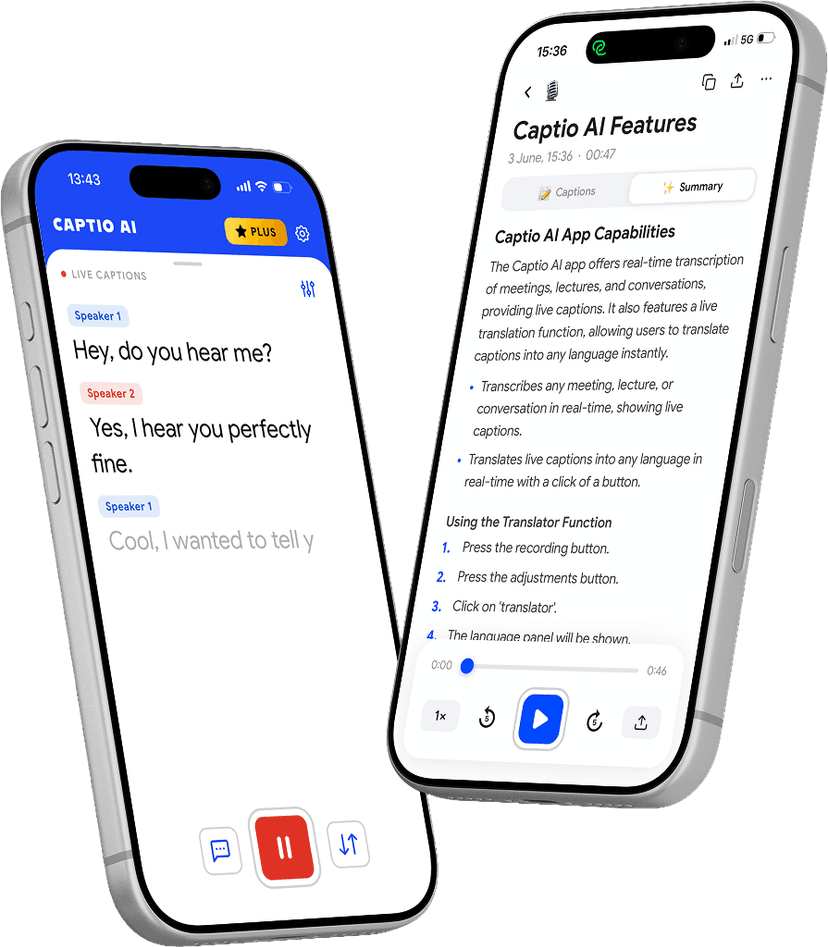
Everything you need to follow German job interviews
Four tools built for deaf and hard of hearing German speakers.
Read the question before you answer
- Every word appears in real time as the interviewer speaks
- Works in person, on video calls, and on the phone
- Discreet — runs quietly on your phone
- No asking for repeats
For interviews in another language
- Captions and translates in real time
- For international employers or roles abroad
- 60+ languages, no setup
- Follow every question in the language you think in
Review the interview afterwards
- Record and transcribe to revisit questions and your answers
- Useful for preparing for follow-up rounds
- Identify what you want to clarify in a second interview
- Works on any recording
Key topics and questions extracted
- Main themes and questions pulled from any interview transcript
- Useful for post-interview reflection and follow-up
- Organised into sections
- Works on any saved recording
Download for free
Every situation covered
Designed for the real moments that matter — not just quiet controlled environments.
German corporate interviews often open formally in standard Hochdeutsch but relax toward regional speech as the conversation proceeds. Captio AI keeps up with both the formal register and the regional aside without any adjustment.
Video interviews over Teams or Zoom are standard at German companies and multinationals with German offices. Captio AI captions the call in real time regardless of audio quality or platform.
Initial phone screens at German firms are conducted in standard Hochdeutsch. Captio AI captions the recruiter's speech live without a video feed.
Panel interviews in Germany may include a Bavarian interviewer and a Berlin speaker in the same room — phonologically very different. Captio AI handles all regional varieties simultaneously.
German tech, automotive, and finance companies conduct a significant share of interviews in English, especially for technical rounds. Captio AI covers German and English in the same interview without any mode change.
Assessment centres at large German employers involve structured tasks, group discussions, and role plays. Captio AI helps you follow every speaker and every instruction across the room.
Most accurate and fastest models
word accuracy
independent benchmark, 2025
real-time captions
first word appears as you speak
Download for free
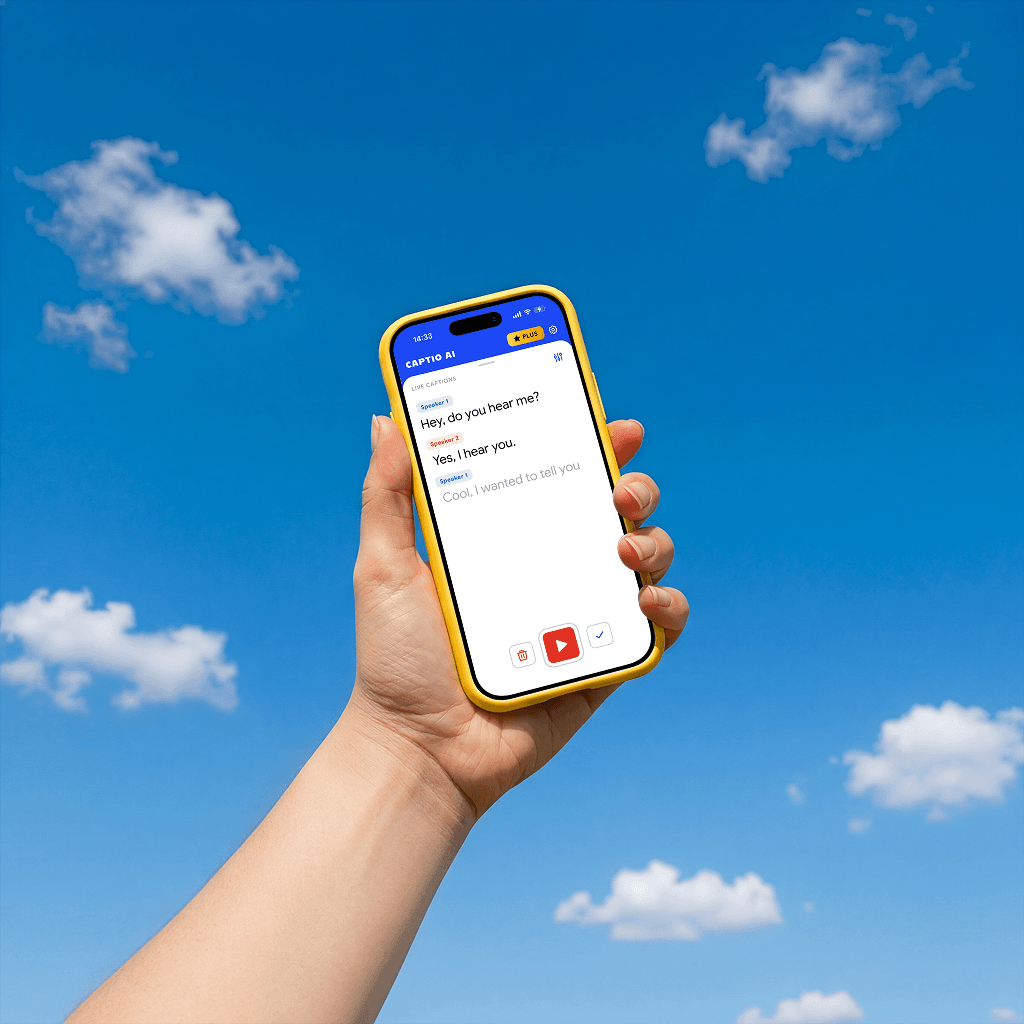
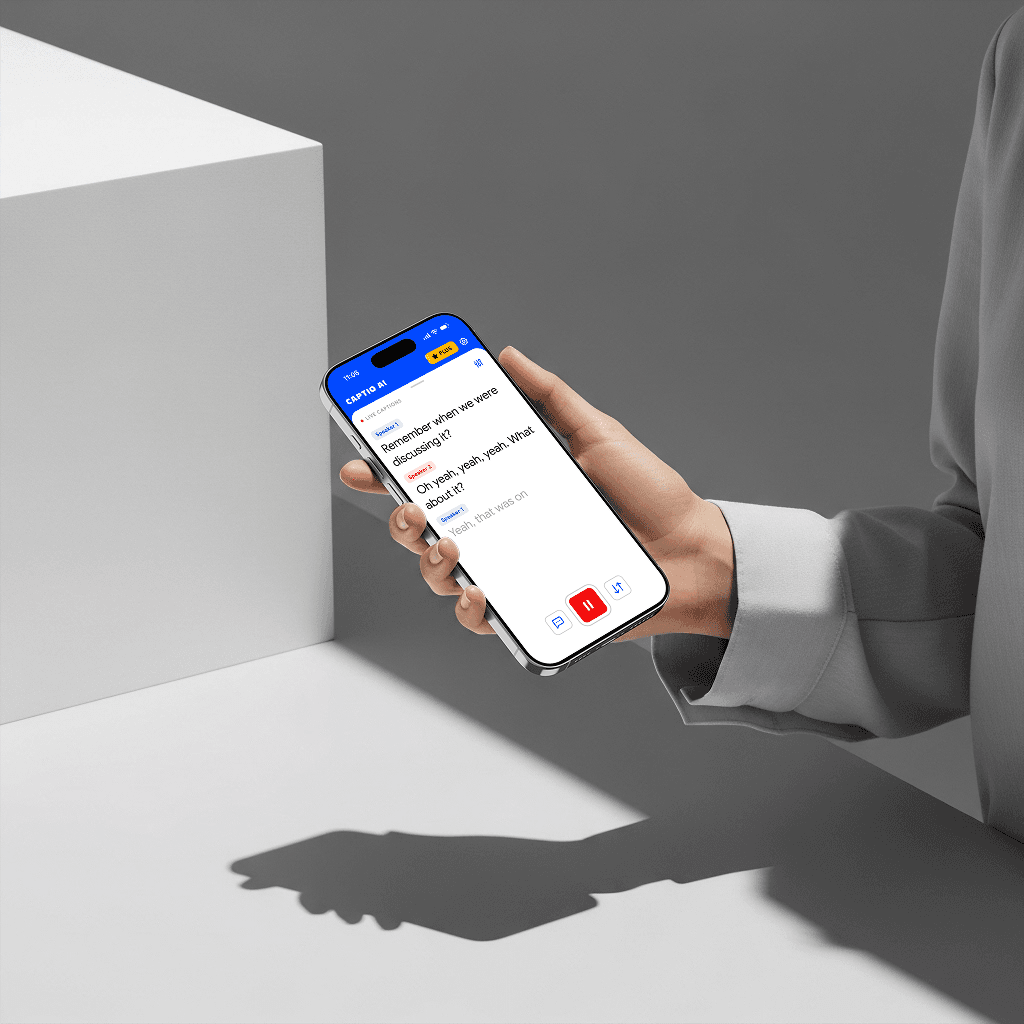
Built for the room where a missed word has real consequences
Read the full question before you answer
Every word appears on screen as the interviewer speaks. You read the question completely before responding — nothing guessed, nothing reconstructed.
Works in person and on any call format
In-person interviews, video calls, phone screens. Place the phone on the table or point it toward the audio — Captio AI handles every format.
Discreet by design
The app runs quietly on your phone. Place it on the table or hold it naturally. No explanation needed, no drawing attention to the accommodation.
No asking for repeats
Asking an interviewer to repeat a question signals uncertainty. Captio AI means you never need to — you read it in real time and answer with confidence.
Any language
For international roles, multilingual panels, or interviews conducted in a second language. Live Translator captions and translates in real time so language is never the barrier.
Private by default
Interview conversations are sensitive. Captio AI processes audio in real time and discards it immediately — nothing is stored, nothing is shared.
Why German is hard to understand
Glottal stop at vowel boundaries
- Word-internal breaks that are audible but invisible
- German inserts a glottal stop before every vowel-initial syllable and at every morpheme boundary inside compound words. These hard breaks are clearly audible and provide structure to a hearing listener — but they are produced entirely in the larynx with no visible articulatory movement, stripping a deaf reader of the boundary cues that carry grammatical meaning.
Compound words
- Thirty characters, one prosodic unit
- German creates extremely long compound nouns and verbs by concatenating morphemes without spaces. A technical interviewer may use a term with five or six morphemes as a single unbroken word — compressing what would be a sentence-length phrase in other languages into one fast prosodic unit with no pauses for a deaf reader to segment meaning.
Regional dialect range
- Bavarian, Berliner, Swabian — all very different
- Hochdeutsch is the formal interview standard, but regional interviewers relax toward dialect when conversation becomes casual — and the shift is not signalled. Bavarian German, Berlin dialect, Swabian, and Low German produce speech patterns that differ substantially from the standard a deaf reader prepared on.
Uvular R
- A consonant produced at the back of the throat
- Standard German R is typically a uvular fricative or approximant, produced at the very back of the throat with no visible lip movement. In casual speech it frequently vocalises entirely — disappearing into a vowel lengthening. A deaf reader tracking visible consonants loses all r-context in the dominant standard pronunciation.
German–English switching
- Two languages per technical question
- German business and tech interviews constantly switch to English for technical vocabulary, product names, and international business terms — often mid-sentence. Both language streams arrive simultaneously and must both be tracked across the same interview.
Download for free
Hearing loss and employment in Germany
A population-based study on hearing loss in Germany found that — applying WHO criteria — the prevalence of hearing impairment in German adults is 16.2%, affecting approximately 11.1 million people. German Sign Language (Deutsche Gebärdensprache, DGS) is used by at least 200,000 people, of whom around 80,000 are deaf. Despite Germany's strong legislative framework for disability rights — including quota systems and workplace integration obligations under the Social Code Book IX — employment barriers for deaf and hard of hearing workers persist, particularly at the recruitment stage where communication accommodation is rarely proactively provided.
A Springer Nature chapter on workplace disability inclusion in Germany, Austria, and Switzerland (2024) documented that despite legal obligations, employers in the DACH region often lack the operational infrastructure to provide real-time communication support in recruitment. For deaf candidates, the most acute barrier is the job interview itself: without captioning, they cannot demonstrate their actual competence, regardless of their qualifications or the employer's formal commitment to inclusion.
The 2025 EFHOH 'Towards Inclusive Employment' report, covering Western European countries, identified fatigue as the leading cause of reduced working hours for hard of hearing employees — particularly in open-plan offices and high-communication-intensity roles common in German engineering and finance sectors. For deaf and hard of hearing job seekers in Berlin, Munich, Hamburg, and Frankfurt, Captio AI provides real-time captions the moment the interviewer speaks — in German or English — without an interpreter and without advance disclosure.
Download for free
What you hear stays with you.
Gone the moment it ends
Captio AI processes your audio in real time and discards it immediately. Nothing is recorded. Nothing is kept.
Not a product
Your conversations are not something Captio AI sells, shares, or monetizes — to anyone, for any reason.
Not used to train anything
What you say in a doctor's appointment or a job interview never ends up in a training dataset. Not ours. Not anyone else's.

Private by default
Captio AI supports 60+ languages
Download for free
Frequently asked questions
Hear every question in German.
Captio AI is free to start
Download for free