

Basque live captions and productivity tool for job interviews
For deaf and hard of hearing people.
Download for free


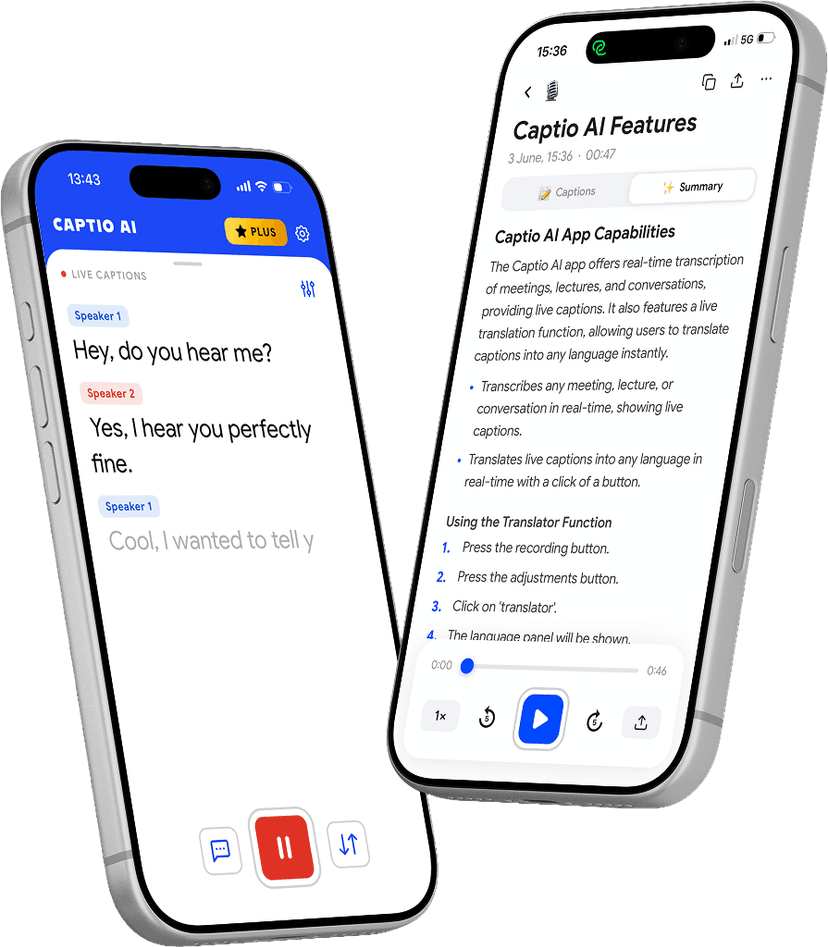
Everything you need to follow Basque job interviews
Four tools built for deaf and hard of hearing Basque speakers.
Read the question before you answer
- Every word appears in real time as the interviewer speaks
- Works in person, on video calls, and on the phone
- Discreet — runs quietly on your phone
- No asking for repeats
For interviews in another language
- Captions and translates in real time
- For international employers or roles abroad
- 60+ languages, no setup
- Follow every question in the language you think in
Review the interview afterwards
- Record and transcribe to revisit questions and your answers
- Useful for preparing for follow-up rounds
- Identify what you want to clarify in a second interview
- Works on any recording
Key topics and questions extracted
- Main themes and questions pulled from any interview transcript
- Useful for post-interview reflection and follow-up
- Organised into sections
- Works on any saved recording
Download for free
Every situation covered
Designed for the real moments that matter — not just quiet controlled environments.
Job interviews in the Basque Autonomous Community may be conducted in Basque, Spanish, or both depending on the employer's language policy. Captio AI handles both in real time so you are prepared for whichever the interviewer opens with.
Video interviews over Teams or Zoom are standard at Basque companies and multinationals in Bilbao and San Sebastián. Captio AI captions the call audio in real time whatever language is used.
Phone screens at Basque public sector and language-sensitive employers are often conducted in Basque. Captio AI captions the speech live without a video feed.
Panel interviews in the Basque Country may include speakers with different dialectal backgrounds — a Biscayan speaker and a Gipuzkoan speaker sound noticeably different. Captio AI handles all varieties in the same room.
International companies operating in Bilbao or San Sebastián often conduct rounds in English before switching to Spanish or Basque. Captio AI covers all three languages in the same session.
Group assessment exercises at Basque employers involve collaborative tasks in Basque or Spanish. Captio AI helps you follow every speaker and every instruction across the group.
Most accurate and fastest models
word accuracy
independent benchmark, 2025
real-time captions
first word appears as you speak
Download for free
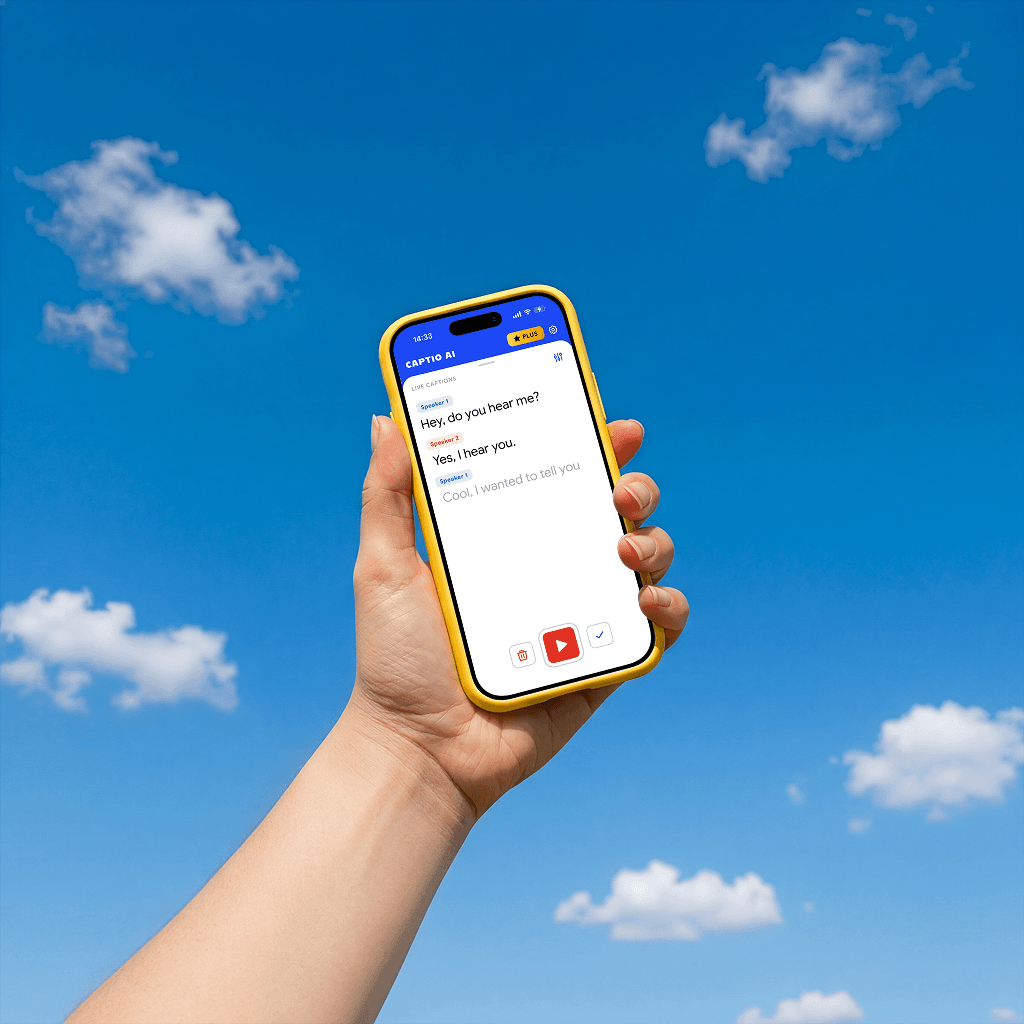
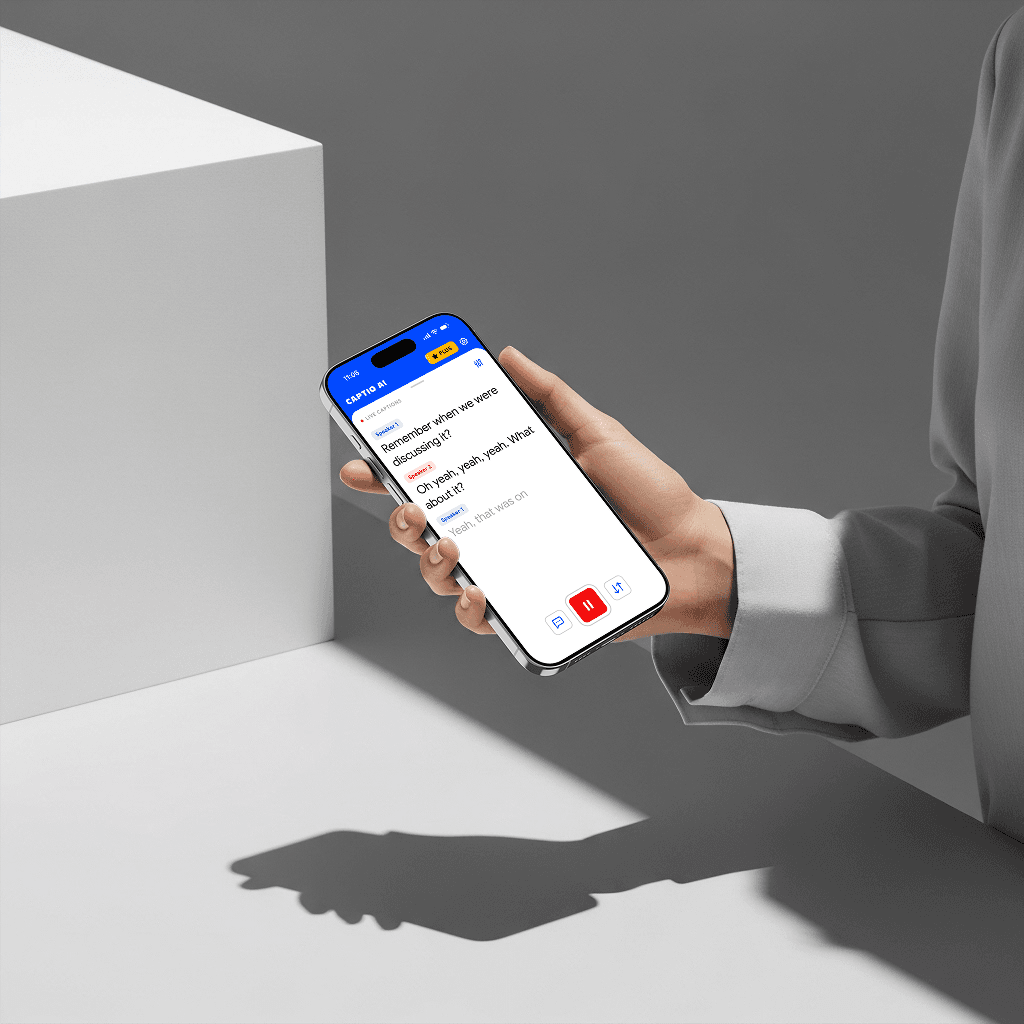
Built for the room where a missed word has real consequences
Read the full question before you answer
Every word appears on screen as the interviewer speaks. You read the question completely before responding — nothing guessed, nothing reconstructed.
Works in person and on any call format
In-person interviews, video calls, phone screens. Place the phone on the table or point it toward the audio — Captio AI handles every format.
Discreet by design
The app runs quietly on your phone. Place it on the table or hold it naturally. No explanation needed, no drawing attention to the accommodation.
No asking for repeats
Asking an interviewer to repeat a question signals uncertainty. Captio AI means you never need to — you read it in real time and answer with confidence.
Any language
For international roles, multilingual panels, or interviews conducted in a second language. Live Translator captions and translates in real time so language is never the barrier.
Private by default
Interview conversations are sensitive. Captio AI processes audio in real time and discards it immediately — nothing is stored, nothing is shared.
Why Basque is hard to understand
Apical vs laminal sibilants
- Two s-sounds, one visible shape
- Basque distinguishes apical sibilants (produced with the tip of the tongue) from laminal sibilants (produced with the blade). Both produce visually similar hissing shapes at the lips but sound markedly different. This distinction — unique among European languages at this level of systematic contrast — is acoustically significant but visually invisible.
Biscayan–Souletin dialect range
- Dialects as different as two separate languages
- The phonological, morphosyntactic, and lexical differences between geographically distant Basque dialects — particularly Biscayan in the west and Souletin in the far east — are as abundant as those between Catalan and Spanish. A deaf reader calibrated on Biscayan Basque used in Bilbao faces a fundamentally different system in a Souletin interview.
Souletin nasal vowels
- A phoneme absent from other Basque varieties
- In the Souletin dialect of French Basque Country, nasal vowels and aspirated consonants appear that are absent from other Basque varieties and from Spanish entirely. These phonemes are produced inside the vocal tract with no visible lip marker, making them undetectable through lip-reading.
Basque–Spanish switching
- Two unrelated languages in one interview
- In the Basque Autonomous Community, professional settings routinely switch between Basque and Spanish — two languages with no shared phonological ancestry whatsoever. Both language streams must be tracked in the same interview, with no shared phonological patterns to bridge them.
Palatal harmony effects
- Consonant series that shift after /i/
- Many Basque dialects exhibit derived palatalization: coronal consonants change to their palatal counterparts after the high front vowel /i/. This means the same consonant produces a different shape depending on what vowel precedes it — adding a context-dependent variation layer invisible in lip-reading.
Download for free
Hearing loss and employment in the Basque Country and Spain
Spain's National Statistics Institute reports 1,064,000 people who are deaf or have a hearing disability — 2.3% of the national population. A 2023 study published in PMC examining the perception of COVID-19's impact on Spaniards with hearing disabilities found that the pandemic amplified longstanding employment vulnerabilities: job losses hit deaf and hard of hearing workers disproportionately, and recovery into formal employment was slower, reflecting the structural communication barriers they face in recruitment that pre-date any specific crisis.
In the Basque Autonomous Community — one of Spain's wealthiest and most bilingual regions — the language policies that protect Basque in public life also mean that job interviews may be conducted in Basque, Spanish, or both. For a deaf candidate, this bilingual environment compounds the standard challenge: they must follow a language that may differ from their dominant one, in a register and at a pace determined entirely by the interviewer.
The WHO World Report on Hearing (2021) estimated the global annual cost of unaddressed hearing loss at over USD 980 billion, concentrated among working-age adults. In France's Basque Country — where a 2022 CONSTANCES cohort study found that 25% of French adults have some degree of hearing loss — the employment implications for deaf and hard of hearing candidates are equally significant. Captio AI gives deaf and hard of hearing job seekers in Bilbao, San Sebastián, and Bayonne a way to follow every word of an interview in Basque, Spanish, or English — in real time, without an interpreter.
Download for free
What you hear stays with you.
Gone the moment it ends
Captio AI processes your audio in real time and discards it immediately. Nothing is recorded. Nothing is kept.
Not a product
Your conversations are not something Captio AI sells, shares, or monetizes — to anyone, for any reason.
Not used to train anything
What you say in a doctor's appointment or a job interview never ends up in a training dataset. Not ours. Not anyone else's.

Private by default
Captio AI supports 60+ languages
Download for free
Frequently asked questions
Hear every question in Basque.
Captio AI is free to start
Download for free