

Polish live captions and productivity tool for job interviews
For deaf and hard of hearing people.
Download for free


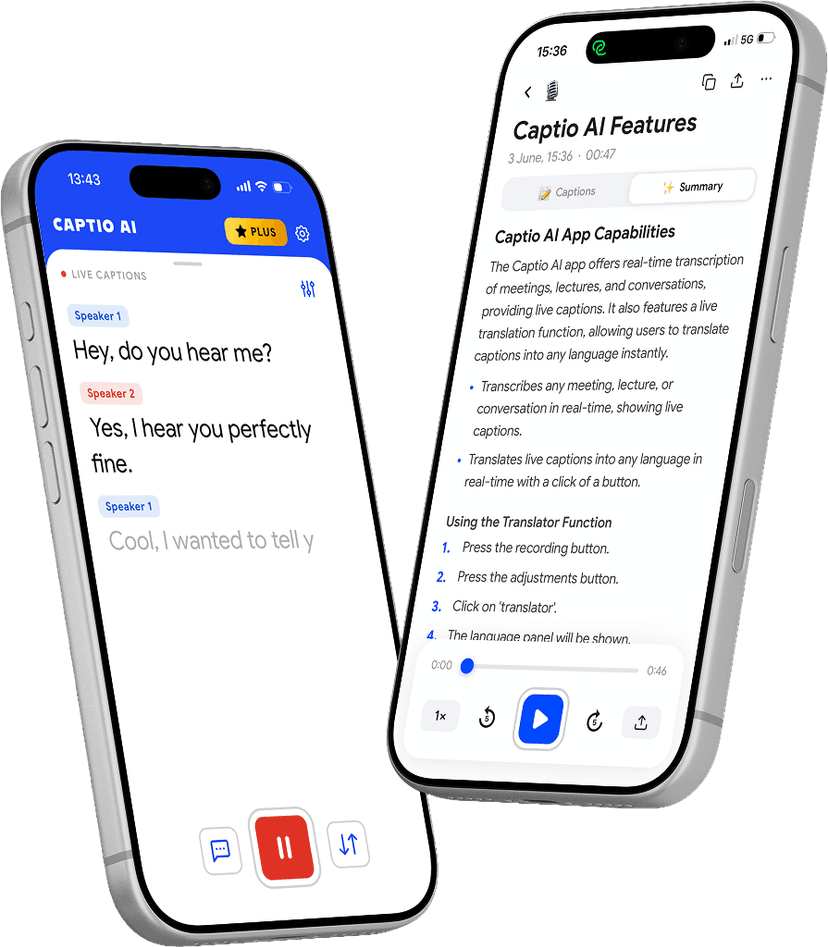
Everything you need to follow Polish job interviews
Four tools built for deaf and hard of hearing Polish speakers.
Read the question before you answer
- Every word appears in real time as the interviewer speaks
- Works in person, on video calls, and on the phone
- Discreet — runs quietly on your phone
- No asking for repeats
For interviews in another language
- Captions and translates in real time
- For international employers or roles abroad
- 60+ languages, no setup
- Follow every question in the language you think in
Review the interview afterwards
- Record and transcribe to revisit questions and your answers
- Useful for preparing for follow-up rounds
- Identify what you want to clarify in a second interview
- Works on any recording
Key topics and questions extracted
- Main themes and questions pulled from any interview transcript
- Useful for post-interview reflection and follow-up
- Organised into sections
- Works on any saved recording
Download for free
Every situation covered
Designed for the real moments that matter — not just quiet controlled environments.
In a Warsaw, Kraków, or Wrocław office — an interviewer speaking Polish at corporate pace. Captio AI captions every question in real time so you read the full sentence before responding.
Video interviews on Teams or Zoom — standard in Polish companies for remote rounds. Put the call on speaker and follow every question in real time.
The initial HR screening call in Polish — fast, formal, with dense consonant sequences. Captio AI captions the recruiter's voice in real time so compressed audio does not become the barrier.
Panel interviews at large Polish companies, state-owned enterprises, or multinationals. Captio AI follows each panelist in real time even when speakers ask questions in quick succession.
For roles at international firms in Poland where the interview shifts between Polish and English. Live Translator handles both languages in the same session without manual switching.
Assessment centres and competency-based interviews — used at major Polish banks, telecoms, and corporate employers. Captio AI covers all facilitator speech and candidate interaction.
Most accurate and fastest models
word accuracy
independent benchmark, 2025
real-time captions
first word appears as you speak
Download for free
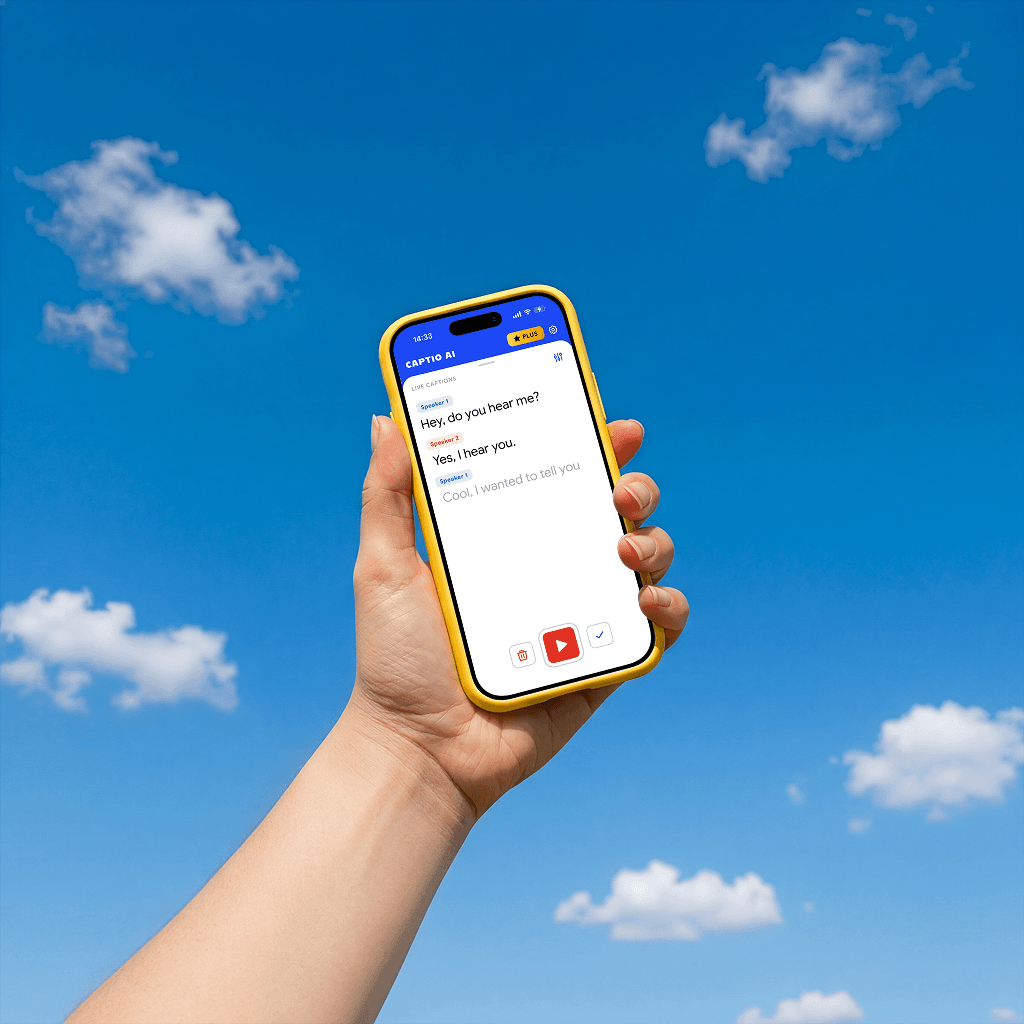
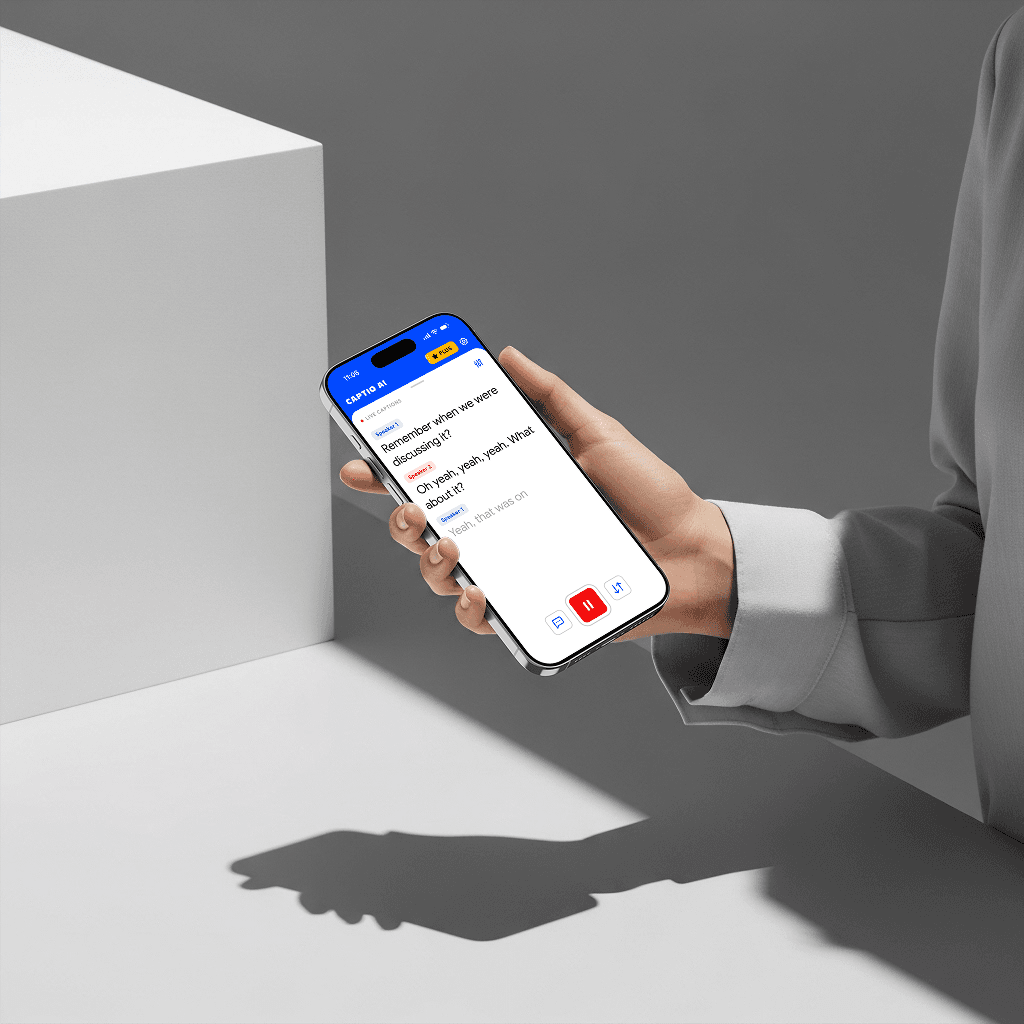
Built for the room where a missed word has real consequences
Read the full question before you answer
Every word appears on screen as the interviewer speaks. You read the question completely before responding — nothing guessed, nothing reconstructed.
Works in person and on any call format
In-person interviews, video calls, phone screens. Place the phone on the table or point it toward the audio — Captio AI handles every format.
Discreet by design
The app runs quietly on your phone. Place it on the table or hold it naturally. No explanation needed, no drawing attention to the accommodation.
No asking for repeats
Asking an interviewer to repeat a question signals uncertainty. Captio AI means you never need to — you read it in real time and answer with confidence.
Any language
For international roles, multilingual panels, or interviews conducted in a second language. Live Translator captions and translates in real time so language is never the barrier.
Private by default
Interview conversations are sensitive. Captio AI processes audio in real time and discards it immediately — nothing is stored, nothing is shared.
Why Polish is hard to understand
Sibilant quartet
- Polish has eight sibilant sounds that all look the same on the lips
- Polish distinguishes four sets of sibilant consonants: plain (s/z), hard retroflex (sz/ż), soft (ś/ź), and affricate pairs (c/dz, cz/dż, ć/dź). That is eight distinct sibilant-like sounds. On the lips, all of them produce visually similar positions — a narrow lip opening with teeth close together. In a fast Warsaw or Kraków interview, these eight sounds appear constantly and a lip-reader cannot distinguish among them.
Consonant cluster density
- Polish allows four consonants together — impossible to parse visually
- Polish permits initial consonant clusters of up to four consonants — words like 'szczególnie', 'źdźbło', 'wstrząs'. Even common business words begin with two or three consonants (praca, sprawy, przez). In fast interview speech, these clusters produce rapid consonant sequences where visual word segmentation is extremely difficult.
Nasal vowels
- Polish ą and ę change meaning but nasalisation is invisible on the lips
- Polish has two nasal vowels — ą /ɔ̃/ and ę /ɛ̃/ — that are phonemically distinctive: 'był' and 'będą' differ in meaning through nasalisation. Nasalisation is produced in the nasal cavity, producing no visible lip movement. A deaf candidate watching a Polish interviewer cannot visually distinguish nasal from oral vowels.
Palatalization
- Soft and hard consonant pairs look identical on the lips
- Polish has extensive soft (palatalized) and hard consonant pairs, where the palatalized version is produced by raising the tongue toward the hard palate — inside the mouth, invisible on the lips. In interview speech, these contrasts carry morphological meaning in verb and noun endings, and a lip-reader cannot distinguish the soft from the hard version of the same consonant.
Formal interview vocabulary
- Polish corporate register uses formal vocabulary distinct from everyday speech
- Polish corporate and government interview register uses Latin-derived and formal vocabulary (kompetencje, doświadczenie, stanowisko) that is less frequent in everyday colloquial Polish. A deaf candidate whose visual vocabulary comes from informal daily speech may not immediately recognise some formal interview terms.
Download for free
190 million with hearing loss in WHO Europe — and Poland's interview process provides no visual support
The WHO European Region has over 190 million people with hearing loss — among the world's largest affected populations by region. In Poland specifically, the EuroTrak POL 2023 survey found that 28% of people with self-declared hearing loss use hearing aids, up from 21% in 2019 — indicating a large un-served population. The Polish Association of the Deaf (PZG — Polski Związek Głuchych), with 15 provincial branches and 45 field offices, is the primary national organisation representing deaf Poles. EU Social Chapter provisions and Poland's law on vocational and social rehabilitation provide a framework for disability employment, but interview-stage captioning is not a legal requirement.
The Polish labour market has been significantly affected by the arrival of deaf Ukrainian refugees since 2022. The European Union of the Deaf's Poland page documents PZG's role in coordinating support for deaf refugees, highlighting how the existing infrastructure for deaf Poles was stretched to accommodate a new group with overlapping but different language needs. For deaf Ukrainian-origin people seeking employment in Poland, the interview barrier is compounded by language: Polish is not their first language, but it is the language of the Polish labour market.
For deaf Polish native speakers, the interview format itself is the barrier. Polish consonant clusters, sibilant variation, and nasal vowels make the language among the harder European ones for lip-reading. A Warsaw interview at a bank, IT company, or state enterprise is a fast spoken process with no visual accommodation. Captio AI requires no employer arrangement: open the app, place the phone on the desk, and every Polish sentence is available in real time — sibilant distinctions resolved from audio, not guessed from lips.
Download for free
What you hear stays with you.
Gone the moment it ends
Captio AI processes your audio in real time and discards it immediately. Nothing is recorded. Nothing is kept.
Not a product
Your conversations are not something Captio AI sells, shares, or monetizes — to anyone, for any reason.
Not used to train anything
What you say in a doctor's appointment or a job interview never ends up in a training dataset. Not ours. Not anyone else's.

Private by default
Captio AI supports 60+ languages
Download for free
Frequently asked questions
Hear every question in Polish.
Captio AI is free to start
Download for free