

Telugu live captions and productivity tool for job interviews
For deaf and hard of hearing people.
Download for free


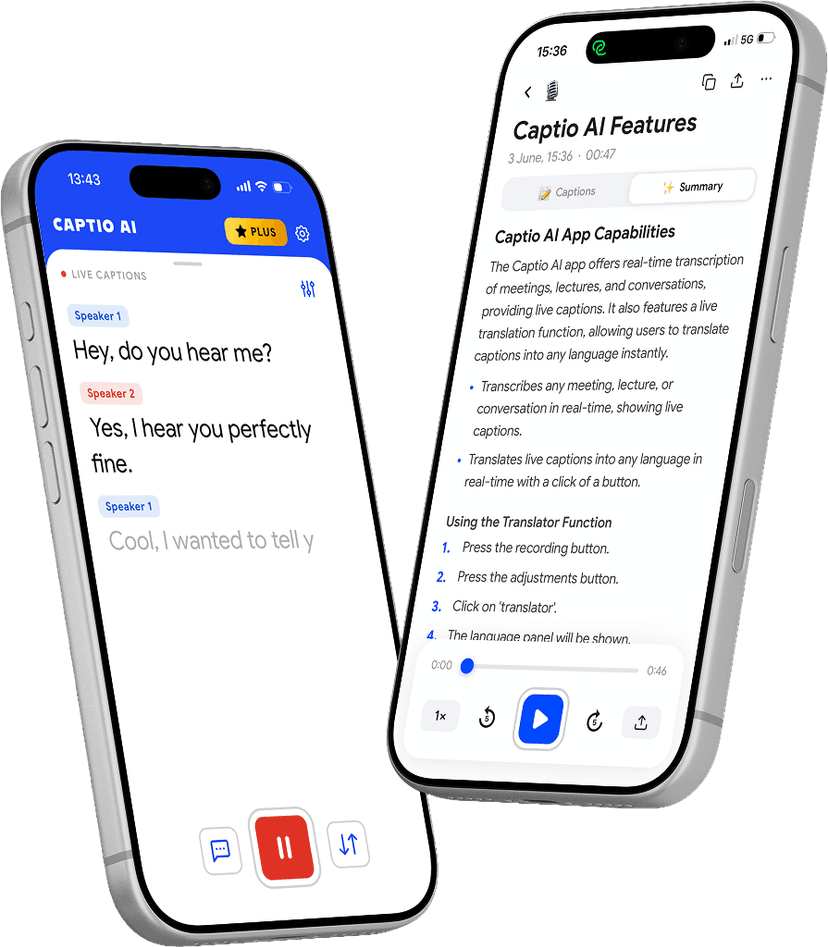
Everything you need to follow Telugu job interviews
Four tools built for deaf and hard of hearing Telugu speakers.
Read the question before you answer
- Every word appears in real time as the interviewer speaks
- Works in person, on video calls, and on the phone
- Discreet — runs quietly on your phone
- No asking for repeats
For interviews in another language
- Captions and translates in real time
- For international employers or roles abroad
- 60+ languages, no setup
- Follow every question in the language you think in
Review the interview afterwards
- Record and transcribe to revisit questions and your answers
- Useful for preparing for follow-up rounds
- Identify what you want to clarify in a second interview
- Works on any recording
Key topics and questions extracted
- Main themes and questions pulled from any interview transcript
- Useful for post-interview reflection and follow-up
- Organised into sections
- Works on any saved recording
Download for free
Every situation covered
Designed for the real moments that matter — not just quiet controlled environments.
In a Hyderabad or Vijayawada office — an interviewer speaking formal Telugu at professional pace. Captio AI captions every question in real time so you read the full sentence before responding.
Zoom or Google Meet in Telugu corporate environments — from Hyderabad IT firms to Andhra Pradesh government interviews. Follow every question in real time without asking for repeats.
HR screening calls in Telugu — fast, formal, often mixed with English. Captio AI captions the recruiter's voice in real time so compressed audio and code-switching do not become barriers.
Panel interviews at large Telangana and Andhra Pradesh employers. Captio AI follows each panelist's question even as they switch between Telugu and English mid-conversation.
For roles at Hyderabad multinationals where interviews move between Telugu and English. Live Translator handles both in the same session without any manual switching.
Group discussions — common in Indian banking and management graduate hiring. Captio AI covers the facilitator's instructions and participant contributions throughout.
Most accurate and fastest models
word accuracy
independent benchmark, 2025
real-time captions
first word appears as you speak
Download for free
Built for the room where a missed word has real consequences
Read the full question before you answer
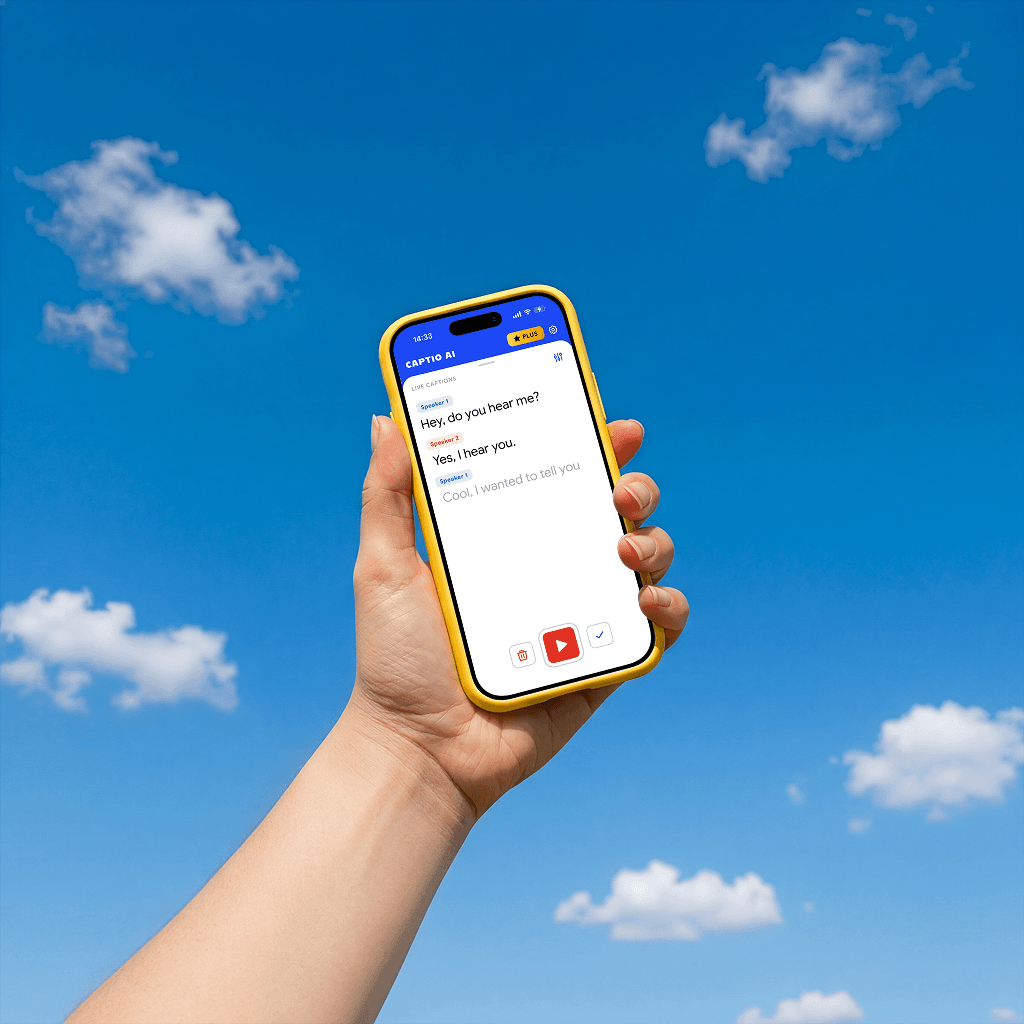
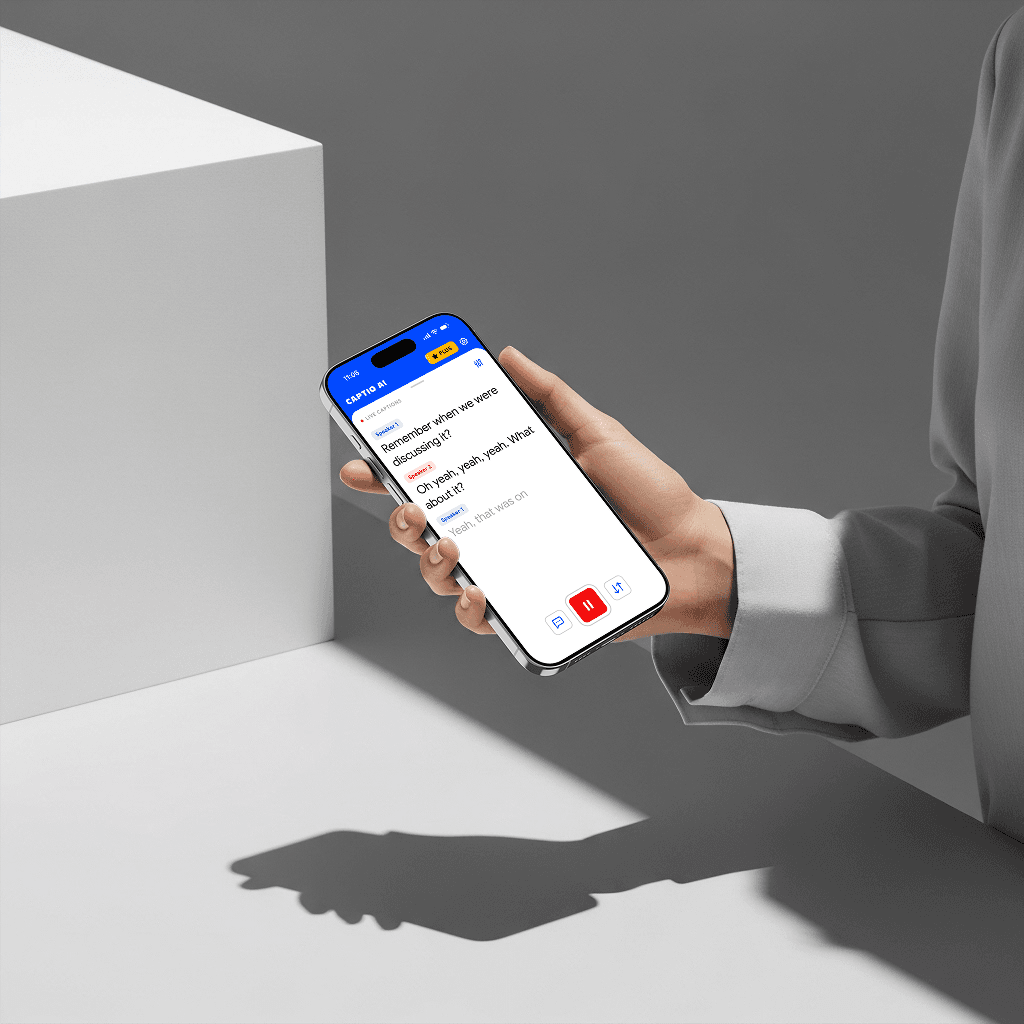
Every word appears on screen as the interviewer speaks. You read the question completely before responding — nothing guessed, nothing reconstructed.
Works in person and on any call format
In-person interviews, video calls, phone screens. Place the phone on the table or point it toward the audio — Captio AI handles every format.
Discreet by design
The app runs quietly on your phone. Place it on the table or hold it naturally. No explanation needed, no drawing attention to the accommodation.
No asking for repeats
Asking an interviewer to repeat a question signals uncertainty. Captio AI means you never need to — you read it in real time and answer with confidence.
Any language
For international roles, multilingual panels, or interviews conducted in a second language. Live Translator captions and translates in real time so language is never the barrier.
Private by default
Interview conversations are sensitive. Captio AI processes audio in real time and discards it immediately — nothing is stored, nothing is shared.
Why Telugu is hard to understand
Consonant gemination
- Double consonants change meaning but look identical on the lips
- Telugu uses consonant gemination — doubled consonants — to distinguish word meanings. 'Padi' (ten) and 'paddi' differ in consonant length. The geminate is produced acoustically by holding the consonant position longer, but the lip shape is identical to the singleton. In a formal Telugu interview, a deaf candidate cannot visually distinguish geminate from singleton consonants in real-time speech.
Agglutinative morphology
- Long suffix chains produce rapid syllable sequences in fast speech
- Telugu is highly agglutinative — verb roots take sequences of tense, aspect, person, number, and gender suffixes stacked in order. In an interview question, the verb at the end of the sentence may be a single long agglutinated word. Lip-reading a 6–8 syllable Telugu verb form requires tracking each morpheme in rapid succession with no pause between units.
Formal diglossia
- Grandhika formal Telugu and everyday Vyanavahara are different registers
- Telugu has a significant diglossia gap: Grandhika (classical literary Telugu) is used in formal writing, official speech, and interviews, while Vyanavahara (colloquial) is everyday conversation. Interview vocabulary in formal Telugu contexts may use literary roots and case endings that don't appear in casual speech. A deaf candidate who lip-reads everyday Telugu faces unfamiliar word forms in a formal interview.
Telugu-English switching
- Hyderabad IT interviews mix Telugu and English unpredictably
- In Hyderabad's large technology sector — one of India's major IT hubs — Telugu and English mix routinely within the same interview sentence. A question may begin in Telugu and end with an English technical term or vice versa. A deaf candidate tracking one language is suddenly watching the other.
Retroflex and aspirated stops
- Telugu shares South Asian invisibility problems for key consonant contrasts
- Telugu distinguishes retroflex consonants (ట, ఠ, డ, ఢ) from dental/alveolar counterparts, and aspirated from unaspirated stops. Both contrasts are acoustic — produced by tongue position and breath respectively — and both look identical on the lips. In formal interview vocabulary, these contrasts carry meaning that cannot be recovered from visual observation alone.
Download for free
63 million with hearing loss in India — and Telangana's IT boom hasn't made hiring accessible
India has an estimated 63 million people with significant hearing loss, distributed across all states including Telangana and Andhra Pradesh — two states that together form one of India's major IT employment corridors centred on Hyderabad. The Deaf Enabled Foundation, based in South India and operating across Telangana, provides vocational training and placement services for deaf candidates. Despite this infrastructure, the interview process at most Hyderabad IT companies, financial firms, and public-sector employers does not include captioning or sign language interpretation as a standard offering.
The Rights of Persons with Disabilities (RPWD) Act 2016 mandates a 4% employment quota in government jobs and requires reasonable accommodation for disabled workers. In practice, private-sector implementation is uneven. Deaf candidates applying to Hyderabad's major tech companies face an interview structure — technical rounds, HR discussions, group exercises — that is designed around spoken communication. Requesting captioning in advance is uncommon and can introduce bias. Not requesting it means managing the interview without support.
The linguistic structure of Telugu amplifies the practical barrier. Formal interview Telugu draws on Grandhika vocabulary unfamiliar from everyday colloquial speech. Technical interviews in Hyderabad's IT sector frequently mix Telugu and English mid-sentence. And Telugu's agglutinative morphology means key information — the verb and its tense, person, and aspect — arrives at the end of a long sentence in a single compressed word. Captio AI requires no employer arrangement: place the phone on the desk, and every Telugu sentence — including the final agglutinated verb — appears in real time.
Download for free
What you hear stays with you.
Gone the moment it ends
Captio AI processes your audio in real time and discards it immediately. Nothing is recorded. Nothing is kept.
Not a product
Your conversations are not something Captio AI sells, shares, or monetizes — to anyone, for any reason.
Not used to train anything
What you say in a doctor's appointment or a job interview never ends up in a training dataset. Not ours. Not anyone else's.

Private by default
Captio AI supports 60+ languages
Download for free
Frequently asked questions
Hear every question in Telugu.
Captio AI is free to start
Download for free