

Belarusian live captions and productivity tool for job interviews
For deaf and hard of hearing people.
Download for free


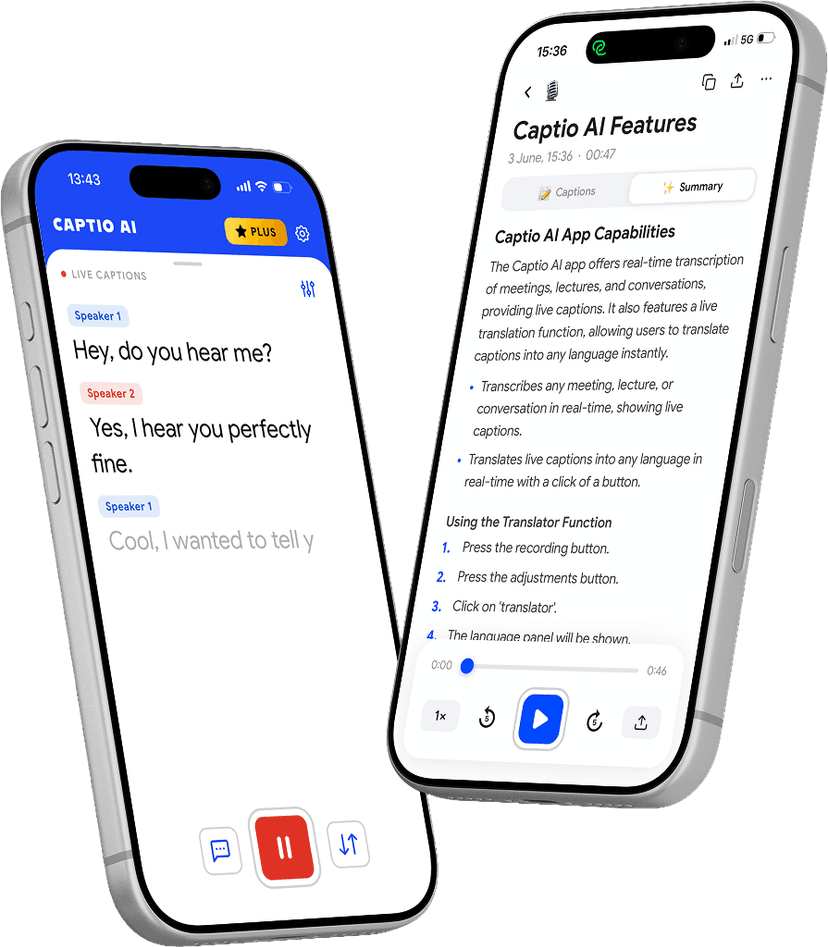
Everything you need to follow Belarusian job interviews
Four tools built for deaf and hard of hearing Belarusian speakers.
Read the question before you answer
- Every word appears in real time as the interviewer speaks
- Works in person, on video calls, and on the phone
- Discreet — runs quietly on your phone
- No asking for repeats
For interviews in another language
- Captions and translates in real time
- For international employers or roles abroad
- 60+ languages, no setup
- Follow every question in the language you think in
Review the interview afterwards
- Record and transcribe to revisit questions and your answers
- Useful for preparing for follow-up rounds
- Identify what you want to clarify in a second interview
- Works on any recording
Key topics and questions extracted
- Main themes and questions pulled from any interview transcript
- Useful for post-interview reflection and follow-up
- Organised into sections
- Works on any saved recording
Download for free
Every situation covered
Designed for the real moments that matter — not just quiet controlled environments.
Belarusian corporate interviews in Minsk are typically conducted in Russian, but some organisations — particularly public sector employers and state-language-conscious companies — use Belarusian. Captio AI handles both so you are prepared regardless of which language the interviewer opens with.
Video interviews over Zoom or Teams are common at Belarusian tech companies and firms with international links. Captio AI captions the audio in real time whatever language is used on the call.
Initial phone screens at Belarusian firms often use Russian or a trasianka mix. Captio AI captions the recruiter's speech live from any phone signal.
Panel interviews at Belarusian state or private enterprises may include speakers switching between Belarusian and Russian within the same conversation. Captio AI follows both without any adjustment.
Belarusian professionals interviewing with international companies often face English mixed with Russian. Captio AI covers English and Russian in the same session.
Group assessment tasks at Belarusian firms are typically conducted in Russian. Captio AI helps you follow fast discussion among multiple speakers and contribute at the right moment.
Most accurate and fastest models
word accuracy
independent benchmark, 2025
real-time captions
first word appears as you speak
Download for free
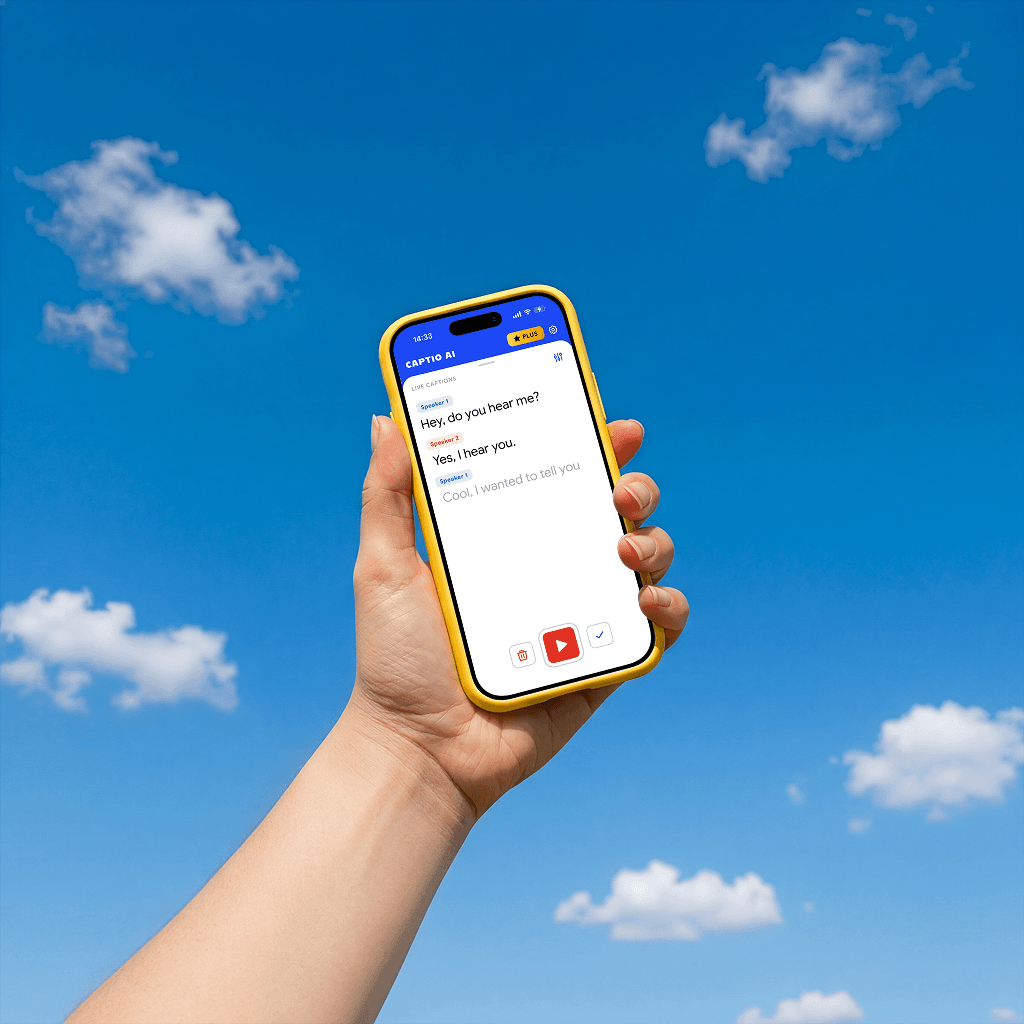
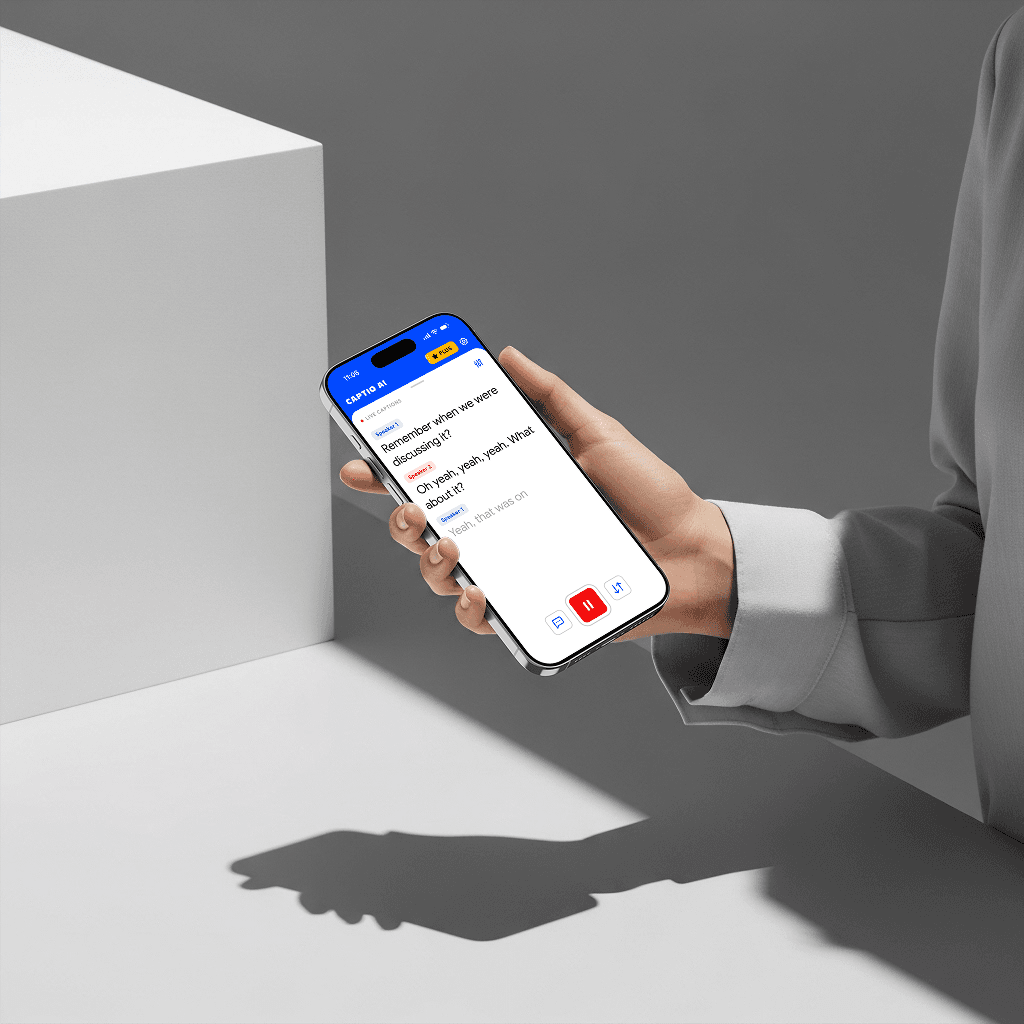
Built for the room where a missed word has real consequences
Read the full question before you answer
Every word appears on screen as the interviewer speaks. You read the question completely before responding — nothing guessed, nothing reconstructed.
Works in person and on any call format
In-person interviews, video calls, phone screens. Place the phone on the table or point it toward the audio — Captio AI handles every format.
Discreet by design
The app runs quietly on your phone. Place it on the table or hold it naturally. No explanation needed, no drawing attention to the accommodation.
No asking for repeats
Asking an interviewer to repeat a question signals uncertainty. Captio AI means you never need to — you read it in real time and answer with confidence.
Any language
For international roles, multilingual panels, or interviews conducted in a second language. Live Translator captions and translates in real time so language is never the barrier.
Private by default
Interview conversations are sensitive. Captio AI processes audio in real time and discards it immediately — nothing is stored, nothing is shared.
Why Belarusian is hard to understand
Trasianka code-mixing
- Two phonological systems at once
- Trasianka is a widespread mixed Belarusian-Russian dialect used across everyday Belarusian speech. In a job interview, a speaker may start in Belarusian and slide into Russian mid-sentence without signalling the switch — a deaf lip-reader faces two overlapping phonological systems simultaneously.
Akan'e — vowel reduction
- Unstressed vowels that change shape
- Belarusian akan'e reduces unstressed /o/ to /a/ throughout the word. Common words change shape dramatically under stress shift, producing lip movements that differ from the citation form a deaf reader may have learned.
Palatalization density
- Contrast produced inside the mouth
- Belarusian has an extremely high density of soft (palatalized) consonants. The distinction between a hard and a soft consonant is produced at the middle of the tongue — invisible at the lips — making the contrast undetectable in lip-reading.
Belarusian–Russian diglossia
- The language can shift mid-session
- Russian and Belarusian are co-official. Many professionals in Minsk use Russian by default but switch to Belarusian for cultural or contextual reasons. The interview language can change without a clear marker, and each language imposes a different phonological expectation.
Consonant cluster compression
- Multiple consonants that collapse in fast speech
- Belarusian words can stack multiple consonants at word junctions. In fast professional speech these clusters compress and assimilate, producing shapes that do not correspond to the individual phonemes a lip-reader would expect.
Download for free
Hearing loss and employment in Belarus
Belarus does not publish comprehensive disability employment statistics in a form widely accessible to international researchers, but WHO data for Eastern Europe suggests that well over 100,000 Belarusians live with disabling hearing loss. For those navigating formal employment, barriers are compounded by a limited policy infrastructure: Belarusian Sign Language has no formal legal recognition, and workplace accommodation obligations for deaf employees remain vague under existing disability legislation.
The Belarusian Society of the Deaf (BelSOG) is the primary representative body for deaf Belarusians, supporting members across a network of regional branches. Despite this civil society presence, deaf Belarusians face significant barriers accessing professional training and formal employment. The WHO World Report on Hearing (2021) emphasised that in countries without strong sign language legislation, the economic and social exclusion of deaf people is systematically more severe — a pattern directly applicable to the Belarusian context.
Globally, the WHO estimates that unaddressed hearing loss costs more than USD 980 billion per year, with working-age adults bearing a disproportionate share through lost earnings and reduced labour market participation. In Minsk's growing tech sector and public administration, where most professional interviews are conducted in fast formal Russian or mixed Belarusian, deaf candidates rarely have access to real-time captioning during recruitment. Captio AI gives them the same information as any hearing candidate — word for word, in real time, from the moment the interviewer starts speaking.
Download for free
What you hear stays with you.
Gone the moment it ends
Captio AI processes your audio in real time and discards it immediately. Nothing is recorded. Nothing is kept.
Not a product
Your conversations are not something Captio AI sells, shares, or monetizes — to anyone, for any reason.
Not used to train anything
What you say in a doctor's appointment or a job interview never ends up in a training dataset. Not ours. Not anyone else's.

Private by default
Captio AI supports 60+ languages
Download for free
Frequently asked questions
Hear every question in Belarusian.
Captio AI is free to start
Download for free