

Arabic live captions and productivity tool for job interviews
For deaf and hard of hearing people.
Download for free


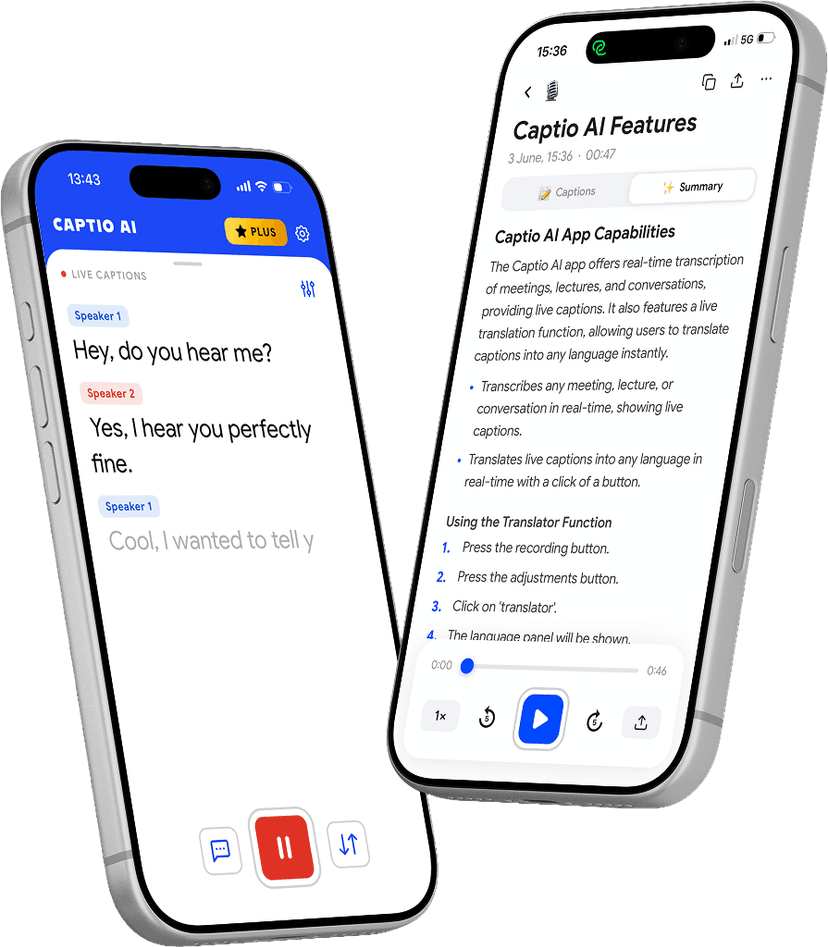
Everything you need to follow Arabic job interviews
Four tools built for deaf and hard of hearing Arabic speakers.
Read the question before you answer
- Every word appears in real time as the interviewer speaks
- Works in person, on video calls, and on the phone
- Discreet — runs quietly on your phone
- No asking for repeats
For interviews in another language
- Captions and translates in real time
- For international employers or roles abroad
- 60+ languages, no setup
- Follow every question in the language you think in
Review the interview afterwards
- Record and transcribe to revisit questions and your answers
- Useful for preparing for follow-up rounds
- Identify what you want to clarify in a second interview
- Works on any recording
Key topics and questions extracted
- Main themes and questions pulled from any interview transcript
- Useful for post-interview reflection and follow-up
- Organised into sections
- Works on any saved recording
Download for free
Every situation covered
Designed for the real moments that matter — not just quiet controlled environments.
In a Riyadh, Dubai, Cairo, or Beirut office — an interviewer speaking in Gulf dialect, MSA, or Levantine Arabic. Captio AI captions whatever variety is being spoken in real time so you read every question before responding.
Video calls on Zoom or Microsoft Teams — standard for first rounds at GCC companies and regional multinationals. Put the call on speaker, open Captio AI, and read every question as it is asked.
The initial HR call — often in Arabic over a mobile line with regional dialect. Captio AI captions the recruiter's voice in real time, so compressed audio and dialect variation do not cost you the interview.
Panel interviews at Gulf Cooperation Council companies or multinational firms in the Arab world. Captio AI follows each panelist in real time, even when they switch between MSA and local dialect mid-question.
For roles at multinational firms where interviews shift between Arabic and English mid-session. Live Translator handles both languages without any manual switching.
Structured assessment events — presentations, group exercises, competency assessments — at large Gulf or North African employers. Captio AI covers every spoken element throughout the day.
Most accurate and fastest models
word accuracy
independent benchmark, 2025
real-time captions
first word appears as you speak
Download for free
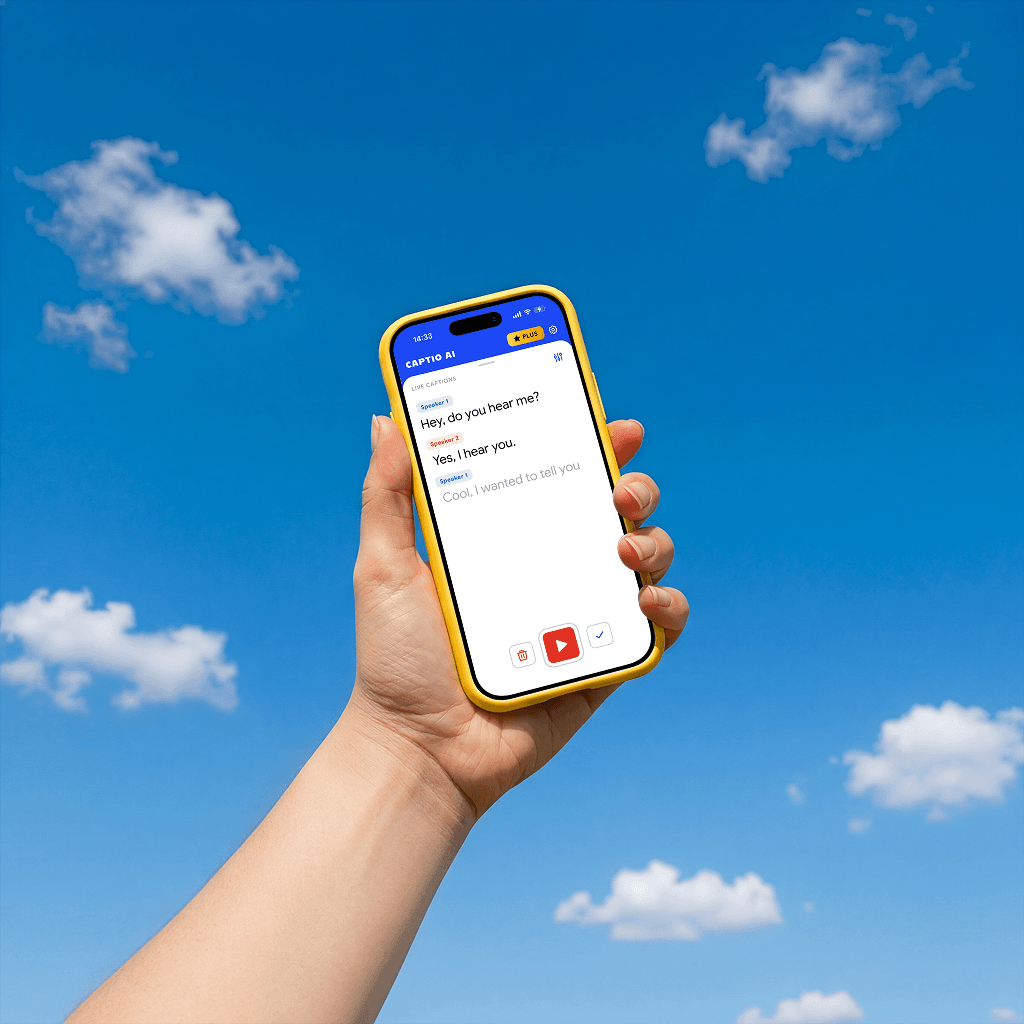
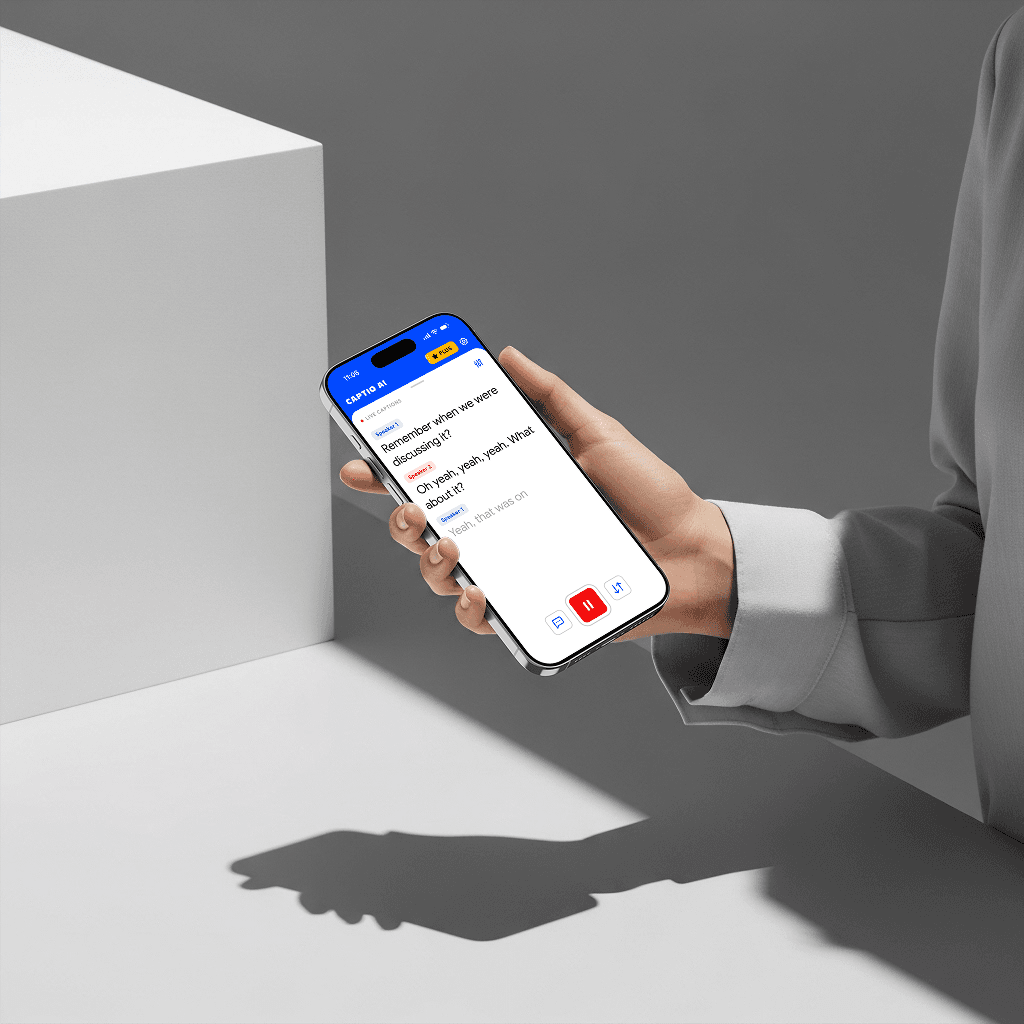
Built for the room where a missed word has real consequences
Read the full question before you answer
Every word appears on screen as the interviewer speaks. You read the question completely before responding — nothing guessed, nothing reconstructed.
Works in person and on any call format
In-person interviews, video calls, phone screens. Place the phone on the table or point it toward the audio — Captio AI handles every format.
Discreet by design
The app runs quietly on your phone. Place it on the table or hold it naturally. No explanation needed, no drawing attention to the accommodation.
No asking for repeats
Asking an interviewer to repeat a question signals uncertainty. Captio AI means you never need to — you read it in real time and answer with confidence.
Any language
For international roles, multilingual panels, or interviews conducted in a second language. Live Translator captions and translates in real time so language is never the barrier.
Private by default
Interview conversations are sensitive. Captio AI processes audio in real time and discards it immediately — nothing is stored, nothing is shared.
Why Arabic is hard to understand
Diglossia gap
- Formal interview Arabic is a different register from everyday speech
- Arabic has a significant diglossia gap: Modern Standard Arabic (MSA / Fusha) is used in formal interviews, official communication, and written Arabic, but nobody speaks MSA at home. A deaf candidate who has learned to track Gulf, Levantine, or Egyptian dialect in daily life is watching a different phonological and lexical system when a formal interviewer switches to MSA. The vocabulary and grammar are different enough that familiar words may simply not appear.
Pharyngeal invisibility
- ح and ع are produced deep in the throat — nothing on the lips
- Two of Arabic's most frequent consonants — ح (voiceless pharyngeal fricative /ħ/) and ع (voiced pharyngeal fricative /ʕ/) — are produced by constricting the pharynx, far behind the lips. They produce no visible lip movement whatsoever. In a GCC business interview, these sounds appear in common words (عمل 'work', حساب 'account', عقد 'contract') and are completely invisible to a lip-reader.
Emphatic consonants
- Pharyngealized consonants change vowel quality invisibly
- Arabic's emphatic consonants (ص, ض, ط, ظ) are pharyngealized versions of plain consonants — they change the quality of surrounding vowels acoustically but look identical to their plain counterparts on the lips. 'صبر' and 'سبر' look the same; 'طلب' and 'تلب' look the same. In an interview question, this creates systematic visual ambiguity that a lip-reader cannot resolve.
Code-switching
- GCC and Levantine interviews switch between MSA, dialect, and English
- Business interviews in the Gulf, Egypt, and the Levant routinely move between formal MSA, local dialect, and English within a single sentence. A deaf candidate tracking one register may be watching the interviewer shift to another without warning — the switch is acoustic and pragmatic, not visible on the lips.
Fast connected speech
- Arabic interview speech links and reduces across word boundaries
- Educated Arabic speech in a professional setting is fast, with significant assimilation across word boundaries and reduction of short vowels that are already absent in the written orthography. In a formal interview, the pace does not slow — it may increase under the time pressure of structured competency-based formats.
Download for free
Hearing loss affects over 7% of the MENA region — and employment protections are among the weakest globally
The WHO estimates that hearing loss affects approximately 7.3% of the Middle East and North Africa population — above the global average of 5%. Across Arab states, negative attitudes towards persons with disabilities are prevalent, and persons with disabilities face documented disadvantages in education, health, and employment. Research published through the Journal of Disability Research notes that disability research and policy development in Arab countries remained limited until 2009, when international frameworks such as the UN Convention on the Rights of Persons with Disabilities began to generate legislative activity. Most Arab countries now have some form of disability legislation, but employment enforcement mechanisms and interview accommodation requirements remain inconsistent across the region.
The International Labour Organization held a Regional Conference for Arab States on Inclusive Employment in 2023, where representatives identified low inclusion rates and poor corporate practices on disability hiring as persistent problems. In Gulf Cooperation Council countries — Saudi Arabia, UAE, Qatar, Kuwait, Bahrain, Oman — employment of deaf and hard of hearing nationals in formal-sector roles is limited, and multinational companies operating in the region vary widely in whether they provide interview accommodations. A deaf candidate attending a job interview in Riyadh or Dubai has no reliable legal guarantee that captioning or sign language interpretation will be available.
The linguistic complexity of the Arabic interview compounds the structural gap. No Arab country has implemented a national standard for captioning in the workplace. Arabic sign languages differ by country — Egyptian Sign Language, Gulf Sign Language, and Levantine varieties are mutually partially intelligible but not identical — and interpreter provision for interviews is rare even where it is theoretically available. A deaf Arabic-speaking candidate faces a language that is phonologically demanding to lip-read even in its simplest form, delivered in formal register, potentially mixed with local dialect and English, with no institutional support at the interview stage. Captio AI captions Arabic in real time across all major dialects — Gulf, Levantine, Egyptian, Moroccan — requiring no employer arrangement and no advance disclosure.
Download for free
What you hear stays with you.
Gone the moment it ends
Captio AI processes your audio in real time and discards it immediately. Nothing is recorded. Nothing is kept.
Not a product
Your conversations are not something Captio AI sells, shares, or monetizes — to anyone, for any reason.
Not used to train anything
What you say in a doctor's appointment or a job interview never ends up in a training dataset. Not ours. Not anyone else's.

Private by default
Captio AI supports 60+ languages
Download for free
Frequently asked questions
Hear every question in Arabic.
Captio AI is free to start
Download for free