

Catalan live captions and productivity tool for job interviews
For deaf and hard of hearing people.
Download for free


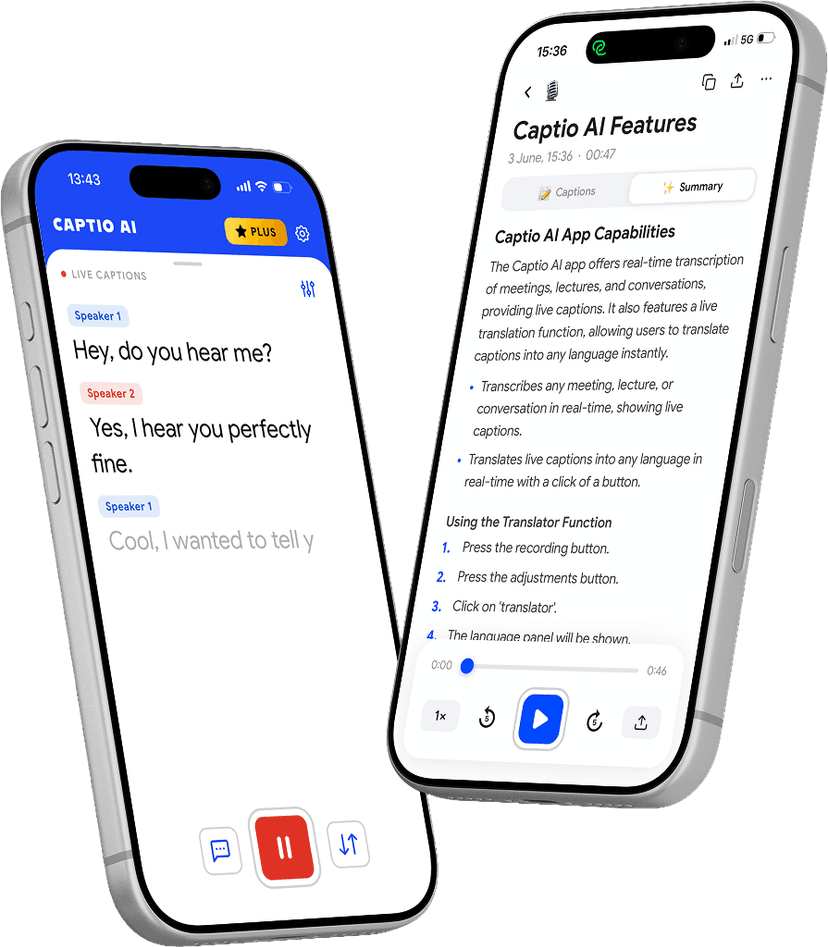
Everything you need to follow Catalan job interviews
Four tools built for deaf and hard of hearing Catalan speakers.
Read the question before you answer
- Every word appears in real time as the interviewer speaks
- Works in person, on video calls, and on the phone
- Discreet — runs quietly on your phone
- No asking for repeats
For interviews in another language
- Captions and translates in real time
- For international employers or roles abroad
- 60+ languages, no setup
- Follow every question in the language you think in
Review the interview afterwards
- Record and transcribe to revisit questions and your answers
- Useful for preparing for follow-up rounds
- Identify what you want to clarify in a second interview
- Works on any recording
Key topics and questions extracted
- Main themes and questions pulled from any interview transcript
- Useful for post-interview reflection and follow-up
- Organised into sections
- Works on any saved recording
Download for free
Every situation covered
Designed for the real moments that matter — not just quiet controlled environments.
Job interviews at Catalan companies typically proceed in Catalan, though the language often shifts to Spanish if any participant is not a native Catalan speaker. Captio AI handles both in the same session so you are prepared for either opening.
Video interviews over Teams or Zoom are standard at Catalan and Barcelona-based companies. Captio AI captions the interviewer's Catalan or Spanish in real time over any compressed call.
Initial phone screens at Catalan firms are often conducted in Catalan by default. Captio AI captions the recruiter's speech live without a video feed.
Panel interviews in Barcelona may include speakers with different regional backgrounds — a Valencian panelist and a Barcelona speaker sound noticeably different. Captio AI handles both varieties in the same room.
International or multinational companies in Catalonia often conduct rounds in English before switching to Catalan or Spanish. Captio AI covers all three languages in the same session.
Group assessment days at Catalan employers involve collaborative tasks in Catalan or Spanish. Captio AI helps you follow every speaker and every instruction across the group.
Most accurate and fastest models
word accuracy
independent benchmark, 2025
real-time captions
first word appears as you speak
Download for free
Built for the room where a missed word has real consequences
Read the full question before you answer
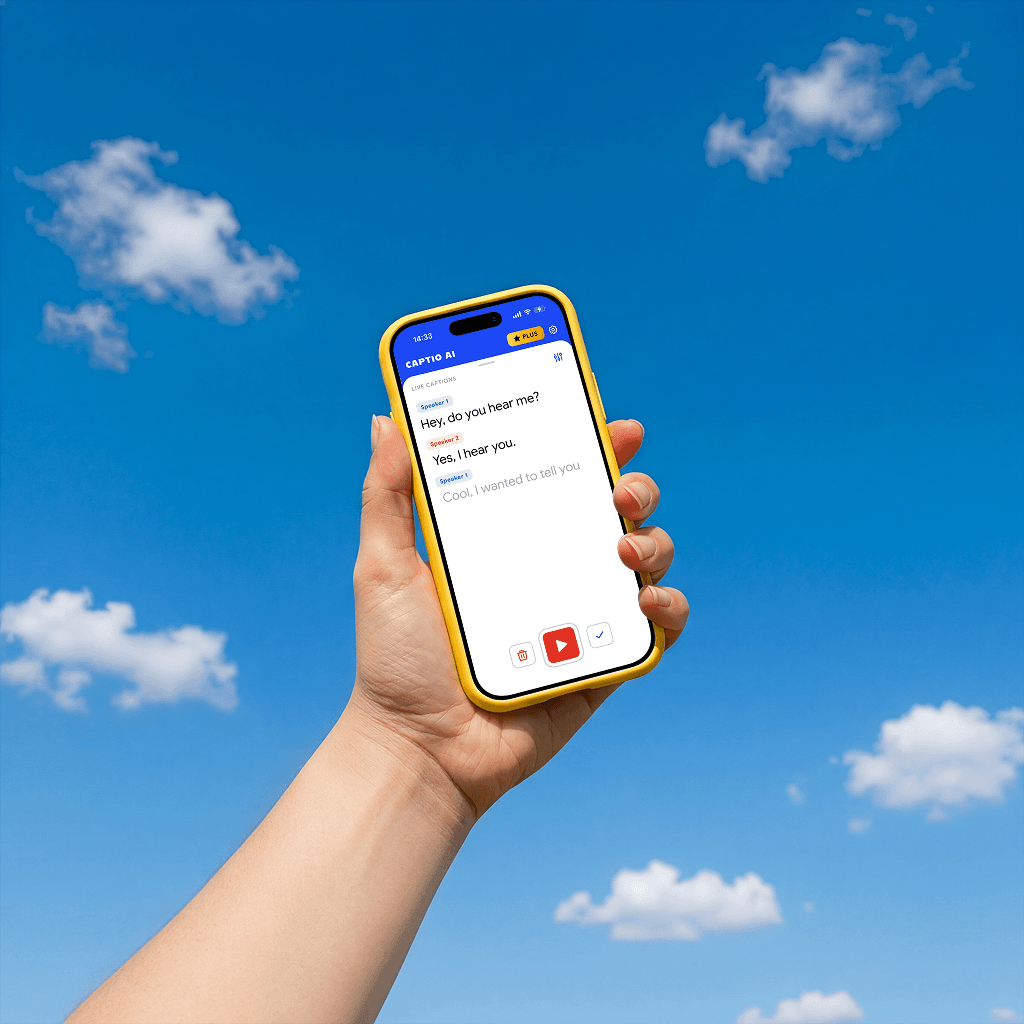
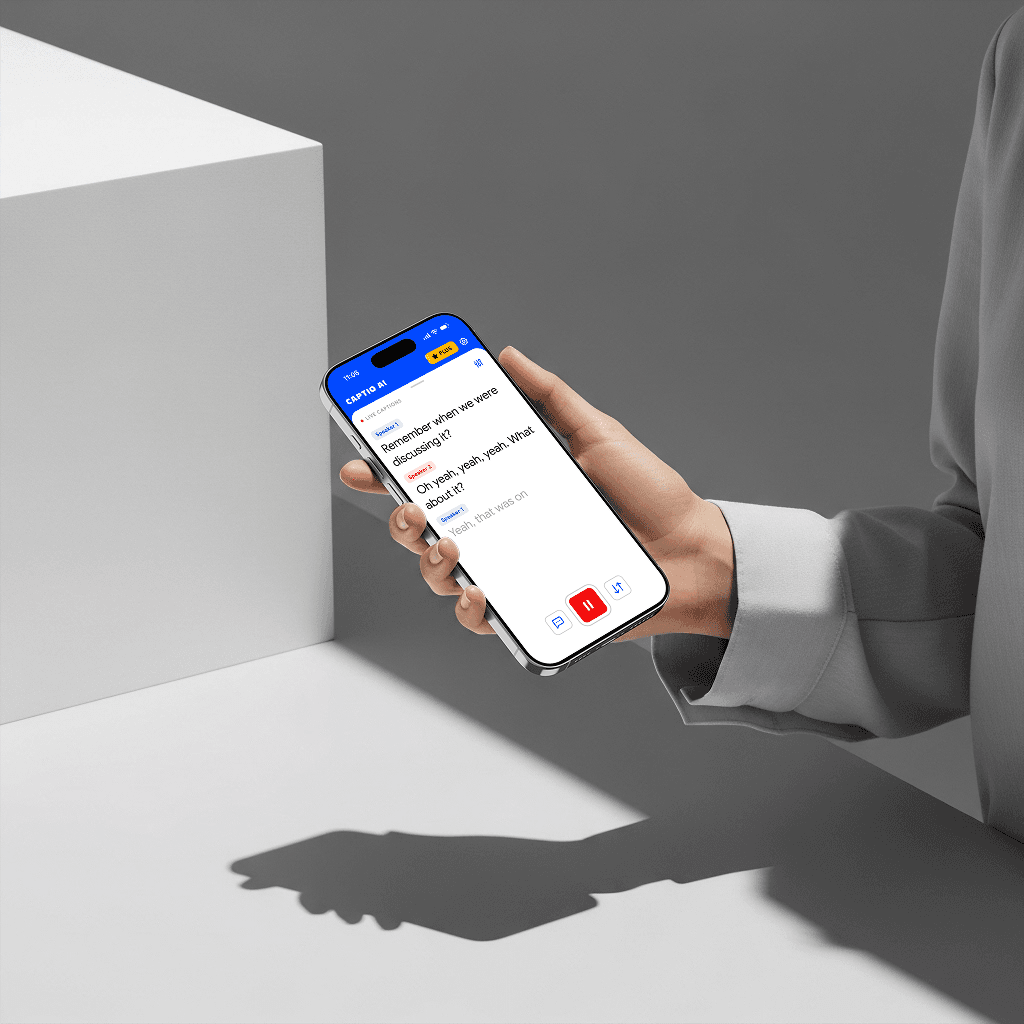
Every word appears on screen as the interviewer speaks. You read the question completely before responding — nothing guessed, nothing reconstructed.
Works in person and on any call format
In-person interviews, video calls, phone screens. Place the phone on the table or point it toward the audio — Captio AI handles every format.
Discreet by design
The app runs quietly on your phone. Place it on the table or hold it naturally. No explanation needed, no drawing attention to the accommodation.
No asking for repeats
Asking an interviewer to repeat a question signals uncertainty. Captio AI means you never need to — you read it in real time and answer with confidence.
Any language
For international roles, multilingual panels, or interviews conducted in a second language. Live Translator captions and translates in real time so language is never the barrier.
Private by default
Interview conversations are sensitive. Captio AI processes audio in real time and discards it immediately — nothing is stored, nothing is shared.
Why Catalan is hard to understand
Unstressed vowel neutralisation
- Words that change shape when unstressed
- Eastern Catalan reduces unstressed /a/ and /e/ to a schwa /ə/, and unstressed /o/ to /u/. Words sound entirely different in conversational speech from their stressed or dictionary form — creating visual mismatches a deaf reader calibrated on citation forms cannot resolve.
Final obstruent devoicing
- Voiced consonants that become voiceless
- Catalan devoices consonants at word ends in speech, even when they are voiced in writing. A word written with a voiced final consonant sounds like its voiceless counterpart. The visible lip shape gives no indication — the distinction is entirely in the larynx.
Valencian–Central divergence
- Two standards, very different sounds
- Valencian and Central (Barcelona) Catalan differ substantially in vowel systems, pronoun forms, and vocabulary. A deaf reader prepared on one variety encounters a partially different phonological system when the interviewer is from the other region.
Catalan–Spanish switching
- Two languages, one professional conversation
- In professional settings across Catalonia, speakers switch between Catalan and Spanish depending on who is in the room and what is being discussed. Both language streams run simultaneously in the same interview and must both be tracked.
Consonant lenition between vowels
- Plosives that weaken mid-word
- Between vowels, Catalan plosives undergo lenition — voiced stops weaken toward fricatives or approximants. The visible lip closure for /b/ may weaken to a labial approximant or disappear entirely, creating a gradient shift that has no clear visual signal.
Download for free
Hearing loss and employment in Catalonia and Spain
Spain's National Statistics Institute (INE) estimates 1,064,000 people in Spain are deaf or have a hearing disability — approximately 2.3% of the population. The Spanish Confederation of Deaf People (CNSE) has documented persistent employment barriers for this community, including a lack of communication accommodation in recruitment and limited captioning infrastructure outside major urban centres. Catalonia, as Spain's most populous region, reflects these national patterns.
Spanish disability employment data published by INE in December 2025 showed a persistent employment gap between workers with and without disabilities. For deaf and hard of hearing workers, communication barriers in job interviews represent the earliest and most concrete point at which this gap is created: a candidate who cannot follow questions accurately cannot demonstrate their actual competence. The accommodation that would address this — a live captioner or interpreter in the interview room — is rarely provided and requires advance arrangement.
The WHO World Report on Hearing (2021) estimated the global annual cost of unaddressed hearing loss at over USD 980 billion, concentrated among working-age adults in countries where accommodation provision is inconsistent. For Catalan-speaking deaf job seekers in Barcelona, Girona, and Lleida, Captio AI provides real-time captions in Catalan the moment the interviewer speaks — without an interpreter, without advance disclosure, and without any change to the interview format.
Download for free
What you hear stays with you.
Gone the moment it ends
Captio AI processes your audio in real time and discards it immediately. Nothing is recorded. Nothing is kept.
Not a product
Your conversations are not something Captio AI sells, shares, or monetizes — to anyone, for any reason.
Not used to train anything
What you say in a doctor's appointment or a job interview never ends up in a training dataset. Not ours. Not anyone else's.

Private by default
Captio AI supports 60+ languages
Download for free
Frequently asked questions
Hear every question in Catalan.
Captio AI is free to start
Download for free