

Urdu live captions and productivity tool for job interviews
For deaf and hard of hearing people.
Download for free


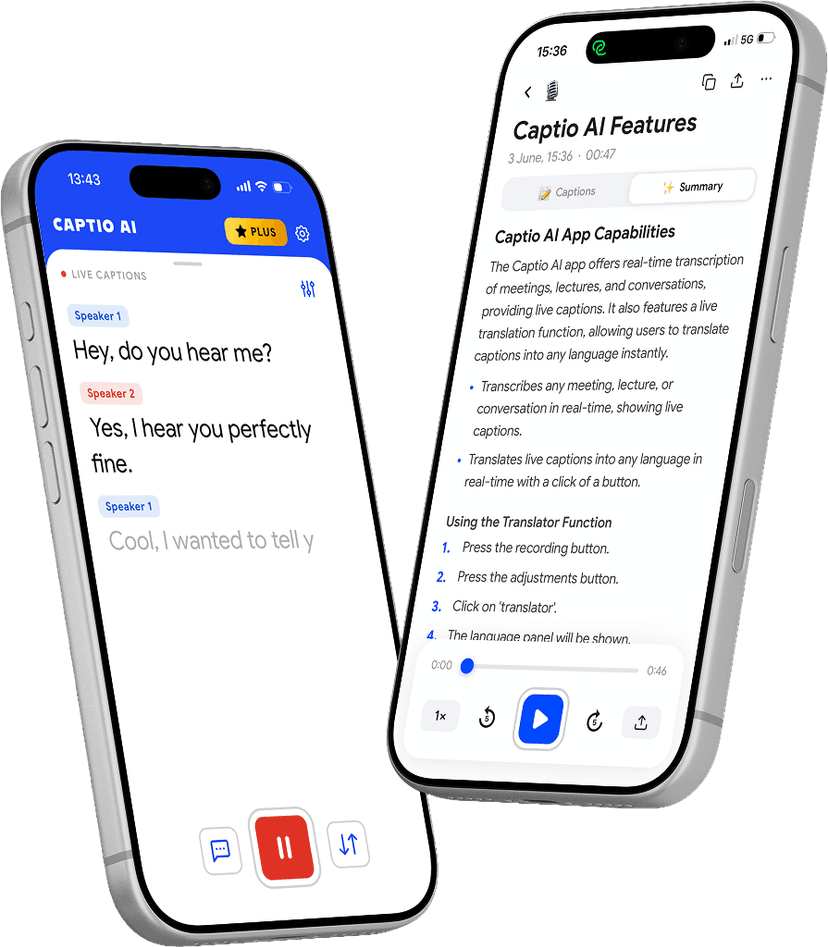
Everything you need to follow Urdu job interviews
Four tools built for deaf and hard of hearing Urdu speakers.
Read the question before you answer
- Every word appears in real time as the interviewer speaks
- Works in person, on video calls, and on the phone
- Discreet — runs quietly on your phone
- No asking for repeats
For interviews in another language
- Captions and translates in real time
- For international employers or roles abroad
- 60+ languages, no setup
- Follow every question in the language you think in
Review the interview afterwards
- Record and transcribe to revisit questions and your answers
- Useful for preparing for follow-up rounds
- Identify what you want to clarify in a second interview
- Works on any recording
Key topics and questions extracted
- Main themes and questions pulled from any interview transcript
- Useful for post-interview reflection and follow-up
- Organised into sections
- Works on any saved recording
Download for free
Every situation covered
Designed for the real moments that matter — not just quiet controlled environments.
In a Karachi, Lahore, or Islamabad office — an interviewer speaking formal Urdu at corporate pace. Captio AI captions every question in real time so you read the full sentence before responding.
Google Meet or Zoom in Pakistani corporate settings. Open Captio AI, put the call on speaker, and follow every question as it is asked — whether in Urdu or English.
The initial HR screening call in Urdu — fast, formal, often mixed with English. Captio AI captions in real time so compressed audio and code-switching do not cost you the interview.
Panel interviews at large Pakistani employers, public-sector organizations, or multinationals. Captio AI follows each panelist's question even as speakers shift between Urdu and English.
For roles at international firms in Pakistan where the interview moves between Urdu and English. Live Translator handles both languages in the same session without any manual setup.
Group discussions and competency assessments — common at Pakistani banks, multinationals, and civil service selection. Captio AI covers evaluator briefings and group dialogue throughout.
Most accurate and fastest models
word accuracy
independent benchmark, 2025
real-time captions
first word appears as you speak
Download for free
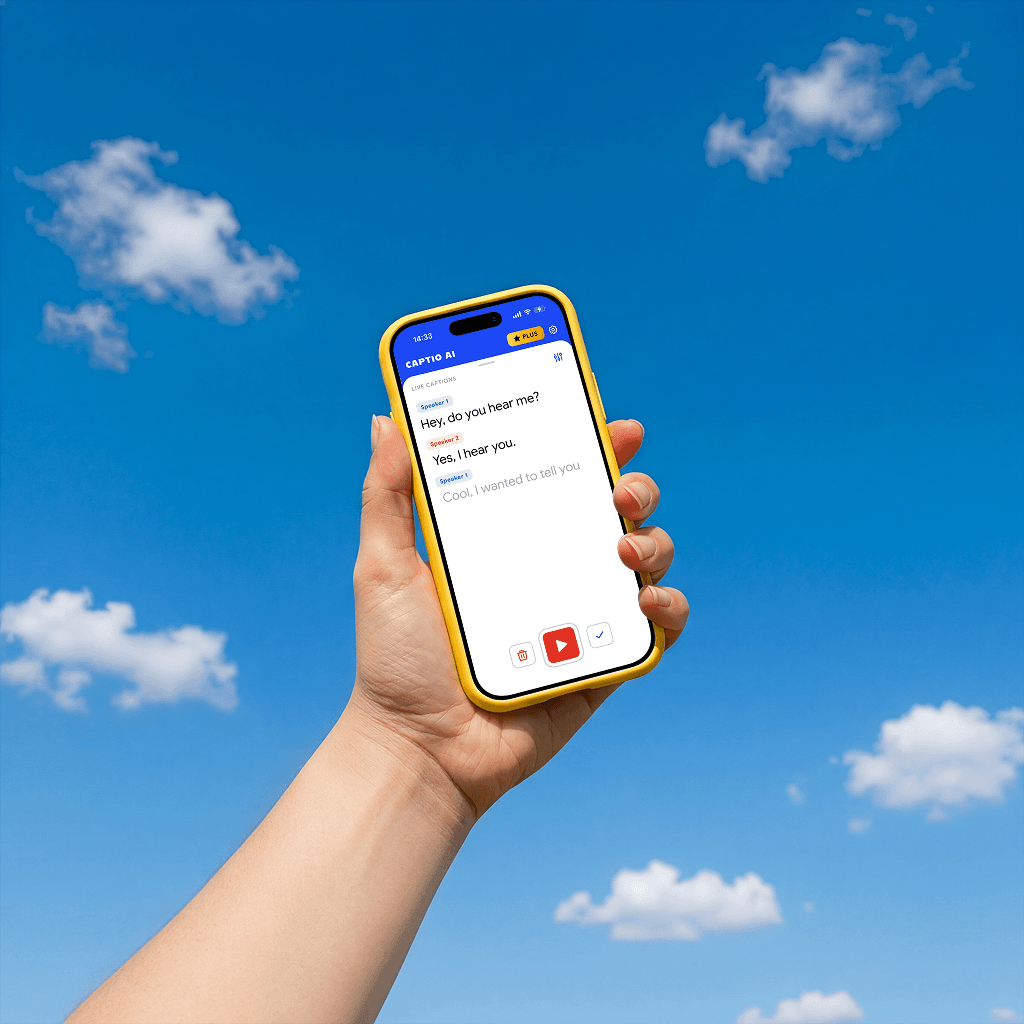
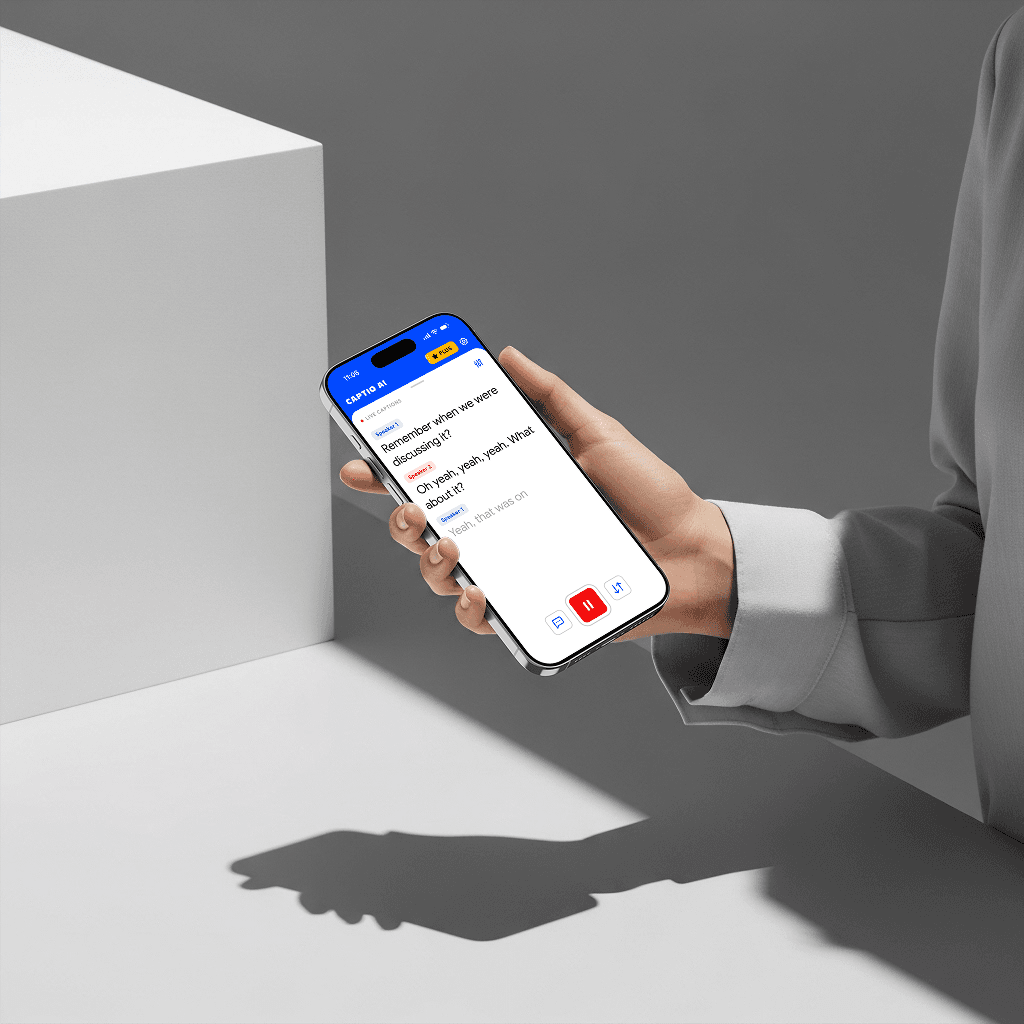
Built for the room where a missed word has real consequences
Read the full question before you answer
Every word appears on screen as the interviewer speaks. You read the question completely before responding — nothing guessed, nothing reconstructed.
Works in person and on any call format
In-person interviews, video calls, phone screens. Place the phone on the table or point it toward the audio — Captio AI handles every format.
Discreet by design
The app runs quietly on your phone. Place it on the table or hold it naturally. No explanation needed, no drawing attention to the accommodation.
No asking for repeats
Asking an interviewer to repeat a question signals uncertainty. Captio AI means you never need to — you read it in real time and answer with confidence.
Any language
For international roles, multilingual panels, or interviews conducted in a second language. Live Translator captions and translates in real time so language is never the barrier.
Private by default
Interview conversations are sensitive. Captio AI processes audio in real time and discards it immediately — nothing is stored, nothing is shared.
Why Urdu is hard to understand
Aspiration pairs
- Aspirated and unaspirated stops look the same on the lips
- Urdu distinguishes aspirated and unaspirated stop pairs: پ/پھ, ت/تھ, ک/کھ, ب/بھ. The aspiration — a burst of breath — is acoustic, not visible. A lip-reader watching an interviewer in a Karachi or Lahore office cannot distinguish 'پل' from 'پھل', 'تان' from 'تھان', or any other aspirated-unaspirated pair. In a formal interview question, these pairs appear in common vocabulary and create systematic visual ambiguity.
Retroflex consonants
- ٹ, ڈ, ڑ look identical to dental ت, د on the lips
- Urdu's retroflex consonants (ٹ, ڈ, ڑ — tongue curled to hard palate) look identical to their dental counterparts (ت, د — tongue at teeth) in lip-reading. These distinctions carry meaning in interview vocabulary and are invisible on the lips. A deaf candidate in a formal interview room cannot resolve which consonant class is being used from visual observation alone.
Urdu-English code-switching
- Pakistani corporate interviews switch between Urdu and English mid-sentence
- Pakistani professional environments routinely mix Urdu and English within individual sentences — a phenomenon involving an estimated 250 million code-switching speakers across South Asia. An interviewer at a Karachi bank or Lahore IT company may begin a question in Urdu and complete it in English. A deaf candidate tracking one language is suddenly watching a sentence in another with no visible signal of the switch.
Formal Urdu register
- High literary Urdu draws on Perso-Arabic vocabulary unfamiliar even to many Urdu speakers
- Formal Urdu — used in official and corporate interview settings — draws heavily on Persian and Arabic vocabulary that does not appear in everyday conversational Hindustani. An interviewer using formal register may use words that even hearing Urdu speakers from informal backgrounds find unfamiliar. For a deaf candidate, these are words with no established visual pattern from daily experience.
Nasalisation
- Nasalised vowels change meaning but leave no lip trace
- Urdu uses nasalisation as a phonemic feature — pairs like 'پان' (betel leaf) and 'پاں' differ only in nasalisation. Nasalisation is produced in the nasal cavity with no visible lip movement. In formal interview speech, nasalised and oral vowels look identical on the lips.
Download for free
4.8% of Pakistan's population has hearing loss — and a 2% employment quota that is rarely filled
Pakistan's Ministry of National Health Sciences has recorded that 4.8% of the total population — approximately 11 million people — has a hearing disability, one of the higher national prevalence rates in South Asia. Pakistan has a statutory 2% job quota for persons with disabilities in all provinces (raised to 3% in Punjab in 2015). A 2019 study of government departments in Khyber Pakhtunkhwa found that almost all departments had failed to meet even the 2% threshold. The gap between what the law requires and what hiring practice delivers is wide, consistent, and undocumented in most of the country's private sector.
Late identification of hearing loss drives educational disadvantage upstream of employment. WHO's Eastern Mediterranean office found that neonatal hearing screening in Pakistan is hindered by financial constraints and a dearth of reliable epidemiological data — most hearing losses are identified late, after the critical period for language development. By the time a deaf or hard of hearing person reaches interview age, they have typically navigated an education system with limited support, reducing access to the qualifications that formal employment requires.
The interview itself presents a separate, acute barrier. Pakistani corporate and government interviews are fast, formal, and conducted in a mix of Urdu and English that can shift unpredictably within a single question. No mechanism requires an employer to provide captioning or a sign language interpreter at the interview stage. Disclosure can invite bias at the shortlisting stage. And the 2% quota, even when met, does not address whether the interview process is accessible. Captio AI requires no employer arrangement — place the phone on the desk at the start of the interview and read every Urdu question as it is asked.
Download for free
What you hear stays with you.
Gone the moment it ends
Captio AI processes your audio in real time and discards it immediately. Nothing is recorded. Nothing is kept.
Not a product
Your conversations are not something Captio AI sells, shares, or monetizes — to anyone, for any reason.
Not used to train anything
What you say in a doctor's appointment or a job interview never ends up in a training dataset. Not ours. Not anyone else's.

Private by default
Captio AI supports 60+ languages
Download for free
Frequently asked questions
Hear every question in Urdu.
Captio AI is free to start
Download for free