

Japanese live captions and productivity tool for job interviews
For deaf and hard of hearing people.
Download for free


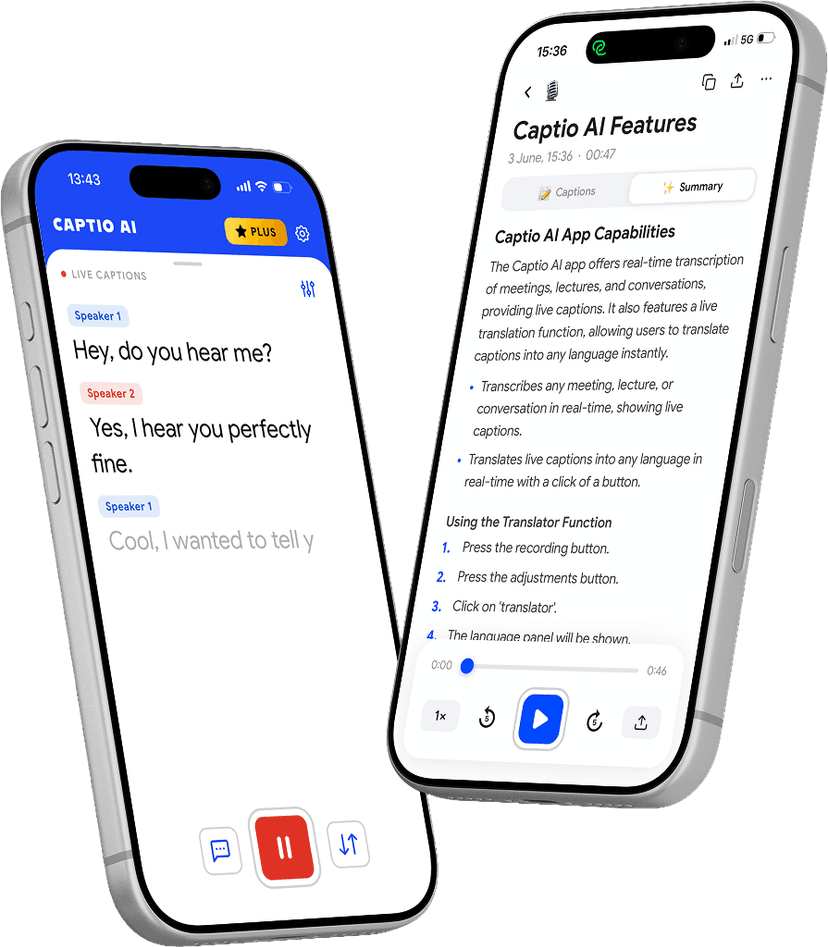
Everything you need to follow Japanese job interviews
Four tools built for deaf and hard of hearing Japanese speakers.
Read the question before you answer
- Every word appears in real time as the interviewer speaks
- Works in person, on video calls, and on the phone
- Discreet — runs quietly on your phone
- No asking for repeats
For interviews in another language
- Captions and translates in real time
- For international employers or roles abroad
- 60+ languages, no setup
- Follow every question in the language you think in
Review the interview afterwards
- Record and transcribe to revisit questions and your answers
- Useful for preparing for follow-up rounds
- Identify what you want to clarify in a second interview
- Works on any recording
Key topics and questions extracted
- Main themes and questions pulled from any interview transcript
- Useful for post-interview reflection and follow-up
- Organised into sections
- Works on any saved recording
Download for free
Every situation covered
Designed for the real moments that matter — not just quiet controlled environments.
In a Tokyo, Osaka, or Nagoya office — an interviewer speaking formal keigo at corporate pace. Captio AI captions every Japanese question in real time so you read the full sentence before responding.
Zoom or Microsoft Teams — standard for remote first rounds at Japanese companies. Put the call on speaker, open Captio AI, and follow every question in real time regardless of speech rate.
The initial HR screening call in fast formal Japanese. Captio AI captions the recruiter's voice in real time so the phone format does not become the barrier to the next round.
Structured panel interviews are standard at Japanese corporations, especially large manufacturers and financial firms. Captio AI follows each panelist's question so you always know who asked what.
For roles at international firms in Japan where the interview shifts between Japanese and English. Live Translator handles both languages in the same session without manual switching.
Group exercises and structured assessment days — used in Japanese new-graduate (shūkatsu) hiring. Captio AI covers evaluator briefings, group discussions, and individual feedback sessions.
Most accurate and fastest models
character accuracy
independent benchmark, 2025
real-time captions
first word appears as you speak
Download for free
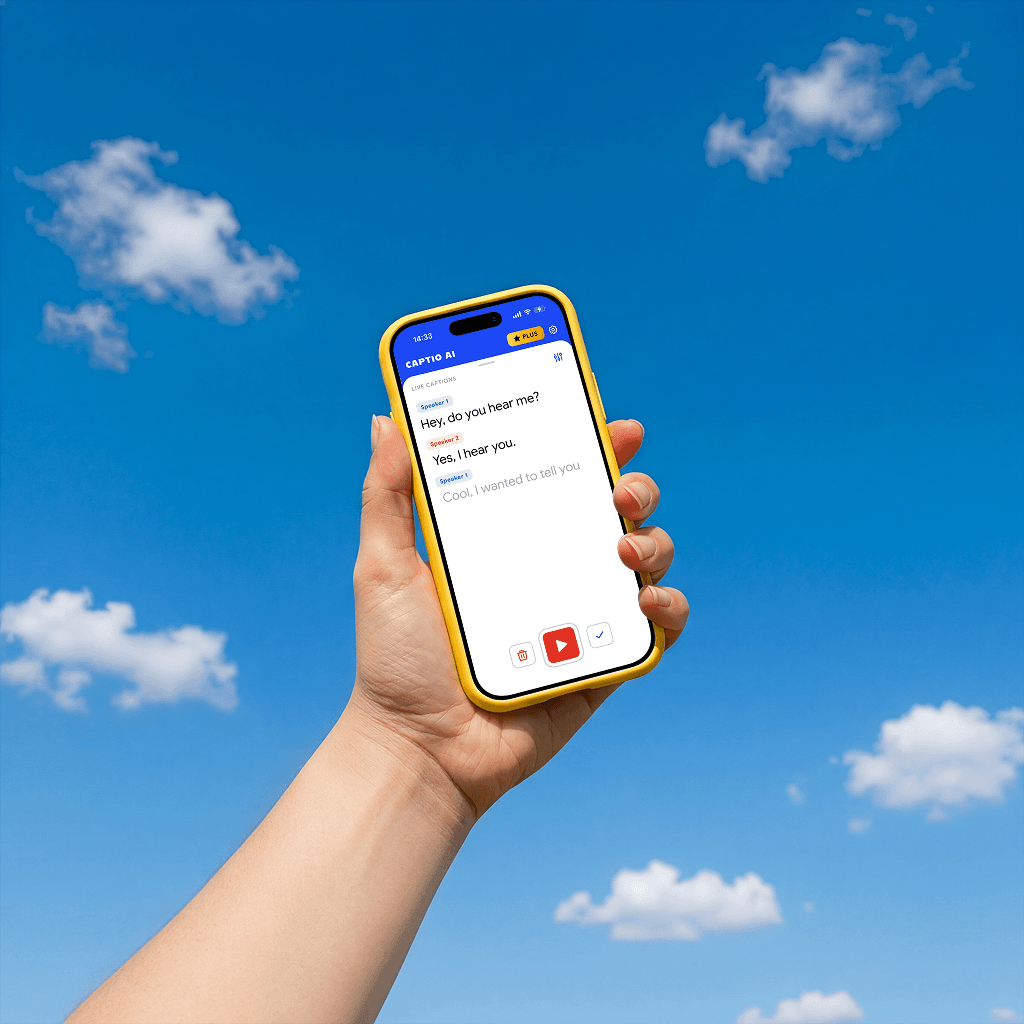
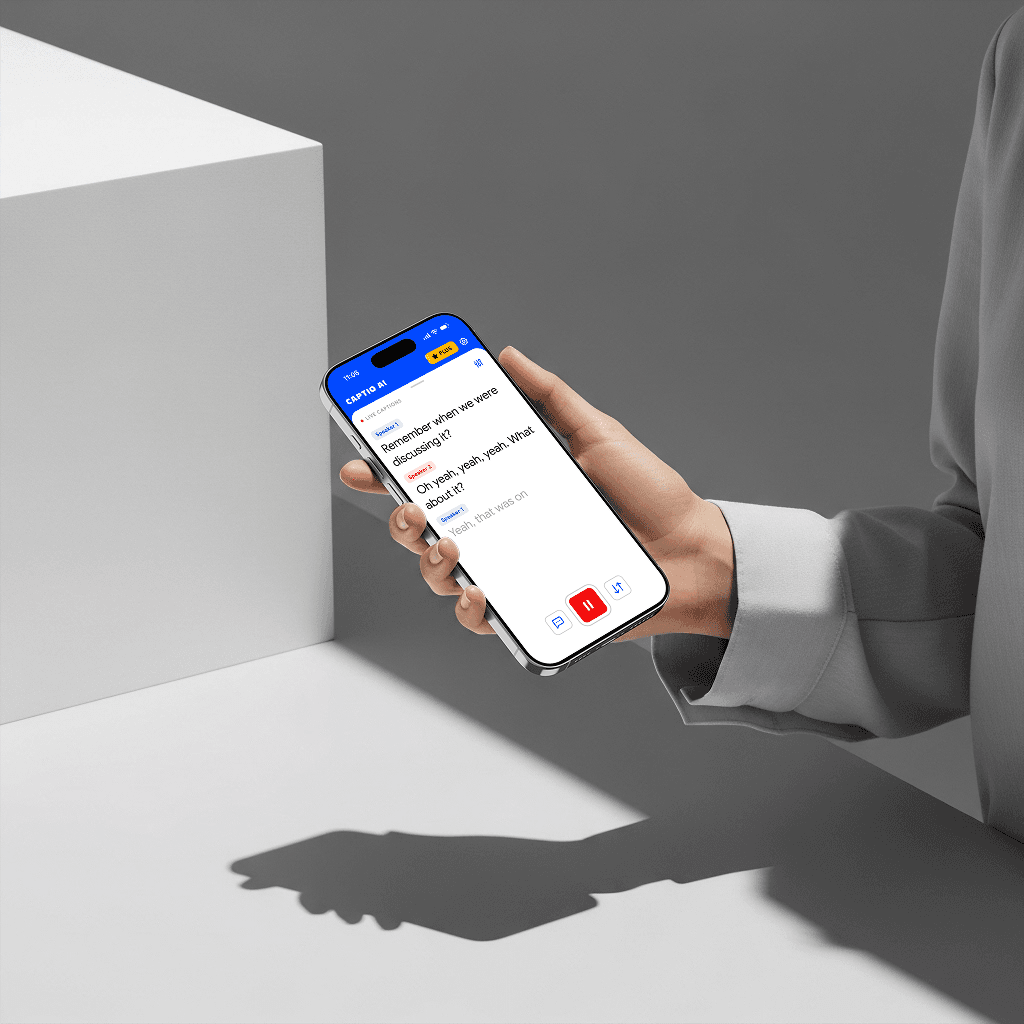
Built for the room where a missed word has real consequences
Read the full question before you answer
Every word appears on screen as the interviewer speaks. You read the question completely before responding — nothing guessed, nothing reconstructed.
Works in person and on any call format
In-person interviews, video calls, phone screens. Place the phone on the table or point it toward the audio — Captio AI handles every format.
Discreet by design
The app runs quietly on your phone. Place it on the table or hold it naturally. No explanation needed, no drawing attention to the accommodation.
No asking for repeats
Asking an interviewer to repeat a question signals uncertainty. Captio AI means you never need to — you read it in real time and answer with confidence.
Any language
For international roles, multilingual panels, or interviews conducted in a second language. Live Translator captions and translates in real time so language is never the barrier.
Private by default
Interview conversations are sensitive. Captio AI processes audio in real time and discards it immediately — nothing is stored, nothing is shared.
Why Japanese is hard to understand
Pitch accent invisibility
- Pitch patterns change meaning but leave no trace on the lips
- Japanese uses lexical pitch accent — high and low pitch patterns on each mora determine word meaning. 'Hashi' (橋 bridge) and 'hashi' (箸 chopsticks) differ only in pitch contour. Pitch is produced in the larynx, not on the lips. In a formal interview, identical lip shapes produce different words depending on pitch, and a deaf candidate has no visual way to distinguish them.
Keigo register
- Formal interview Japanese uses vocabulary deaf candidates may never have encountered
- Japanese corporate interviews require keigo — the formal honorific register with its own vocabulary, verb forms, and grammatical structures separate from ordinary polite speech. Phrases used in a Tokyo boardroom interview are different words and different lip shapes from the same meaning in casual Japanese. A deaf candidate whose visual Japanese is based on everyday speech faces an unfamiliar lexical set in a keigo interview.
Consonant devoicing
- Tokyo Japanese regularly drops vowels between voiceless consonants
- In standard Tokyo Japanese, high vowels /i/ and /u/ are routinely devoiced or deleted between voiceless consonants. 'Desu' is spoken as [des], 'shite' as [ɕte]. In a fast interview sentence, these deleted vowels create gaps in the lip sequence — syllables that appear in writing but produce no visible mouth movement in speech.
Mora compression
- Fast mora-timed interview speech compresses to a rapid uniform stream
- Japanese is mora-timed — each mora gets roughly equal duration, which creates a uniform rapid stream in fast speech. In a structured panel interview, the interviewer speaks at corporate pace without natural pauses between clauses. A lip-reader tracking mora boundaries in fast Japanese has very little time between each unit and no stress-timed variation to help segment what was said.
Compound question structure
- Japanese interview questions stack clauses in a single long sentence
- Japanese puts the verb at the end of the sentence, and formal interview questions frequently stack multiple subordinate clauses before the main verb arrives. A long compound question arrives in a single stream ending in a formal verb form. By the time a deaf candidate reaches the main verb, the earlier clauses — the content of the question — may have been partially lost.
Download for free
350,000 deaf people in Japan — and a corporate hiring system built on auditory keigo
Japan has approximately 350,000 deaf people and a much larger group who are hard of hearing, with around 6 million people estimated to use hearing aids — approximately 4.7% of the population. The Act for Eliminating Discrimination Against Persons with Disabilities came into force in 2016, and the Act on Promotion of Employment of Persons with Disabilities mandates that large employers maintain a set percentage of disabled workers. Despite these legal frameworks, practical barriers in the hiring process remain significant. Japanese job listings and HR professionals have historically reported communication difficulties as a primary reason for not hiring deaf candidates — the interview format itself is the obstacle.
The standard Japanese corporate interview — particularly in the large-employer (daikigyō) and public-sector sectors — is a formal, structured, highly verbal process. Keigo is expected. Questions are multi-clause and delivered at professional pace. The structured group interview (shūdan mensetsu) used in new-graduate hiring involves multiple candidates responding in turn to rapid questions from multiple interviewers. For a deaf or hard of hearing candidate, this format is one of the most acoustically demanding interview designs in any major economy. Some businesses offer visual tools and captioning, but the Japan Handbook on deaf accessibility notes that many others offer nothing.
Research published in PLOS ONE identified triple disadvantages for Japanese women with hearing loss — in employment, health, and social participation — highlighting how hearing loss compounds existing social inequalities in the Japanese labour market. Japan's sign language community uses JSL (Nihon Shuwa), but provision of JSL interpreters at job interviews is not a legal requirement and is rarely offered by private employers unprompted. Captio AI requires no advance arrangement: open the app at the start of a keigo interview in Tokyo or Osaka, place the phone on the desk, and every Japanese sentence appears in real time — including the formal vocabulary and compound clauses that define the Japanese hiring interview.
Download for free
What you hear stays with you.
Gone the moment it ends
Captio AI processes your audio in real time and discards it immediately. Nothing is recorded. Nothing is kept.
Not a product
Your conversations are not something Captio AI sells, shares, or monetizes — to anyone, for any reason.
Not used to train anything
What you say in a doctor's appointment or a job interview never ends up in a training dataset. Not ours. Not anyone else's.

Private by default
Captio AI supports 60+ languages
Download for free
Frequently asked questions
Hear every question in Japanese.
Captio AI is free to start
Download for free