

Afrikaans live captions and productivity tool for job interviews
For deaf and hard of hearing people.
Download for free


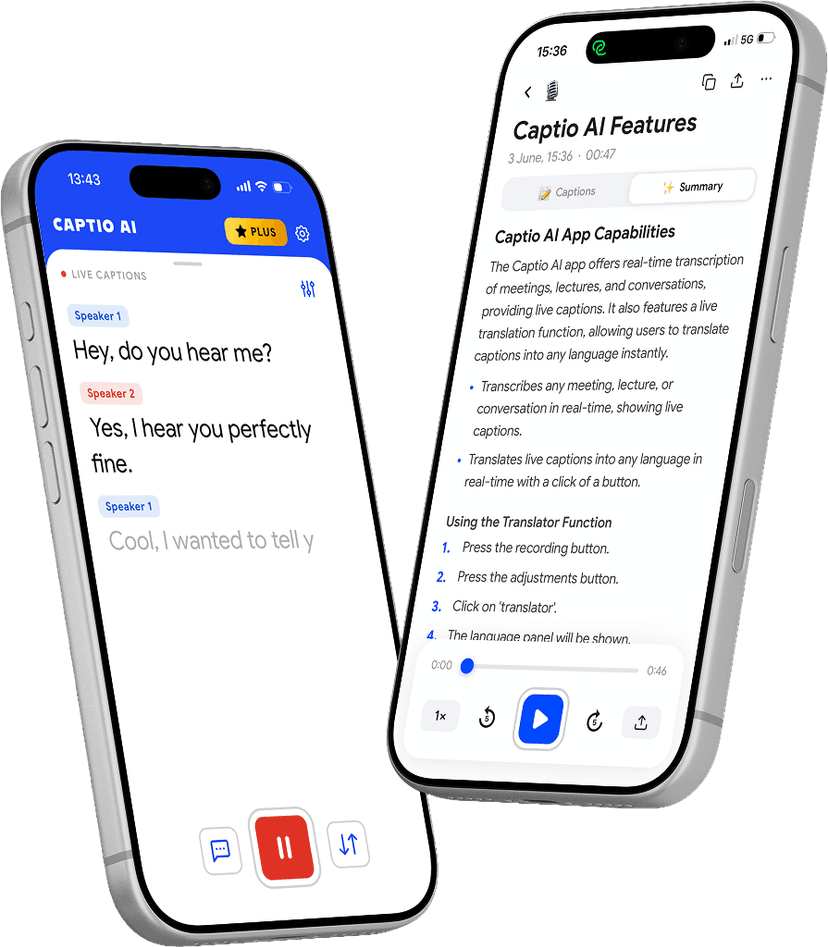
Everything you need to follow Afrikaans job interviews
Four tools built for deaf and hard of hearing Afrikaans speakers.
Read the question before you answer
- Every word appears in real time as the interviewer speaks
- Works in person, on video calls, and on the phone
- Discreet — runs quietly on your phone
- No asking for repeats
For interviews in another language
- Captions and translates in real time
- For international employers or roles abroad
- 60+ languages, no setup
- Follow every question in the language you think in
Review the interview afterwards
- Record and transcribe to revisit questions and your answers
- Useful for preparing for follow-up rounds
- Identify what you want to clarify in a second interview
- Works on any recording
Key topics and questions extracted
- Main themes and questions pulled from any interview transcript
- Useful for post-interview reflection and follow-up
- Organised into sections
- Works on any saved recording
Download for free
Every situation covered
Designed for the real moments that matter — not just quiet controlled environments.
Job interviews in the Cape and inland provinces often mix Afrikaans and English naturally within the same conversation. Captio AI captions both languages in real time so you never lose track mid-switch.
Video interviews over Teams or Zoom are standard at South African companies. Captio AI captions the interviewer's Afrikaans or English in real time over compressed call audio.
Afrikaans phone screens at South African firms often move quickly, with recruiters using casual register. Captio AI captions the call live so you can focus on your answers.
Panel interviews at South African companies sometimes include an Afrikaans-speaking manager and an English-speaking HR representative in the same room. Captio AI covers both in one session without any adjustment.
South African multinational interviews may start in English and shift to Afrikaans when the panel relaxes or when cultural familiarity takes over. Captio AI handles both without switching modes.
Assessment days at large South African employers involve structured group tasks in Afrikaans or English. Captio AI keeps you in the room for every instruction and every question.
Most accurate and fastest models
word accuracy
independent benchmark, 2025
real-time captions
first word appears as you speak
Download for free
Built for the room where a missed word has real consequences
Read the full question before you answer
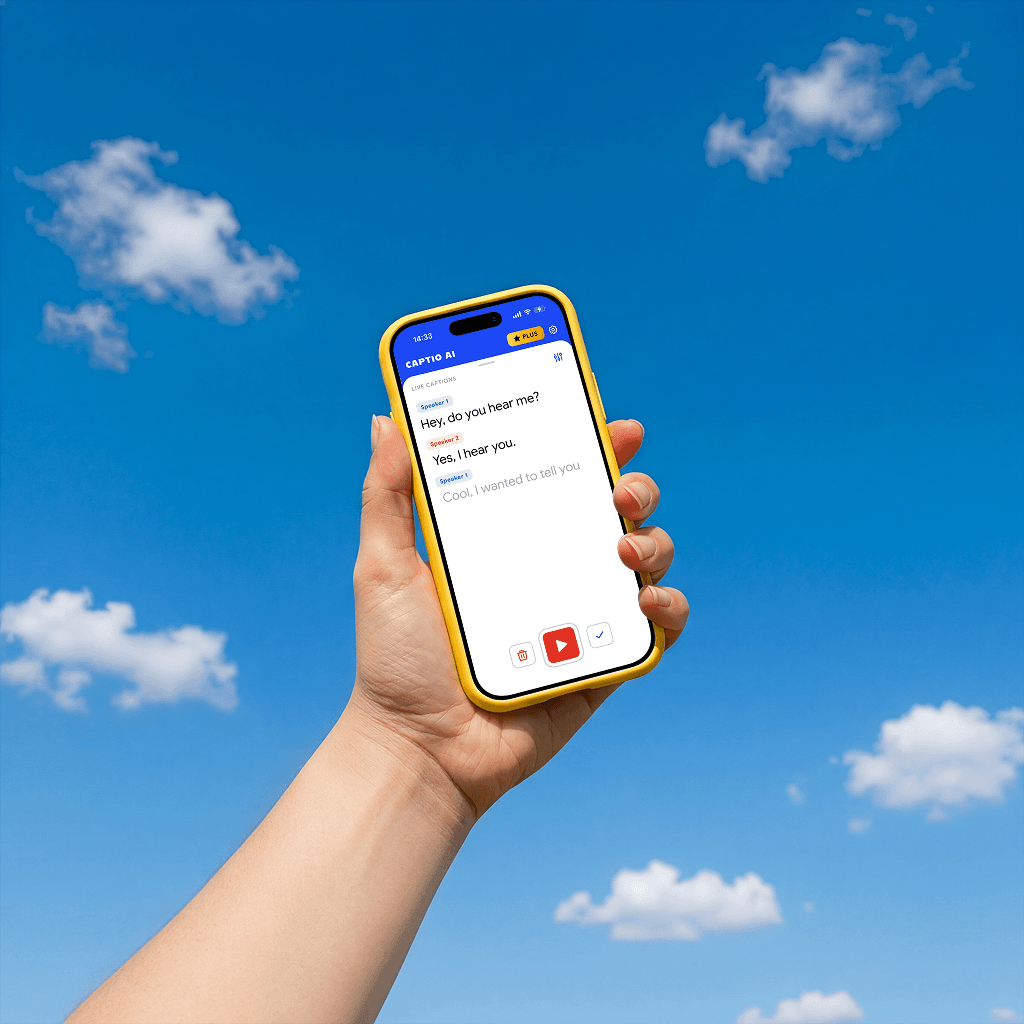
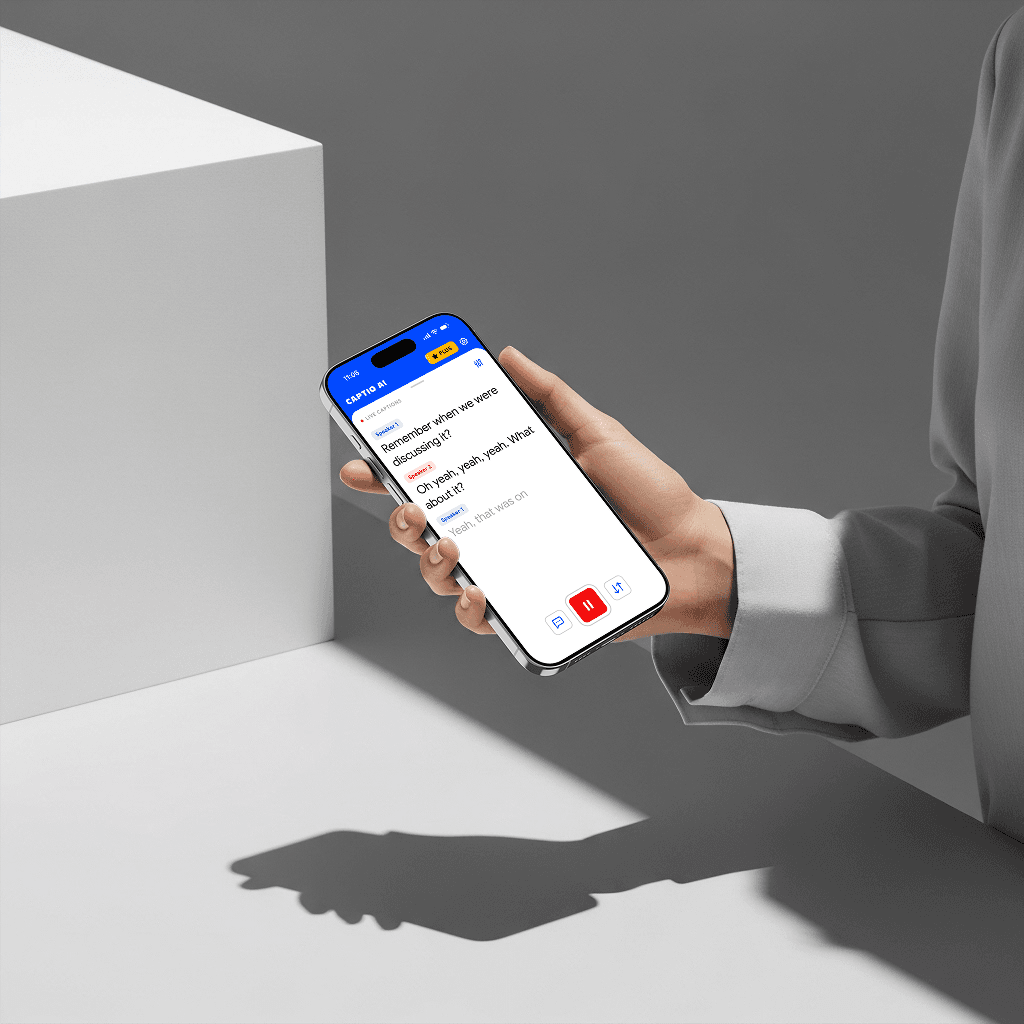
Every word appears on screen as the interviewer speaks. You read the question completely before responding — nothing guessed, nothing reconstructed.
Works in person and on any call format
In-person interviews, video calls, phone screens. Place the phone on the table or point it toward the audio — Captio AI handles every format.
Discreet by design
The app runs quietly on your phone. Place it on the table or hold it naturally. No explanation needed, no drawing attention to the accommodation.
No asking for repeats
Asking an interviewer to repeat a question signals uncertainty. Captio AI means you never need to — you read it in real time and answer with confidence.
Any language
For international roles, multilingual panels, or interviews conducted in a second language. Live Translator captions and translates in real time so language is never the barrier.
Private by default
Interview conversations are sensitive. Captio AI processes audio in real time and discards it immediately — nothing is stored, nothing is shared.
Why Afrikaans is hard to understand
Guttural G
- The most frequent consonant with no face
- Afrikaans 'g' is a uvular or velar fricative produced at the back of the throat with no visible lip or face movement. It is one of the most frequent consonants in Afrikaans and is completely absent from visual speech, leaving a deaf reader filling a gap in almost every word.
Tonogenesis shift
- A live sound change in progress
- Younger Afrikaans speakers, especially in Cape Town, are undergoing an active shift where voicing contrasts in plosives are turning into tonal differences. A deaf reader calibrated on older speech will see lip shapes that no longer map predictably to meaning.
Cape–Standard dialect gap
- Two very different varieties
- Cape Afrikaans, shaped by Malay, Khoisan, and Bantu contact languages, has distinct vowel shifts and vocabulary from inland standard Afrikaans. A candidate calibrated on one variety is partially unprepared for the other in a job interview.
Afrikaans–English switching
- Two languages in one interview
- In Cape Town and Johannesburg offices, Afrikaans speakers switch to English for technical terms, business jargon, and whenever the audience includes non-Afrikaans speakers. Both streams run simultaneously and must both be tracked.
Front-rounded vowels
- Shapes that look like something else
- Afrikaans has front-rounded vowel phonemes — similar to Dutch ui and eu — not present in English. These require specific rounded lip shapes that are easily confused with unrounded front vowels, creating visual minimal pairs that are genuinely ambiguous.
Download for free
Hearing loss and employment in South Africa
The South African National Council for the Deaf estimates that approximately 3.4 million South Africans — around 6% of the population — experience some degree of hearing loss. Employment outcomes for deaf South Africans are severe: estimates place unemployment for deaf people at up to 80%, compared with around 39% for the general population. South Africa's constrained economic growth means that even for hearing candidates, formal employment is difficult to secure; for deaf candidates, barriers are compounded by a lack of workplace accommodation and limited captioning infrastructure outside major urban centres.
The WHO World Report on Hearing (2021) documented that hearing aid penetration in sub-Saharan Africa is below 3% among those who could benefit — the lowest of any global region. A 2025 study in PMC examining the economic costs of congenital hearing loss in a South African cohort traced the downstream consequences: reduced educational attainment, lower workforce participation, and diminished lifetime earnings, concentrated among communities already facing economic exclusion.
South Africa's Employment Equity Act requires designated employers to take affirmative measures for people with disabilities, but compliance is uneven and specific obligations around communication accommodation in recruitment are rarely operationalised. For Afrikaans-speaking deaf and hard of hearing job seekers in Cape Town, Stellenbosch, and Pretoria, the combination of spoken Afrikaans's auditory demands and an under-resourced accommodation system means a standard interview is rarely on equal terms. Captio AI changes that — captions appear the moment the interviewer speaks, in the candidate's home language, without any setup or advance disclosure.
Download for free
What you hear stays with you.
Gone the moment it ends
Captio AI processes your audio in real time and discards it immediately. Nothing is recorded. Nothing is kept.
Not a product
Your conversations are not something Captio AI sells, shares, or monetizes — to anyone, for any reason.
Not used to train anything
What you say in a doctor's appointment or a job interview never ends up in a training dataset. Not ours. Not anyone else's.

Private by default
Captio AI supports 60+ languages
Download for free
Frequently asked questions
Hear every question in Afrikaans.
Captio AI is free to start
Download for free