

Bengali live captions and productivity tool for job interviews
For deaf and hard of hearing people.
Download for free


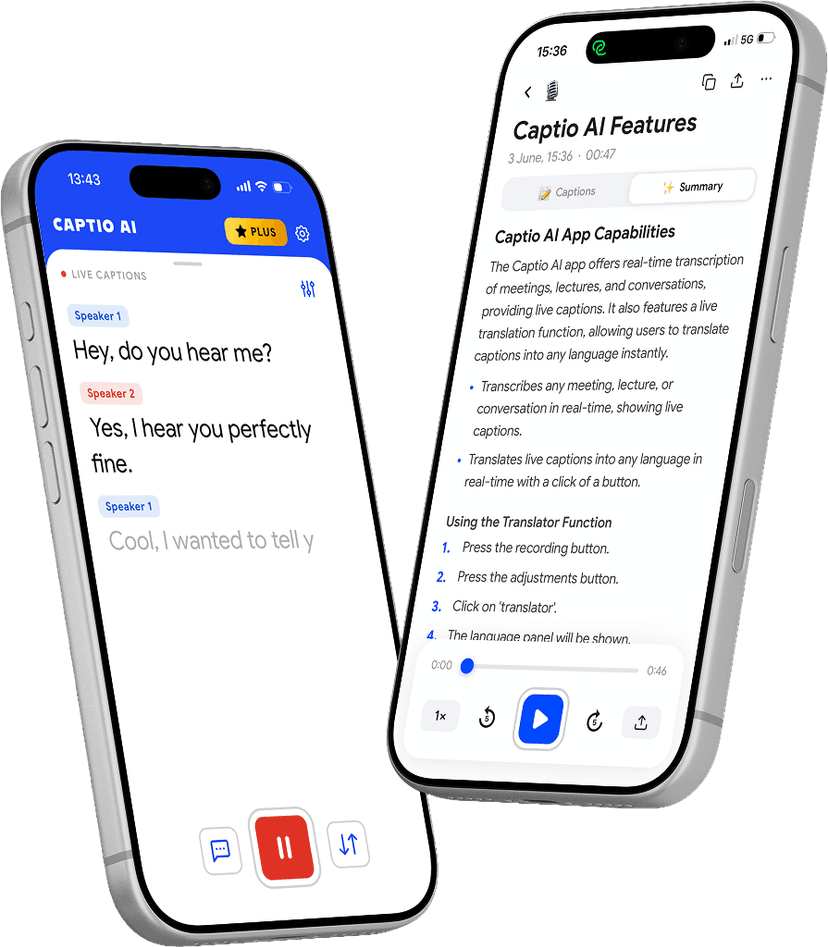
Everything you need to follow Bengali job interviews
Four tools built for deaf and hard of hearing Bengali speakers.
Read the question before you answer
- Every word appears in real time as the interviewer speaks
- Works in person, on video calls, and on the phone
- Discreet — runs quietly on your phone
- No asking for repeats
For interviews in another language
- Captions and translates in real time
- For international employers or roles abroad
- 60+ languages, no setup
- Follow every question in the language you think in
Review the interview afterwards
- Record and transcribe to revisit questions and your answers
- Useful for preparing for follow-up rounds
- Identify what you want to clarify in a second interview
- Works on any recording
Key topics and questions extracted
- Main themes and questions pulled from any interview transcript
- Useful for post-interview reflection and follow-up
- Organised into sections
- Works on any saved recording
Download for free
Every situation covered
Designed for the real moments that matter — not just quiet controlled environments.
In a Dhaka or Kolkata office — an interviewer speaking formal Bengali at professional pace. Captio AI captions every question in real time so you read the full sentence before responding.
Google Meet or Zoom in Bengali corporate environments — at Dhaka-based garment companies, NGOs, banking firms, or IT companies. Follow every question in real time without asking for repeats.
Initial HR screening calls in Bengali — fast formal speech over a mobile line. Captio AI captions the recruiter's voice in real time so compressed audio does not become the barrier to the next round.
Panel interviews at large Bangladeshi or West Bengali employers. Captio AI follows each panelist's question even when they switch between Bengali and English mid-conversation.
For roles at international NGOs or multinational companies in Bangladesh where interviews may mix Bengali and English. Live Translator handles both in the same session without manual switching.
Group discussion rounds at competitive Bangladeshi and Indian employers — common in banking, civil service, and management graduate hiring. Captio AI covers facilitator instructions and participant contributions in real time.
Most accurate and fastest models
word accuracy
independent benchmark, 2025
real-time captions
first word appears as you speak
Download for free
Built for the room where a missed word has real consequences
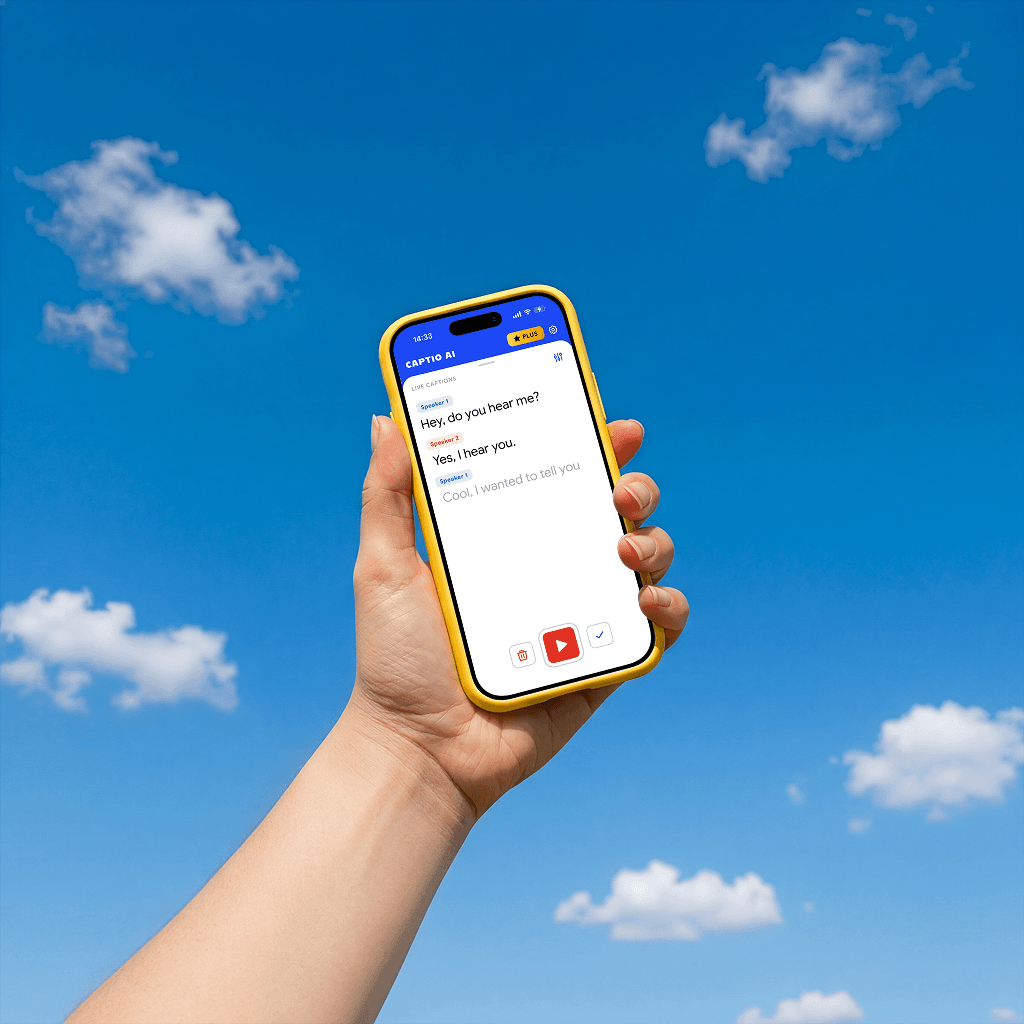
Read the full question before you answer
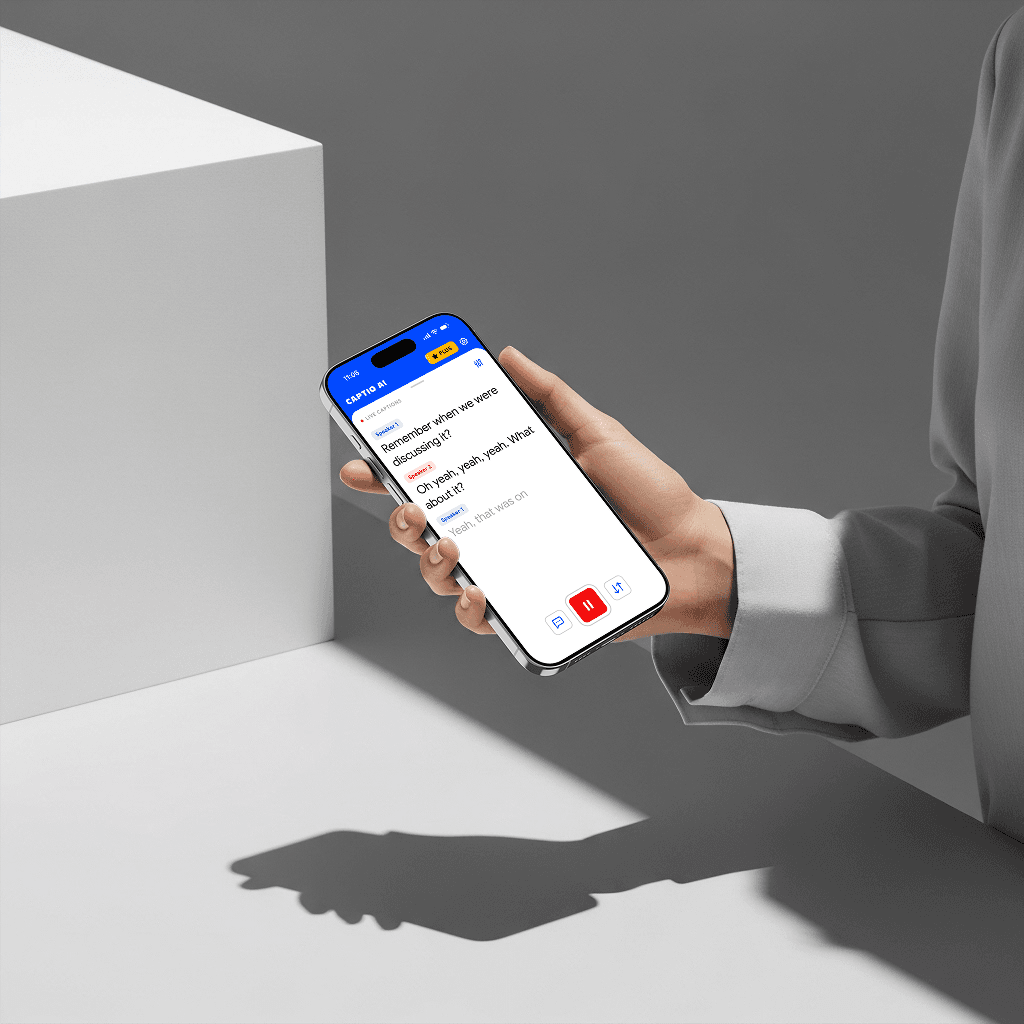
Every word appears on screen as the interviewer speaks. You read the question completely before responding — nothing guessed, nothing reconstructed.
Works in person and on any call format
In-person interviews, video calls, phone screens. Place the phone on the table or point it toward the audio — Captio AI handles every format.
Discreet by design
The app runs quietly on your phone. Place it on the table or hold it naturally. No explanation needed, no drawing attention to the accommodation.
No asking for repeats
Asking an interviewer to repeat a question signals uncertainty. Captio AI means you never need to — you read it in real time and answer with confidence.
Any language
For international roles, multilingual panels, or interviews conducted in a second language. Live Translator captions and translates in real time so language is never the barrier.
Private by default
Interview conversations are sensitive. Captio AI processes audio in real time and discards it immediately — nothing is stored, nothing is shared.
Why Bengali is hard to understand
Retroflex-dental collision
- ট/ঠ/ড/ঢ and ত/থ/দ/ধ are visually identical in interview speech
- Bengali contrasts retroflex consonants (ট, ঠ, ড, ঢ — tongue curled to hard palate) with dental consonants (ত, থ, দ, ধ — tongue at teeth). These two sets sound categorically different but look nearly identical on the lips. In a formal interview question, a deaf candidate watching the interviewer cannot distinguish words that differ only in this contrast.
Nasal vowel gap
- Kolkata and Dhaka nasal vowels diverge silently
- Standard Kolkata Bengali uses nasal vowels that carry meaning — oral and nasal vowels are distinct phonemes. Bangladeshi Standard (Dhaka) Bengali largely lacks this contrast due to Eastern dialect influence. An interviewer from West Bengal and one from Dhaka produce different phonological signals that look identical on the lips, creating comprehension gaps for a deaf candidate from either city watching the other.
Formal register divergence
- Shadhubhasha vocabulary in formal interviews is invisible without context
- Formal written and interview Bengali — Shadhubhasha — uses Sanskritic and Perso-Arabic vocabulary absent from everyday Cholita Bengali speech. Corporate and government interviews in Dhaka and Kolkata draw on this register. For a deaf candidate whose visual vocabulary is built around everyday conversational Bengali, formal interview vocabulary presents an unfamiliar set of lip patterns.
Bengali-English code-switching
- Corporate interviews mix Bengali and English unpredictably
- Bangladeshi and Indian corporate interviews — in banking, NGO, IT, and management roles — routinely switch between Bengali and English mid-sentence. A deaf candidate tracking Bengali may suddenly be watching an English phrase they were not expecting, with no visible signal of the language shift.
Dhaka-Kolkata register gap
- Two standard varieties, two sets of lip patterns
- Bangladeshi Standard Bengali and West Bengali Standard Bengali differ in vocabulary, grammar, and phonology. An interview in Dhaka and an interview in Kolkata are linguistically similar but not identical. Regional consonant assimilation patterns and lexical preferences differ in ways that add up in a fast interview setting.
Download for free
Disability employment in Bangladesh: millions affected, systems barely started
Bangladesh's 2022 Labour Force Survey incorporated disability indicators for the first time — a recognition that systematic data on disabled workers had been absent from the country's employment reporting. The initial findings confirmed what disability advocates had long observed: only one-third of working-age people with disabilities in Bangladesh are employed, with a marked gender disparity favouring men. Late identification of hearing loss — driven by limited neonatal screening outside Dhaka and a shortage of audiologists — means many deaf and hard of hearing children enter school without timely support, leading to educational gaps that compound employment disadvantage before the interview stage is ever reached.
The interview format in Bangladesh — for competitive positions in banking, government service, NGOs, and corporate employers — is formal, fast, and conducted entirely in spoken Bengali or a Bengali-English mix. No legal standard requires employers to provide captioning or sign language interpretation at the interview stage. Disclosing a hearing disability before an interview can introduce bias at the shortlisting stage. Not disclosing and struggling in the room produces a different, equally damaging outcome. The systems that should bridge this gap — subsidised interpreter services, employer accommodation mandates — are nascent or absent.
In West Bengal, India's Bengali-speaking state, the picture is shaped by India's RPWD Act 2016, which mandates reasonable accommodations in employment. But as with national policy, implementation in practice is inconsistent — particularly for private-sector interviews, where legal requirements are rarely enforced and awareness among hiring managers is low. Across both Bangladesh and West Bengal, the structural reality is the same: a deaf or hard of hearing Bengali-speaking candidate enters a job interview in a system that was designed without them in mind. Captio AI requires no employer arrangement — open the app, place the phone on the desk, and read every Bengali question as it is asked.
Download for free
What you hear stays with you.
Gone the moment it ends
Captio AI processes your audio in real time and discards it immediately. Nothing is recorded. Nothing is kept.
Not a product
Your conversations are not something Captio AI sells, shares, or monetizes — to anyone, for any reason.
Not used to train anything
What you say in a doctor's appointment or a job interview never ends up in a training dataset. Not ours. Not anyone else's.

Private by default
Captio AI supports 60+ languages
Download for free
Frequently asked questions
Hear every question in Bengali.
Captio AI is free to start
Download for free