

Welsh live captions and productivity tool for doctor appointments
For deaf and hard of hearing people.
Download for free
Everything you need to follow Welsh doctor appointments
Four tools built for deaf and hard of hearing Welsh speakers.
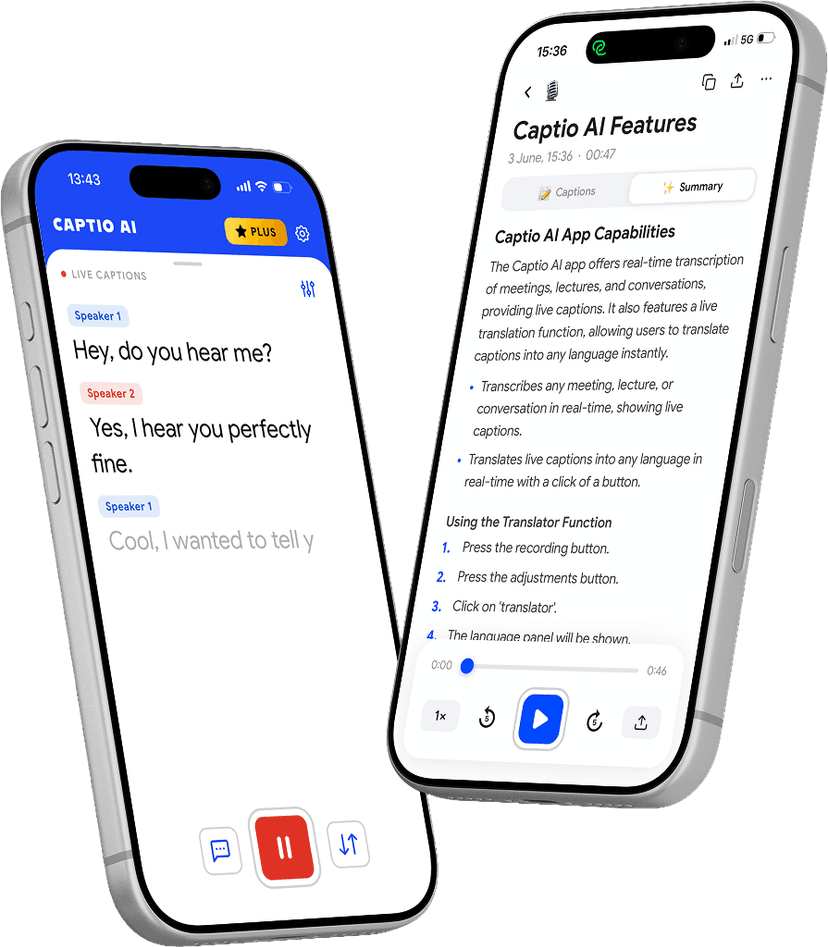
Follow what the doctor says in real time
- Captions appear word by word as they speak
- Handles medical terminology, drug names, and clinical language
- Place the phone on the desk — no setup needed
- Works in any consultation room, clinic, or hospital setting
When the doctor speaks another language
- Captions and translates in real time
- Follow your diagnosis in the language you understand best
- 60+ languages, no manual switching
- For foreign specialists, travel, or immigration settings
A full record of the consultation
- Record the appointment and upload it for a complete transcript
- Review instructions, drug names, and follow-up steps at home
- Share with a family member or carer if needed
- Works on any consultation recording
Key instructions extracted automatically
- Diagnosis, medication, and follow-up steps pulled from any transcript
- Organised into clear sections
- Nothing important missed or forgotten
- Works on any saved appointment recording
Download for free
Every situation covered
Designed for the real moments that matter — not just quiet controlled environments.
At a meddygfa (GP surgery) in Bangor, Swansea, or a smaller tref, your meddyg explains symptoms and treatment in Welsh. Captio AI captions every word so you follow the full consultation.
At a specialist appointment at Ysbyty Gwynedd or the University Hospital of Wales, medical terminology arrives in Welsh or English. Captio AI captions both in real time so you follow every detail.
At the fferyllfa (pharmacy), the fferyllydd explains dosage and drug interactions in Welsh or English. Point your phone toward them and read the instructions as they speak.
At the deintydd (dental clinic), the dentist gives instructions during treatment when lip-reading is impossible. Captio AI captions from audio alone.
In a session with a seicolegydd or seiciatrydd, sensitive conversations require full comprehension. Captio AI captions the full session so you engage without gaps.
At the uned frys (emergency unit), staff speak quickly under pressure. Open Captio AI and read their instructions in real time.
Most accurate and fastest models
word accuracy
independent benchmark, 2025
real-time captions
first word appears as you speak
Download for free
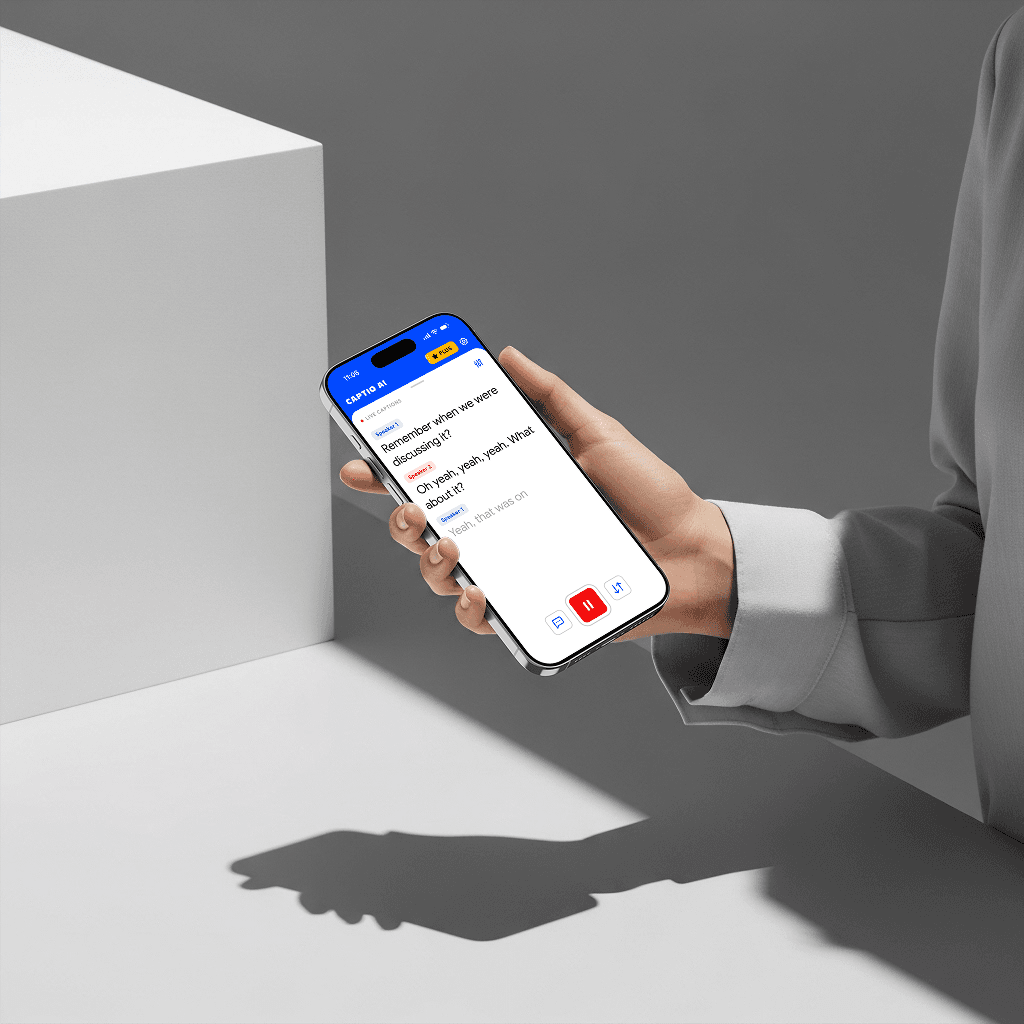
Built for the conversations where every word matters
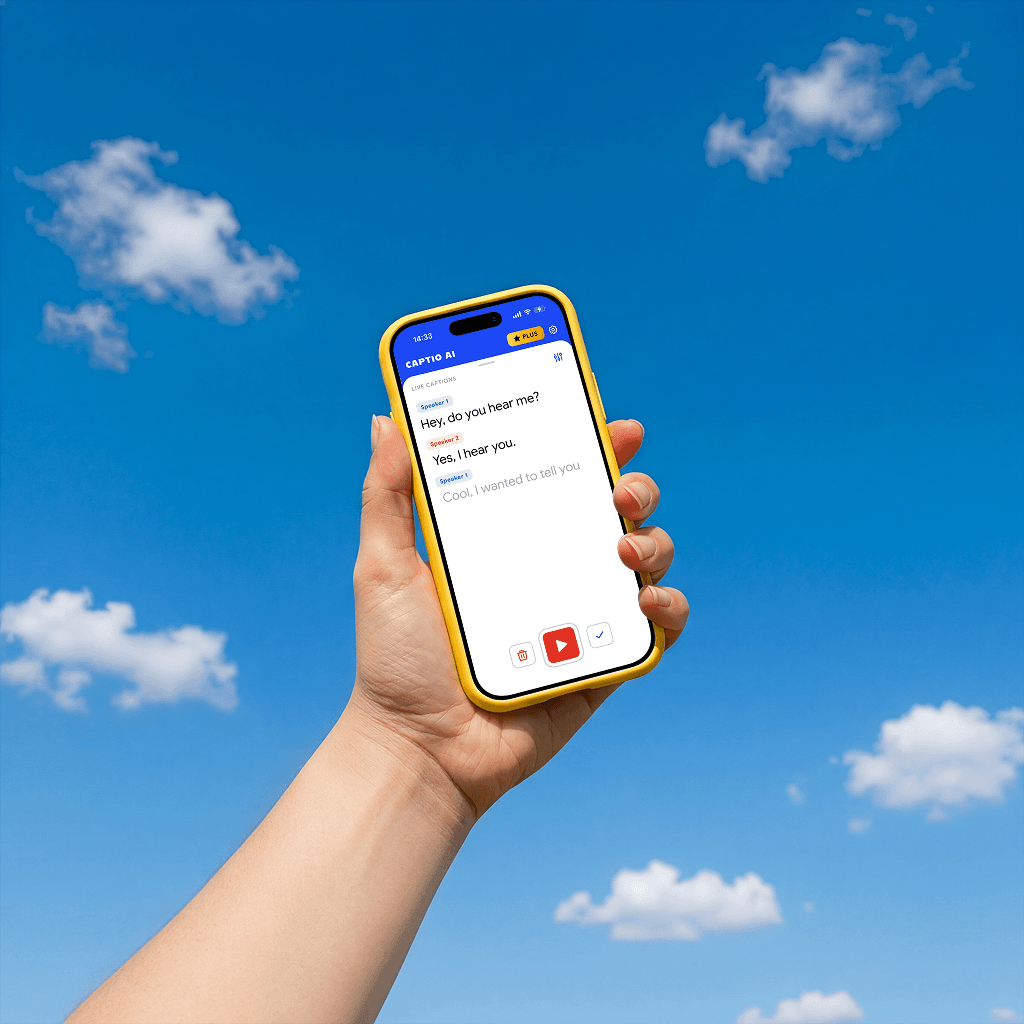
Captions as the doctor speaks
Words appear on screen while the doctor is still talking. You read the diagnosis, drug name, or follow-up instruction at the same moment it is said — not after they have moved on.
Medical terminology handled accurately
Drug names, procedure names, clinical terms. Captio AI handles the vocabulary of a real consultation — not just everyday speech.
Review the appointment after
Record the consultation and upload it to Audio Transcription. Get a full written record of everything said — instructions, dosages, referrals — to review at home and share with a carer if needed.
Works in any clinical setting
Consultation rooms, hospital wards, A&E, dental chairs, pharmacy counters. Place the phone near the speaker and Captio AI captions whoever is talking.
Any language
For foreign-language doctors, specialists abroad, or appointments through an interpreter. Live Translator captions and translates in real time so you follow your diagnosis in the language you understand best.
100% private
Medical conversations are among the most sensitive there are. Captio AI processes audio in real time and discards it immediately. Nothing is recorded, stored, or shared.
Why Welsh is hard to understand
Consonant mutations
- Welsh consonant mutations change the start of words based on grammar — unpredictably for lip-readers
- Welsh has three types of consonant mutation — soft, nasal, and aspirate — that change the initial consonant of words based on grammatical context. 'Pen' (head) becomes 'Ben', 'Mhen', or 'Phen' depending on what precedes it. In clinical speech, a doctor uses mutated forms throughout every sentence. A deaf or hard of hearing patient who learned to lip-read the base form of a medical term will encounter mutated initial consonants that produce different lip shapes at word onsets — an unpredictable visual sequence with no English or Latinate parallel.
Unique consonants LL and CH
- Welsh LL and CH have no equivalent in English and are ambiguous on the lips
- Welsh has two distinctive consonants absent from English: the voiceless lateral fricative /ɬ/ (written 'll', as in 'llygad' — eye) and the velar fricative /x/ (written 'ch', as in 'cloch'). The 'll' produces a distinctive but visually ambiguous lateral tongue placement, and 'ch' is produced at the back of the mouth with no distinctive lip movement. Both sounds appear in Welsh medical vocabulary and anatomical terms. A deaf patient lip-reading Welsh encounters sounds that produce no reliable visual cue.
North–South Welsh dialect gap
- North and South Welsh differ markedly in vocabulary and pronunciation
- Welsh dialects divide broadly between North Welsh (spoken in Gwynedd, Anglesey, Conwy) and South Welsh (spoken in the South Wales valleys, Cardiff, Swansea). These varieties differ in vocabulary — 'llaeth' (milk) in the North vs 'llefrith' in the South — and in pronunciation of vowels and some consonants. A deaf patient trained to lip-read North Welsh finds South Welsh clinical staff producing different lip shapes for clinical vocabulary, and vice versa.
Welsh–English code-switching
- Welsh clinical speech switches continuously between Welsh and English
- In Welsh-medium healthcare settings, code-switching between Welsh and English is extremely common — even among fluent Welsh speakers. Medical terminology often appears in English (or Latin-origin forms) while explanations are given in Welsh. A deaf patient lip-reading Welsh must track two phonological systems within the same sentence, with no visual marker signalling which language is active.
Voiceless sonorants
- Welsh RH and NG produce sounds with no close lip-reading equivalents
- Welsh has voiceless versions of normally voiced sonorants — the voiceless /r̥/ (rh, as in 'rhedeg') and the nasal /ŋ/ (ng). These sounds are unique to Welsh among British languages and produce articulation patterns a deaf patient trained in English or any other language will not have reference shapes for. In Welsh anatomical and clinical vocabulary, these sounds appear in words with no visual equivalent in any related language.
Download for free
Hearing loss in Wales: 610,000 people, twice the mental health risk, and a BSL bill still being fought for
Wales has approximately 610,000 people with hearing loss, deafness, or tinnitus. Of these, an estimated 4,000 to 7,300 use British Sign Language (BSL) as their first or preferred language. Research from Bangor University's Deaf Health and Well-Being Wales programme has documented that deaf people in Wales are twice as likely to experience mental health problems as the general population — a statistic that reflects the cumulative toll of communication exclusion, social isolation, and inconsistent healthcare access. The NHS and public health system in Wales has acknowledged health inequalities in the deaf community, but the report from The Hearing Review found that the Welsh deaf community faces inconsistent interpretation services, poor communications that can lead to misdiagnosis, and a lack of health information available in BSL.
In January 2025, the Institute of Welsh Affairs published a detailed analysis arguing why a BSL (Wales) Bill is needed — making the case that Wales needs its own dedicated legislation separate from the UK-wide BSL Act 2022, specifically to address the healthcare, education, and public service access gaps that the community continues to face. The fact that a dedicated Welsh BSL Bill is being argued for in 2025 — three years after national BSL recognition — illustrates the gap between legal recognition and practical clinical access. Welsh-language deaf people face a double specificity: navigating healthcare in Welsh, a language with consonant mutations, unique phonemes, and dialectal variation, while doing so without guaranteed BSL interpretation.
For deaf and hard of hearing Welsh speakers who rely on lip-reading and assistive technology, Welsh presents more visual lip-reading challenges per sentence than almost any other European language — with three mutation types, unique consonants, and continuous code-switching into English. A deaf Welsh speaker attending a Welsh-medium meddygfa without an interpreter and without technology must lip-read across this phonological landscape with little institutional support. Captio AI captions Welsh and English in real time at any meddygfa or ysbyty in Wales, so every patient follows their doctor's words completely.
Download for free
What you hear stays with you.
Gone the moment it ends
Captio AI processes your audio in real time and discards it immediately. Nothing is recorded. Nothing is kept.
Not a product
Your conversations are not something Captio AI sells, shares, or monetizes — to anyone, for any reason.
Not used to train anything
What you say in a doctor's appointment or a job interview never ends up in a training dataset. Not ours. Not anyone else's.
Private by default
Captio AI supports 60+ languages
Download for free
Frequently asked questions
Understand your diagnosis in Welsh.
Captio AI is free to start
Download for free