

Arabic live captions and productivity tool for doctor appointments
For deaf and hard of hearing people.
Download for free


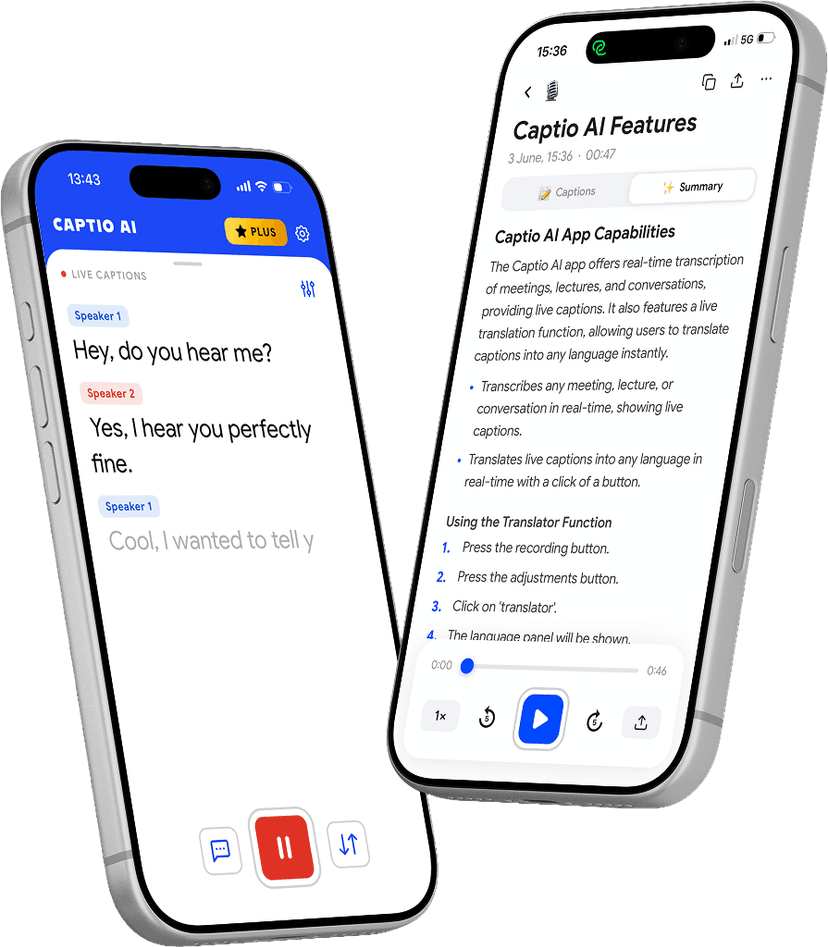
Everything you need to follow Arabic doctor appointments
Four tools built for deaf and hard of hearing Arabic speakers.
Follow what the doctor says in real time
- Captions appear word by word as they speak
- Handles medical terminology, drug names, and clinical language
- Place the phone on the desk — no setup needed
- Works in any consultation room, clinic, or hospital setting
When the doctor speaks another language
- Captions and translates in real time
- Follow your diagnosis in the language you understand best
- 60+ languages, no manual switching
- For foreign specialists, travel, or immigration settings
A full record of the consultation
- Record the appointment and upload it for a complete transcript
- Review instructions, drug names, and follow-up steps at home
- Share with a family member or carer if needed
- Works on any consultation recording
Key instructions extracted automatically
- Diagnosis, medication, and follow-up steps pulled from any transcript
- Organised into clear sections
- Nothing important missed or forgotten
- Works on any saved appointment recording
Download for free
Every situation covered
Designed for the real moments that matter — not just quiet controlled environments.
Primary care and polyclinic visits across Arabic-speaking countries, where the doctor covers the complaint, diagnosis, and prescription in a brief consultation. Captio AI captions everything in real time.
Specialist consultations in Arabic — cardiologist, neurologist, endocrinologist — where the doctor may mix MSA, dialect, and English. Captio AI captions every switch.
Pharmacy conversations at the صيدلية counter where the pharmacist explains dosage and side effects in Arabic. Captio AI captions the instructions so nothing is missed.
Dental visits where the dentist explains treatment in Arabic while working, then names the procedure in clinical vocabulary. Captio AI captures the full explanation when they step back to speak.
Mental health consultations at clinics in major Arab cities, where accurate understanding of the session is clinically essential. Captio AI captions the clinician in real time.
Emergency room visits at government hospitals in Arabic-speaking countries where triage staff speak quickly. Captio AI captions the key clinical instructions in real time.
Most accurate and fastest models
word accuracy
independent benchmark, 2025
real-time captions
first word appears as you speak
Download for free
Built for the conversations where every word matters
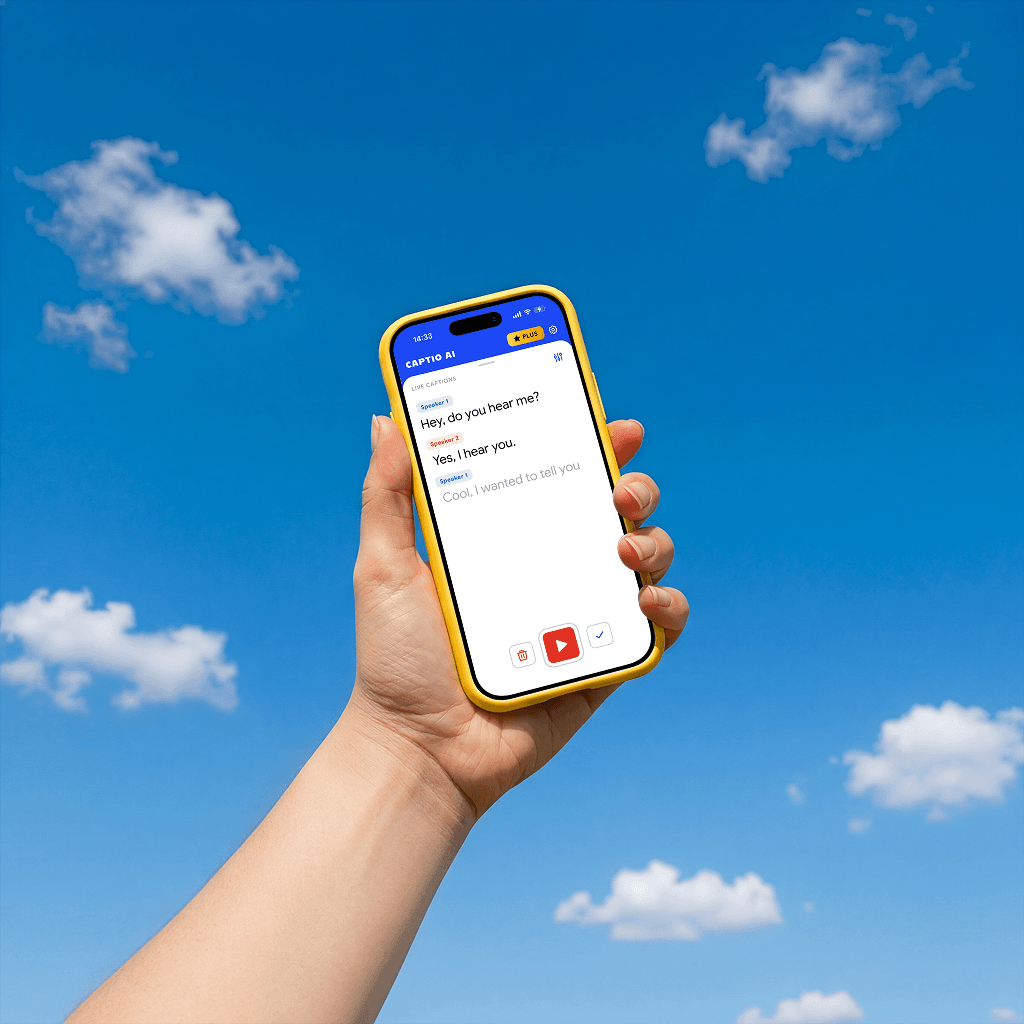
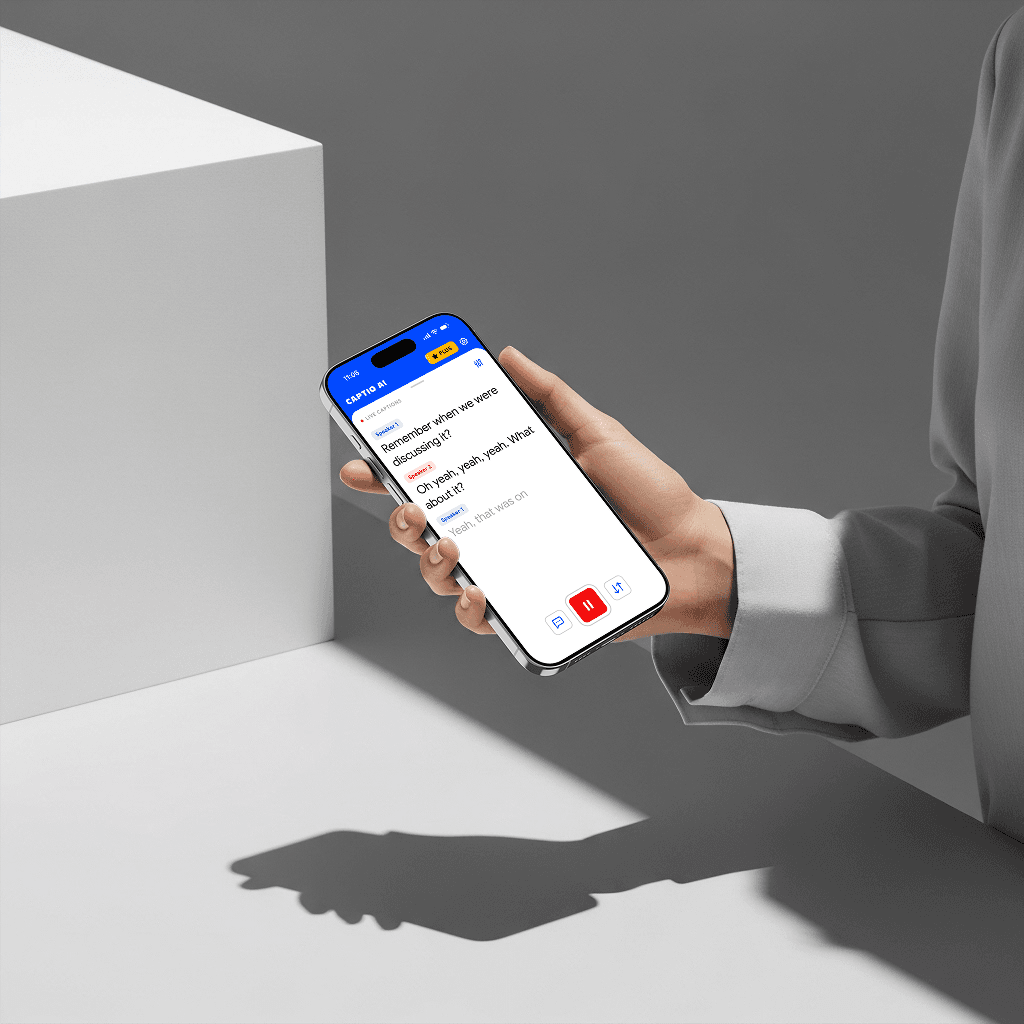
Captions as the doctor speaks
Words appear on screen while the doctor is still talking. You read the diagnosis, drug name, or follow-up instruction at the same moment it is said — not after they have moved on.
Medical terminology handled accurately
Drug names, procedure names, clinical terms. Captio AI handles the vocabulary of a real consultation — not just everyday speech.
Review the appointment after
Record the consultation and upload it to Audio Transcription. Get a full written record of everything said — instructions, dosages, referrals — to review at home and share with a carer if needed.
Works in any clinical setting
Consultation rooms, hospital wards, A&E, dental chairs, pharmacy counters. Place the phone near the speaker and Captio AI captions whoever is talking.
Any language
For foreign-language doctors, specialists abroad, or appointments through an interpreter. Live Translator captions and translates in real time so you follow your diagnosis in the language you understand best.
100% private
Medical conversations are among the most sensitive there are. Captio AI processes audio in real time and discards it immediately. Nothing is recorded, stored, or shared.
Why Arabic is hard to understand
Diglossia at the diagnosis
- Arabic doctors switch from dialect to Modern Standard Arabic for the clinical terms
- Arabic is diglossic: everyday speech uses regional dialects (Egyptian, Gulf, Levantine, Maghrebi), while formal clinical register uses Modern Standard Arabic (MSA). In a consultation, a doctor might explain the complaint in Egyptian dialect, deliver the diagnosis in MSA, and name the drug in English — three phonological registers in one appointment. A deaf patient calibrated to one variety loses the thread when another appears, and the most specific clinical content typically arrives in the register least familiar to the patient.
Guttural sounds invisible on the lips
- Arabic pharyngeal and uvular consonants are produced in the throat — nothing shows on the lips
- Arabic's pharyngeal (ح, ع) and uvular (خ, غ) consonants are produced in the throat and produce no visible lip movement. Medical vocabulary built on these roots — خطير (serious), عملية (operation), حساسية (allergy), عدوى (infection) — is virtually impossible to distinguish by lip-reading. In a clinical setting where these words carry the specific risk or treatment information, their visual invisibility is most consequential.
Cross-dialect medical vocabulary
- The same symptom is called by different words across Arabic-speaking countries
- Medical vocabulary is not standardized across the Arab world. The same body part, symptom, or condition may be called by entirely different words in Moroccan darija versus Gulf Arabic versus Levantine Arabic — and formal MSA may be a third option the patient has rarely encountered. A deaf patient from one Arabic-speaking country navigating healthcare in another faces a vocabulary gap on top of a phonological one.
Fast urban clinic pace
- Hospital consultations in Cairo, Riyadh, and Dubai move at a pace that leaves no room for repetition
- Large government hospitals in Cairo, Riyadh, Amman, and Dubai operate under enormous patient load. Consultations are brief and the delivery is fast. A deaf patient who asks for repetition disrupts a queue and draws attention. In Gulf hospitals serving large expatriate populations, English–Arabic code-switching adds another layer on top of an already complex linguistic environment.
English in Arabic prescriptions
- Drug names and test results across the Arab world arrive in English
- Across Arabic-speaking countries, pharmaceutical brand names and medical test names are routinely given in English — pronounced with Arabic phonology. A deaf patient tracking Arabic loses the thread when the specific drug or investigation arrives in English. This switching carries the most specific clinical content of the appointment.
Download for free
Healthcare workers across the Arab world don't know how to communicate with deaf patients.
A study published in Cureus (2023) assessed the knowledge, attitudes, and practices of healthcare workers toward deaf patients at a major Saudi Arabian medical institution. The results were stark: 88.6% of healthcare workers had poor knowledge about deaf patients, and none of the healthcare workers surveyed could correctly answer basic questions about the causes of deafness or the prevalence of deaf patients in the facility. The study found that most believed lip-reading and written notes were adequate for deaf patients, despite evidence that lip-reading recovers only around 30% of speech content under ideal conditions.
Across the 22 Arab countries, the prevalence of hereditary hearing loss ranges from 1.20 to 18 per 1,000 births per year, with particularly high rates in countries where consanguineous marriage is common, according to a systematic review in Otology & Neurotology (2020). In Saudi Arabia, approximately 1.4% of the population has hearing impairment in national survey data — but this almost certainly undercounts the true burden, as many individuals in rural areas lack access to audiological assessment. Sign language across the Arab world is not standardized: different countries use different sign systems, and there is no shared Arabic Sign Language a deaf patient can assume an interpreter will know across borders.
The practical consequence of these structural gaps is that deaf Arabic-speaking patients across the region attend medical appointments without language support, rely on hearing family members to interpret, or simply avoid appointments they cannot follow. In Gulf hospitals serving international patients, a deaf Arabic speaker navigating an English-medium hospital encounters the convergence of multiple inaccessibility layers. Captio AI captions Arabic speech in real time — across dialects, MSA formal register, and English code-switching — so the diagnosis, drug name, and follow-up instruction are readable the moment they are spoken.
Download for free
What you hear stays with you.
Gone the moment it ends
Captio AI processes your audio in real time and discards it immediately. Nothing is recorded. Nothing is kept.
Not a product
Your conversations are not something Captio AI sells, shares, or monetizes — to anyone, for any reason.
Not used to train anything
What you say in a doctor's appointment or a job interview never ends up in a training dataset. Not ours. Not anyone else's.

Private by default
Captio AI supports 60+ languages
Download for free
Frequently asked questions
Understand your diagnosis in Arabic.
Captio AI is free to start
Download for free