

Latvian live captions and productivity tool for doctor appointments
For deaf and hard of hearing people.
Download for free


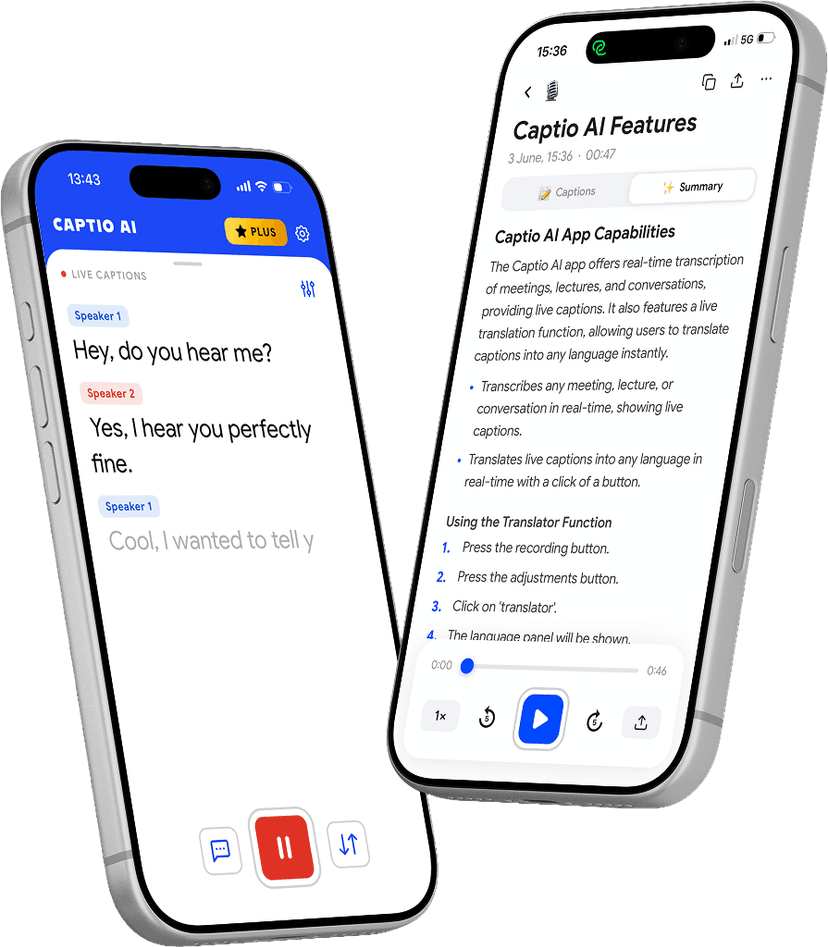
Everything you need to follow Latvian doctor appointments
Four tools built for deaf and hard of hearing Latvian speakers.
Follow what the doctor says in real time
- Captions appear word by word as they speak
- Handles medical terminology, drug names, and clinical language
- Place the phone on the desk — no setup needed
- Works in any consultation room, clinic, or hospital setting
When the doctor speaks another language
- Captions and translates in real time
- Follow your diagnosis in the language you understand best
- 60+ languages, no manual switching
- For foreign specialists, travel, or immigration settings
A full record of the consultation
- Record the appointment and upload it for a complete transcript
- Review instructions, drug names, and follow-up steps at home
- Share with a family member or carer if needed
- Works on any consultation recording
Key instructions extracted automatically
- Diagnosis, medication, and follow-up steps pulled from any transcript
- Organised into clear sections
- Nothing important missed or forgotten
- Works on any saved appointment recording
Download for free
Every situation covered
Designed for the real moments that matter — not just quiet controlled environments.
At a ģimenes ārsta kabinets (GP surgery) in Riga, Daugavpils, or a smaller pilsēta, your ārsts explains symptoms and treatment in Latvian. Captio AI captions every word so you follow the full consultation.
At a specialist appointment at Paula Stradiņa Klīniskā universitātes slimnīca or a regional slimnīca, medical terminology arrives in Latvian. Captio AI captions in real time so you follow every detail.
At the aptieka (pharmacy), the farmaceits explains dosage and drug interactions quickly. Point your phone toward them and read the instructions as they speak.
At the zobārsts (dental clinic), the dentist gives instructions during treatment when lip-reading is impossible. Captio AI captions from audio alone.
In a session with a psihologs or psihiatrs, sensitive conversations require full comprehension. Captio AI captions the full session so you engage without gaps.
At the neatliekamā palīdzība (emergency department), staff speak quickly under pressure. Open Captio AI and read their instructions in real time.
Most accurate and fastest models
word accuracy
independent benchmark, 2025
real-time captions
first word appears as you speak
Download for free
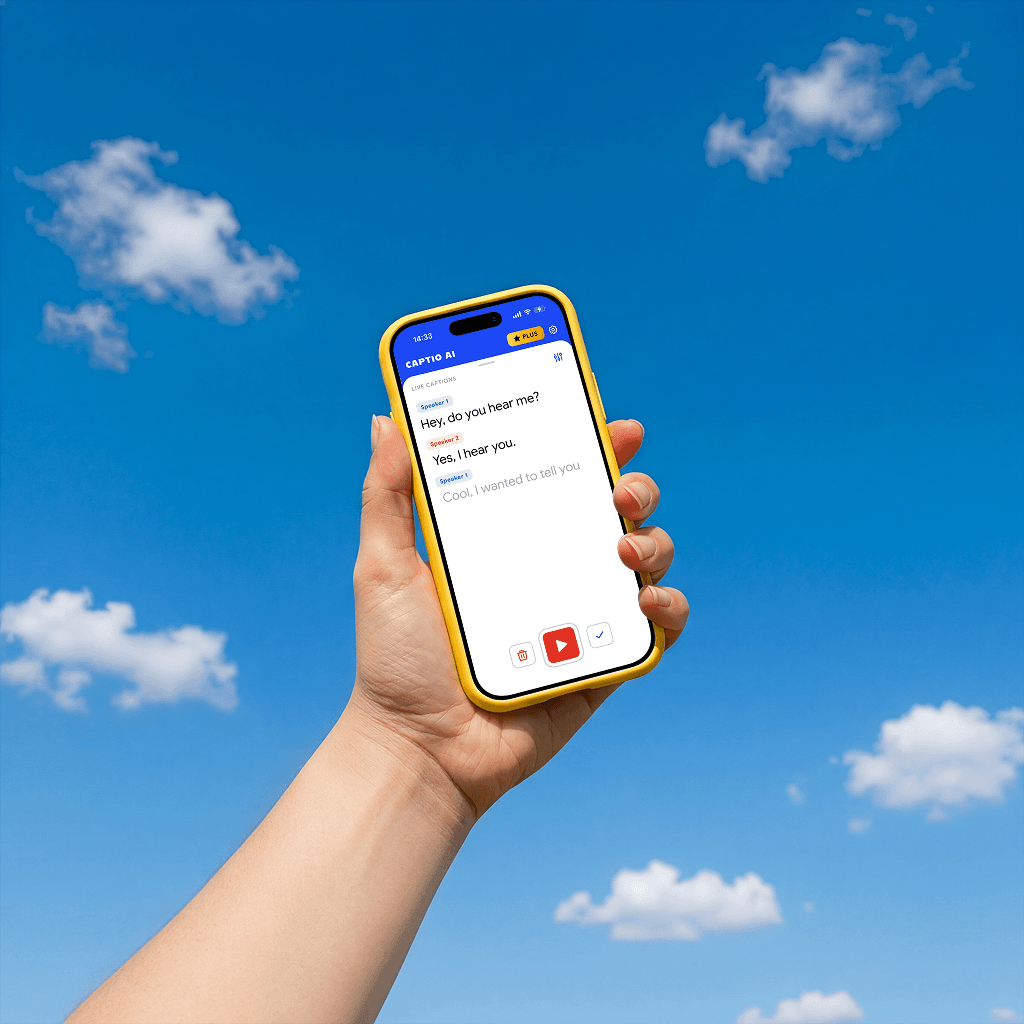
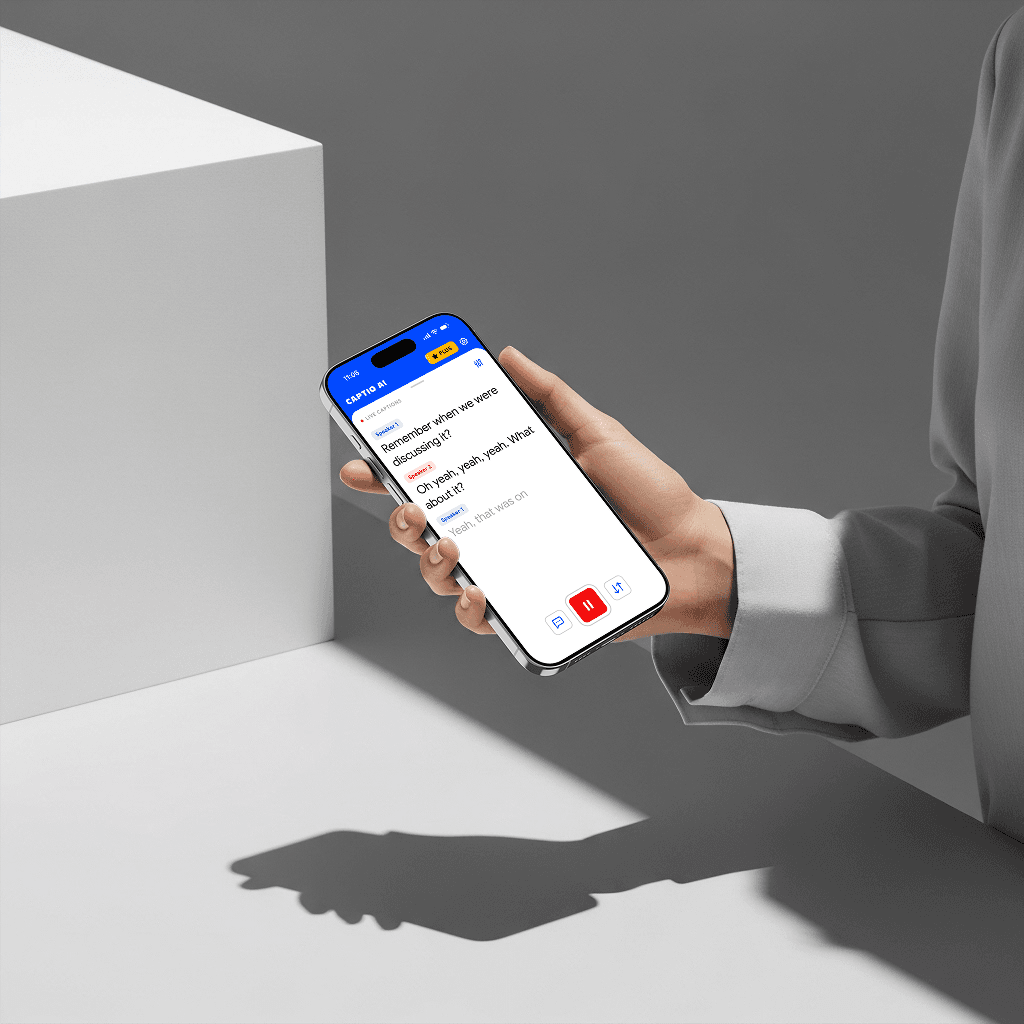
Built for the conversations where every word matters
Captions as the doctor speaks
Words appear on screen while the doctor is still talking. You read the diagnosis, drug name, or follow-up instruction at the same moment it is said — not after they have moved on.
Medical terminology handled accurately
Drug names, procedure names, clinical terms. Captio AI handles the vocabulary of a real consultation — not just everyday speech.
Review the appointment after
Record the consultation and upload it to Audio Transcription. Get a full written record of everything said — instructions, dosages, referrals — to review at home and share with a carer if needed.
Works in any clinical setting
Consultation rooms, hospital wards, A&E, dental chairs, pharmacy counters. Place the phone near the speaker and Captio AI captions whoever is talking.
Any language
For foreign-language doctors, specialists abroad, or appointments through an interpreter. Live Translator captions and translates in real time so you follow your diagnosis in the language you understand best.
100% private
Medical conversations are among the most sensitive there are. Captio AI processes audio in real time and discards it immediately. Nothing is recorded, stored, or shared.
Why Latvian is hard to understand
Three pitch tones
- Latvian has three pitch distinctions — including a broken tone invisible on the lips
- Latvian contrasts three pitch intonations on long syllables: level (stieptā), falling (krītošā), and broken (lauztā). The broken tone — a falling pitch with a glottal constriction partway through — is produced in the larynx and creates no visible lip movement. This three-way pitch distinction is phonemically significant and appears throughout Latvian vocabulary including clinical terms. For a deaf or hard of hearing patient lip-reading a Latvian doctor, all three tones produce identical lip shapes.
Long vowel contrast
- Long and short vowels are phonemically distinct but look identical
- Latvian contrasts short and long versions of each vowel — 'kāja' (leg) vs 'kaja' is the kind of distinction that changes clinical meaning. These length contrasts are auditory and produce no visible difference in lip shape. A deaf patient lip-reading Latvian misses a layer of phonological meaning that runs through the entire lexicon, including in medical vocabulary where short/long contrasts matter.
Latgalian dialect
- Latgalian — Eastern Latvian — has a distinct phonological system from Standard Latvian
- Latgalian, spoken in the Latgale region of eastern Latvia, is sometimes classified as a separate language and differs substantially from Standard Latvian in vowel system, consonant inventory, and vocabulary. Medical staff from Rēzekne, Daugavpils, or the Latgale region may speak with Latgalian-influenced phonology, producing lip shapes for clinical vocabulary that a deaf patient trained in Standard Latvian does not recognise.
Palatal consonants
- Latvian palatal consonants produce sounds invisible at lip-reading distance
- Latvian has a series of palatalised (soft) consonants — ģ, ķ, ļ, ņ — where articulation occurs at the hard palate, producing sounds with no distinctive visible lip movement. These palatal consonants appear throughout Latvian vocabulary including clinical terms. A deaf patient lip-reading Latvian cannot distinguish the palatal versions from their non-palatal counterparts, introducing systematic ambiguity in clinical vocabulary.
Russian heritage in Latvian healthcare
- Russian appears in Latvian clinical settings — especially among older medical staff
- Latvia has a large Russian-speaking minority (approximately 25% of the population), and many older Latvian medical professionals received their training in Russian during the Soviet era. In some clinics — particularly in Riga's mixed-language districts or Daugavpils where Russian is the majority language — medical staff may use Russian for clinical vocabulary while speaking Latvian otherwise. A deaf patient lip-reading Latvian encounters Russian-phonology words without warning.
Download for free
Hearing loss in Latvia: 32,000 at risk, EU-funded projects, and childbirth without communication
Approximately 32,000 people in Latvia are at risk of social exclusion due to deafness or significantly impaired hearing, according to the Latvian Association of the Deaf (LAD). Latvian Sign Language received legal status under the Official Language Law of 1999 (in force from September 2000), which stipulated that the state shall ensure the development and use of Latvian Sign Language for people with impaired hearing. Latvia has been screening newborns for hearing impairment since 2008, and two specialist schools for deaf and hearing-impaired children offer education in signed and oral Latvian respectively — providing a dual-track educational structure that is relatively developed for a country of its size.
Despite this legal and institutional framework, practical access gaps remain. EU Cohesion Fund projects have specifically targeted the healthcare gap for deaf Latvians: one European Commission project funded additional support for deaf and hearing-impaired citizens including improved deaf communication services, while another specifically addressed the situation of deaf and hearing-impaired women during and after childbirth — a setting where communication access is both critical and routinely absent. The specific focus on childbirth in a funded project is revealing: it indicates that Latvia's healthcare system identified the maternity ward as a point where deaf patients were experiencing systematic communication failure serious enough to require dedicated intervention.
For deaf and hard of hearing Latvians in everyday healthcare settings — not maternity wards but regular GP appointments, specialist consultations, and pharmacy visits — the picture is one of incomplete and inconsistent access. Latvian Sign Language interpreter provision for routine medical appointments is limited by the small size of the certified interpreter workforce relative to the 32,000 people at risk. For a deaf person attending a ģimenes ārsta kabinets in a smaller Latvian city, interpreter support is not reliably available. Captio AI captions Latvian in real time at any ārsta kabinets or slimnīca, giving every patient direct access to what their doctor says without depending on an interpreter who may not be there.
Download for free
What you hear stays with you.
Gone the moment it ends
Captio AI processes your audio in real time and discards it immediately. Nothing is recorded. Nothing is kept.
Not a product
Your conversations are not something Captio AI sells, shares, or monetizes — to anyone, for any reason.
Not used to train anything
What you say in a doctor's appointment or a job interview never ends up in a training dataset. Not ours. Not anyone else's.
Private by default
Captio AI supports 60+ languages
Download for free
Frequently asked questions
Understand your diagnosis in Latvian.
Captio AI is free to start
Download for free