

Dutch live captions and productivity tool for doctor appointments
For deaf and hard of hearing people.
Download for free
Everything you need to follow Dutch doctor appointments
Four tools built for deaf and hard of hearing Dutch speakers.
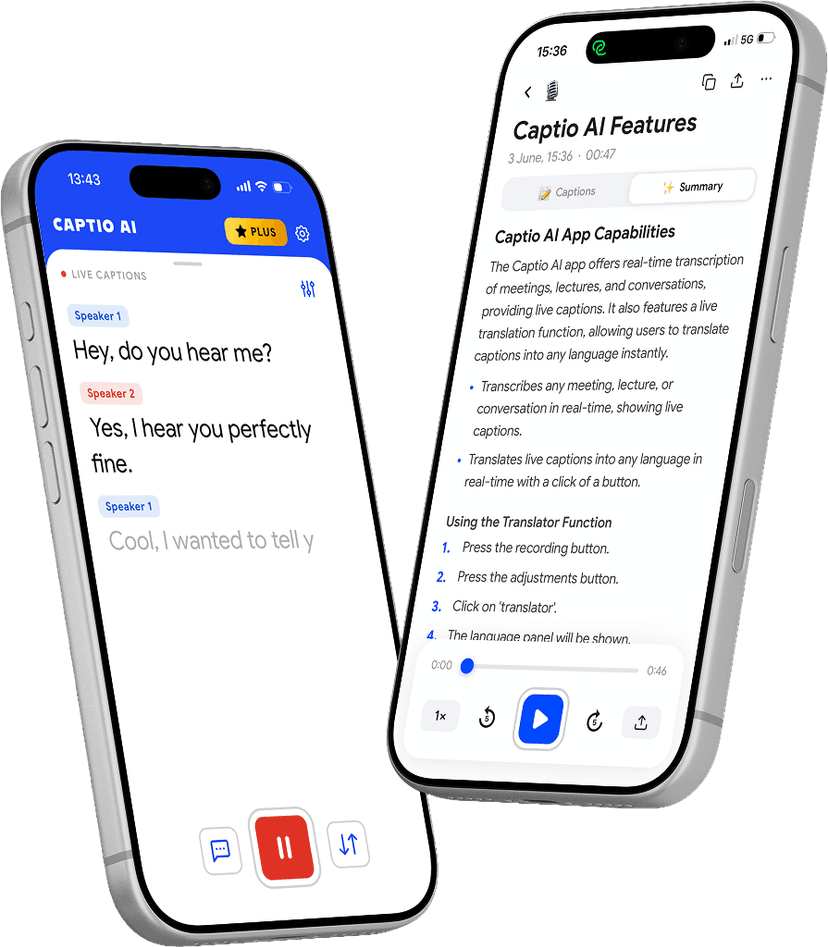
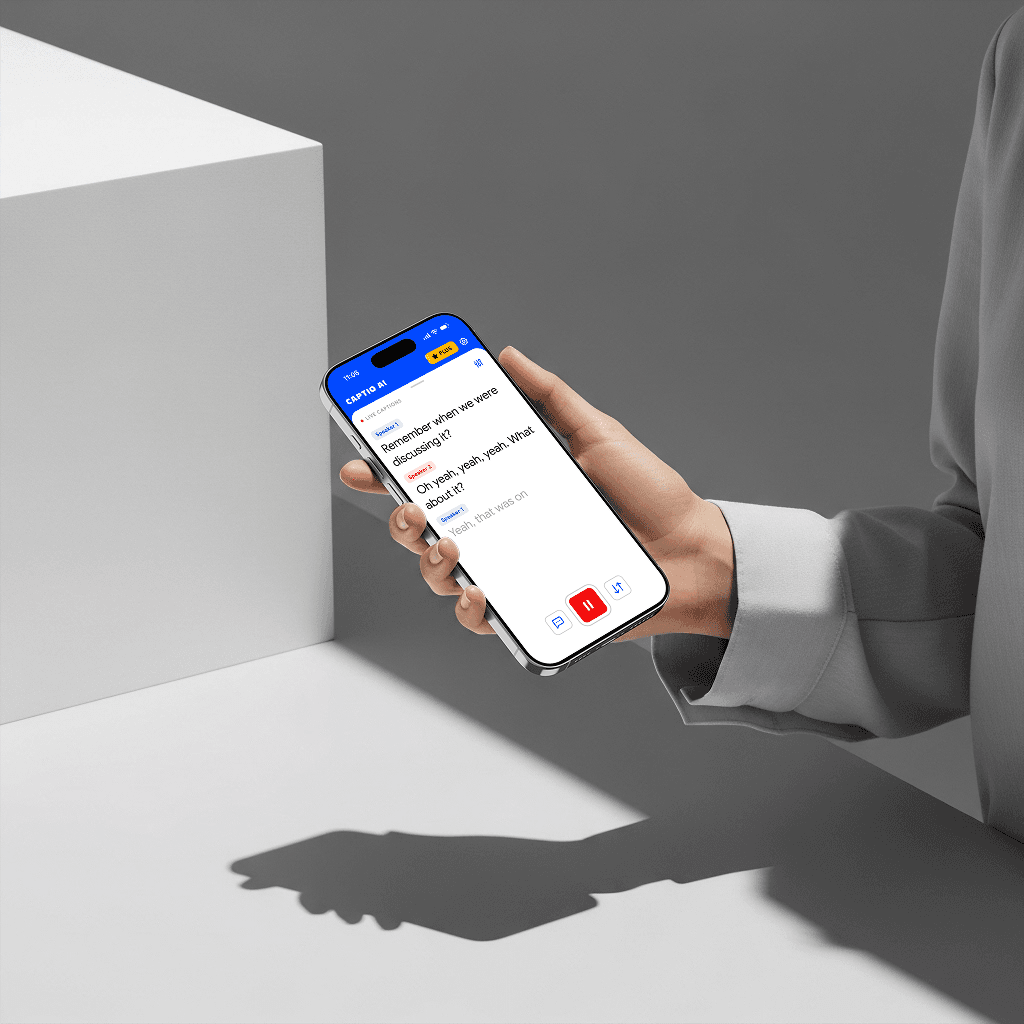
Follow what the doctor says in real time
- Captions appear word by word as they speak
- Handles medical terminology, drug names, and clinical language
- Place the phone on the desk — no setup needed
- Works in any consultation room, clinic, or hospital setting
When the doctor speaks another language
- Captions and translates in real time
- Follow your diagnosis in the language you understand best
- 60+ languages, no manual switching
- For foreign specialists, travel, or immigration settings
A full record of the consultation
- Record the appointment and upload it for a complete transcript
- Review instructions, drug names, and follow-up steps at home
- Share with a family member or carer if needed
- Works on any consultation recording
Key instructions extracted automatically
- Diagnosis, medication, and follow-up steps pulled from any transcript
- Organised into clear sections
- Nothing important missed or forgotten
- Works on any saved appointment recording
Download for free
Every situation covered
Designed for the real moments that matter — not just quiet controlled environments.
At a huisarts (GP) in Amsterdam, Rotterdam, or a smaller town, your doctor explains symptoms and prescriptions in Dutch. Captio AI captions every word in real time so you follow the full consultation.
At a specialist appointment at an academisch ziekenhuis (university hospital) or regional hospital, medical terminology arrives in a mix of Dutch and Latinate clinical vocabulary. Captio AI keeps pace with both.
At the apotheek (pharmacy), the pharmacist explains dosage and drug interactions quickly. Point your phone toward them and read the instructions as they speak.
At a tandarts (dental clinic), the dentist gives instructions during treatment when you cannot see their face. Captio AI captions from audio alone so you follow every direction.
In a mental health session with a psycholoog or psychiater, conversations go deep quickly. Captio AI captions the full session so you engage without missing nuance.
At a spoedeisende hulp (emergency department), staff speak quickly under pressure. Open Captio AI and read their instructions as they arrive.
Most accurate and fastest models
word accuracy
independent benchmark, 2025
real-time captions
first word appears as you speak
Download for free
Built for the conversations where every word matters
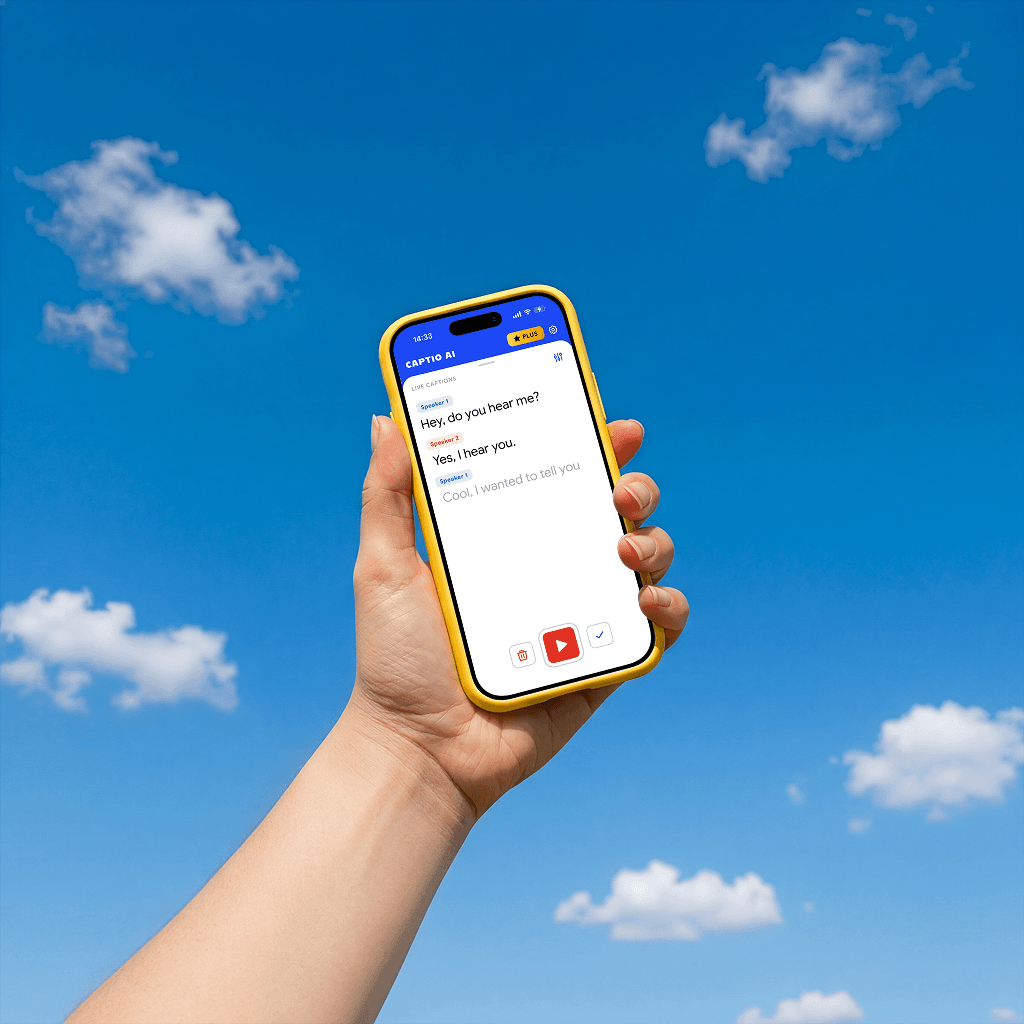
Captions as the doctor speaks
Words appear on screen while the doctor is still talking. You read the diagnosis, drug name, or follow-up instruction at the same moment it is said — not after they have moved on.
Medical terminology handled accurately
Drug names, procedure names, clinical terms. Captio AI handles the vocabulary of a real consultation — not just everyday speech.
Review the appointment after
Record the consultation and upload it to Audio Transcription. Get a full written record of everything said — instructions, dosages, referrals — to review at home and share with a carer if needed.
Works in any clinical setting
Consultation rooms, hospital wards, A&E, dental chairs, pharmacy counters. Place the phone near the speaker and Captio AI captions whoever is talking.
Any language
For foreign-language doctors, specialists abroad, or appointments through an interpreter. Live Translator captions and translates in real time so you follow your diagnosis in the language you understand best.
100% private
Medical conversations are among the most sensitive there are. Captio AI processes audio in real time and discards it immediately. Nothing is recorded, stored, or shared.
Why Dutch is hard to understand
The G problem
- The Dutch G is invisible and varies by region
- Dutch has two distinct realizations of /g/ — the hard northern velar fricative and the soft southern variety — both produced at the back of the throat where lips show nothing. Medical vocabulary is dense with g-initial words (gezondheid, geneesmiddel, gebruik). A deaf patient cannot read the g on anyone's lips regardless of which Dutch region the doctor is from.
Final devoicing
- Word-final consonants are devoiced in fast speech
- Dutch devoices voiced consonants at the end of words — 'hond' is pronounced with a final /t/ sound. In connected speech this interacts with liaison, producing unexpected consonant clusters across word boundaries. A deaf patient lip-reading Dutch encounters a phonological system that regularly says one thing and means another at word boundaries.
Schwa reduction
- Unstressed syllables collapse to schwa and disappear
- In casual clinical speech, Dutch unstressed syllables reduce heavily to schwa (/ə/) or drop entirely. 'Ik heb het al gezegd' becomes a near-continuous stream. Medical instructions already dense with polysyllabic terminology become even harder to segment when every unstressed syllable is swallowed.
Dialectal register gap
- Flemish, Zeelandic, and Limburg speech differ markedly
- Dutch dialects in Belgium (Flemish), Zeeland, and Limburg have distinct vowel realisations and intonation patterns from Standard Dutch. A deaf or hard of hearing patient who learned to lip-read Standard Dutch will find a Belgian Flemish doctor's face producing unfamiliar vowel shapes for the same words.
Medical latinate vocabulary
- Clinical terms layer Latin-origin words onto Dutch phonology
- Dutch clinical communication mixes Germanic Dutch with Latinate medical vocabulary. 'Bloedverdunners' versus 'anticoagulantia' — the same drug named two different ways depending on the doctor's register. A deaf patient must parse which register is active and lip-read across the resulting hybrid phonology.
Download for free
Hearing loss in the Netherlands: recognition and real barriers
Approximately 1.5 million people in the Netherlands live with some degree of hearing loss — roughly one in eleven residents. Around 150,000 people purchase hearing aids every year, and more than a third of the hearing-impaired population use some form of hearing device. Despite this scale, the legal framework protecting deaf people in Dutch society lagged behind many comparable European nations. Nederlandse Gebarentaal (NGT — Dutch Sign Language) was only awarded official legal recognition in October 2020, after decades of lobbying by the deaf community. Before that recognition, Roma, Frisian, and Yiddish had all been legally recognised as minority languages in the Netherlands while NGT had not.
The recognition of NGT in 2020 marked a legal milestone, but formal recognition and practical access are not the same thing. Healthcare settings in the Netherlands still lack consistent, funded interpreter provision for deaf patients. A deaf person attending a huisarts or specialist consultation is not guaranteed access to an NGT interpreter — they may be offered a telephone relay service, a family member's assistance, or simply a slower conversation pace. Research on sign language navigation in the Netherlands has examined how hearing parents of deaf children struggle to access sufficient sign language support, a gap that points to a broader infrastructure deficit in interpreter provision across the country.
In a Dutch clinical context, the combination of a fast-speaking doctor, medical vocabulary that mixes Germanic and Latinate registers, and no guaranteed interpreter means deaf and hard of hearing patients regularly leave appointments with incomplete information. This is not a question of willingness — Dutch healthcare workers frequently want to communicate effectively — but a structural mismatch between what patients need and what the system provides. Captio AI captions Dutch in real time at any huisarts or ziekenhuis, so the patient receives the doctor's words in full without relying on a third party.
Download for free
What you hear stays with you.
Gone the moment it ends
Captio AI processes your audio in real time and discards it immediately. Nothing is recorded. Nothing is kept.
Not a product
Your conversations are not something Captio AI sells, shares, or monetizes — to anyone, for any reason.
Not used to train anything
What you say in a doctor's appointment or a job interview never ends up in a training dataset. Not ours. Not anyone else's.

Private by default
Captio AI supports 60+ languages
Download for free
Frequently asked questions
Understand your diagnosis in Dutch.
Captio AI is free to start
Download for free