

Hungarian live captions and productivity tool for doctor appointments
For deaf and hard of hearing people.
Download for free


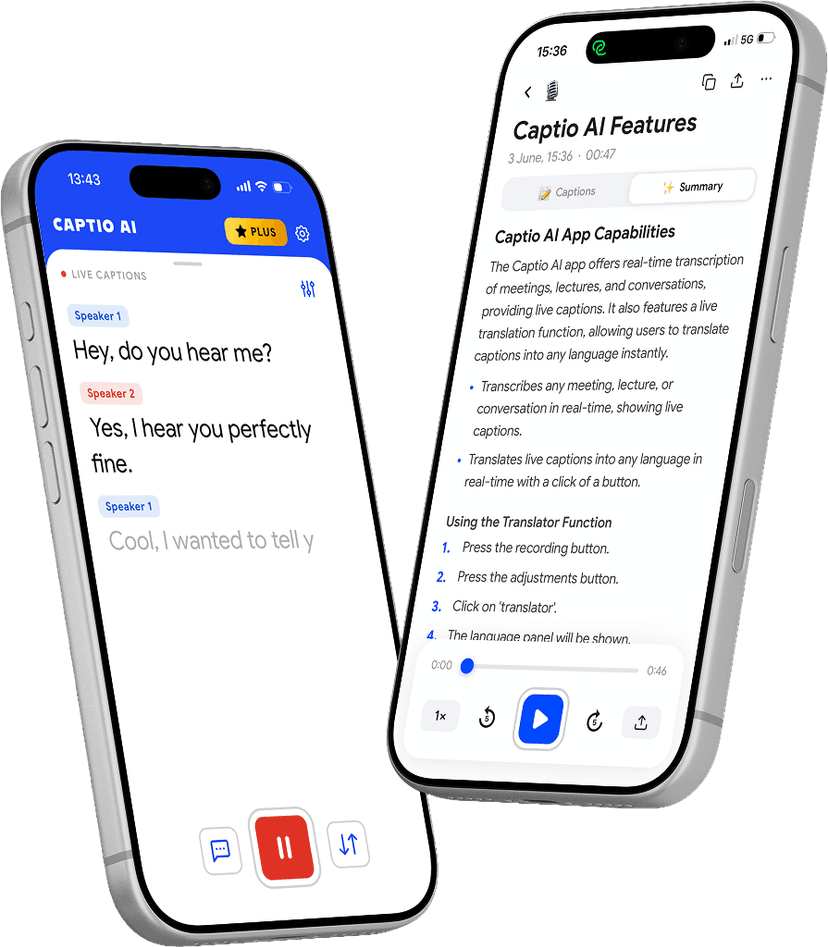
Everything you need to follow Hungarian doctor appointments
Four tools built for deaf and hard of hearing Hungarian speakers.
Follow what the doctor says in real time
- Captions appear word by word as they speak
- Handles medical terminology, drug names, and clinical language
- Place the phone on the desk — no setup needed
- Works in any consultation room, clinic, or hospital setting
When the doctor speaks another language
- Captions and translates in real time
- Follow your diagnosis in the language you understand best
- 60+ languages, no manual switching
- For foreign specialists, travel, or immigration settings
A full record of the consultation
- Record the appointment and upload it for a complete transcript
- Review instructions, drug names, and follow-up steps at home
- Share with a family member or carer if needed
- Works on any consultation recording
Key instructions extracted automatically
- Diagnosis, medication, and follow-up steps pulled from any transcript
- Organised into clear sections
- Nothing important missed or forgotten
- Works on any saved appointment recording
Download for free
Every situation covered
Designed for the real moments that matter — not just quiet controlled environments.
At a háziorvos (GP) in Budapest or a vidéki rendelő (rural surgery), your doctor explains a diagnosis in Hungarian. Captio AI captions every word in real time so you follow without missing critical details.
At a specialist consultation at Semmelweis Klinikák or a county hospital, medical terminology arrives in Hungarian mixed with Latinate clinical vocabulary. Captio AI keeps pace with both.
At the gyógyszertár (pharmacy), the pharmacist explains dosage and interactions in rapid Hungarian. Point your phone toward them and read the instructions as they speak.
At a fogorvos (dental clinic), the dentist gives instructions during treatment when lip-reading is impossible. Captio AI captions from audio alone so you follow every direction.
In a mental health session with a pszichológus or pszichiáter, sensitive conversations require full comprehension. Captio AI captions the entire session so you engage on equal terms.
At the sürgősségi (emergency department), staff speak quickly under pressure. Open Captio AI and read their instructions as they arrive.
Most accurate and fastest models
word accuracy
independent benchmark, 2025
real-time captions
first word appears as you speak
Download for free
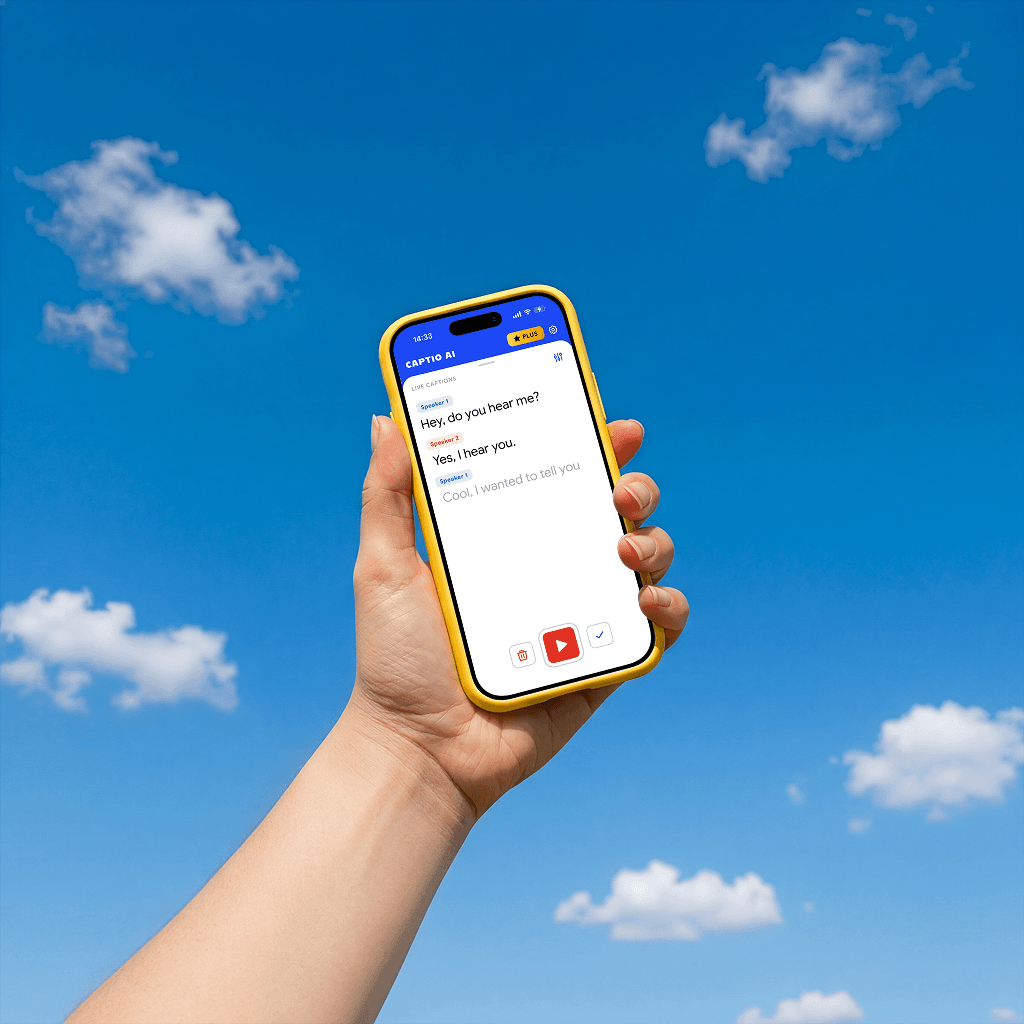
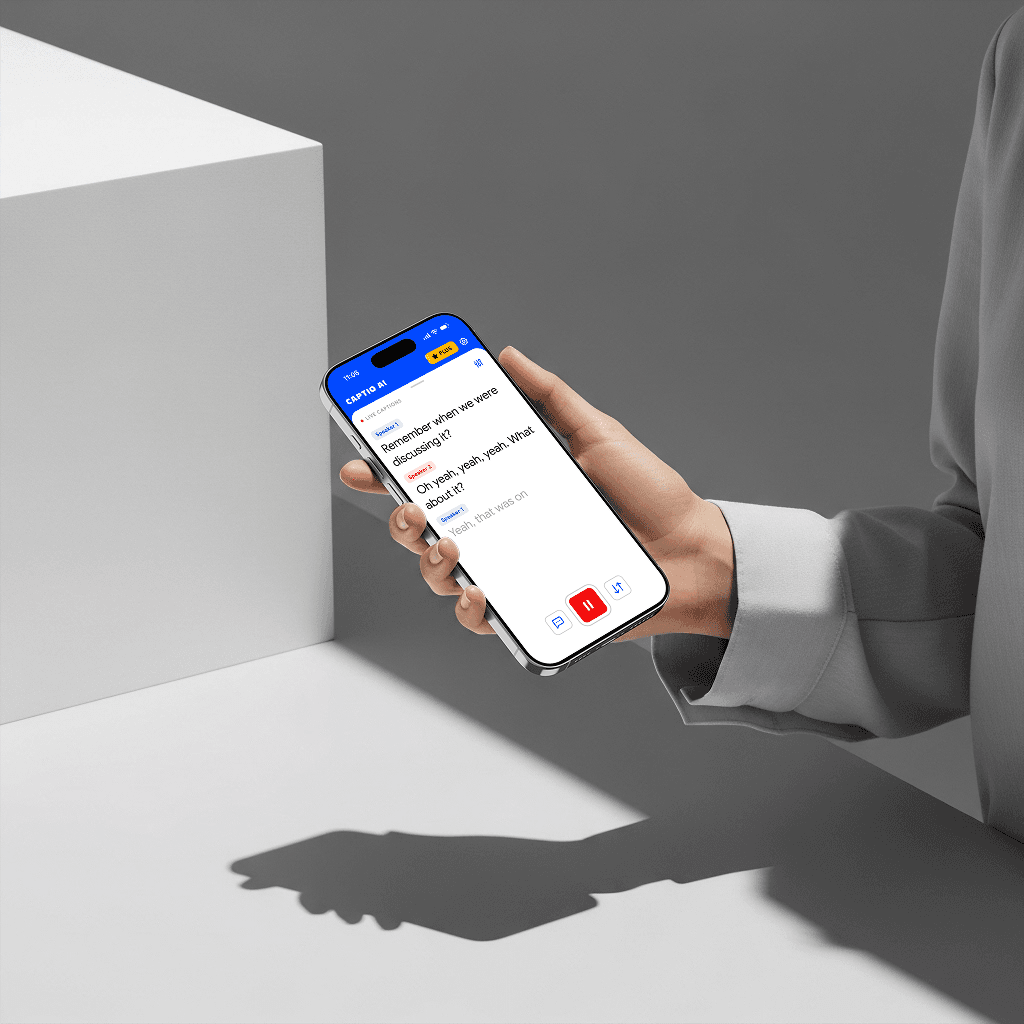
Built for the conversations where every word matters
Captions as the doctor speaks
Words appear on screen while the doctor is still talking. You read the diagnosis, drug name, or follow-up instruction at the same moment it is said — not after they have moved on.
Medical terminology handled accurately
Drug names, procedure names, clinical terms. Captio AI handles the vocabulary of a real consultation — not just everyday speech.
Review the appointment after
Record the consultation and upload it to Audio Transcription. Get a full written record of everything said — instructions, dosages, referrals — to review at home and share with a carer if needed.
Works in any clinical setting
Consultation rooms, hospital wards, A&E, dental chairs, pharmacy counters. Place the phone near the speaker and Captio AI captions whoever is talking.
Any language
For foreign-language doctors, specialists abroad, or appointments through an interpreter. Live Translator captions and translates in real time so you follow your diagnosis in the language you understand best.
100% private
Medical conversations are among the most sensitive there are. Captio AI processes audio in real time and discards it immediately. Nothing is recorded, stored, or shared.
Why Hungarian is hard to understand
Vowel harmony complexity
- Fourteen vowels arranged in harmony patterns blur together on the lips
- Hungarian has 14 vowel phonemes — a, á, e, é, i, í, o, ó, ö, ő, u, ú, ü, ű — including front rounded vowels like ö, ő, ü, ű that are rare in European languages. In clinical speech these vowels must harmonise across long suffixed words, producing repetitive vowel sequences where the lip shapes for similar vowels (ö vs o, ü vs u) are difficult to distinguish from a lip-reading distance.
Geminate consonants
- Doubled consonants are phonemic but invisible
- Hungarian is one of the few European languages where geminate (doubled) consonants carry meaning: 'megy' (goes) vs 'meggy' (sour cherry), 'hal' (fish) vs 'hall' (hears/hall). The doubled consonant is phonemically crucial but produces minimal visible difference in lip shape — only a slightly longer closure. In clinical vocabulary where pairs like these appear, lip-reading alone is unreliable.
Agglutinative suffix chains
- Long words with stacked suffixes compress into single rapid units
- Hungarian stacks suffixes to express tense, case, possession, and negation in a single word. In fast clinical speech, words like 'egészségügyi' (healthcare) or 'vérvizsgálatomnak' (of my blood test) are pronounced as one long unit without natural pause points. A deaf patient lip-reading must parse a word as long as a sentence without word-boundary cues.
Unique prosody
- Hungarian stress falls on the first syllable of every word
- Hungarian has fixed first-syllable stress — a prosodic pattern unlike most European languages. In connected speech this produces a distinctive rhythm that does not match the lip-reading patterns developed by deaf people who also encounter German, English, or other languages. Clinical vocabulary with this consistent first-syllable stress pattern requires relearning how to visually parse rhythm.
Latinate medical register
- Clinical vocabulary mixes Hungarian and Latin-origin terms
- Hungarian clinical speech alternates between native Magyar vocabulary and Latinate medical terms. 'Szívroham' and 'infarktus' may describe the same condition in the same sentence. A deaf patient must lip-read across two phonologically distinct systems — the agglutinative native Hungarian and the Latinate suffix-light medical vocabulary — within a single consultation.
Download for free
Hearing loss in Hungary: scale, employment barriers, and the limits of legal frameworks
Hungary's National Disability Programme 2015–2025 identified employment as the central challenge for people with disabilities — and hearing impairment is no exception. Hungarian Sign Language has approximately 10,000 native signers, a community navigating employment, education, and healthcare in a system where interpreter provision is inconsistent and the practical implementation of disability rights lags behind the legal text. Hungary defines disability to include sensory impairment and recognises the need for rehabilitation-focused employment support, but deaf Hungarians continue to face significantly higher unemployment rates than their hearing peers, and reduced access to education and healthcare where communication support is not routinely provided.
In the healthcare system specifically, deaf and hard of hearing Hungarians face the same structural gap found across Central European countries: a legal right to accessibility that is not matched by interpreter infrastructure at the point of care. A deaf patient booking a specialist appointment at Semmelweis Klinikák or a county hospital in Pécs or Debrecen cannot expect a qualified Hungarian Sign Language interpreter to be present. The most common accommodation — a family member who translates — introduces the same filtering and omission problems seen across the region. Clinical information that requires precision (dosage, contraindications, follow-up procedures) is the most likely to be lost in informal interpretation.
Beyond interpreter access, Hungarian presents particular linguistic challenges for technological solutions and for deaf individuals who rely on any assistive technology. The language's agglutinative structure, long suffixed words, and 14-vowel phoneme inventory make it one of the more complex European languages for speech processing. GBD 2019 data estimated that 1.57 billion people globally had hearing loss, and Hungary's share of that burden — in a relatively small population of under 10 million — still represents hundreds of thousands of people navigating daily life with reduced hearing. Captio AI captions Hungarian in real time at any rendelő or kórház, giving deaf and hard of hearing Hungarians direct access to their doctor's words in full.
Download for free
What you hear stays with you.
Gone the moment it ends
Captio AI processes your audio in real time and discards it immediately. Nothing is recorded. Nothing is kept.
Not a product
Your conversations are not something Captio AI sells, shares, or monetizes — to anyone, for any reason.
Not used to train anything
What you say in a doctor's appointment or a job interview never ends up in a training dataset. Not ours. Not anyone else's.

Private by default
Captio AI supports 60+ languages
Download for free
Frequently asked questions
Understand your diagnosis in Hungarian.
Captio AI is free to start
Download for free