

Croatian live captions and productivity tool for doctor appointments
For deaf and hard of hearing people.
Download for free
Everything you need to follow Croatian doctor appointments
Four tools built for deaf and hard of hearing Croatian speakers.
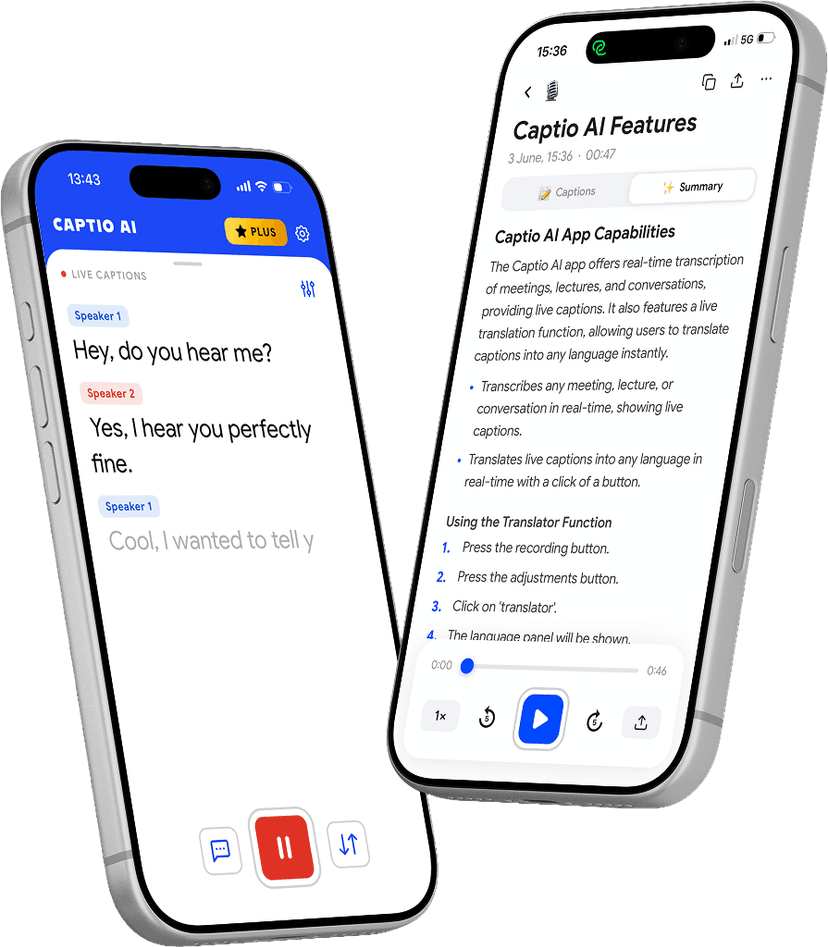
Follow what the doctor says in real time
- Captions appear word by word as they speak
- Handles medical terminology, drug names, and clinical language
- Place the phone on the desk — no setup needed
- Works in any consultation room, clinic, or hospital setting
When the doctor speaks another language
- Captions and translates in real time
- Follow your diagnosis in the language you understand best
- 60+ languages, no manual switching
- For foreign specialists, travel, or immigration settings
A full record of the consultation
- Record the appointment and upload it for a complete transcript
- Review instructions, drug names, and follow-up steps at home
- Share with a family member or carer if needed
- Works on any consultation recording
Key instructions extracted automatically
- Diagnosis, medication, and follow-up steps pulled from any transcript
- Organised into clear sections
- Nothing important missed or forgotten
- Works on any saved appointment recording
Download for free
Every situation covered
Designed for the real moments that matter — not just quiet controlled environments.
At a dom zdravlja (health centre) or ordinacija obiteljske medicine (family medicine clinic) in Zagreb, Split, or a smaller grad, your liječnik explains symptoms and treatment in Croatian. Captio AI captions every word in real time.
At a specialist appointment at Klinički bolnički centar Zagreb or a regional klinička bolnica, medical terms arrive in formal Croatian. Captio AI captions in real time so you follow the full explanation.
At the ljekarna (pharmacy), the ljekarnik explains dosage and drug interactions quickly in Croatian. Point your phone toward them and read the instructions as they speak.
At the zubar (dental clinic), the dentist gives instructions during treatment when lip-reading is impossible. Captio AI captions from audio alone.
In a session with a psiholog or psihijatar, sensitive conversations require full comprehension. Captio AI captions the full session so you engage without missing nuance.
At the hitna pomoć (emergency department), staff speak quickly under pressure. Open Captio AI and read their instructions in real time.
Most accurate and fastest models
word accuracy
independent benchmark, 2025
real-time captions
first word appears as you speak
Download for free
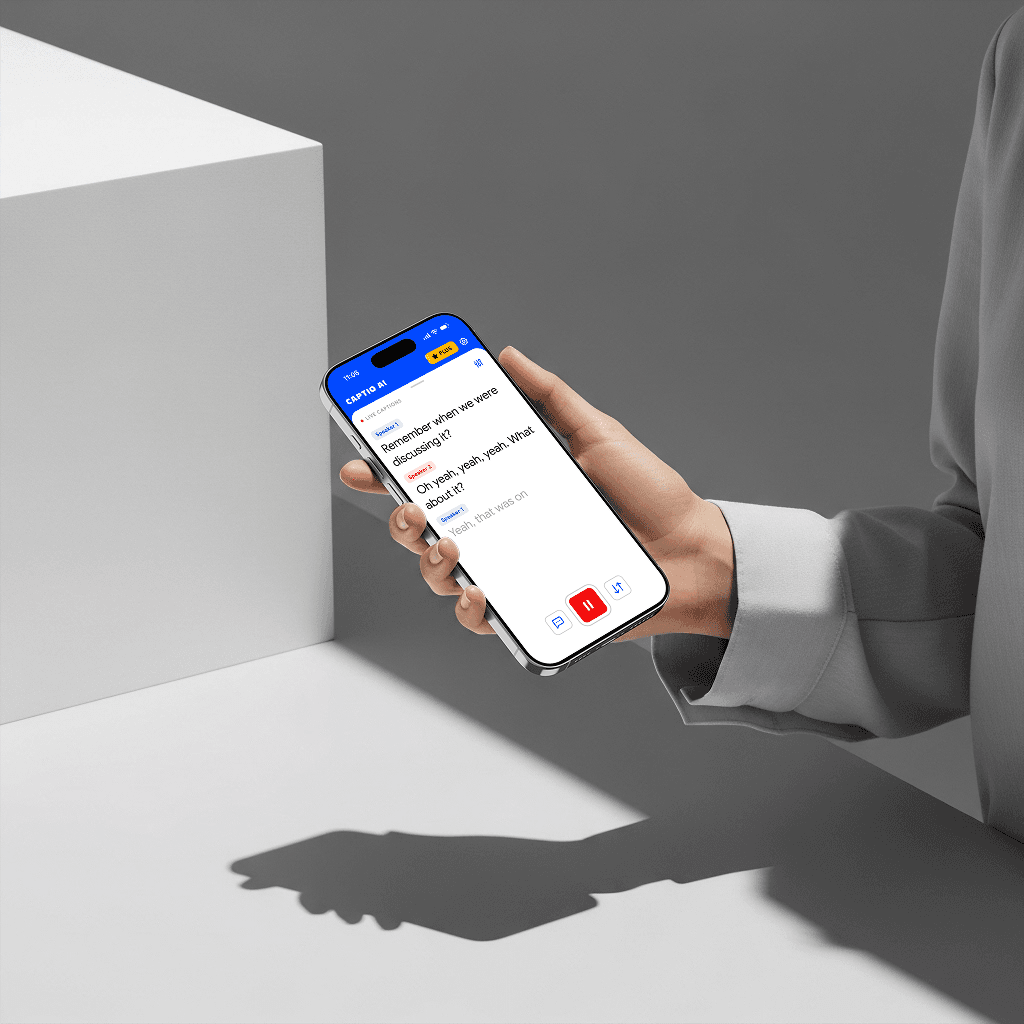
Built for the conversations where every word matters
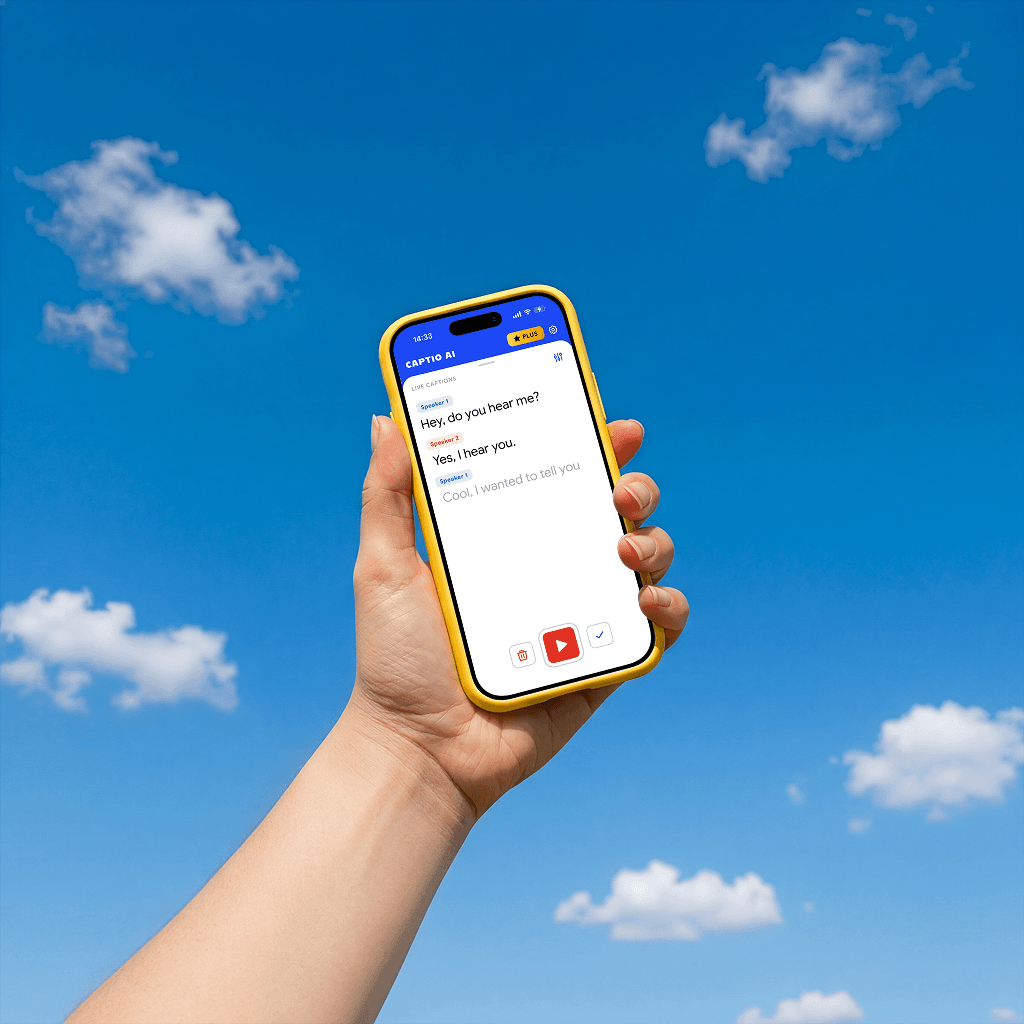
Captions as the doctor speaks
Words appear on screen while the doctor is still talking. You read the diagnosis, drug name, or follow-up instruction at the same moment it is said — not after they have moved on.
Medical terminology handled accurately
Drug names, procedure names, clinical terms. Captio AI handles the vocabulary of a real consultation — not just everyday speech.
Review the appointment after
Record the consultation and upload it to Audio Transcription. Get a full written record of everything said — instructions, dosages, referrals — to review at home and share with a carer if needed.
Works in any clinical setting
Consultation rooms, hospital wards, A&E, dental chairs, pharmacy counters. Place the phone near the speaker and Captio AI captions whoever is talking.
Any language
For foreign-language doctors, specialists abroad, or appointments through an interpreter. Live Translator captions and translates in real time so you follow your diagnosis in the language you understand best.
100% private
Medical conversations are among the most sensitive there are. Captio AI processes audio in real time and discards it immediately. Nothing is recorded, stored, or shared.
Why Croatian is hard to understand
Four-tone pitch accent
- Croatian's four pitch tones change meaning but are invisible on lips
- Croatian has a pitch accent system with four tones: short falling, short rising, long falling, and long rising. These tones are phonemically significant — the same syllable sequence carries different meaning depending on pitch pattern. For a deaf or hard of hearing patient, all four tones are purely auditory. No change in lip shape distinguishes them, making clinical vocabulary built on pitch contrasts impossible to read from the face.
Ijekavian pronunciation
- Croatian Ijekavian realisations produce different lip shapes from Serbian Ekavian
- Standard Croatian uses Ijekavian pronunciation — the historical yat vowel realises as 'ije' or 'je': 'mlijeko' (milk), 'liječnik' (doctor). This differs from Serbian Ekavian ('mleko', 'lekar') and from Bosnian variants. A deaf patient who learned to lip-read Ekavian Serbian — common in the ex-Yugoslav diaspora — will find Croatian-speaking medical staff producing different mouth shapes for equivalent clinical vocabulary throughout the consultation.
Puristic Croatian vocabulary
- Croatian uses native Croatian terms where other ex-Yugoslav languages use international ones
- Croatian language policy favours native Croatian vocabulary over international loanwords where alternatives exist: 'bolnica' (hospital, not 'klinika'), 'liječnik' (doctor, not 'lekar'), 'lijek' (medicine, not 'lek'), 'ljekarna' (pharmacy, not 'apoteka'). A deaf patient familiar with medical vocabulary in Serbian, Bosnian, or international forms encounters a different lexicon in Croatian clinical speech — requiring lip-reading of unfamiliar word shapes for known concepts.
Consonant clusters
- Croatian initial consonant clusters produce rapid closures with no vowel anchor
- Croatian permits many initial consonant clusters: 'crv' (worm), 'brz' (fast), 'trg' (square), 'krv' (blood — relevant in clinical speech). In fast speech these clusters appear at word onsets without an initial vowel to anchor the lip shape sequence. A deaf patient lip-reading Croatian encounters words that begin with multi-consonant closures before any open vowel shape appears.
Critical interpreter shortage
- Only twenty sign language interpreters serve the entire country
- Croatia has approximately 20 active sign language interpreters nationally — three of whom are based in Zagreb. Against a deaf and hard of hearing population of over 13,000, this represents one interpreter per 650 people. In clinical settings outside Zagreb, access to a qualified Croatian Sign Language interpreter is essentially unavailable. The Croatian Sign Language Act has been written but has not been sent to parliamentary adoption — the legal protection that would change this situation does not yet exist.
Download for free
Hearing loss in Croatia: 13,000 registered, 20 interpreters, no Sign Language Act
A 2011 Croatian census recorded 13,230 persons with hearing impairment, of whom 2,763 had total or major disability. The Croatian Association of the Deaf and Hard of Hearing was established in 1921 and today has approximately 9,000 members across 23 regional organisations — one of the older deaf organisations in the Balkans, reflecting a long history of community advocacy. Despite this organisational history, the structural support for deaf Croatians in healthcare and public life remains severely constrained by one critical bottleneck: the interpreter workforce.
Croatia has approximately 20 active sign language interpreters nationally, three of whom are based in Zagreb. This interpreter workforce serves a community of 9,000 registered Association members plus an additional thousands of non-members with significant hearing impairment. The Croatian Sign Language Act has been drafted — a significant procedural step — but has not been submitted to parliamentary adoption. Without a Sign Language Act, there is no legal mandate for interpreter provision in healthcare, no right to sign language education, and no enforcement mechanism for accessibility. Croatia's deaf community has the oldest advocacy organisation in the Western Balkans and the smallest interpreter workforce in the region per registered deaf person.
In clinical settings, this means a deaf patient attending an appointment at a klinički bolnički centar outside Zagreb has effectively no prospect of a qualified interpreter. The experience of Croatian deaf patients in healthcare closely mirrors the pattern found across the region: a family member who translates imperfectly, a doctor who writes key terms on paper, or — for patients with strong lip-reading skills — a partial comprehension of clinical instructions that is sufficient some of the time and insufficient when it matters most. Captio AI captions Croatian in real time at any dom zdravlja or bolnica, so every patient has immediate access to their doctor's words without depending on a legislative process that has not yet delivered.
Download for free
What you hear stays with you.
Gone the moment it ends
Captio AI processes your audio in real time and discards it immediately. Nothing is recorded. Nothing is kept.
Not a product
Your conversations are not something Captio AI sells, shares, or monetizes — to anyone, for any reason.
Not used to train anything
What you say in a doctor's appointment or a job interview never ends up in a training dataset. Not ours. Not anyone else's.
Private by default
Captio AI supports 60+ languages
Download for free
Frequently asked questions
Understand your diagnosis in Croatian.
Captio AI is free to start
Download for free