

Japanese live captions and productivity tool for doctor appointments
For deaf and hard of hearing people.
Download for free


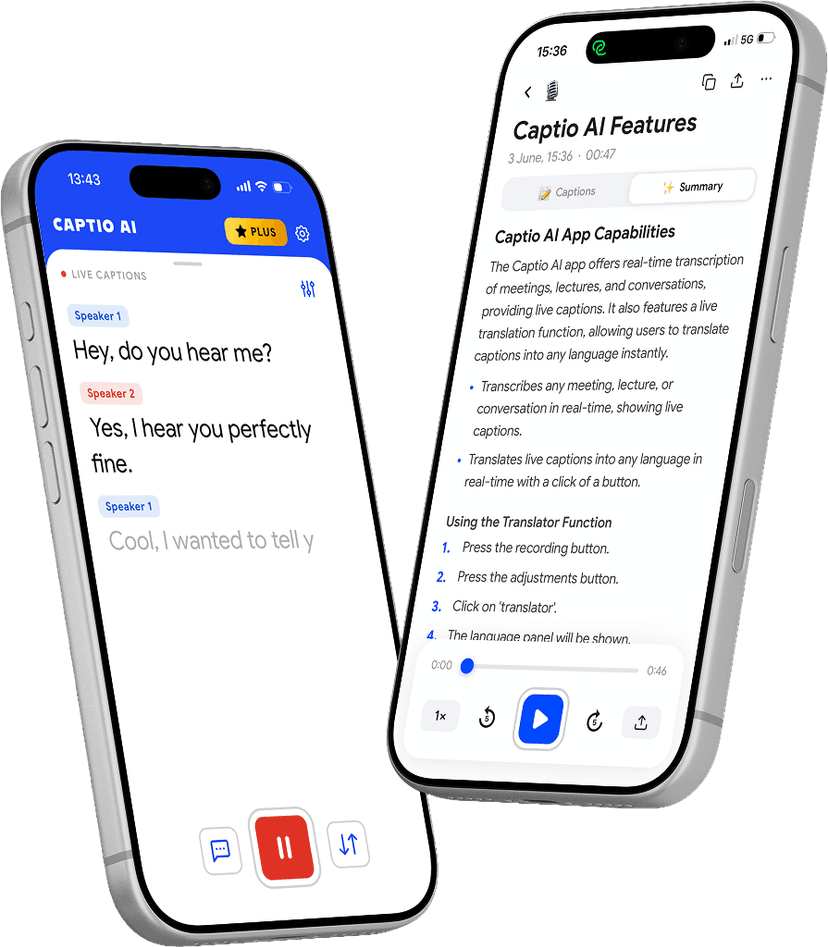
Everything you need to follow Japanese doctor appointments
Four tools built for deaf and hard of hearing Japanese speakers.
Follow what the doctor says in real time
- Captions appear word by word as they speak
- Handles medical terminology, drug names, and clinical language
- Place the phone on the desk — no setup needed
- Works in any consultation room, clinic, or hospital setting
When the doctor speaks another language
- Captions and translates in real time
- Follow your diagnosis in the language you understand best
- 60+ languages, no manual switching
- For foreign specialists, travel, or immigration settings
A full record of the consultation
- Record the appointment and upload it for a complete transcript
- Review instructions, drug names, and follow-up steps at home
- Share with a family member or carer if needed
- Works on any consultation recording
Key instructions extracted automatically
- Diagnosis, medication, and follow-up steps pulled from any transcript
- Organised into clear sections
- Nothing important missed or forgotten
- Works on any saved appointment recording
Download for free
Every situation covered
Designed for the real moments that matter — not just quiet controlled environments.
GP and internal medicine visits at a 内科 (naika) clinic, where the doctor speaks quickly and often looks at the computer screen rather than the patient.
Specialist consultations at a 大学病院 (daigaku byōin) or major hospital, where medical terminology is dense and consultation time is short.
Pharmacy counter at a 薬局 (yakkyoku), where the pharmacist explains dosage instructions verbally and may speak quietly behind a glass partition.
Dental appointments at a 歯科 (shika) clinic, where the patient cannot see the dentist's face during treatment and verbal instructions continue throughout.
Mental health or psychiatry consultations (精神科, seishin-ka), where follow-up questions are frequent and nuance in tone carries clinical weight.
Emergency room (救急外来, kyūkyū gairai) visits, where staff move fast, speak at speed, and masks are mandatory.
Most accurate and fastest models
character accuracy
independent benchmark, 2025
real-time captions
first word appears as you speak
Download for free
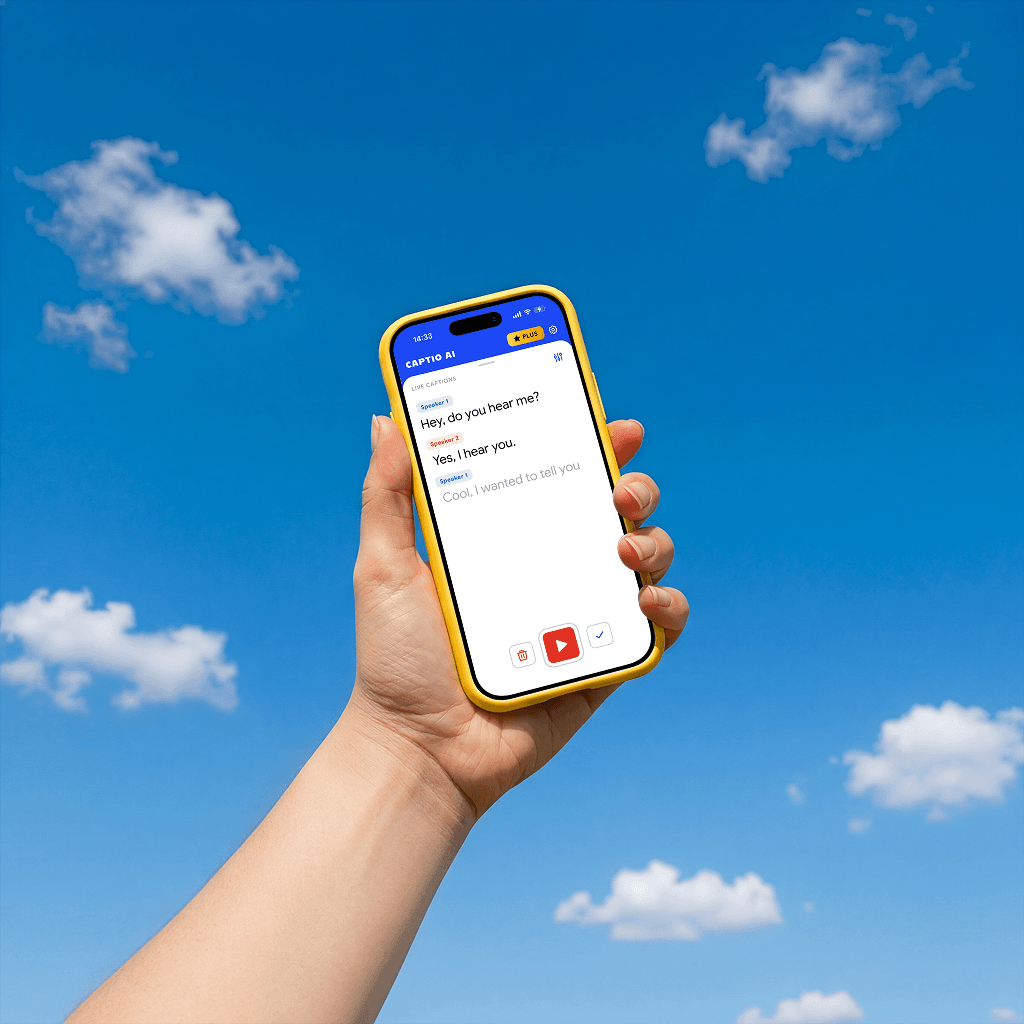
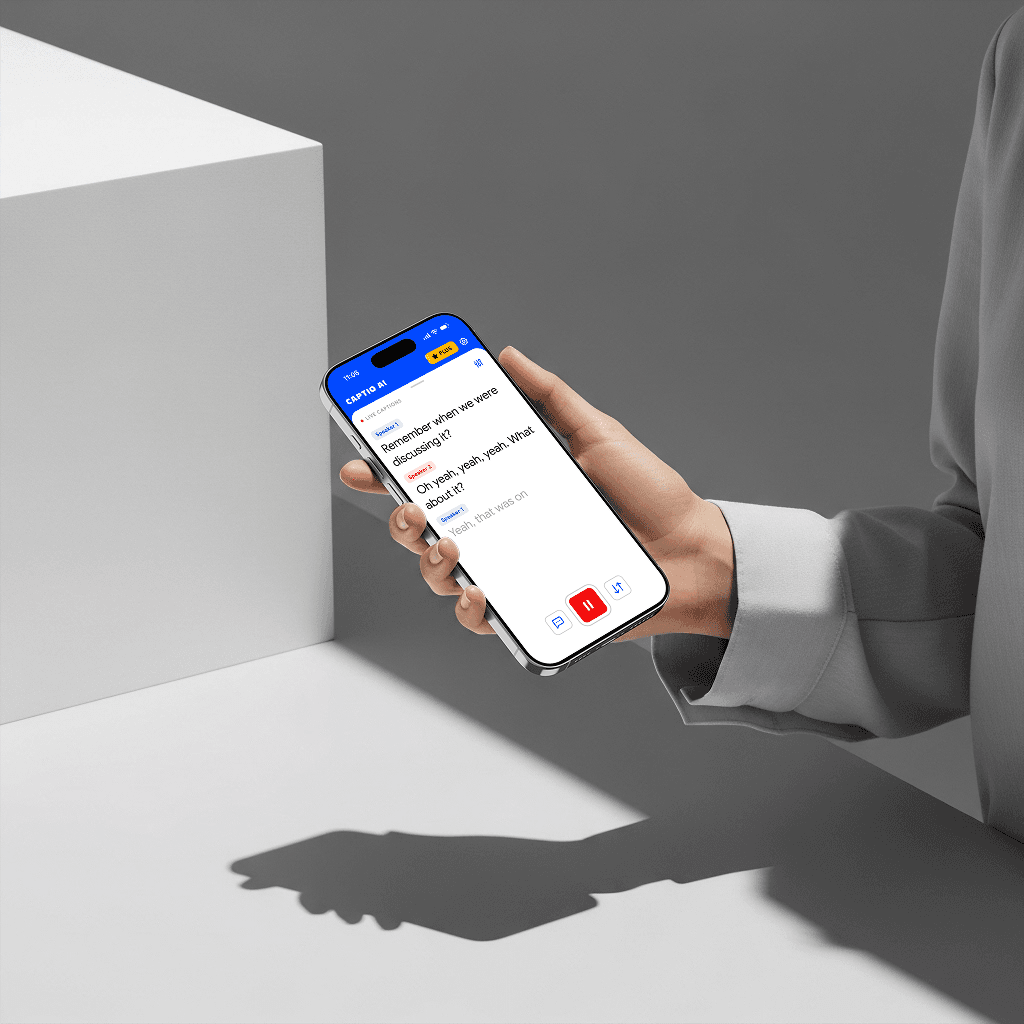
Built for the conversations where every word matters
Captions as the doctor speaks
Words appear on screen while the doctor is still talking. You read the diagnosis, drug name, or follow-up instruction at the same moment it is said — not after they have moved on.
Medical terminology handled accurately
Drug names, procedure names, clinical terms. Captio AI handles the vocabulary of a real consultation — not just everyday speech.
Review the appointment after
Record the consultation and upload it to Audio Transcription. Get a full written record of everything said — instructions, dosages, referrals — to review at home and share with a carer if needed.
Works in any clinical setting
Consultation rooms, hospital wards, A&E, dental chairs, pharmacy counters. Place the phone near the speaker and Captio AI captions whoever is talking.
Any language
For foreign-language doctors, specialists abroad, or appointments through an interpreter. Live Translator captions and translates in real time so you follow your diagnosis in the language you understand best.
100% private
Medical conversations are among the most sensitive there are. Captio AI processes audio in real time and discards it immediately. Nothing is recorded, stored, or shared.
Why Japanese is hard to understand
Lip movement suppressed
- Japanese speakers move their lips less
- Research shows native Japanese speakers are naturally less reliant on lip movement than English speakers. In a clinical consultation, where the doctor's head may be angled toward a screen, a deaf or hard of hearing patient misses both the audio and the facial movement that English lip-readers depend on.
Cultural lip concealment
- Doctors and staff often cover their mouths
- In Japanese clinical and social contexts, people frequently cover or conceal the mouth — when speaking softly, showing concern, or coughing. This is socially normal but eliminates any residual lip-reading cues a hard of hearing patient might otherwise use at the reception desk or bedside.
Sino-Japanese medical register
- Medical terminology uses Sino-Japanese readings
- Words used in everyday speech have one pronunciation; the clinical terms for the same condition use Sino-Japanese (on'yomi) readings that sound completely different. 肺炎 (haien, pneumonia) and 高血圧 (kōketsuatsu, hypertension) bear no resemblance to their colloquial descriptions. This register gap widens in every medical appointment.
Dialect divergence
- Kansai, Tohoku, and Kyushu doctors sound different
- A deaf patient used to Standard Tokyo Japanese may struggle with a doctor speaking Kansai-ben or Tohoku-ben. These regional varieties shift vowel length, pitch accent, and consonant realization in ways that are disorienting even in casual speech — let alone under the stress of a medical consultation.
Brief consultation pace
- Japanese outpatient appointments move fast
- Hospital consultations in Japan are often under five minutes, with doctors typing notes simultaneously. Explanations are compressed, questions are rapid, and a deaf patient has almost no opportunity to ask for repetition before the next step begins.
Download for free
16.5 million people. An interpreter system that cannot keep up.
Japan has the world's oldest population by median age, and hearing loss grows sharply with age. A study of Japanese adults aged 65 and above found hearing impairment prevalence reaching 43.7% in men aged 65–69 and 84.3% in men over 80. The estimated total number of hearing-impaired people aged over 65 in Japan exceeds 16.5 million — a figure the country's healthcare infrastructure was not built to serve with adequate communication support.
As of 2023, Japan's Ministry of Health, Labour and Welfare had officially certified only 3,932 Japanese Sign Language (JSL) interpreters nationwide. With 16.5 million people over 65 alone experiencing hearing difficulty, each certified interpreter would need to serve more than 4,000 people. National JSL recognition remains incomplete — while some prefectures have passed sign language ordinances, there is no uniform national standard requiring hospitals to provide interpreter access. Deaf patients in many regions rely on written notes or a family member accompanying them, neither of which is a reliable substitute during a clinical consultation.
The gap between legal intent and daily reality is stark. A 2023 report by the Japanese Federation of the Deaf noted that sign language interpretation should be available 24 hours a day, 365 days a year — but this remains an advocacy goal rather than standard practice. Hospital admissions, specialist referrals, and emergency room visits all depend on verbal communication that passes deaf and hard of hearing patients by.
Download for free
What you hear stays with you.
Gone the moment it ends
Captio AI processes your audio in real time and discards it immediately. Nothing is recorded. Nothing is kept.
Not a product
Your conversations are not something Captio AI sells, shares, or monetizes — to anyone, for any reason.
Not used to train anything
What you say in a doctor's appointment or a job interview never ends up in a training dataset. Not ours. Not anyone else's.

Private by default
Captio AI supports 60+ languages
Download for free
Frequently asked questions
Understand your diagnosis in Japanese.
Captio AI is free to start
Download for free