

Marathi live captions and productivity tool for doctor appointments
For deaf and hard of hearing people.
Download for free


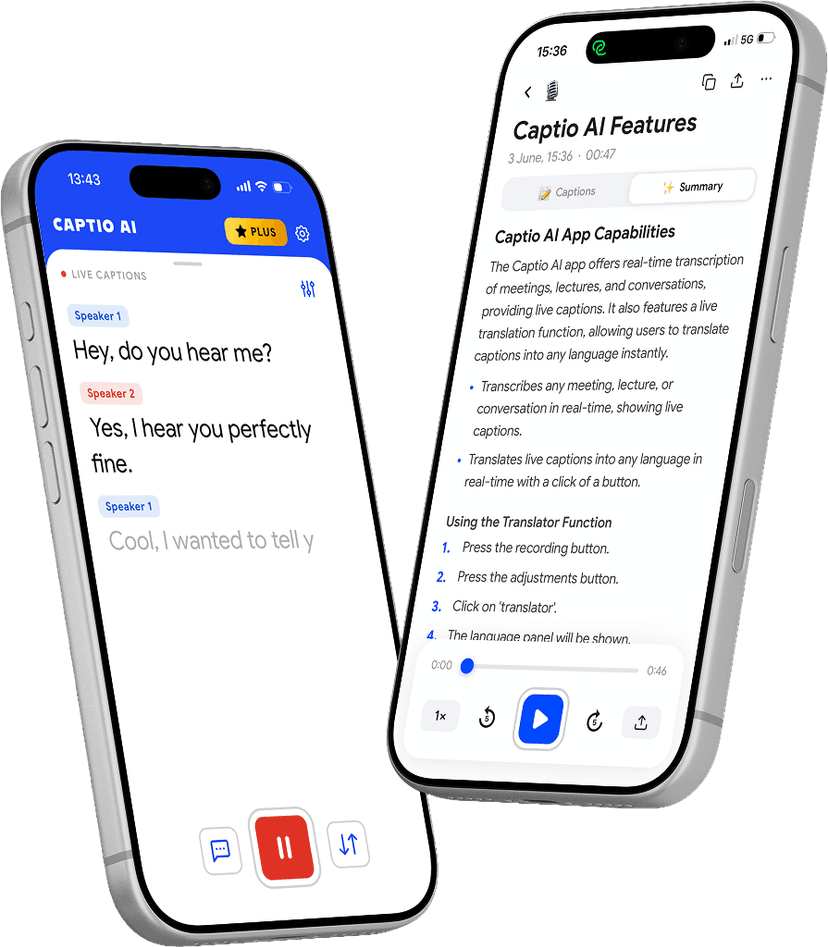
Everything you need to follow Marathi doctor appointments
Four tools built for deaf and hard of hearing Marathi speakers.
Follow what the doctor says in real time
- Captions appear word by word as they speak
- Handles medical terminology, drug names, and clinical language
- Place the phone on the desk — no setup needed
- Works in any consultation room, clinic, or hospital setting
When the doctor speaks another language
- Captions and translates in real time
- Follow your diagnosis in the language you understand best
- 60+ languages, no manual switching
- For foreign specialists, travel, or immigration settings
A full record of the consultation
- Record the appointment and upload it for a complete transcript
- Review instructions, drug names, and follow-up steps at home
- Share with a family member or carer if needed
- Works on any consultation recording
Key instructions extracted automatically
- Diagnosis, medication, and follow-up steps pulled from any transcript
- Organised into clear sections
- Nothing important missed or forgotten
- Works on any saved appointment recording
Download for free
Every situation covered
Designed for the real moments that matter — not just quiet controlled environments.
Government hospital OPD visits in cities like Pune, Nashik, or Aurangabad, where consultation time is short and the room is noisy with other patients.
Specialist consultations at a 大型 ruj̈nālay (major public hospital), where medical jargon is dense and patient turnover is high.
Pharmacy counter at a औषधालय (aushadhalay), where the chemist explains dosage instructions quickly in mixed Marathi and Hindi.
Dental appointments where the dentist speaks over the patient's face and verbal instructions continue throughout the procedure.
Psychiatry or mental health consultations, where follow-up questions are frequent and emotional register matters.
Private clinic visits in smaller towns, where the doctor may use a Vidarbha or Marathwada regional accent unfamiliar to an urban patient.
Most accurate and fastest models
word accuracy
independent benchmark, 2025
real-time captions
first word appears as you speak
Download for free
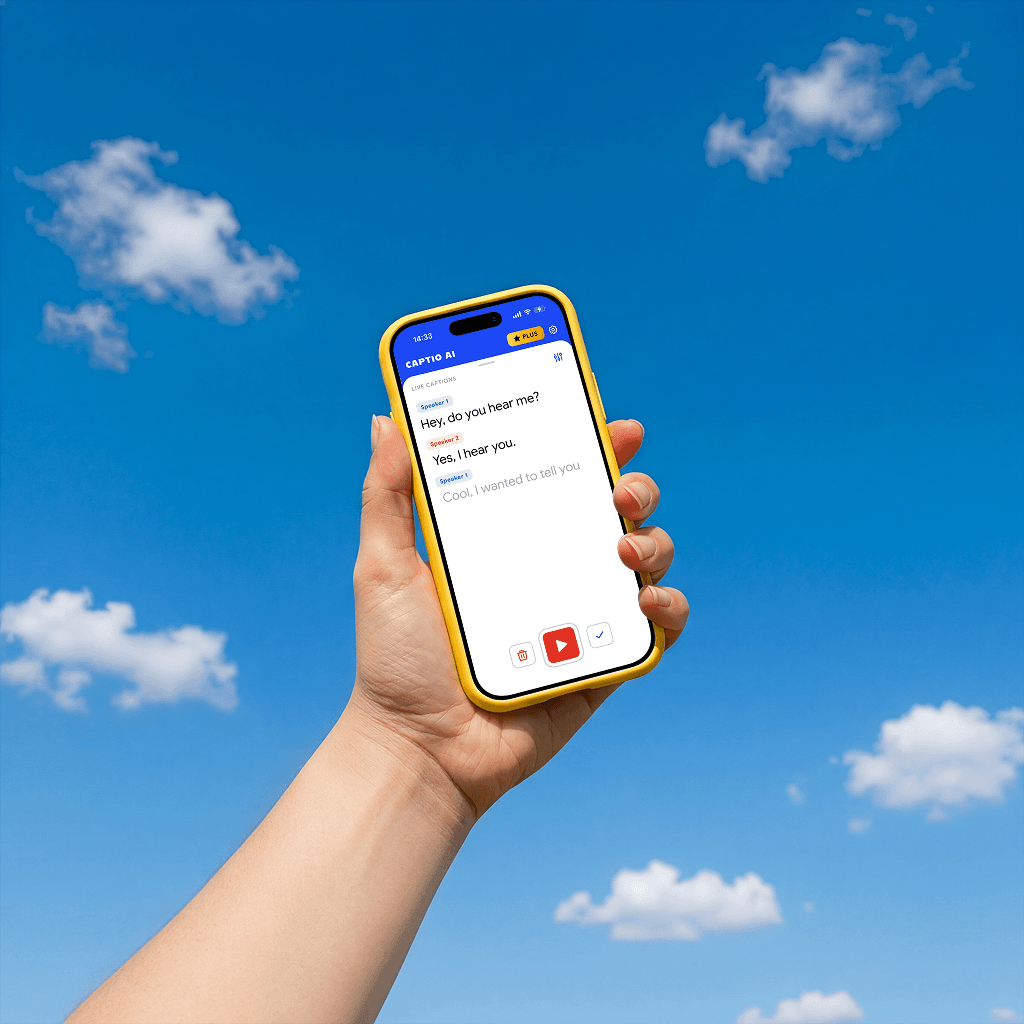
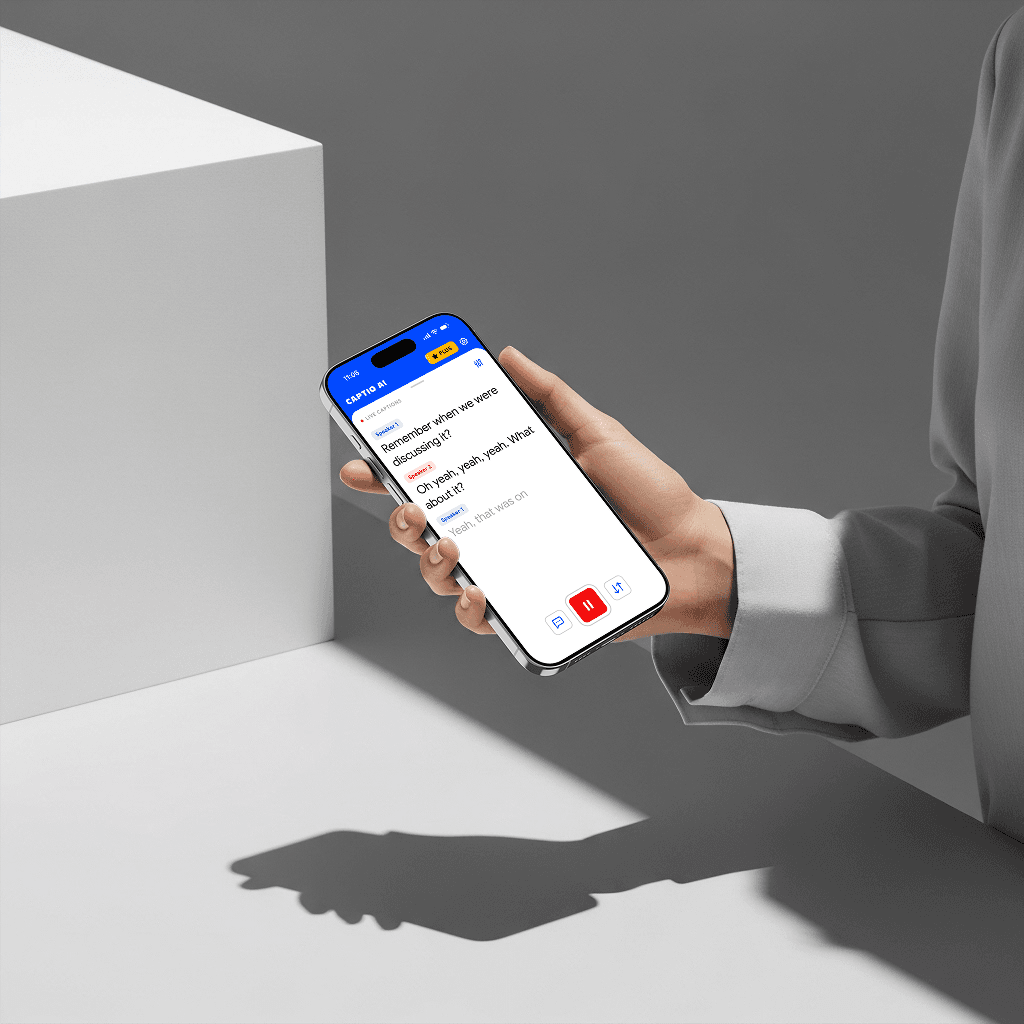
Built for the conversations where every word matters
Captions as the doctor speaks
Words appear on screen while the doctor is still talking. You read the diagnosis, drug name, or follow-up instruction at the same moment it is said — not after they have moved on.
Medical terminology handled accurately
Drug names, procedure names, clinical terms. Captio AI handles the vocabulary of a real consultation — not just everyday speech.
Review the appointment after
Record the consultation and upload it to Audio Transcription. Get a full written record of everything said — instructions, dosages, referrals — to review at home and share with a carer if needed.
Works in any clinical setting
Consultation rooms, hospital wards, A&E, dental chairs, pharmacy counters. Place the phone near the speaker and Captio AI captions whoever is talking.
Any language
For foreign-language doctors, specialists abroad, or appointments through an interpreter. Live Translator captions and translates in real time so you follow your diagnosis in the language you understand best.
100% private
Medical conversations are among the most sensitive there are. Captio AI processes audio in real time and discards it immediately. Nothing is recorded, stored, or shared.
Why Marathi is hard to understand
Aspiration contrast invisible
- Aspirated and unaspirated consonants look identical on lips
- Marathi distinguishes aspirated and unaspirated stops across four categories — the difference between क/ख (k/kh), ग/घ (g/gh), ट/ठ (ṭ/ṭh) and so on. The aspiration — a puff of air — is entirely acoustic and invisible on the lips. At a hospital counter or doctor's desk, a deaf patient watching the doctor's face cannot separate these phoneme pairs.
Retroflex-dental confusion
- Retroflex sounds look the same as dental sounds
- Marathi uses retroflex consonants (ट, ठ, ड, ढ, ण) alongside dental counterparts (त, थ, द, ध, न). The retroflex sounds are produced with the tongue curled back, invisible outside the mouth. On the lips alone, a retroflex and its dental counterpart are indistinguishable — a persistent source of ambiguity when a doctor names medications or procedures.
Marathi–Hindi–English code-switch
- Clinical Marathi mixes three languages mid-sentence
- In Maharashtra's hospitals, doctors commonly switch between Marathi, Hindi, and English in a single consultation. A deaf or hard of hearing patient following Marathi lip patterns is abruptly confronted with Hindi grammar or English drug names — a different rhythm, different mouth shapes, no visual warning.
Register gap
- Standard Marathi differs sharply from spoken Marathi
- Formal written Marathi used in medical reports and prescriptions sounds different from the conversational Marathi that fills hospital corridors and waiting rooms. Rural Marathi dialects from Vidarbha, Marathwada, and the Konkan coast differ further. A deaf patient in a government hospital in Nagpur may hear very different speech from one in Mumbai.
Short OPD consultation
- Government hospital outpatient pace is rapid
- Maharashtra's government hospital outpatient departments (OPDs) run under high patient load. A consultation lasting three to five minutes leaves a deaf patient almost no time to request written clarification or repetition before being handed a prescription and waved to the next window.
Download for free
63 million Indians with hearing loss. A healthcare system built for the hearing.
India has one of the world's largest populations of people with significant hearing loss: approximately 63 million people, or 6.3% of the country's population, according to WHO estimates. Hearing disability is the second most common cause of disability in India and the leading cause of sensory deficit, with rural populations disproportionately affected — 310 per 100,000 persons in rural areas compared to 236 per 100,000 in urban regions. Maharashtra has 34 district hospitals running the National Programme for Prevention and Control of Deafness (NPPCD), but coverage across the state's 36 districts remains uneven.
For deaf and hard of hearing adults in the working-age bracket, the consequences are direct. A 2011 census found that 73.9% of people aged 15–59 with hearing disability were only marginal workers. Access to healthcare without a family member or interpreter present means navigating verbal consultations, verbal dosage instructions, and verbal discharge summaries without adequate support. There is no statutory mandate in India requiring hospitals to provide sign language interpreters, and Indian Sign Language (ISL) was only adopted as an official language in 2023 — with implementation still in progress.
The gap between policy intent and clinical reality is particularly visible in Maharashtra's government hospital OPDs, where patient volumes are high, consultation time is limited, and written communication is rarely offered. A deaf patient in a busy OPD has no way to pause the doctor, request repetition, or receive written notes without drawing attention to their disability — often leading to guessed diagnoses and incorrect medication use.
Download for free
What you hear stays with you.
Gone the moment it ends
Captio AI processes your audio in real time and discards it immediately. Nothing is recorded. Nothing is kept.
Not a product
Your conversations are not something Captio AI sells, shares, or monetizes — to anyone, for any reason.
Not used to train anything
What you say in a doctor's appointment or a job interview never ends up in a training dataset. Not ours. Not anyone else's.

Private by default
Captio AI supports 60+ languages
Download for free
Frequently asked questions
Understand your diagnosis in Marathi.
Captio AI is free to start
Download for free