

Afrikaans live captions and productivity tool for doctor appointments
For deaf and hard of hearing people.
Download for free


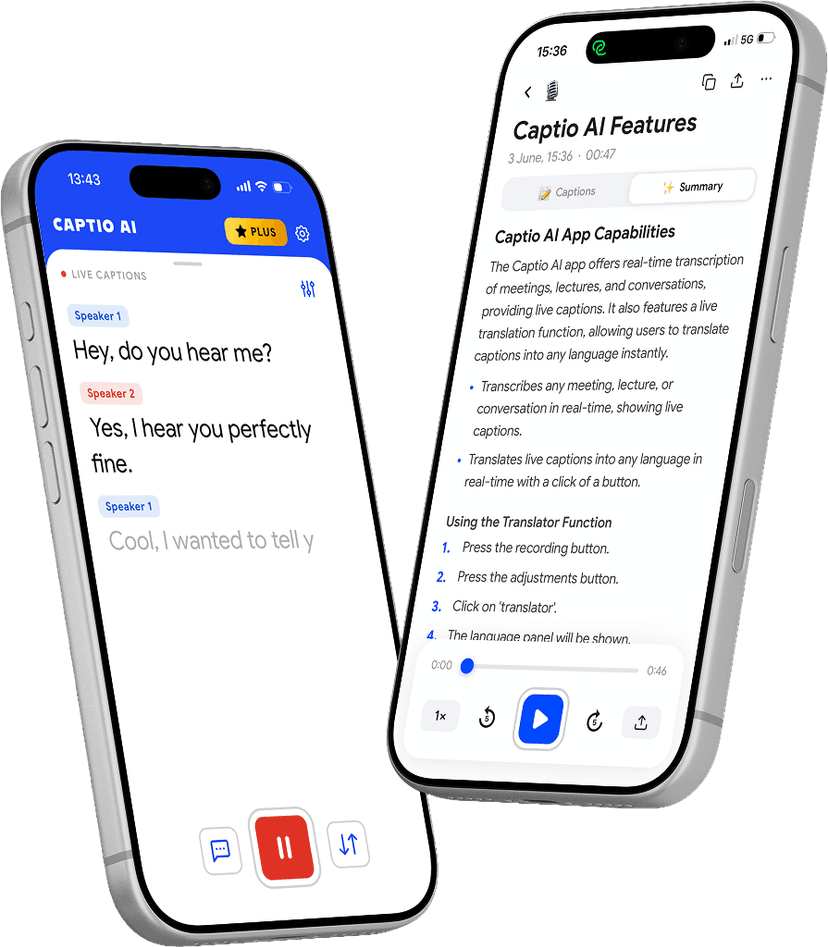
Everything you need to follow Afrikaans doctor appointments
Four tools built for deaf and hard of hearing Afrikaans speakers.
Follow what the doctor says in real time
- Captions appear word by word as they speak
- Handles medical terminology, drug names, and clinical language
- Place the phone on the desk — no setup needed
- Works in any consultation room, clinic, or hospital setting
When the doctor speaks another language
- Captions and translates in real time
- Follow your diagnosis in the language you understand best
- 60+ languages, no manual switching
- For foreign specialists, travel, or immigration settings
A full record of the consultation
- Record the appointment and upload it for a complete transcript
- Review instructions, drug names, and follow-up steps at home
- Share with a family member or carer if needed
- Works on any consultation recording
Key instructions extracted automatically
- Diagnosis, medication, and follow-up steps pulled from any transcript
- Organised into clear sections
- Nothing important missed or forgotten
- Works on any saved appointment recording
Download for free
Every situation covered
Designed for the real moments that matter — not just quiet controlled environments.
At a gemeenskapsgesondheidssentrum (community health centre) in Cape Town, Johannesburg, or a smaller dorp, your dokter explains symptoms and treatment in Afrikaans. Captio AI captions every word so you follow the full consultation.
At a specialist appointment at Tygerberg Hospital or a provincial hospital, medical terms arrive in Afrikaans or English. Captio AI captions both in real time.
At the apteek (pharmacy), the apteeker explains dosage and interactions quickly in Afrikaans. Point your phone toward them and read the instructions as they speak.
At the tandarts (dental surgery), the dentist gives instructions during treatment when lip-reading is impossible. Captio AI captions from audio alone.
In a session with a sielkundige (psychologist), sensitive topics require full comprehension. Captio AI captions the entire session so you engage on equal terms.
At the noodgevalle (emergency department), staff speak quickly under pressure. Open Captio AI and read their instructions as they arrive.
Most accurate and fastest models
word accuracy
independent benchmark, 2025
real-time captions
first word appears as you speak
Download for free
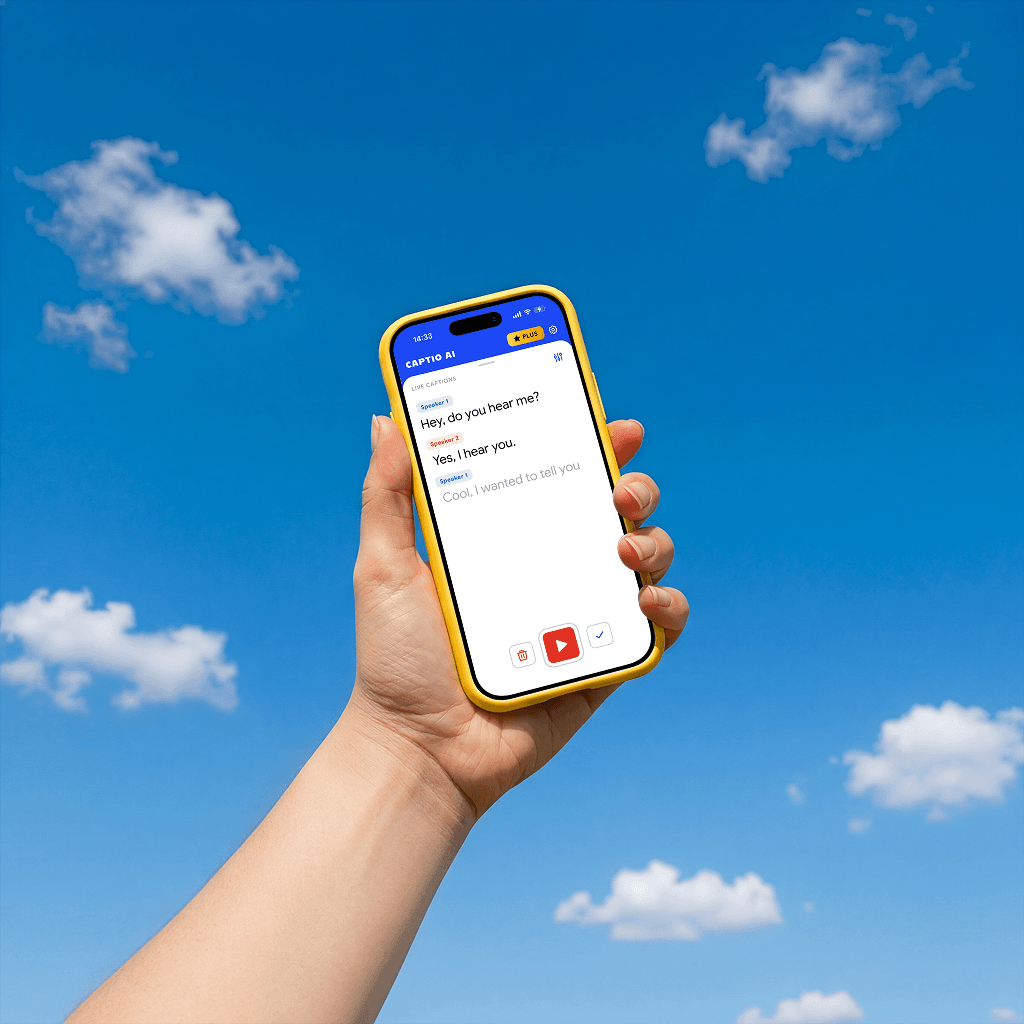
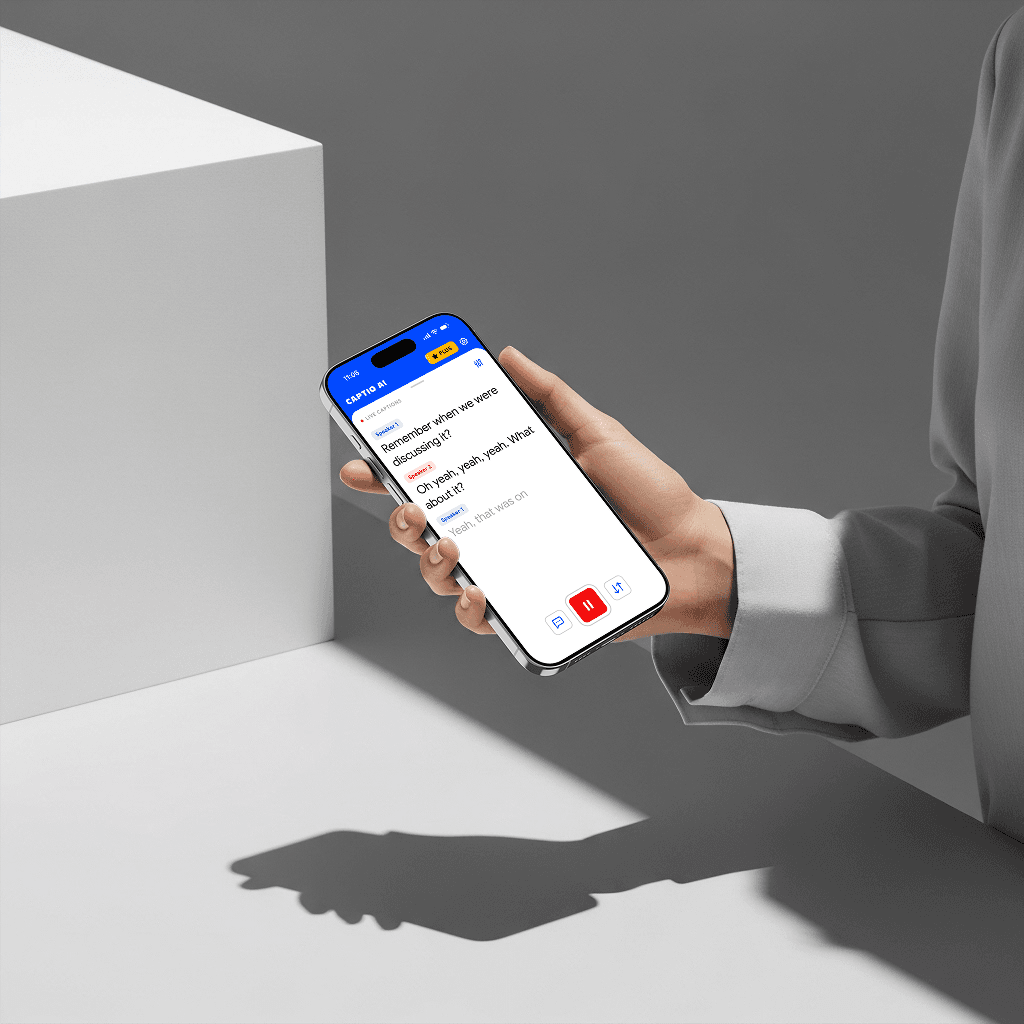
Built for the conversations where every word matters
Captions as the doctor speaks
Words appear on screen while the doctor is still talking. You read the diagnosis, drug name, or follow-up instruction at the same moment it is said — not after they have moved on.
Medical terminology handled accurately
Drug names, procedure names, clinical terms. Captio AI handles the vocabulary of a real consultation — not just everyday speech.
Review the appointment after
Record the consultation and upload it to Audio Transcription. Get a full written record of everything said — instructions, dosages, referrals — to review at home and share with a carer if needed.
Works in any clinical setting
Consultation rooms, hospital wards, A&E, dental chairs, pharmacy counters. Place the phone near the speaker and Captio AI captions whoever is talking.
Any language
For foreign-language doctors, specialists abroad, or appointments through an interpreter. Live Translator captions and translates in real time so you follow your diagnosis in the language you understand best.
100% private
Medical conversations are among the most sensitive there are. Captio AI processes audio in real time and discards it immediately. Nothing is recorded, stored, or shared.
Why Afrikaans is hard to understand
Cape Afrikaans variation
- Cape, Orange River, and Eastern Border Afrikaans differ in vowel quality
- Afrikaans has three main regional dialect clusters: Cape Afrikaans (Western Cape, heavily influenced by Malay and Khoisan languages), Orange River Afrikaans (Northern Cape), and Eastern Border Afrikaans (Eastern Cape, English-influenced). Each has distinct vowel qualities and intonation patterns. A deaf patient who lip-reads Standard Afrikaans encounters Cape Afrikaans-speaking healthcare workers in Cape Town producing different mouth shapes for the same clinical vocabulary.
Afrikaans G invisibility
- The Afrikaans g is produced at the back of the throat
- Like its Dutch ancestor, Afrikaans retains the velar fricative /x/ — the 'g' sound — produced at the back of the throat with no lip movement. In Afrikaans medical vocabulary, this sound appears constantly in words like 'gesondheidsentrum' (health centre), 'gebruik' (use), and 'geneesmiddel' (medicine). A deaf patient lip-reading Afrikaans systematically misses this consonant, which is the initial sound of many clinical terms.
Code-switching
- Afrikaans–English–Xhosa switching is common in South African healthcare
- South African healthcare settings mix Afrikaans, English, and local African languages including Xhosa, Zulu, and Sotho depending on the province and facility. A deaf patient who lip-reads Afrikaans attends appointments where the doctor may switch to English for clinical vocabulary, to Xhosa for a reassuring phrase, and back to Afrikaans for instructions — a multi-language lip-reading task that no individual language training prepares them for.
Fast vowel reduction
- Afrikaans unstressed vowels reduce heavily in casual speech
- In fast conversational Afrikaans — the register doctors shift to after the formal diagnosis — unstressed syllables reduce toward schwa or drop, words merge across boundaries, and the pace increases. Medical aftercare instructions delivered in casual Afrikaans produce a stream significantly harder to lip-read than the deliberate clinical vocabulary that preceded the diagnosis.
Rural access gap
- Rural deaf patients face the greatest communication barriers in clinical settings
- Most hearing loss in South Africa — including among Afrikaans-speaking communities in the Northern Cape and rural Western Cape — occurs in communities with limited audiological infrastructure. A deaf patient in a rural dorpshospitaal (town hospital) attends appointments without access to South African Sign Language interpreters, without amplification systems, and often without clinical staff trained in deaf communication, making lip-reading the only tool available in an environment that makes it particularly difficult.
Download for free
Hearing loss in South Africa: 20% prevalence and healthcare access gaps
Approximately 20% of the South African population — around nine million people — experiences some degree of hearing loss. Of these, 9.24 million have mild hearing loss, 2.1 million have moderate hearing loss, and an estimated 124,000 have total hearing loss, according to data cited by the National Council for Persons with Physical Disabilities. Around 600,000 South Africans use South African Sign Language (SASL). In February 2023, the National Assembly approved SASL as South Africa's 12th official language — a landmark recognition that followed years of advocacy, but which is still in the early stages of practical implementation.
South African health research has documented persistent and severe access barriers for deaf and hard of hearing patients. A 2020 South African Health Review chapter titled 'Ensuring equal access to health services for the Deaf in South Africa' found that deaf patients face critical communication gaps at public facilities — no SASL interpreters at clinics and hospitals, health information not available in sign language, and healthcare workers untrained in deaf communication. A study in PMC found that hard of hearing learners in the Eastern Cape have limited educational pathways that restrict their entry into higher education and professional employment, compounding the healthcare access gap across generations.
For Afrikaans-speaking deaf patients in the Western Cape and Northern Cape — where Afrikaans is the dominant clinical language in public health facilities — the gap between SASL's new constitutional recognition and its practical implementation in a medical appointment is wide. A patient at a dorpshospitaal in the Karoo has no more access to a SASL interpreter today than they did before the February 2023 vote, because interpreter training, deployment, and legislative implementation take years to follow legal recognition. Captio AI captions Afrikaans in real time at any gemeenskapsgesondheidssentrum or hospitaal, bridging that implementation gap immediately.
Download for free
What you hear stays with you.
Gone the moment it ends
Captio AI processes your audio in real time and discards it immediately. Nothing is recorded. Nothing is kept.
Not a product
Your conversations are not something Captio AI sells, shares, or monetizes — to anyone, for any reason.
Not used to train anything
What you say in a doctor's appointment or a job interview never ends up in a training dataset. Not ours. Not anyone else's.
Private by default
Captio AI supports 60+ languages
Download for free
Frequently asked questions
Understand your diagnosis in Afrikaans.
Captio AI is free to start
Download for free