

Lithuanian live captions and productivity tool for doctor appointments
For deaf and hard of hearing people.
Download for free

Everything you need to follow Lithuanian doctor appointments
Four tools built for deaf and hard of hearing Lithuanian speakers.
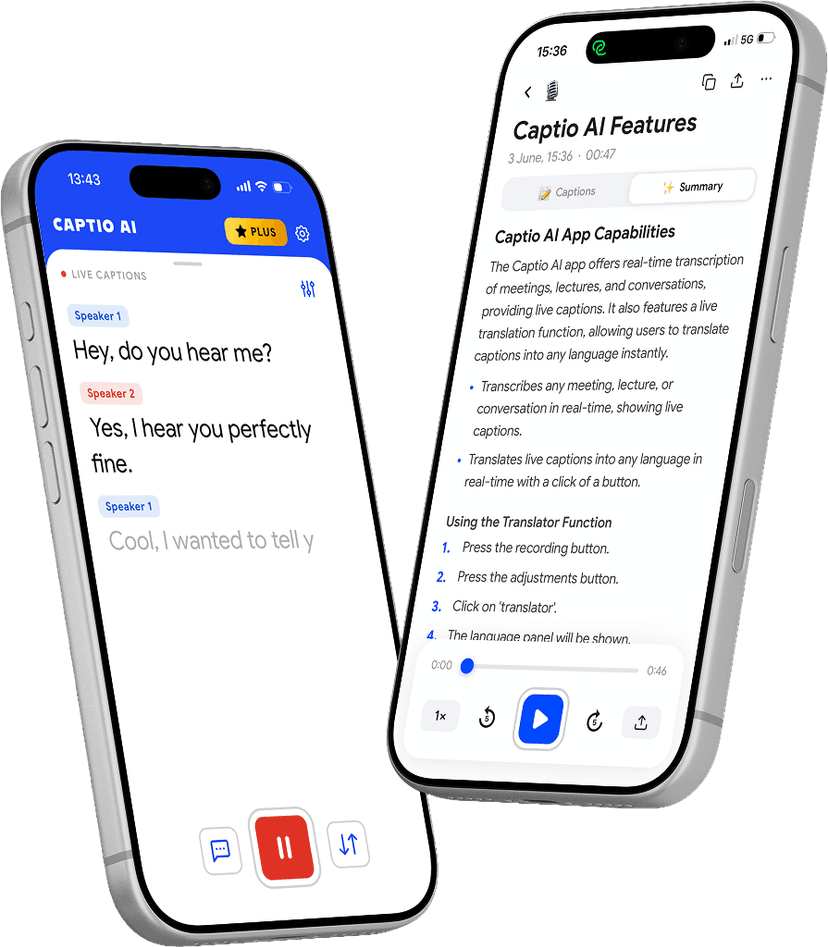
Follow what the doctor says in real time
- Captions appear word by word as they speak
- Handles medical terminology, drug names, and clinical language
- Place the phone on the desk — no setup needed
- Works in any consultation room, clinic, or hospital setting
When the doctor speaks another language
- Captions and translates in real time
- Follow your diagnosis in the language you understand best
- 60+ languages, no manual switching
- For foreign specialists, travel, or immigration settings
A full record of the consultation
- Record the appointment and upload it for a complete transcript
- Review instructions, drug names, and follow-up steps at home
- Share with a family member or carer if needed
- Works on any consultation recording
Key instructions extracted automatically
- Diagnosis, medication, and follow-up steps pulled from any transcript
- Organised into clear sections
- Nothing important missed or forgotten
- Works on any saved appointment recording
Download for free
Every situation covered
Designed for the real moments that matter — not just quiet controlled environments.
At a pirminės sveikatos priežiūros centras (primary healthcare centre) in Vilnius, Kaunas, or a smaller miestas, your gydytojas explains symptoms and treatment in Lithuanian. Captio AI captions every word so you follow the full consultation.
At a specialist appointment at Vilniaus universiteto ligoninė or a regional ligoninė, medical terminology arrives in Lithuanian mixed with Latinate vocabulary. Captio AI captions both in real time.
At the vaistinė (pharmacy), the vaistininkas explains dosage and drug interactions quickly. Point your phone toward them and read the instructions as they speak.
At the odontologijos klinika (dental clinic), the dentist gives instructions during treatment when lip-reading is impossible. Captio AI captions from audio alone.
In a session with a psichologas or psichiatras, sensitive conversations require full comprehension. Captio AI captions the full session so you engage without gaps.
At the priėmimo skyrius (emergency department), staff speak quickly under pressure. Open Captio AI and read their instructions in real time.
Most accurate and fastest models
word accuracy
independent benchmark, 2025
real-time captions
first word appears as you speak
Download for free
Built for the conversations where every word matters
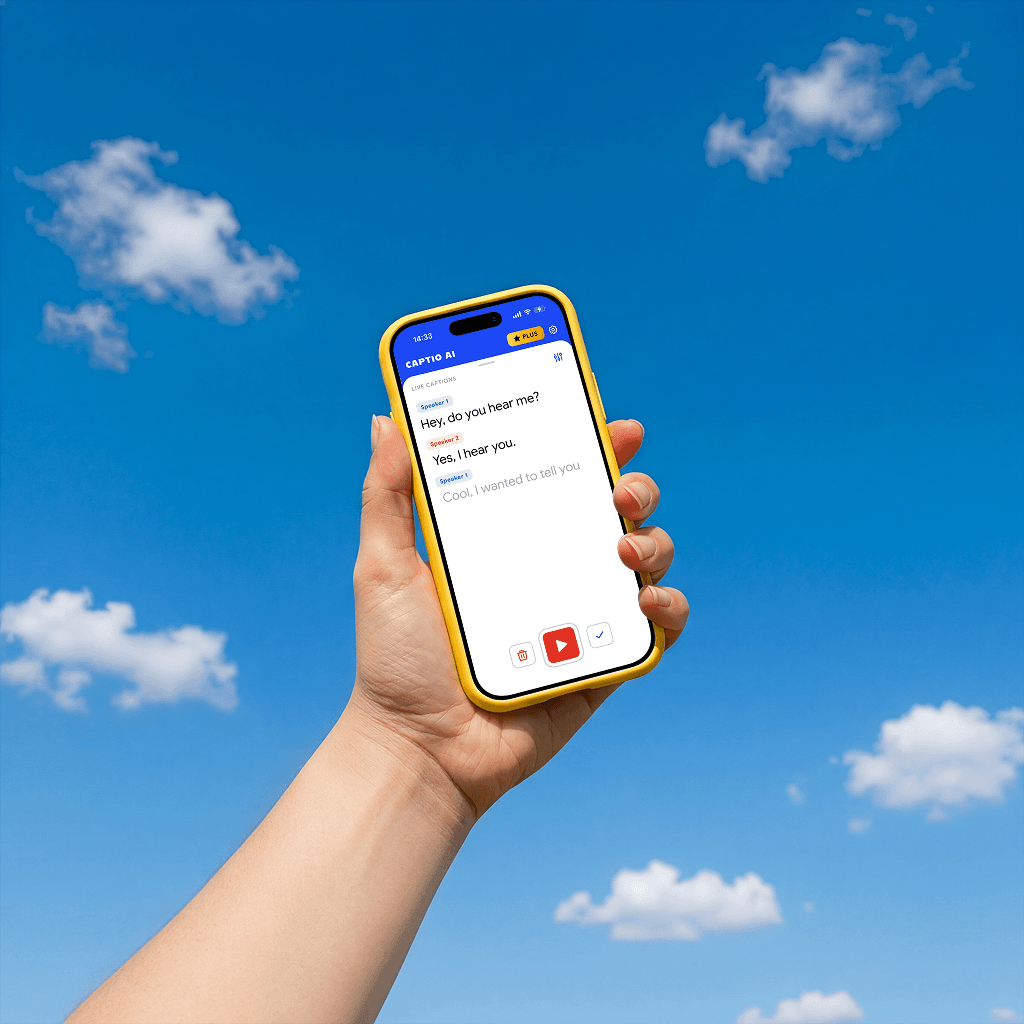
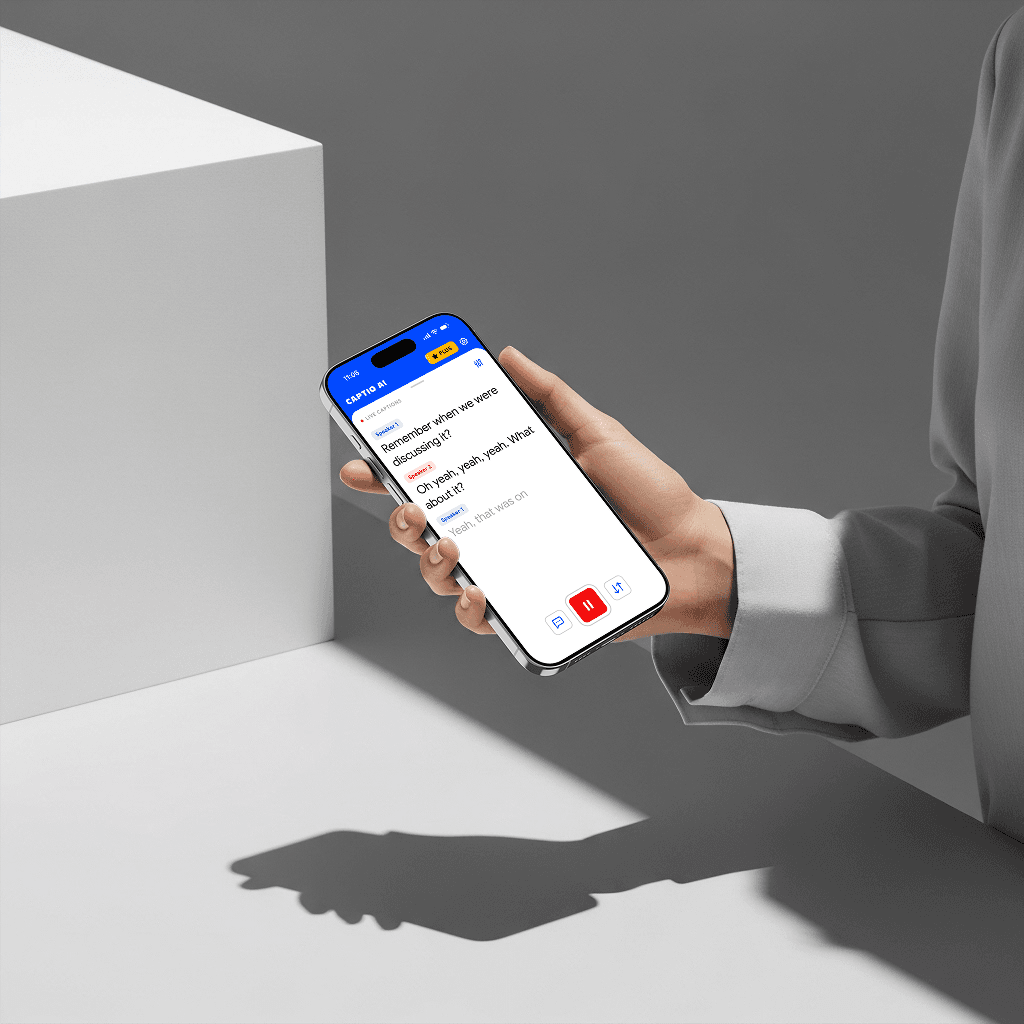
Captions as the doctor speaks
Words appear on screen while the doctor is still talking. You read the diagnosis, drug name, or follow-up instruction at the same moment it is said — not after they have moved on.
Medical terminology handled accurately
Drug names, procedure names, clinical terms. Captio AI handles the vocabulary of a real consultation — not just everyday speech.
Review the appointment after
Record the consultation and upload it to Audio Transcription. Get a full written record of everything said — instructions, dosages, referrals — to review at home and share with a carer if needed.
Works in any clinical setting
Consultation rooms, hospital wards, A&E, dental chairs, pharmacy counters. Place the phone near the speaker and Captio AI captions whoever is talking.
Any language
For foreign-language doctors, specialists abroad, or appointments through an interpreter. Live Translator captions and translates in real time so you follow your diagnosis in the language you understand best.
100% private
Medical conversations are among the most sensitive there are. Captio AI processes audio in real time and discards it immediately. Nothing is recorded, stored, or shared.
Why Lithuanian is hard to understand
Pitch accent
- Lithuanian's two pitch tones change meaning but leave no trace on the lips
- Lithuanian uses a pitch accent system in which stressed heavy syllables carry one of two tones: the acute (falling) and the circumflex (rising). These tones are phonemically significant in clinical vocabulary — the same vowel sequence carries different meaning depending on pitch contour. For a deaf or hard of hearing patient, both tones produce identical lip shapes. The entire tonal layer of Lithuanian phonology is invisible at lip-reading distance.
Samogitian broken tone
- Samogitian dialects add a glottal stop that is invisible on the lips
- In Samogitian (Žemaitian) dialects — spoken across western Lithuania including Klaipėda, Šiauliai, and the Samogitia region — the acute tone is realised through a glottal stop followed by a sharp pitch drop. This broken tone is produced in the larynx and creates no visible lip movement. A deaf patient lip-reading a Samogitian-accented doctor encounters a phonological feature that is absent both from their lip-reading training and from the visual signal.
Seven grammatical cases
- The same root word takes seven different forms, each with different lip shapes
- Lithuanian has seven grammatical cases, meaning the same medical term appears in different forms throughout a single sentence depending on its grammatical role. In a clinical consultation, a doctor names a condition, then refers to it again in three different cases — each producing a different ending and a different lip shape. A deaf patient must recognise a word across all its case endings rather than in a single stable form.
Vowel length contrast
- Long and short vowels change meaning but produce identical lip shapes
- Lithuanian contrasts long and short vowels throughout its vowel system. Length is phonemically significant in clinical vocabulary but produces no visible difference in lip shape — only duration, which is auditory. A deaf patient lip-reading Lithuanian misses the length contrast that distinguishes word meanings, creating systematic ambiguity across entire categories of clinical vocabulary.
Aukštaitian–Samogitian dialect gap
- High and Low Lithuanian produce different vowel shapes for the same words
- Lithuanian divides into two major dialect groups: Aukštaitian (High Lithuanian, the basis for Standard Lithuanian) and Samogitian (Low Lithuanian, spoken in the west). These dialects differ in vowel quality, pitch realisation, and vocabulary. A deaf patient trained to lip-read Standard Lithuanian encounters Samogitian-speaking medical staff producing different mouth shapes for clinical vocabulary they recognise.
Download for free
Hearing loss in Lithuania: genetics, sign language recognition, and clinical access
Lithuania has approximately 14,500 deaf people who use Lithuanian Sign Language (LGK — Lietuvių gestų kalba) as their primary means of communication. Lithuanian Sign Language has formal recognition within the Lithuanian education and social welfare system, providing a legal basis for interpreter provision and sign language education. Notably, Lithuania has one of the highest identified prevalence rates of the GJB2 gene mutation c.313_326del14 among European populations — a mutation associated with non-syndromic sensorineural hearing loss — with research published in PMC identifying this mutation at a frequency of 28.3% of pathogenic alleles in the Lithuanian population, suggesting an ancestral origin in Lithuanian ancestors. This genetic factor contributes to a deaf and hard of hearing community whose size is shaped not only by acquired hearing loss but by a significant inherited component.
For deaf and hard of hearing Lithuanians, the healthcare system presents the same structural access challenges found across Central and Eastern Europe: legal recognition of sign language in principle, with interpreter availability that does not always match demand in practice. A deaf patient attending a gydytojo kabinetas or ligoninė outside Vilnius or Kaunas may find that booking a qualified LGK interpreter in advance is difficult, and for urgent or same-day appointments, it may be impossible. Lithuanian clinical speech — with its pitch accent system, case-inflected medical vocabulary, and dialectal diversity — is also among the more phonologically complex Baltic languages for lip-reading purposes.
The combination of a genetically shaped deaf community, limited interpreter infrastructure outside major cities, and a phonologically demanding language creates an access problem that is felt most acutely at the appointment itself. A deaf Lithuanian attending a rural pirminės sveikatos priežiūros centras without an interpreter must lip-read a language with invisible tonal distinctions across a seven-case vocabulary — conditions under which even an expert lip-reader will miss clinically critical information. Captio AI captions Lithuanian in real time at any gydytojo kabinetas or ligoninė, giving every patient direct access to their doctor's words.
Download for free
What you hear stays with you.
Gone the moment it ends
Captio AI processes your audio in real time and discards it immediately. Nothing is recorded. Nothing is kept.
Not a product
Your conversations are not something Captio AI sells, shares, or monetizes — to anyone, for any reason.
Not used to train anything
What you say in a doctor's appointment or a job interview never ends up in a training dataset. Not ours. Not anyone else's.

Private by default
Captio AI supports 60+ languages
Download for free
Frequently asked questions
Understand your diagnosis in Lithuanian.
Captio AI is free to start
Download for free