

Turkish live captions and productivity tool for doctor appointments
For deaf and hard of hearing people.
Download for free
Everything you need to follow Turkish doctor appointments
Four tools built for deaf and hard of hearing Turkish speakers.
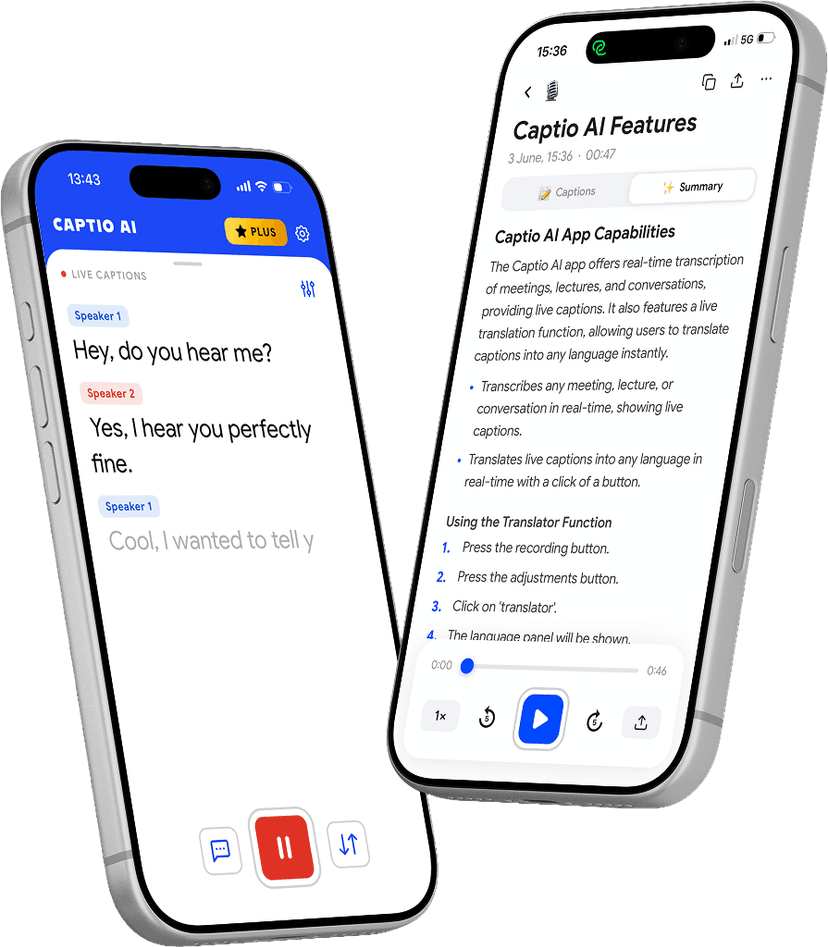
Follow what the doctor says in real time
- Captions appear word by word as they speak
- Handles medical terminology, drug names, and clinical language
- Place the phone on the desk — no setup needed
- Works in any consultation room, clinic, or hospital setting
When the doctor speaks another language
- Captions and translates in real time
- Follow your diagnosis in the language you understand best
- 60+ languages, no manual switching
- For foreign specialists, travel, or immigration settings
A full record of the consultation
- Record the appointment and upload it for a complete transcript
- Review instructions, drug names, and follow-up steps at home
- Share with a family member or carer if needed
- Works on any consultation recording
Key instructions extracted automatically
- Diagnosis, medication, and follow-up steps pulled from any transcript
- Organised into clear sections
- Nothing important missed or forgotten
- Works on any saved appointment recording
Download for free
Every situation covered
Designed for the real moments that matter — not just quiet controlled environments.
Government hospital polyclinic visits (poliklinik), where patient volumes are high and consultations are brief.
Specialist appointments at a devlet hastanesi or şehir hastanesi, where medical language is dense and appointment time is limited.
Pharmacy consultations at an eczane, where the pharmacist explains dosage instructions quickly in standard Turkish.
Dental appointments, where the dentist continues speaking during treatment and the patient cannot turn to lip-read.
Mental health consultations at a psikiyatri clinic, where follow-up questions and emotional nuance are central.
Emergency room visits (acil servis), where staff communicate rapidly and the environment is loud.
Most accurate and fastest models
word accuracy
independent benchmark, 2025
real-time captions
first word appears as you speak
Download for free
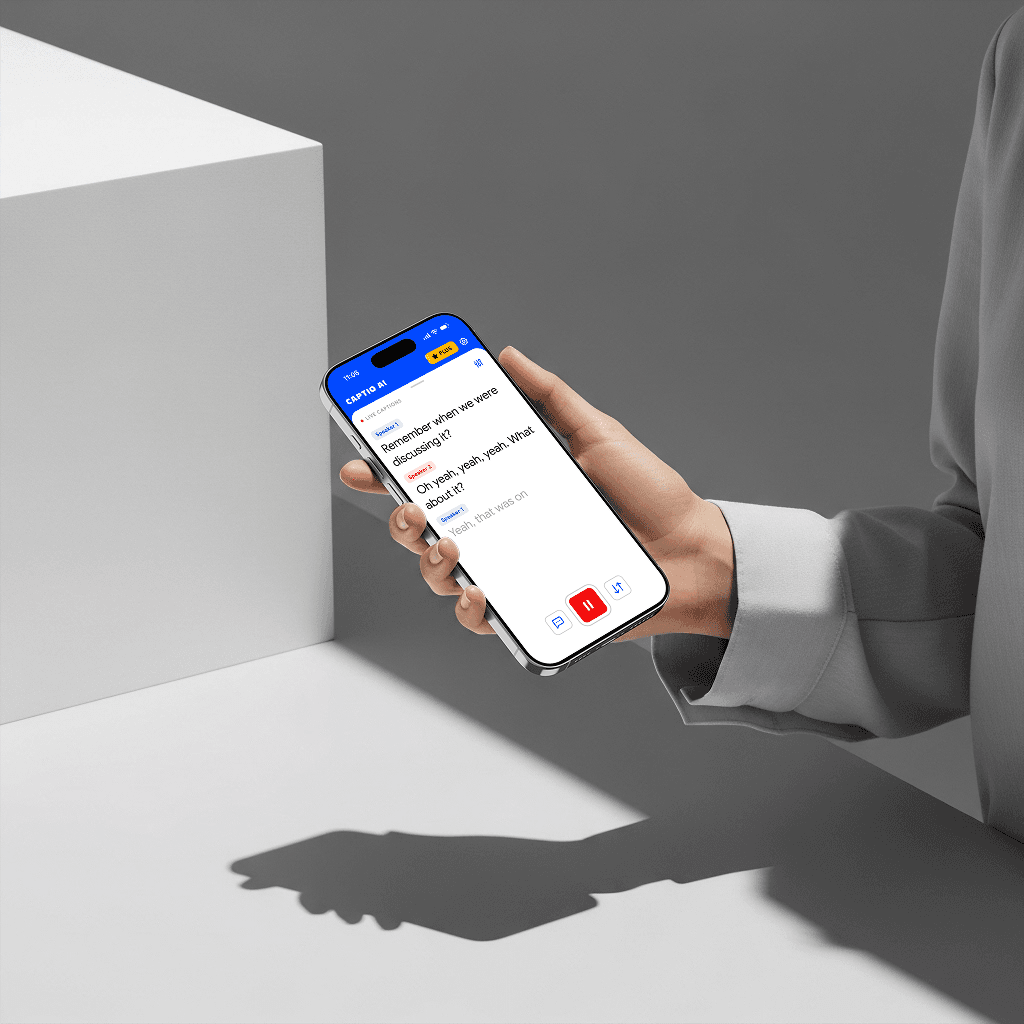
Built for the conversations where every word matters
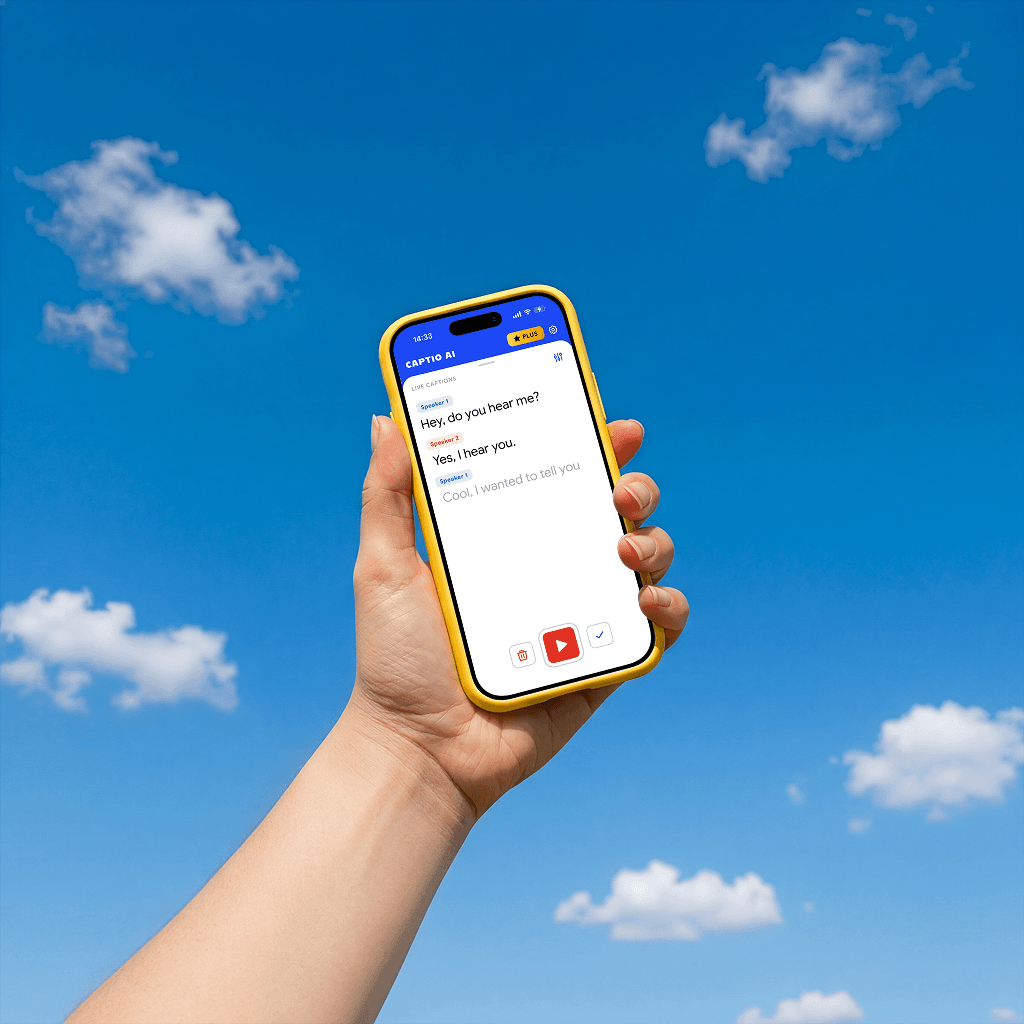
Captions as the doctor speaks
Words appear on screen while the doctor is still talking. You read the diagnosis, drug name, or follow-up instruction at the same moment it is said — not after they have moved on.
Medical terminology handled accurately
Drug names, procedure names, clinical terms. Captio AI handles the vocabulary of a real consultation — not just everyday speech.
Review the appointment after
Record the consultation and upload it to Audio Transcription. Get a full written record of everything said — instructions, dosages, referrals — to review at home and share with a carer if needed.
Works in any clinical setting
Consultation rooms, hospital wards, A&E, dental chairs, pharmacy counters. Place the phone near the speaker and Captio AI captions whoever is talking.
Any language
For foreign-language doctors, specialists abroad, or appointments through an interpreter. Live Translator captions and translates in real time so you follow your diagnosis in the language you understand best.
100% private
Medical conversations are among the most sensitive there are. Captio AI processes audio in real time and discards it immediately. Nothing is recorded, stored, or shared.
Why Turkish is hard to understand
Vowel harmony invisible
- Vowel harmony shifts happen inside the mouth
- Turkish operates on a vowel harmony system — all vowels in a word align as front or back, rounded or unrounded. The distinctions between the eight vowels occur largely in the back of the mouth and pharynx, producing surface lip positions that are ambiguous. For a deaf patient, many Turkish suffixes — including those that mark tense, negation, and case — look identical on the lips even when they carry different clinical meaning.
Agglutinative complexity
- One long word can carry an entire clinical sentence
- Turkish is agglutinative: suffixes stack onto verb and noun roots to encode tense, person, case, negation, and conditionality in a single word. A doctor saying 'geliniz' (please come in) or 'ameliyata hazırlanmanız gerekiyor' (you need to prepare for surgery) packs complex information into words that a lip-reader must parse as a single visual unit.
Medical register mix
- Turkish clinical terms mix Arabic, French, and Greek roots
- Turkish medical language draws from Ottoman Arabic, French medicine (due to 19th-century medical education), and Greek anatomical terminology. A deaf patient familiar with everyday Turkish may not recognise the lip patterns for terms like 'anjiyografi' (angiography) or 'ekokardiyografi' (echocardiography) because these words have no visual connection to their everyday Turkish roots.
Regional accent divergence
- Black Sea, Aegean, and Eastern Turkish sound different
- Standard Istanbul Turkish differs measurably from Black Sea (Karadeniz) Turkish — which raises pitch significantly — and from Eastern Anatolian varieties influenced by Kurdish phonology. A deaf patient from Izmir attending a clinic staffed by doctors from Trabzon or Erzurum faces a different set of lip patterns for the same words.
Oralism legacy
- Deaf Turkish patients were historically pushed toward lip-reading alone
- Turkish Sign Language (TID) was banned in schools from the 1800s until 2005, and the deaf education system emphasised oral speech. Many deaf Turkish adults were raised to rely solely on lip-reading — but the lip-reading of Turkish, with its deep back-vowels and agglutinative word forms, is among the most difficult tasks in any language.
Download for free
4 million Turks with hearing impairment. A sign language law that hasn't reached the clinic.
Approximately 4 million people — around 5% of Turkey's population — live with hearing impairment. Of these, an estimated 200,000 are users of Turkish Sign Language (TID), a language that was banned in education from the 1800s until 2005. The Law on Disabled Individuals passed that year gave formal recognition to TID, and a 2013 discrimination law extended protections, but neither law mandated sign language interpreter provision in healthcare settings. As of the mid-2020s, access to a TID interpreter in a Turkish hospital remains the exception rather than the rule.
The educational consequences of the oralism period are still visible. The rate of higher education attendance among deaf people in Turkey is approximately 1 in 1,000, compared to 11% for visually impaired people — a gap that reflects decades of communication-disadvantaged schooling. Deaf adults in Turkey entering the healthcare system do so with, on average, lower health literacy and a greater dependence on family members to interpret verbal consultations, prescriptions, and discharge summaries.
In 2020, sign language interpretation on television became mandatory in Turkey — a significant step that does not extend to hospitals or pharmacies. A deaf patient attending a government poliklinik or emergency department in Ankara or Istanbul typically has no interpreter available and must rely on written notes, a family member, or guesswork. In a country with 4 million people affected, the gap between legal recognition and clinical access remains large.
Download for free
What you hear stays with you.
Gone the moment it ends
Captio AI processes your audio in real time and discards it immediately. Nothing is recorded. Nothing is kept.
Not a product
Your conversations are not something Captio AI sells, shares, or monetizes — to anyone, for any reason.
Not used to train anything
What you say in a doctor's appointment or a job interview never ends up in a training dataset. Not ours. Not anyone else's.

Private by default
Captio AI supports 60+ languages
Download for free
Frequently asked questions
Understand your diagnosis in Turkish.
Captio AI is free to start
Download for free