

Macedonian live captions and productivity tool for doctor appointments
For deaf and hard of hearing people.
Download for free

Everything you need to follow Macedonian doctor appointments
Four tools built for deaf and hard of hearing Macedonian speakers.
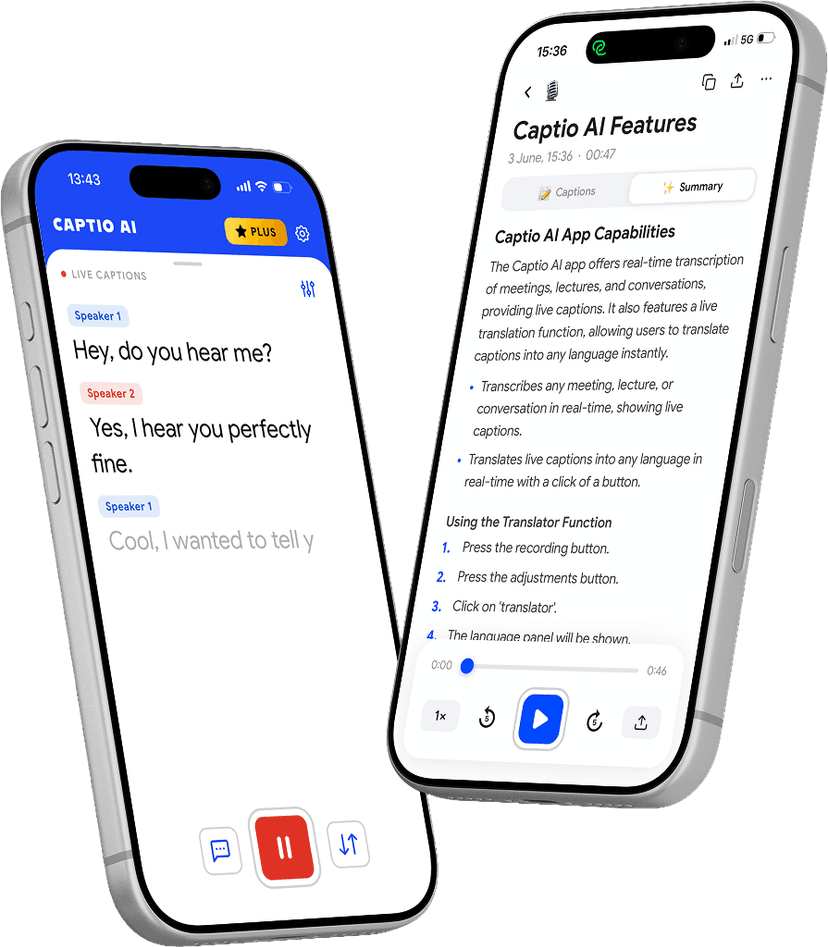
Follow what the doctor says in real time
- Captions appear word by word as they speak
- Handles medical terminology, drug names, and clinical language
- Place the phone on the desk — no setup needed
- Works in any consultation room, clinic, or hospital setting
When the doctor speaks another language
- Captions and translates in real time
- Follow your diagnosis in the language you understand best
- 60+ languages, no manual switching
- For foreign specialists, travel, or immigration settings
A full record of the consultation
- Record the appointment and upload it for a complete transcript
- Review instructions, drug names, and follow-up steps at home
- Share with a family member or carer if needed
- Works on any consultation recording
Key instructions extracted automatically
- Diagnosis, medication, and follow-up steps pulled from any transcript
- Organised into clear sections
- Nothing important missed or forgotten
- Works on any saved appointment recording
Download for free
Every situation covered
Designed for the real moments that matter — not just quiet controlled environments.
At a dom na zdravjeto (health centre) in Skopje, Bitola, or a smaller grad, your lekar explains symptoms and treatment in Macedonian. Captio AI captions every word so you follow the full consultation.
At a specialist appointment at Klinički centar Majka Tereza or a regional bolnica, medical terms arrive in Macedonian mixed with Latinate vocabulary. Captio AI captions both in real time.
At the apteka (pharmacy), the farmacevt explains dosage and drug interactions quickly. Point your phone toward them and read the instructions as they speak.
At the stomatolog (dental clinic), the dentist gives instructions during treatment when lip-reading is impossible. Captio AI captions from audio alone.
In a session with a psiholog or psihijatar, sensitive conversations require full comprehension. Captio AI captions the full session so you engage without gaps.
At the itna pomoš (emergency department), staff speak quickly under pressure. Open Captio AI and read their instructions in real time.
Most accurate and fastest models
word accuracy
independent benchmark, 2025
real-time captions
first word appears as you speak
Download for free
Built for the conversations where every word matters
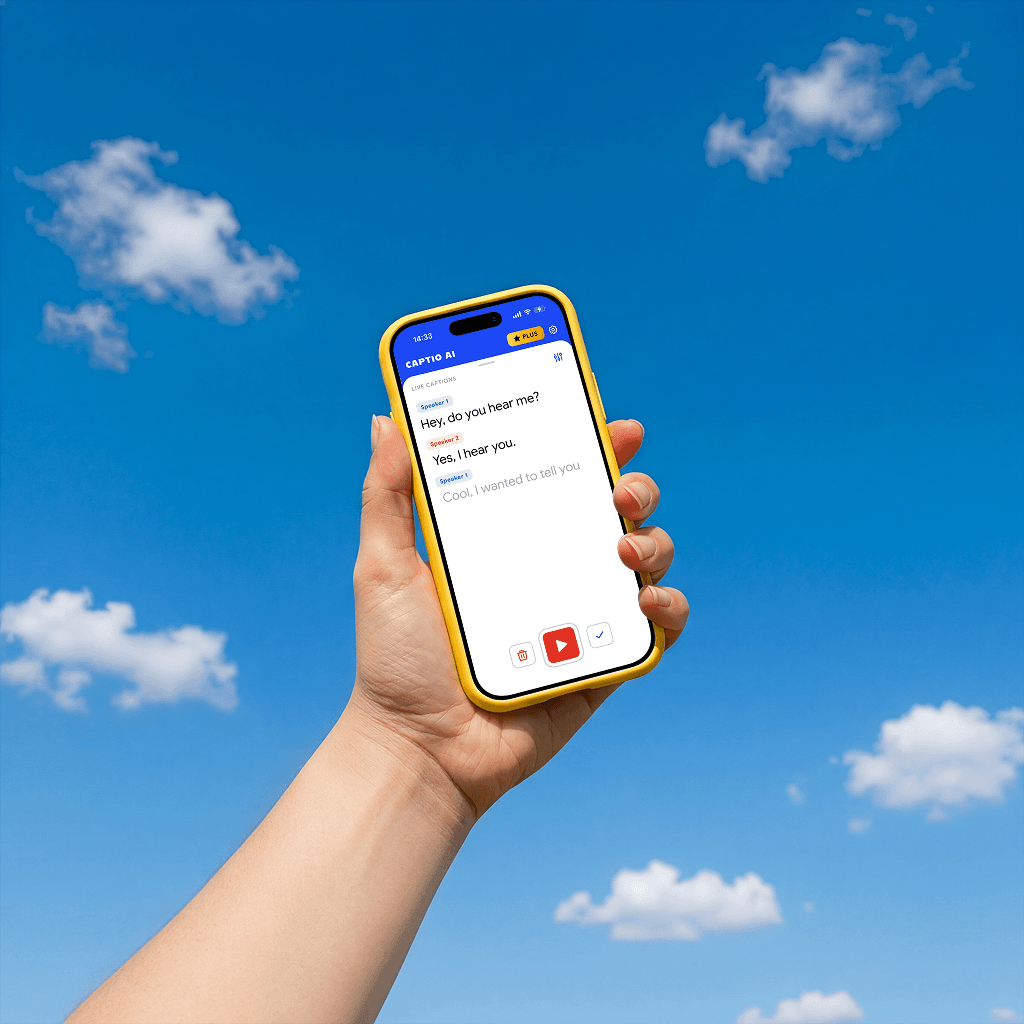
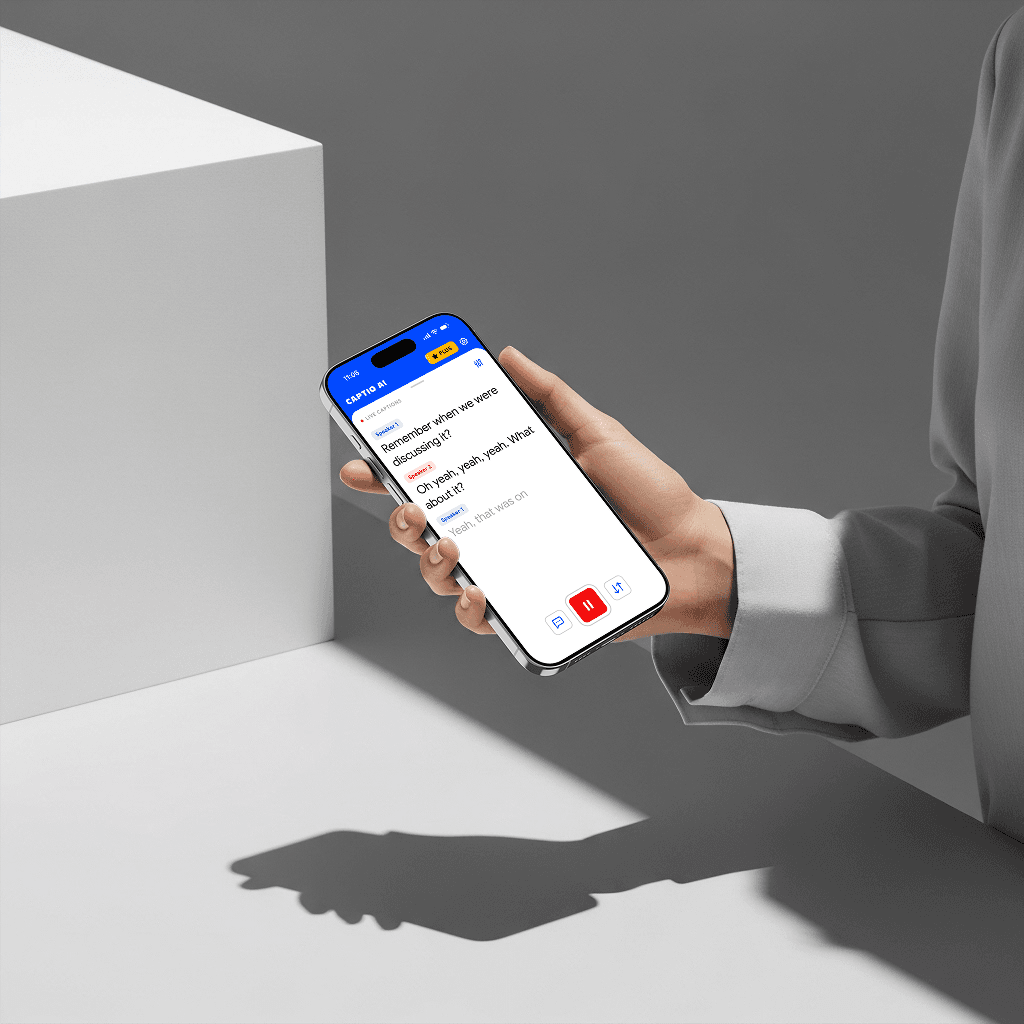
Captions as the doctor speaks
Words appear on screen while the doctor is still talking. You read the diagnosis, drug name, or follow-up instruction at the same moment it is said — not after they have moved on.
Medical terminology handled accurately
Drug names, procedure names, clinical terms. Captio AI handles the vocabulary of a real consultation — not just everyday speech.
Review the appointment after
Record the consultation and upload it to Audio Transcription. Get a full written record of everything said — instructions, dosages, referrals — to review at home and share with a carer if needed.
Works in any clinical setting
Consultation rooms, hospital wards, A&E, dental chairs, pharmacy counters. Place the phone near the speaker and Captio AI captions whoever is talking.
Any language
For foreign-language doctors, specialists abroad, or appointments through an interpreter. Live Translator captions and translates in real time so you follow your diagnosis in the language you understand best.
100% private
Medical conversations are among the most sensitive there are. Captio AI processes audio in real time and discards it immediately. Nothing is recorded, stored, or shared.
Why Macedonian is hard to understand
Fixed antepenultimate stress
- Macedonian stress falls on the third syllable from the end — an unusual pattern for lip-readers
- Standard Macedonian has fixed stress on the antepenultimate (third-from-last) syllable of every word. This consistent pattern differs from the variable stress of Serbian, Croatian, and Bulgarian, and from the first-syllable stress of Hungarian or Finnish. A deaf patient trained to lip-read Serbian or Bulgarian will encounter Macedonian clinical vocabulary stressed differently from familiar patterns — requiring recalibration of which syllable carries the visual energy of stressed speech.
Schwa dialectal variation
- The schwa phoneme varies across Macedonian dialects and is invisible on the lips
- Macedonian has a phonemic schwa /ə/ in many dialects that is marginal in the standard language. In regional clinical speech — particularly from doctors who are native speakers of western or eastern Macedonian dialects — the schwa appears in positions where Standard Macedonian would have a different vowel. This produces lip shapes that do not match the standard word forms a deaf patient was trained to lip-read, and the schwa itself produces a nearly neutral, uninformative mouth opening.
Albanian code-switching
- Western Macedonian healthcare settings may involve Albanian switching
- Approximately 25% of North Macedonia's population speaks Albanian as a first language, concentrated in western cities including Tetovo, Gostivar, and Ohrid. In healthcare facilities in these areas, medical staff may switch between Macedonian and Albanian within a consultation or corridor conversation. A deaf patient tracking lip shapes in Macedonian encounters an entirely different phonological system without warning when Albanian is used.
Regional dialect variation
- Macedonian dialect groups produce different mouth shapes for standard vocabulary
- Macedonian has significant regional dialect variation: the standard language is based on the Prilep-Bitola dialect of central Macedonia, but western, eastern, and northern dialects differ in vowel quality, consonant realisations, and prosody. A deaf patient who lip-reads Standard Macedonian will find doctors from Štip, Strumica, or Tetovo producing different lip shapes for clinical vocabulary they recognise.
Latinate medical register
- Clinical vocabulary layers Latin-origin terms onto Macedonian phonology
- Macedonian clinical speech mixes native Macedonian vocabulary with Latinate and Greek-origin medical terminology. In a single consultation, a doctor may use a native Macedonian word for a condition and then name it formally in a Latin medical term — producing two phonological registers within one sentence. A deaf patient must lip-read across both the South Slavic phonological base of Macedonian and the Latinate clinical vocabulary that overlays it.
Download for free
Hearing loss in North Macedonia: a small country navigating access with limited infrastructure
North Macedonia has a population of approximately 2.1 million and a deaf and hard of hearing community that navigates daily life including healthcare with limited formal sign language infrastructure. Macedonian Sign Language (МЖЈ — Makedonski jazik na znaci) is used by the deaf community and is supported by the Association of Deaf and Hard of Hearing of Macedonia. North Macedonia ratified the UN Convention on the Rights of Persons with Disabilities, committing formally to accessible public services including healthcare. In practice, the interpreter workforce available to support deaf Macedonians in clinical settings is small, and access outside Skopje is inconsistent.
The healthcare challenge for deaf Macedonians is compounded by the multi-ethnic composition of the country. Western Macedonia's significant Albanian-speaking minority means that healthcare facilities in Tetovo, Gostivar, and surrounding areas operate in both Macedonian and Albanian. A deaf patient navigating a healthcare appointment in western Macedonia may encounter staff switching between two languages — neither of which they can lip-read with full accuracy — in settings where sign language interpretation is not available in either language. The 2021 census recorded that Albanian speakers make up approximately 25% of the population, a proportion that shapes everyday clinical communication in the west of the country.
For deaf and hard of hearing Macedonians who rely on lip-reading and assistive technology, the combination of fixed antepenultimate stress (unusual for patients familiar with Serbian or Bulgarian stress patterns), dialectal vowel variation, and Albanian code-switching creates a multilayered access problem at medical appointments. In a healthcare system where interpreter provision is limited and the legislative framework for disability access is still developing, the practical experience of a deaf patient at a dom na zdravjeto in any Macedonian city is often one of partial comprehension and improvised communication. Captio AI captions Macedonian in real time at any dom na zdravjeto or bolnica, giving every patient direct access to their doctor's words.
Download for free
What you hear stays with you.
Gone the moment it ends
Captio AI processes your audio in real time and discards it immediately. Nothing is recorded. Nothing is kept.
Not a product
Your conversations are not something Captio AI sells, shares, or monetizes — to anyone, for any reason.
Not used to train anything
What you say in a doctor's appointment or a job interview never ends up in a training dataset. Not ours. Not anyone else's.
Private by default
Captio AI supports 60+ languages
Download for free
Frequently asked questions
Understand your diagnosis in Macedonian.
Captio AI is free to start
Download for free