

Korean live captions and productivity tool for doctor appointments
For deaf and hard of hearing people.
Download for free

Everything you need to follow Korean doctor appointments
Four tools built for deaf and hard of hearing Korean speakers.
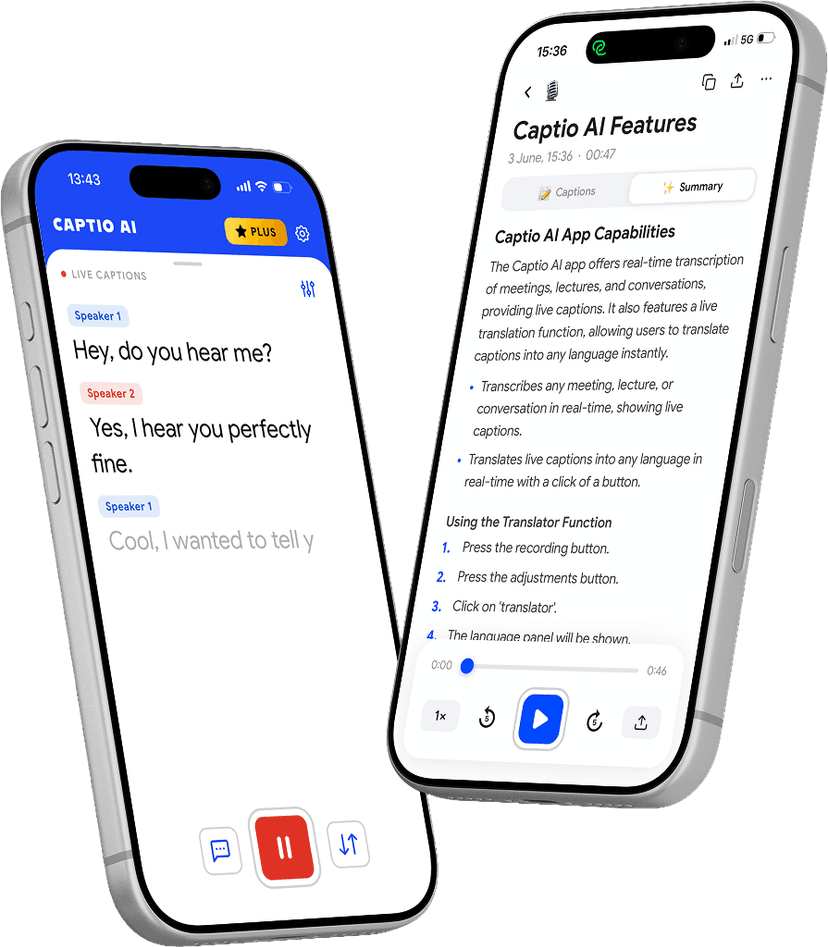
Follow what the doctor says in real time
- Captions appear word by word as they speak
- Handles medical terminology, drug names, and clinical language
- Place the phone on the desk — no setup needed
- Works in any consultation room, clinic, or hospital setting
When the doctor speaks another language
- Captions and translates in real time
- Follow your diagnosis in the language you understand best
- 60+ languages, no manual switching
- For foreign specialists, travel, or immigration settings
A full record of the consultation
- Record the appointment and upload it for a complete transcript
- Review instructions, drug names, and follow-up steps at home
- Share with a family member or carer if needed
- Works on any consultation recording
Key instructions extracted automatically
- Diagnosis, medication, and follow-up steps pulled from any transcript
- Organised into clear sections
- Nothing important missed or forgotten
- Works on any saved appointment recording
Download for free
Every situation covered
Designed for the real moments that matter — not just quiet controlled environments.
General practice and internal medicine visits at a clinic (의원, uiwon), where consultation time is short and doctors type notes simultaneously.
Specialist consultations at a major hospital (종합병원, jonghap byeongwon) in Seoul, Busan, or Daegu, where medical terminology is dense.
Pharmacy consultations at a 약국 (yakguk), where the pharmacist explains dosage instructions in standard Korean.
Dental appointments, where the dentist continues giving instructions during the procedure and the patient cannot turn to face them.
Mental health consultations at a 정신건강의학과 clinic, where nuance and follow-up questions are central.
Emergency room visits (응급실, eungeup-sil), where staff communicate rapidly and environments are loud.
Most accurate and fastest models
character accuracy
independent benchmark, 2025
real-time captions
first word appears as you speak
Download for free
Built for the conversations where every word matters
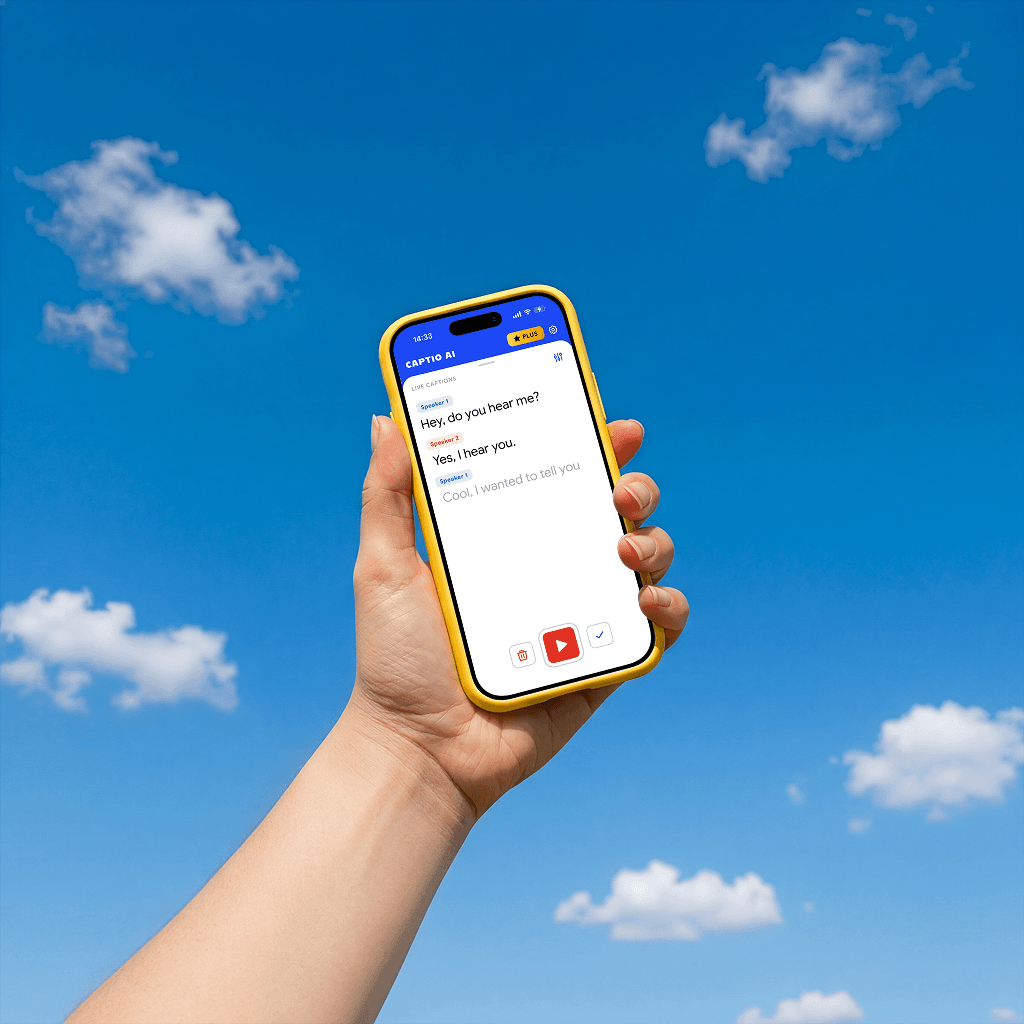
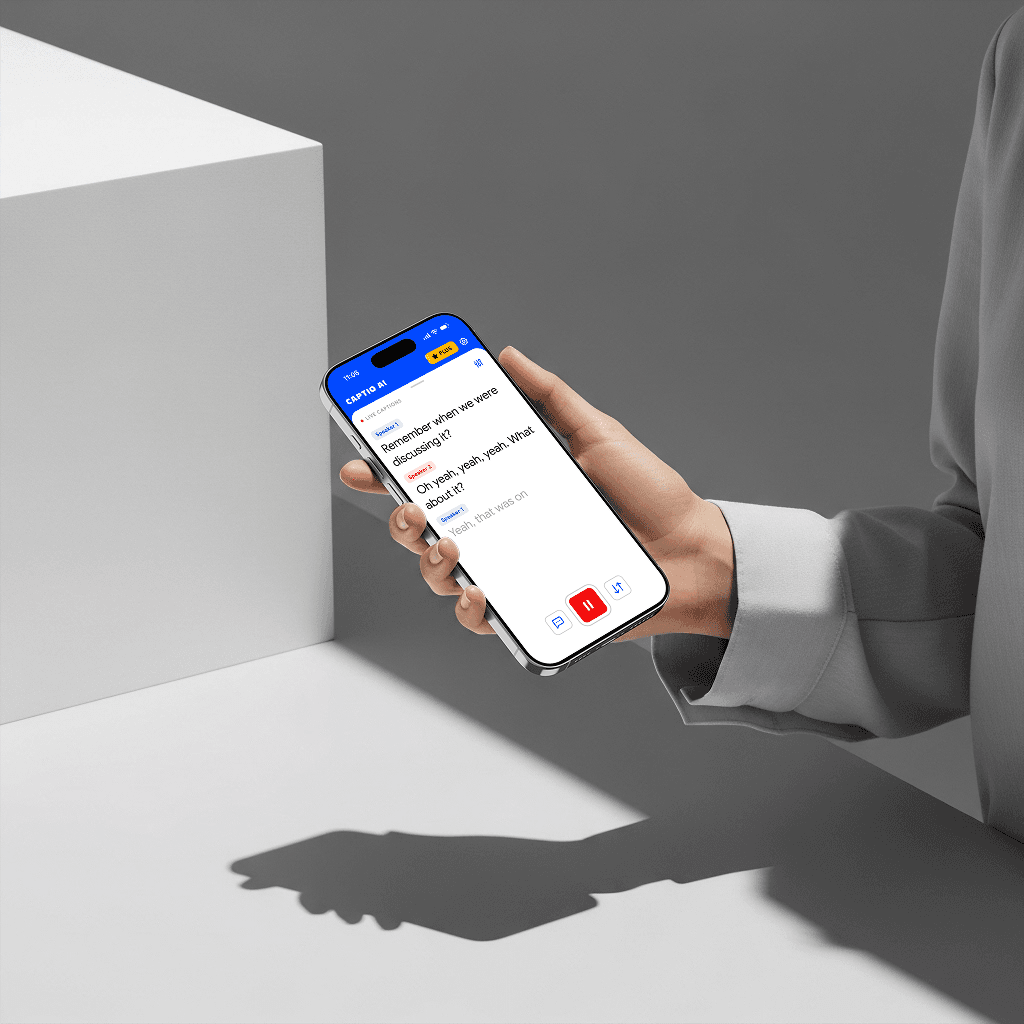
Captions as the doctor speaks
Words appear on screen while the doctor is still talking. You read the diagnosis, drug name, or follow-up instruction at the same moment it is said — not after they have moved on.
Medical terminology handled accurately
Drug names, procedure names, clinical terms. Captio AI handles the vocabulary of a real consultation — not just everyday speech.
Review the appointment after
Record the consultation and upload it to Audio Transcription. Get a full written record of everything said — instructions, dosages, referrals — to review at home and share with a carer if needed.
Works in any clinical setting
Consultation rooms, hospital wards, A&E, dental chairs, pharmacy counters. Place the phone near the speaker and Captio AI captions whoever is talking.
Any language
For foreign-language doctors, specialists abroad, or appointments through an interpreter. Live Translator captions and translates in real time so you follow your diagnosis in the language you understand best.
100% private
Medical conversations are among the most sensitive there are. Captio AI processes audio in real time and discards it immediately. Nothing is recorded, stored, or shared.
Why Korean is hard to understand
Three-way consonant contrast
- Lenis, tense, and aspirated consonants look identical
- Korean has a three-way contrast for stops: plain (lenis), tense, and aspirated. The tense consonants (ㄲ, ㄸ, ㅃ, ㅆ, ㅉ) and aspirated consonants (ㅋ, ㅌ, ㅍ, ㅊ) differ from their plain counterparts entirely in laryngeal tension and aspiration — neither of which is visible on the lips. In a clinical consultation, a deaf patient cannot distinguish a medication dosage instruction that hinges on one of these phoneme pairs.
Unreleased final consonants
- Syllable-final stops are silent on the lips
- Korean syllable-final stops (받침, batchim) are unreleased — the mouth closes to form the stop but never releases it audibly. The words end in what sounds and looks like nothing. When a doctor says a clinical term ending in -k, -p, or -t, the final phoneme is invisible and inaudible. This is a unique challenge for Korean lip-readers that does not exist in the same form for English.
Sino-Korean medical vocabulary
- Medical terminology uses Chinese-origin Korean words
- Korean medical language draws heavily on Sino-Korean vocabulary — words derived from Chinese characters, pronounced in Korean but bearing no visual connection to everyday speech. 고혈압 (gohyeorap, hypertension) and 폐렴 (pyeryeom, pneumonia) share little visible pattern with their colloquial Korean descriptions. A deaf patient fluent in everyday Korean encounters a different visual language at the hospital.
Regional dialect shift
- Jeolla and Gyeongsang accents sound different from Seoul Korean
- Standard Seoul Korean is the broadcast and clinical norm, but a doctor from Busan speaks Gyeongsang-do Korean with different intonation patterns; one from Gwangju speaks Jeolla-do Korean. These regional varieties shift vowel length and pitch accent in ways that alter the visual and auditory pattern of clinical speech, compounding the challenge for a deaf patient who has learned to navigate standard Korean.
Fast Seoul speech
- Colloquial Korean drops and merges syllables at speed
- Fast informal Korean — including the speech common between medical staff and regular patients — merges unstressed syllables and contracts common phrases. A doctor saying 'What are your symptoms?' may produce a compressed string that looks and sounds nothing like the formal words a deaf patient has learned to recognise. Clinical consultations move fast and repetition is rarely offered.
Download for free
9.2% of Korean adults. Government support that reaches the aid but not the appointment.
South Korea's Korea National Health and Nutrition Examination Survey found that 9.2% of Korean adults have moderate-to-profound hearing impairment — rising to 69.7% among adults aged 65 and over. With a rapidly ageing population, the scale of hearing loss in South Korea is significant and growing. A 2018 nationwide population-based study confirmed that severe-to-profound hearing loss affected approximately 250,000 South Koreans in the period studied, with registration in the national disability registry enabling financial support for hearing aids and cochlear implants.
South Korea's national disability framework is among the more developed in Asia: registered deaf individuals receive approximately $1,000 toward hearing aid costs, and up to 90% coverage for cochlear implants. But financial support for devices does not address the communication gap inside the consultation room. There is no requirement for hospitals or clinics to provide sign language interpreters, and the availability of Korean Sign Language (KSL) interpretation in outpatient settings varies widely by region and institution.
A 2015 revision to Korea's hearing aid subsidy policy led to a documented increase in the reported prevalence of hearing loss — suggesting that many cases were previously going unregistered. For people living with hearing loss who are not registered in the disability system, and for the growing elderly population with age-related hearing decline, the clinical consultation remains a largely unmediated verbal exchange with no systematic support.
Download for free
What you hear stays with you.
Gone the moment it ends
Captio AI processes your audio in real time and discards it immediately. Nothing is recorded. Nothing is kept.
Not a product
Your conversations are not something Captio AI sells, shares, or monetizes — to anyone, for any reason.
Not used to train anything
What you say in a doctor's appointment or a job interview never ends up in a training dataset. Not ours. Not anyone else's.

Private by default
Captio AI supports 60+ languages
Download for free
Frequently asked questions
Understand your diagnosis in Korean.
Captio AI is free to start
Download for free