

Basque live captions and productivity tool for doctor appointments
For deaf and hard of hearing people.
Download for free
Everything you need to follow Basque doctor appointments
Four tools built for deaf and hard of hearing Basque speakers.
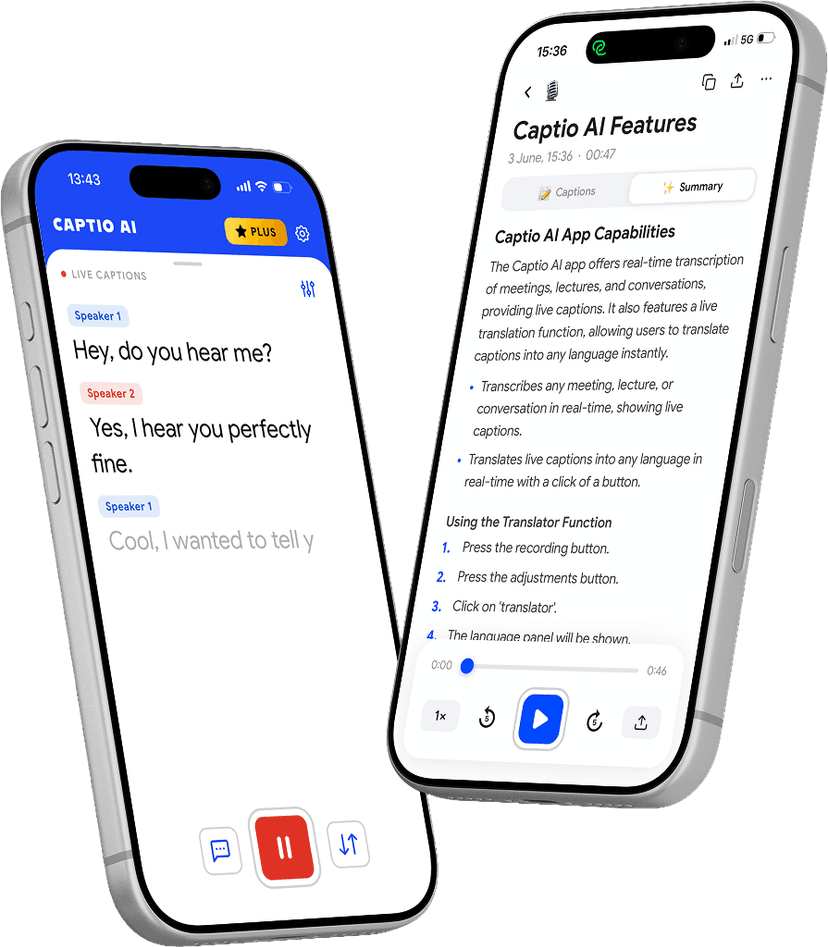
Follow what the doctor says in real time
- Captions appear word by word as they speak
- Handles medical terminology, drug names, and clinical language
- Place the phone on the desk — no setup needed
- Works in any consultation room, clinic, or hospital setting
When the doctor speaks another language
- Captions and translates in real time
- Follow your diagnosis in the language you understand best
- 60+ languages, no manual switching
- For foreign specialists, travel, or immigration settings
A full record of the consultation
- Record the appointment and upload it for a complete transcript
- Review instructions, drug names, and follow-up steps at home
- Share with a family member or carer if needed
- Works on any consultation recording
Key instructions extracted automatically
- Diagnosis, medication, and follow-up steps pulled from any transcript
- Organised into clear sections
- Nothing important missed or forgotten
- Works on any saved appointment recording
Download for free
Every situation covered
Designed for the real moments that matter — not just quiet controlled environments.
At an osasun-etxe (health centre) in Bilbao, San Sebastián, or a smaller herri, your medikua explains symptoms and treatment in Basque. Captio AI captions every word so you follow the full consultation.
At a specialist appointment at Basurto Unibertsitate Ospitalea or a regional ospitale, medical terms arrive in Basque or Spanish. Captio AI captions both in real time so you follow every detail.
At the farmazia (pharmacy), the farmazilaria explains dosage and drug interactions in Basque or Spanish. Point your phone toward them and read the instructions as they speak.
At the hortzetakoa (dental clinic), the dentist gives instructions during treatment when lip-reading is impossible. Captio AI captions from audio alone.
In a session with a psikologo or psikiatra, sensitive conversations require full comprehension. Captio AI captions the full session so you engage without gaps.
At the larrialdiak (emergency department), staff speak quickly under pressure. Open Captio AI and read their instructions in real time.
Most accurate and fastest models
word accuracy
independent benchmark, 2025
real-time captions
first word appears as you speak
Download for free
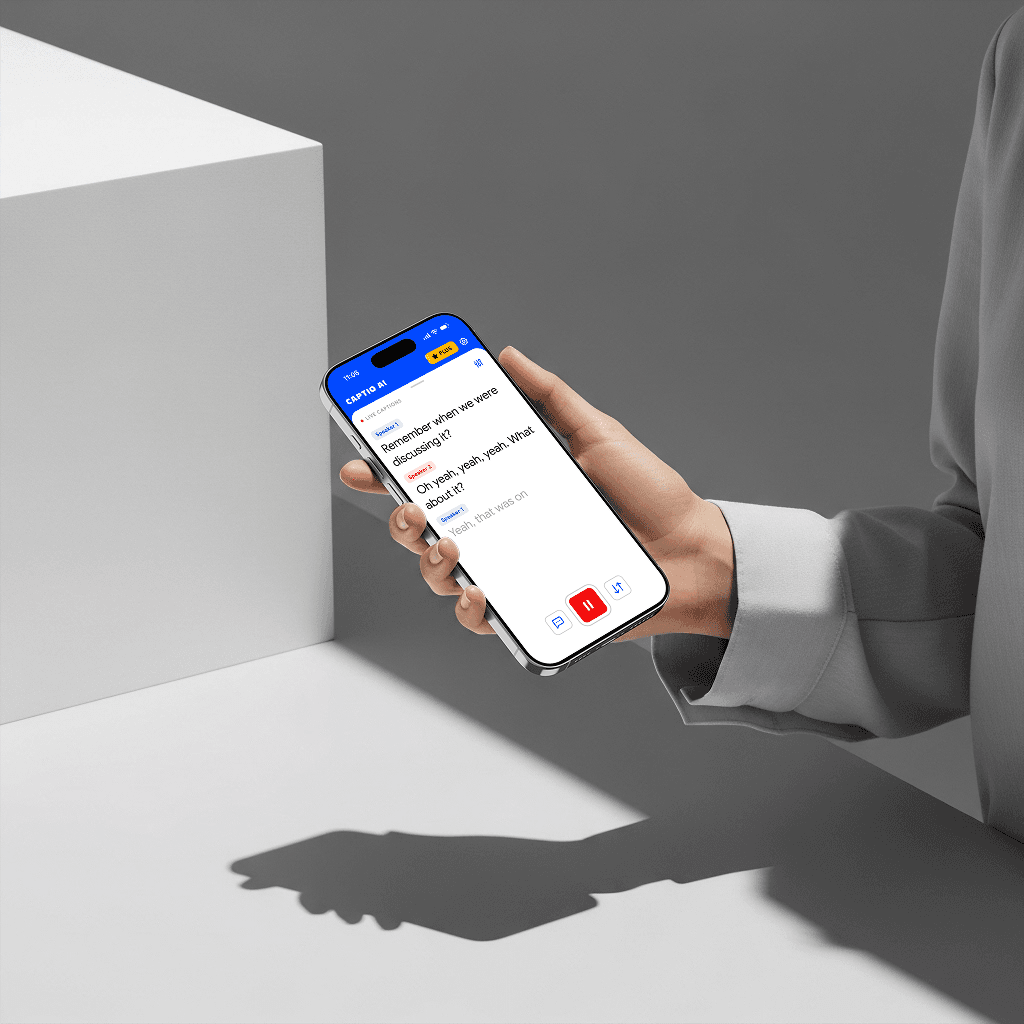
Built for the conversations where every word matters
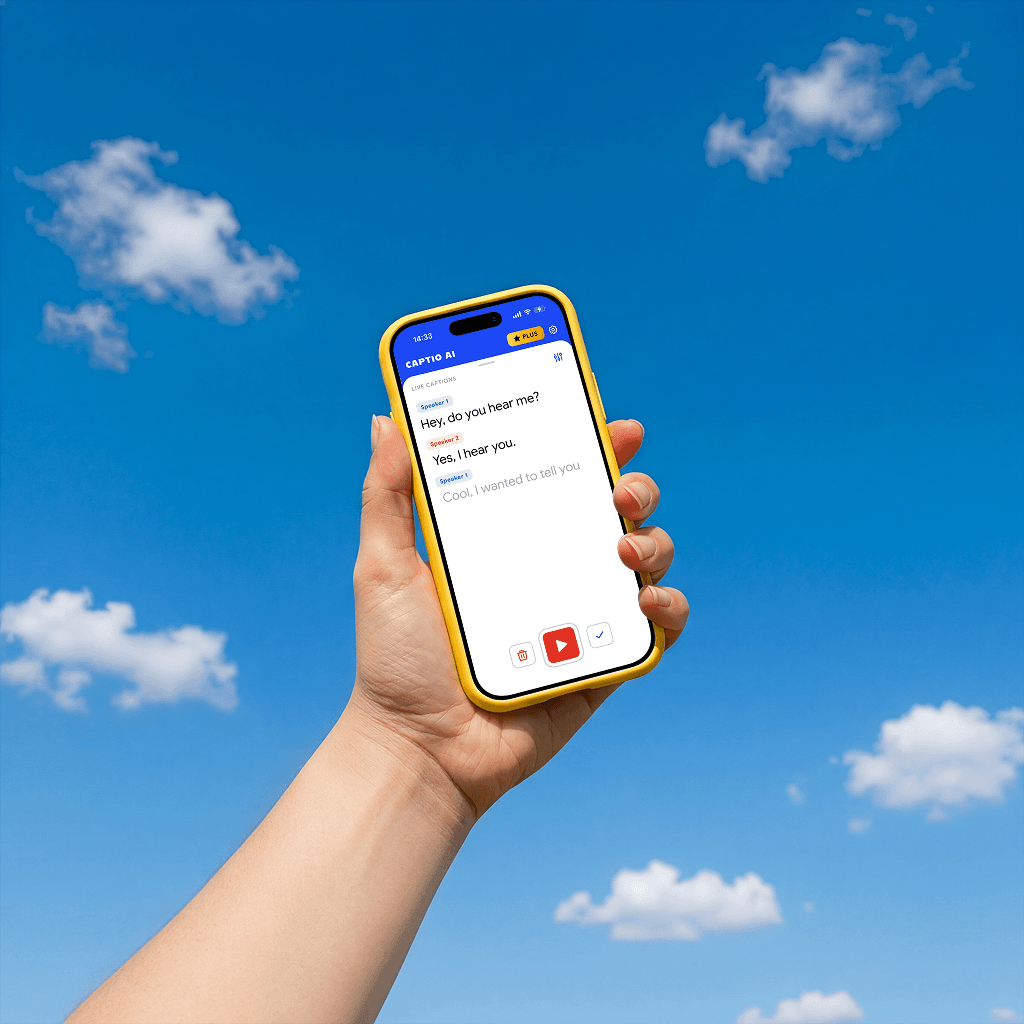
Captions as the doctor speaks
Words appear on screen while the doctor is still talking. You read the diagnosis, drug name, or follow-up instruction at the same moment it is said — not after they have moved on.
Medical terminology handled accurately
Drug names, procedure names, clinical terms. Captio AI handles the vocabulary of a real consultation — not just everyday speech.
Review the appointment after
Record the consultation and upload it to Audio Transcription. Get a full written record of everything said — instructions, dosages, referrals — to review at home and share with a carer if needed.
Works in any clinical setting
Consultation rooms, hospital wards, A&E, dental chairs, pharmacy counters. Place the phone near the speaker and Captio AI captions whoever is talking.
Any language
For foreign-language doctors, specialists abroad, or appointments through an interpreter. Live Translator captions and translates in real time so you follow your diagnosis in the language you understand best.
100% private
Medical conversations are among the most sensitive there are. Captio AI processes audio in real time and discards it immediately. Nothing is recorded, stored, or shared.
Why Basque is hard to understand
Language isolate phonology
- Basque has no related language — its phonological patterns have no European parallel
- Basque (Euskara) is a language isolate — unrelated to any other language on earth, including all its Indo-European neighbours in Spain and France. Its consonant inventory, syllable structure, and prosodic patterns follow rules that cannot be predicted from Spanish, French, or any other language a deaf patient may have lip-reading experience with. For a deaf or hard of hearing person who lip-reads Spanish, Basque produces a completely unfamiliar sequence of lip movements — nothing transfers across.
Northern aspirated stops
- Northern Basque dialects have aspirated stop consonants absent in southern Basque
- Northern Basque (spoken in the French Basque Country — Lapurdi, Behe-Nafarroa, Zuberoa) has aspirated stop consonants: ph, th, kh, as in French Basque 'philoa' (bean). These aspirated stops produce a small puff of air after the stop closure — an auditory cue with no reliable visual equivalent. Southern Basque (Spain's Basque Country) lacks these aspirated stops. A deaf patient who lip-reads one variety finds the other phonologically distinct at the level of individual consonant categories.
Six dialect zones
- Basque has six major dialect groups that differ substantially from each other
- Basque divides into six major dialect zones: Bizkaian, Gipuzkoan, Upper Navarrese, Lower Navarrese, Lapurdian, and Souletin — with further sub-dialects within each. These varieties differ in vocabulary, phonology, and even grammar. Standard Basque (Batua), created in 1968 and used in formal education and media, is a unified variety that most speakers use as a second register alongside their home dialect. In clinical settings, a doctor's Batua is overlaid with their home dialect's phonology — meaning a deaf patient must lip-read the dialect hybrid rather than the clean standard.
Basque–Spanish code-switching
- Clinical appointments in the Basque Country switch between Euskara and Spanish
- In the Basque Country (Euskadi) and Navarre, healthcare settings code-switch between Basque and Spanish (Castilian) routinely — doctors may give diagnoses in Spanish and explanations in Basque, or use Spanish for Latinate medical vocabulary while conducting the consultation in Basque. A deaf patient lip-reading Basque encounters Spanish-phonology words without warning, across two phonological systems with no structural similarity to each other.
Agglutinative suffix complexity
- Basque's agglutinative structure stacks suffixes that change word length and shape
- Basque is an agglutinative language that builds complex words through suffix stacking — case markers, tense, aspect, and politeness are all expressed through suffixes attached to the stem. In clinical speech, a single Basque word may encode a full English phrase. A deaf patient lip-reading Basque must parse a single long continuous word form where an English-trained lip-reader would expect several separate words.
Download for free
Hearing loss in the Basque Country: Spain's numbers, a unique language, and a sign language law that works in Spanish
Spain has approximately 1,064,000 people who are deaf or have a significant hearing disability — 2.3% of the population. The Basque Country (Euskadi) has a population of approximately 2.2 million across three provinces, and the proportion of deaf and hard of hearing residents follows the national pattern. Spain's Law 27/2007 recognises Spanish Sign Language (Lengua de Signos Española, LSE) and regulates communication support for deaf, hard of hearing, and deafblind people. In the Basque Country, the primary sign language used by the deaf community is LSE — not a Basque Sign Language. This means that for a deaf Basque speaker who uses Basque as their primary language, communication support in healthcare settings arrives primarily through Spanish Sign Language, not a language variety tied to Basque culture or phonology.
The practical access challenge in Basque healthcare settings is shaped by three factors: the relatively small interpreter workforce for LSE in the Basque Country, the code-switching nature of clinical appointments between Basque and Spanish, and the phonological uniqueness of Basque itself. A deaf Basque patient attending an osasun-etxe without an interpreter must lip-read a language with no Indo-European relatives — a task for which no training from any other European language provides relevant preparation. Even an experienced Spanish lip-reader cannot transfer their skills to Basque phonology. COVID-19 research published in PMC found that people with hearing disabilities across Spain experienced systematic inaccessibility of health information during the pandemic, with Basque-language health communications presenting an additional layer of access failure for Basque-preferring deaf residents.
The combination of Basque's linguistic uniqueness, the six-dialect landscape, the Basque-Spanish code-switching in clinical settings, and the absence of a dedicated Basque sign language tied to the deaf community's cultural experience creates an access problem unlike any other in Europe. A deaf Basque patient has no prior language from which to transfer lip-reading skills, limited interpreter access, and a healthcare system that communicates partly in a language (Spanish) that differs phonologically from Basque in every dimension. Captio AI captions Basque and Spanish in real time at any osasun-etxe or ospitale in the Basque Country and Navarre, so every patient receives their doctor's words directly.
Download for free
What you hear stays with you.
Gone the moment it ends
Captio AI processes your audio in real time and discards it immediately. Nothing is recorded. Nothing is kept.
Not a product
Your conversations are not something Captio AI sells, shares, or monetizes — to anyone, for any reason.
Not used to train anything
What you say in a doctor's appointment or a job interview never ends up in a training dataset. Not ours. Not anyone else's.
Private by default
Captio AI supports 60+ languages
Download for free
Frequently asked questions
Understand your diagnosis in Basque.
Captio AI is free to start
Download for free