

Hebrew live captions and productivity tool for doctor appointments
For deaf and hard of hearing people.
Download for free
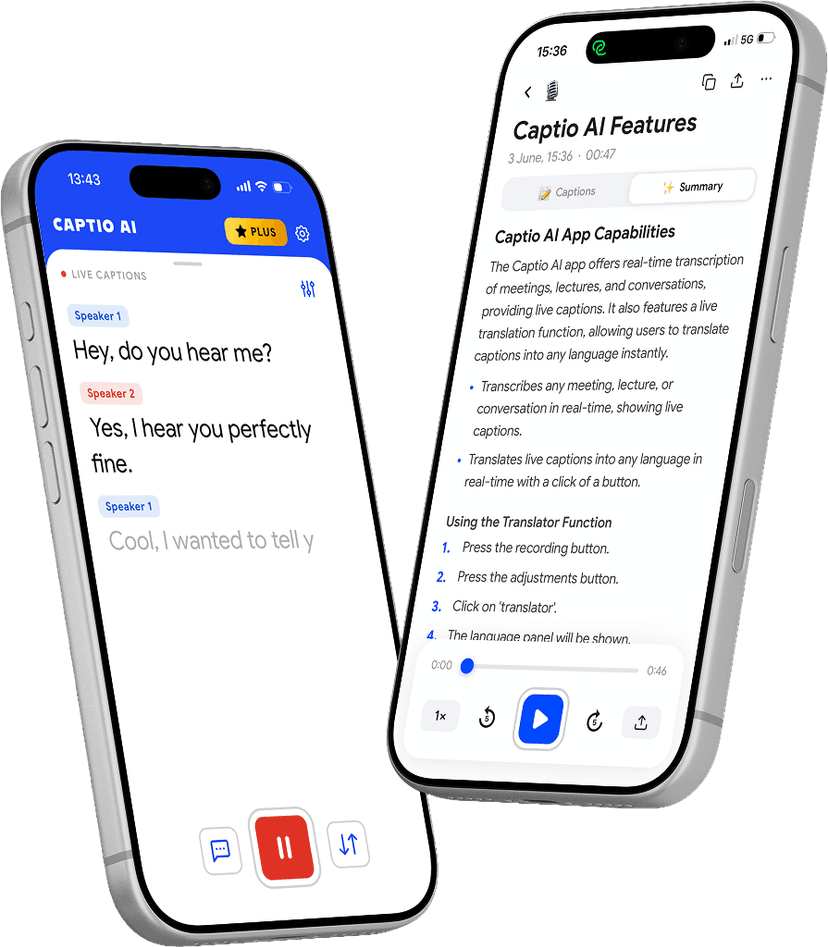
Everything you need to follow Hebrew doctor appointments
Four tools built for deaf and hard of hearing Hebrew speakers.
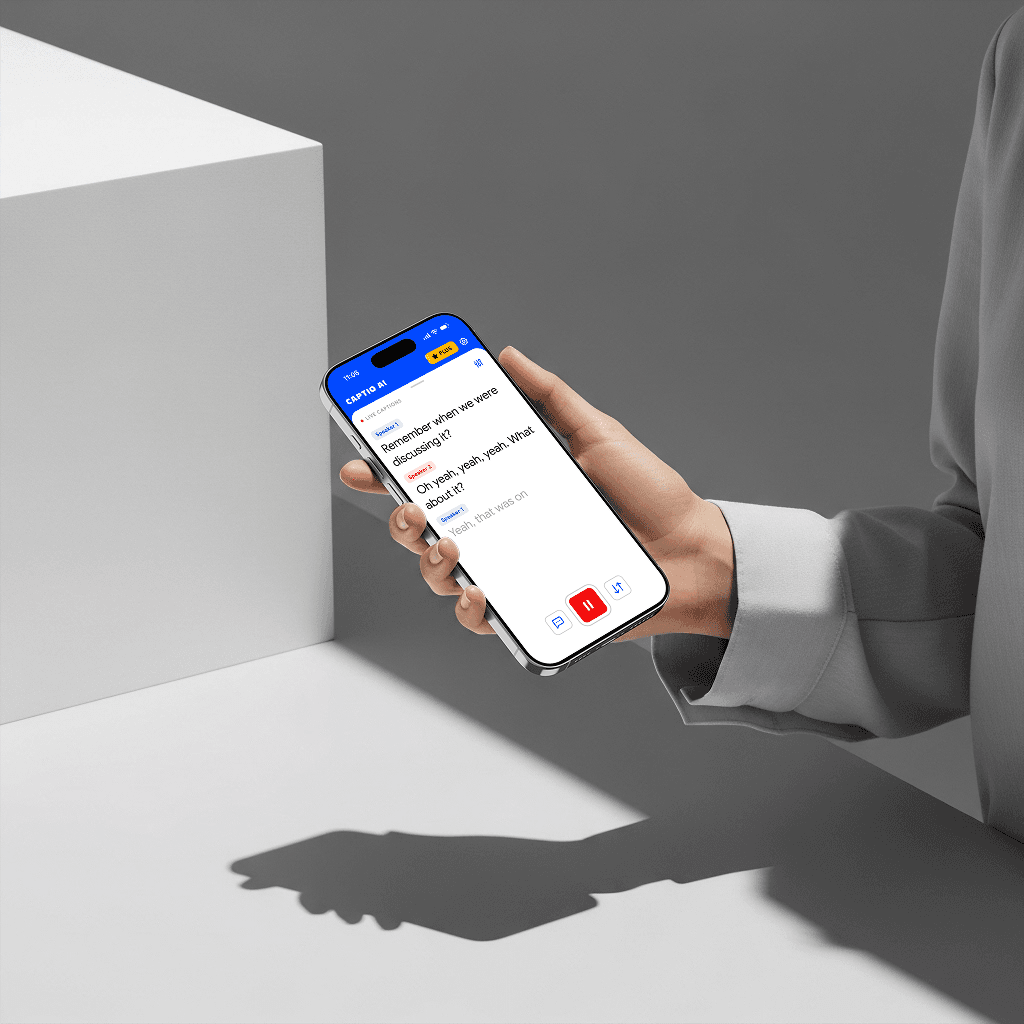
Follow what the doctor says in real time
- Captions appear word by word as they speak
- Handles medical terminology, drug names, and clinical language
- Place the phone on the desk — no setup needed
- Works in any consultation room, clinic, or hospital setting
When the doctor speaks another language
- Captions and translates in real time
- Follow your diagnosis in the language you understand best
- 60+ languages, no manual switching
- For foreign specialists, travel, or immigration settings
A full record of the consultation
- Record the appointment and upload it for a complete transcript
- Review instructions, drug names, and follow-up steps at home
- Share with a family member or carer if needed
- Works on any consultation recording
Key instructions extracted automatically
- Diagnosis, medication, and follow-up steps pulled from any transcript
- Organised into clear sections
- Nothing important missed or forgotten
- Works on any saved appointment recording
Download for free
Every situation covered
Designed for the real moments that matter — not just quiet controlled environments.
At a קופת חולים (kupat holim — health fund clinic) in Tel Aviv, Jerusalem, or Haifa, your doctor explains a diagnosis in Hebrew. Captio AI captions every word so you follow without missing critical details.
At a specialist consultation at Hadassah, Sheba Medical Center, or a regional hospital, medical terminology arrives in formal Hebrew. Captio AI captions in real time so you follow the full explanation.
At the בית מרקחת (pharmacy), the pharmacist explains dosage and drug interactions in fast Hebrew. Point your phone toward them and read the instructions as they speak.
At the מרפאת שיניים (dental clinic), the dentist gives instructions during treatment when you cannot see their face. Captio AI captions from audio alone.
In a session with a פסיכולוג (psychologist), sensitive topics require full comprehension. Captio AI captions the entire consultation so you engage on equal terms.
At the מיון (emergency room), staff speak quickly under pressure. Open Captio AI and read their instructions as they arrive.
Most accurate and fastest models
word accuracy
independent benchmark, 2025
real-time captions
first word appears as you speak
Download for free
Built for the conversations where every word matters
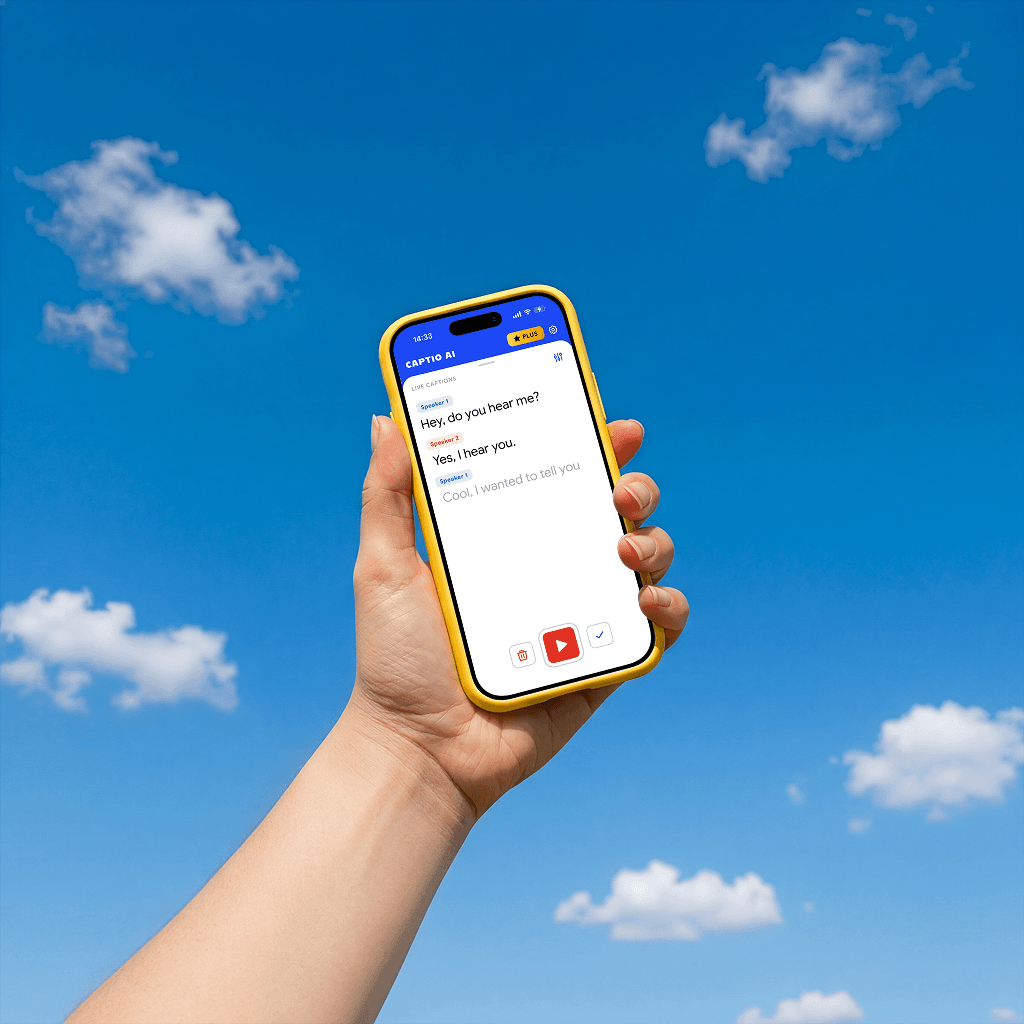
Captions as the doctor speaks
Words appear on screen while the doctor is still talking. You read the diagnosis, drug name, or follow-up instruction at the same moment it is said — not after they have moved on.
Medical terminology handled accurately
Drug names, procedure names, clinical terms. Captio AI handles the vocabulary of a real consultation — not just everyday speech.
Review the appointment after
Record the consultation and upload it to Audio Transcription. Get a full written record of everything said — instructions, dosages, referrals — to review at home and share with a carer if needed.
Works in any clinical setting
Consultation rooms, hospital wards, A&E, dental chairs, pharmacy counters. Place the phone near the speaker and Captio AI captions whoever is talking.
Any language
For foreign-language doctors, specialists abroad, or appointments through an interpreter. Live Translator captions and translates in real time so you follow your diagnosis in the language you understand best.
100% private
Medical conversations are among the most sensitive there are. Captio AI processes audio in real time and discards it immediately. Nothing is recorded, stored, or shared.
Why Hebrew is hard to understand
Guttural consonants
- Hebrew's throat consonants produce no lip movement
- Modern Hebrew has several consonants produced in the throat or deep in the mouth — the 'ayin' (ע), 'chet' (ח), and 'resh' (ר) sounds — which are entirely invisible on the lips. These appear constantly in Hebrew vocabulary, including in clinical terms. A deaf or hard of hearing patient lip-reading Hebrew misses a significant portion of every word that contains these consonants.
Trilateral root ambiguity
- Words built from the same three-letter root look alike on the lips
- Hebrew vocabulary is built from trilateral consonant roots — a three-consonant base that generates dozens of related words. Words sharing the same root look similar on the lips because they share the same consonant skeleton, differing mainly in vowel patterns that are auditory rather than visual. In clinical vocabulary, where precision matters, two words from the same root can have very different meanings but be nearly indistinguishable on a doctor's lips.
Unvocalised speech
- Hebrew is written as an abjad — vowels are omitted in normal text
- Everyday written Hebrew omits vowel markers (nikud), writing only consonants. Deaf patients who use written backup notes during an appointment receive consonant-only text that requires active vowel inference. A medical instruction written hastily in Hebrew as 'פעמים ביום' (three times a day, without vowels) requires literacy knowledge to decode correctly — a literacy gap that compounds when the patient is already navigating hearing impairment.
Pronunciation variation
- Mizrahi, Ashkenazi, and Yemenite Hebrew differ phonologically
- Modern Israeli Hebrew standardised around a Sephardic/Mizrahi-influenced phonology, but doctors trained in different communities, or older clinicians, may retain Ashkenazi or Yemenite phonological features — particularly in vowel quality and consonant realisation. A deaf patient who lip-reads one community's Hebrew may find a doctor from another background producing different mouth shapes for the same words.
Fast informal registers
- Casual Israeli Hebrew compresses and elides in conversation
- Formal Hebrew and conversational Israeli Hebrew differ substantially in speech rate and phonological reduction. In casual post-diagnosis conversation — the part where the doctor explains next steps informally — speech rates increase, consonants merge across word boundaries, and unstressed syllables reduce. The gap between the formal clinical vocabulary and the casual register for aftercare instructions is wide in Hebrew, and both are hard to lip-read.
Download for free
Hearing loss in Israel: legal rights, real gaps, and forty-five hours a year
Approximately 10,000 people in Israel are profoundly deaf, with a further 150,000 to 200,000 hard of hearing — roughly 2% of the total population. Israeli Sign Language (ISL) has gained significant formal recognition in recent years: in 2021, Shirly Pinto became the Knesset's first-ever deaf lawmaker, delivering her first speech in ISL and drawing national attention to the deaf community's standing. The Israeli Academy of the Hebrew Language formally recognised ISL as a real and legitimate language. These symbolic milestones reflect genuine progress in legal recognition, but formal recognition does not translate automatically into interpreter availability at the point where it matters most: the clinic.
Israel's Equal Rights for People with Disabilities Law guarantees equal access to public services, employment, and daily life for deaf and hard of hearing people. In practice, communication assistance for deaf Israelis is means-tested and quota-limited. Those who qualify receive up to 45 hours of ISL interpretation per year — less than an hour per week — to cover every appointment, legal matter, government service, and workplace interaction they need. A person managing a chronic condition that requires regular GP visits, specialist appointments, and pharmacy consultations can exhaust this annual quota in a single quarter.
For deaf and hard of hearing Israelis who do not meet the qualification threshold for state-funded interpretation, or who have used their annual allocation, healthcare appointments proceed without communication support. The result — as in many countries with legally robust but practically constrained accessibility frameworks — is that patients nod, guess, and ask family members to attend and interpret. Clinical accuracy suffers, medication errors follow, and follow-up care is missed. Captio AI captions Hebrew in real time at any kupat holim or hospital, so every appointment is fully accessible without waiting for a quota to refill or an interpreter to become available.
Download for free
What you hear stays with you.
Gone the moment it ends
Captio AI processes your audio in real time and discards it immediately. Nothing is recorded. Nothing is kept.
Not a product
Your conversations are not something Captio AI sells, shares, or monetizes — to anyone, for any reason.
Not used to train anything
What you say in a doctor's appointment or a job interview never ends up in a training dataset. Not ours. Not anyone else's.

Private by default
Captio AI supports 60+ languages
Download for free
Frequently asked questions
Understand your diagnosis in Hebrew.
Captio AI is free to start
Download for free