

Estonian live captions and productivity tool for doctor appointments
For deaf and hard of hearing people.
Download for free


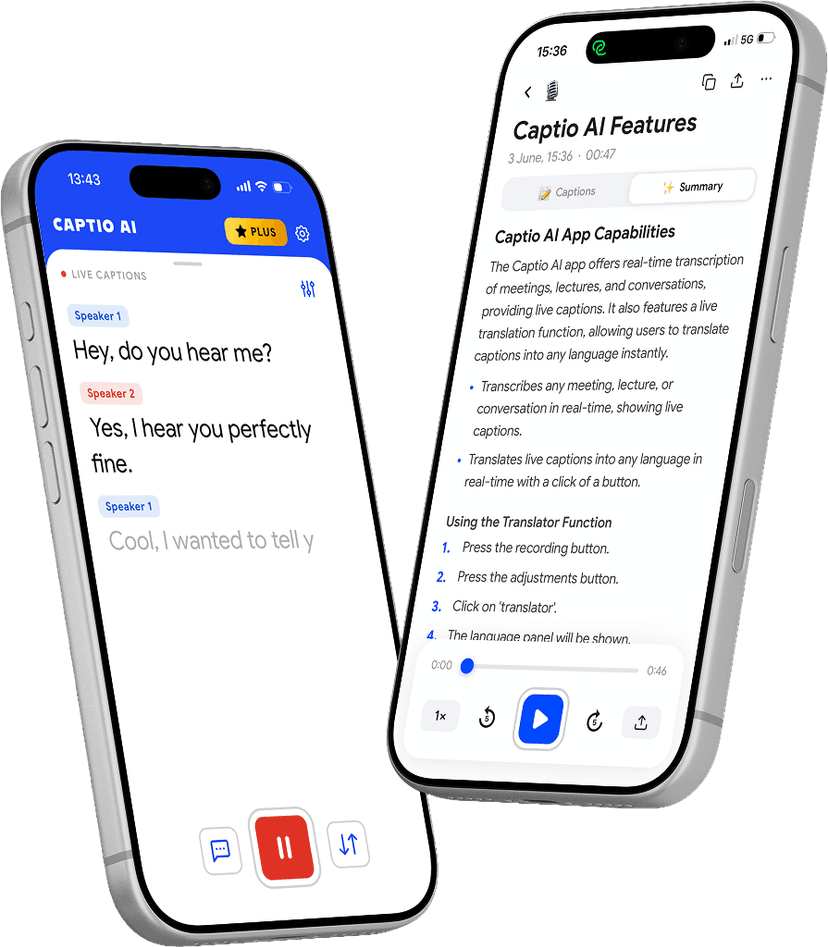
Everything you need to follow Estonian doctor appointments
Four tools built for deaf and hard of hearing Estonian speakers.
Follow what the doctor says in real time
- Captions appear word by word as they speak
- Handles medical terminology, drug names, and clinical language
- Place the phone on the desk — no setup needed
- Works in any consultation room, clinic, or hospital setting
When the doctor speaks another language
- Captions and translates in real time
- Follow your diagnosis in the language you understand best
- 60+ languages, no manual switching
- For foreign specialists, travel, or immigration settings
A full record of the consultation
- Record the appointment and upload it for a complete transcript
- Review instructions, drug names, and follow-up steps at home
- Share with a family member or carer if needed
- Works on any consultation recording
Key instructions extracted automatically
- Diagnosis, medication, and follow-up steps pulled from any transcript
- Organised into clear sections
- Nothing important missed or forgotten
- Works on any saved appointment recording
Download for free
Every situation covered
Designed for the real moments that matter — not just quiet controlled environments.
At a perearstikeskus (GP centre) in Tallinn, Tartu, or a smaller vald, your perearst explains symptoms and treatment in Estonian. Captio AI captions every word so you follow the full consultation.
At a specialist appointment at Tartu Ülikooli Kliinikum or a regional haigla, medical terminology arrives in formal Estonian. Captio AI captions in real time so you follow every detail.
At the apteek (pharmacy), the proviisor explains dosage and drug interactions quickly. Point your phone toward them and read the instructions as they speak.
At the hambaarst (dental clinic), the dentist gives instructions during treatment when lip-reading is impossible. Captio AI captions from audio alone.
In a session with a psühholoog or psühhiaater, sensitive conversations require full comprehension. Captio AI captions the full session so you engage without gaps.
At the erakorraline meditsiiniosakond (emergency department), staff speak quickly under pressure. Open Captio AI and read their instructions in real time.
Most accurate and fastest models
word accuracy
independent benchmark, 2025
real-time captions
first word appears as you speak
Download for free
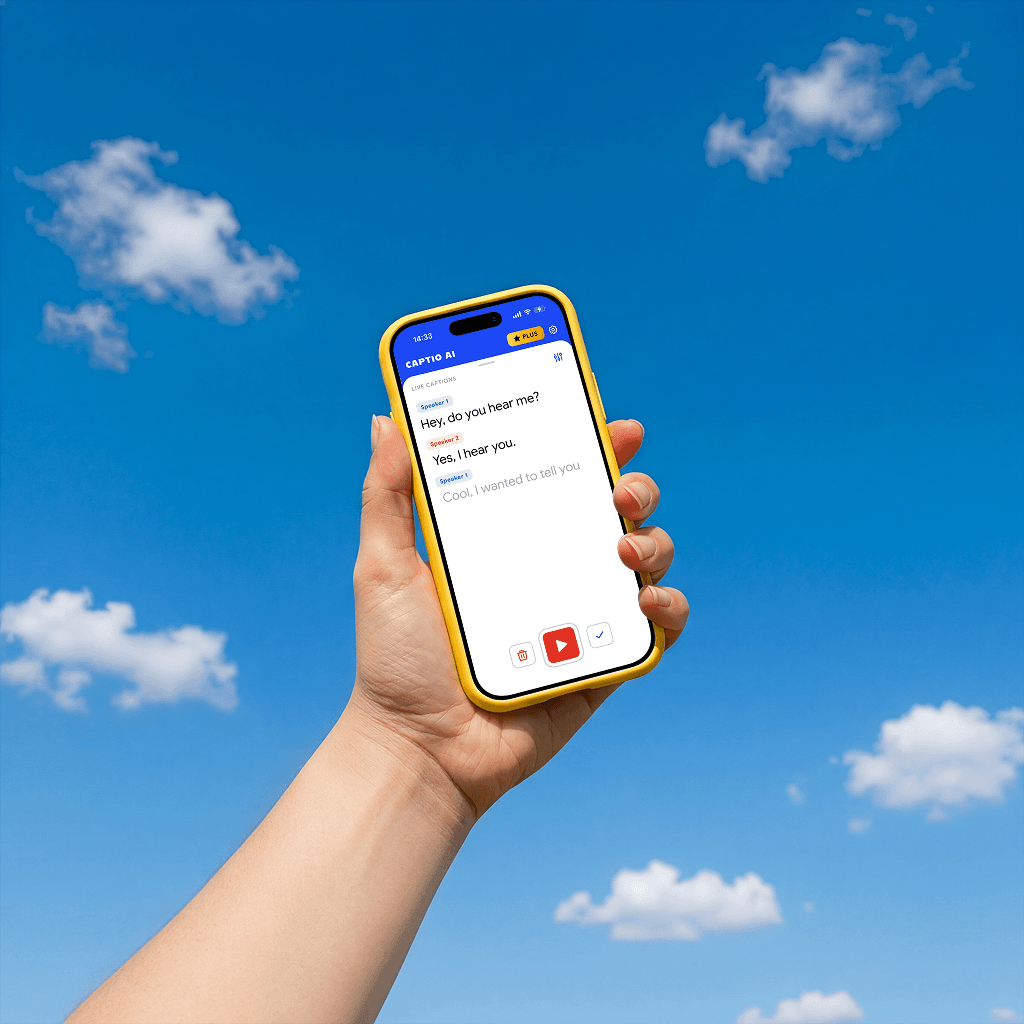
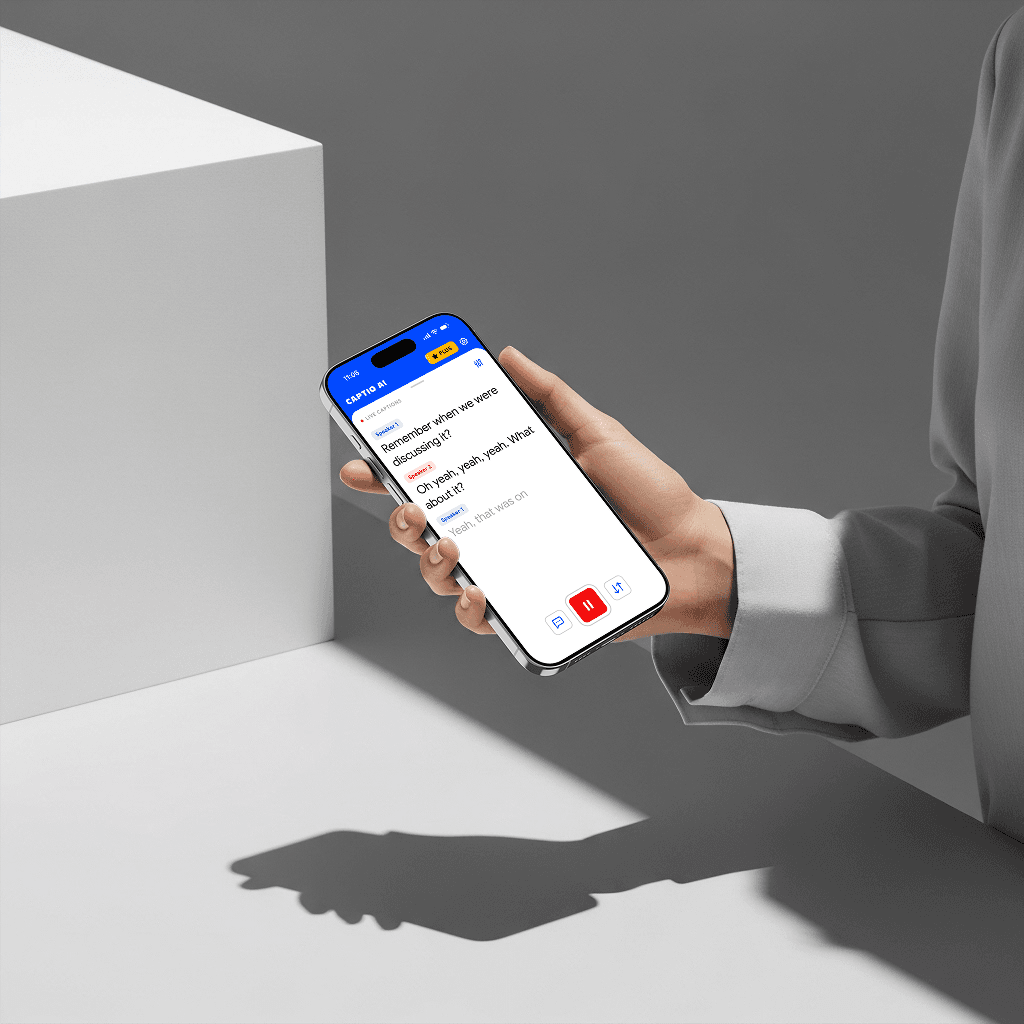
Built for the conversations where every word matters
Captions as the doctor speaks
Words appear on screen while the doctor is still talking. You read the diagnosis, drug name, or follow-up instruction at the same moment it is said — not after they have moved on.
Medical terminology handled accurately
Drug names, procedure names, clinical terms. Captio AI handles the vocabulary of a real consultation — not just everyday speech.
Review the appointment after
Record the consultation and upload it to Audio Transcription. Get a full written record of everything said — instructions, dosages, referrals — to review at home and share with a carer if needed.
Works in any clinical setting
Consultation rooms, hospital wards, A&E, dental chairs, pharmacy counters. Place the phone near the speaker and Captio AI captions whoever is talking.
Any language
For foreign-language doctors, specialists abroad, or appointments through an interpreter. Live Translator captions and translates in real time so you follow your diagnosis in the language you understand best.
100% private
Medical conversations are among the most sensitive there are. Captio AI processes audio in real time and discards it immediately. Nothing is recorded, stored, or shared.
Why Estonian is hard to understand
Three phonological lengths
- Estonian has three degrees of vowel and consonant length — unique in Europe
- Estonian is one of very few languages in the world with a three-way phonological length contrast: short, long, and overlong (Q1, Q2, Q3). 'Lina' (sheet), 'linna' (of the city), and 'linna' (overlong) are distinguished by length alone — and the overlong grade has no parallel in any neighbouring language. For a deaf or hard of hearing patient, all three lengths produce the same lip shape but last different durations — a purely auditory distinction invisible on the speaker's face.
Fourteen grammatical cases
- Estonian's fourteen cases create many different word forms from the same root
- Estonian has fourteen grammatical cases, meaning a single medical term may appear in up to fourteen different forms depending on its grammatical role in a sentence. In a clinical consultation, a doctor names a condition, discusses it, and refers to it again — in different cases each time, each with a different ending and a different lip shape. A deaf patient lip-reading Estonian must recognise a clinical term across all the case forms it takes throughout the appointment.
South Estonian (Võro/Seto)
- South Estonian varieties differ substantially from Standard (North) Estonian
- South Estonian — including Võro and Seto varieties spoken in southeastern Estonia — is distinct enough from Standard Estonian to be considered by some linguists a separate language. Medical staff from Võru, Põlva, or Valga county may speak with South Estonian phonological features that produce different vowel and consonant shapes from Standard Estonian. A deaf patient lip-reading Standard Estonian encounters South Estonian clinical speech as a substantially different phonological system.
Consonant gradation
- Estonian consonant gradation alternates consonant forms unpredictably across word forms
- Like Finnish, Estonian uses consonant gradation — a systematic alternation between strong and weak consonant grades across grammatical forms: 'jalg' (leg) vs 'jala' (of the leg), 'õpik' (textbook) vs 'õpiku'. In clinical speech where medical vocabulary appears in multiple grammatical forms, the same word's consonant changes between forms. A deaf patient lip-reading Estonian sees different lip shapes for the same word depending on its case — making recognition harder across the full span of a consultation.
Russian minority language in healthcare
- Russian is spoken by a significant minority and appears in some clinical settings
- Approximately 24% of Estonia's population is Russian-speaking, concentrated in Tallinn and the Ida-Viru region of northeastern Estonia. In healthcare facilities in these areas, medical staff may use Russian alongside Estonian — including for clinical terms where Soviet-era Russian medical vocabulary is still in use. A deaf patient lip-reading Estonian at an appointment in Narva or northeastern Tallinn may find Russian-phonology words appearing without advance notice.
Download for free
Hearing loss in Estonia: 43,500 people and a community shaped by centuries of deaf education
Estonia has approximately 43,500 deaf and hard of hearing people — around 3.3% of the total population, one of the higher proportions in the EU. The Estonian deaf community has a long history: the first records of deaf education in Estonia date to the seventeenth century, and in 1866 Pastor Ernst Sokolovski established the first deaf school in Vändra, which helped to unify Estonian Sign Language (ESL — Eesti viipekeel). Estonian Sign Language is formally recognised and has an active signing community. The Estonian Association of the Deaf (Eesti Kurdumüte Liit) represents the community and advocates for access across healthcare, education, and public life.
For deaf and hard of hearing Estonians navigating healthcare, the picture is of a well-documented community with formal recognition and active institutions, but with the structural constraints that face all small-country sign language communities: a finite interpreter workforce that cannot cover every clinical appointment on demand. The EU Cohesion Fund has supported specific projects improving services for deaf communities in both Estonia's Baltic neighbours, and Estonia has been screening newborns for hearing impairment. The intersection of Estonian's three-length phonological system and its fourteen grammatical cases makes it among the more linguistically challenging European languages for deaf patients who supplement or replace sign language with lip-reading.
In northeastern Estonia — Narva, Kohtla-Järve — the Russian-speaking minority is the majority population, meaning healthcare appointments in these cities may be conducted in Russian rather than Estonian. For a deaf Estonian who lip-reads Estonian and not Russian, attending a clinic in Narva means navigating a medical appointment in a language they were not trained to read. Captio AI captions Estonian and Russian in real time at any perearstikeskus or haigla across Estonia, so every patient receives their doctor's words directly regardless of which language is being used.
Download for free
What you hear stays with you.
Gone the moment it ends
Captio AI processes your audio in real time and discards it immediately. Nothing is recorded. Nothing is kept.
Not a product
Your conversations are not something Captio AI sells, shares, or monetizes — to anyone, for any reason.
Not used to train anything
What you say in a doctor's appointment or a job interview never ends up in a training dataset. Not ours. Not anyone else's.

Private by default
Captio AI supports 60+ languages
Download for free
Frequently asked questions
Understand your diagnosis in Estonian.
Captio AI is free to start
Download for free