

Albanian live captions and productivity tool for doctor appointments
For deaf and hard of hearing people.
Download for free
Everything you need to follow Albanian doctor appointments
Four tools built for deaf and hard of hearing Albanian speakers.
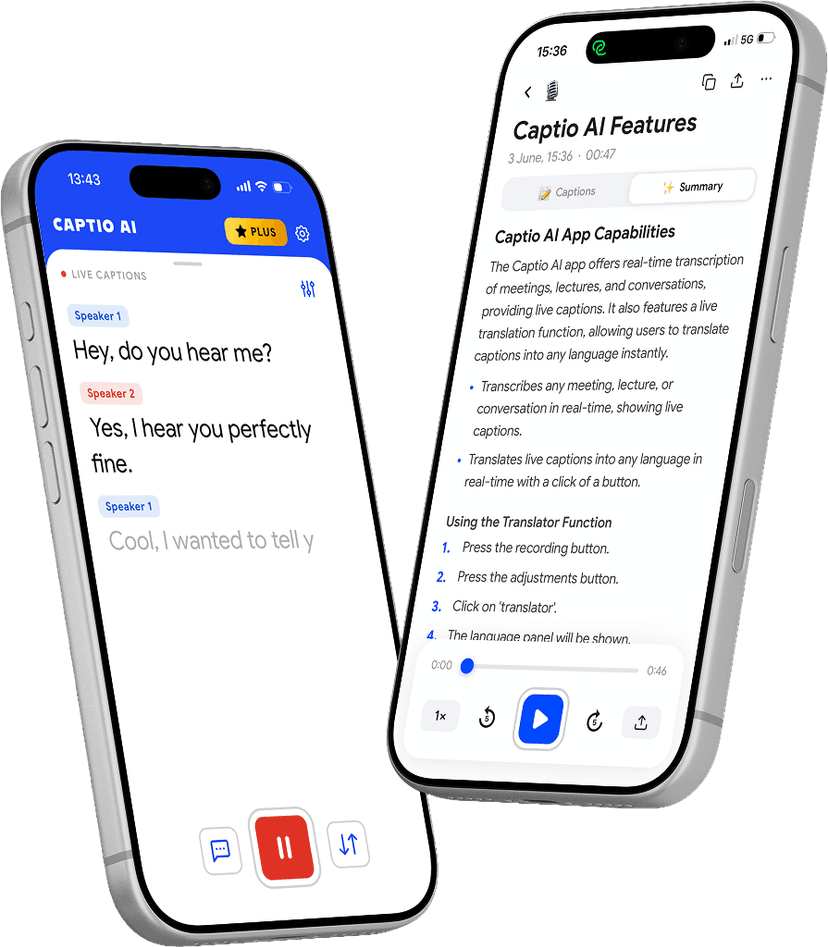
Follow what the doctor says in real time
- Captions appear word by word as they speak
- Handles medical terminology, drug names, and clinical language
- Place the phone on the desk — no setup needed
- Works in any consultation room, clinic, or hospital setting
When the doctor speaks another language
- Captions and translates in real time
- Follow your diagnosis in the language you understand best
- 60+ languages, no manual switching
- For foreign specialists, travel, or immigration settings
A full record of the consultation
- Record the appointment and upload it for a complete transcript
- Review instructions, drug names, and follow-up steps at home
- Share with a family member or carer if needed
- Works on any consultation recording
Key instructions extracted automatically
- Diagnosis, medication, and follow-up steps pulled from any transcript
- Organised into clear sections
- Nothing important missed or forgotten
- Works on any saved appointment recording
Download for free
Every situation covered
Designed for the real moments that matter — not just quiet controlled environments.
At a qendër shëndetësore (health centre) in Tirana, Shkodër, or a smaller town, your mjek (doctor) explains symptoms and treatment in Albanian. Captio AI captions every word so you follow the full consultation.
At a specialist appointment at a spital universitar (university hospital), medical terms arrive in Albanian mixed with Latinate vocabulary. Captio AI captions both in real time.
At the farmaci (pharmacy), the pharmacist explains dosage and interactions quickly in Albanian. Point your phone toward them and read the instructions as they speak.
At the dentist's surgery, instructions arrive during treatment when lip-reading is impossible. Captio AI captions from audio alone so you follow every direction.
In a session with a psikolog or psikiatër, sensitive conversations require full comprehension. Captio AI captions the entire consultation so you engage without missing context.
At the urgjencë (emergency department), staff speak quickly under pressure. Open Captio AI and read their instructions in real time.
Most accurate and fastest models
word accuracy
independent benchmark, 2025
real-time captions
first word appears as you speak
Download for free
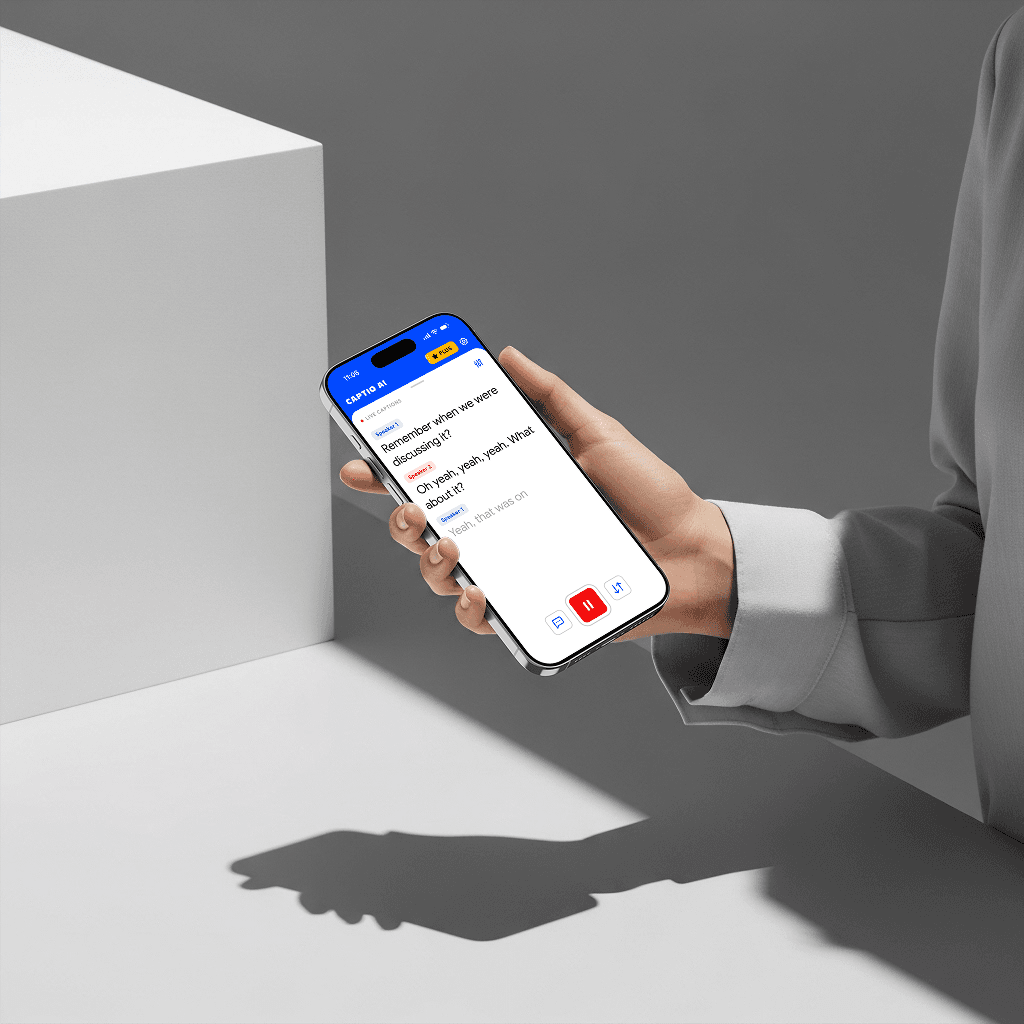
Built for the conversations where every word matters
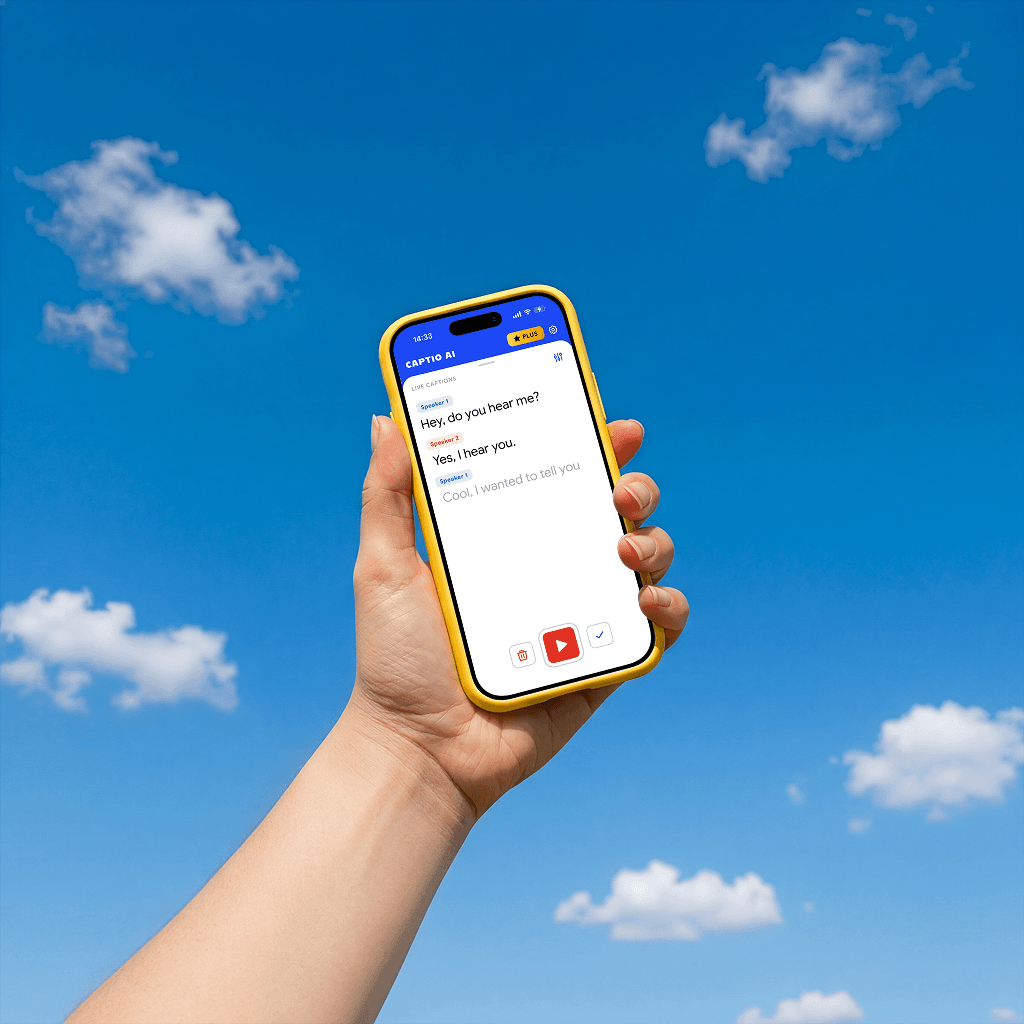
Captions as the doctor speaks
Words appear on screen while the doctor is still talking. You read the diagnosis, drug name, or follow-up instruction at the same moment it is said — not after they have moved on.
Medical terminology handled accurately
Drug names, procedure names, clinical terms. Captio AI handles the vocabulary of a real consultation — not just everyday speech.
Review the appointment after
Record the consultation and upload it to Audio Transcription. Get a full written record of everything said — instructions, dosages, referrals — to review at home and share with a carer if needed.
Works in any clinical setting
Consultation rooms, hospital wards, A&E, dental chairs, pharmacy counters. Place the phone near the speaker and Captio AI captions whoever is talking.
Any language
For foreign-language doctors, specialists abroad, or appointments through an interpreter. Live Translator captions and translates in real time so you follow your diagnosis in the language you understand best.
100% private
Medical conversations are among the most sensitive there are. Captio AI processes audio in real time and discards it immediately. Nothing is recorded, stored, or shared.
Why Albanian is hard to understand
Gheg–Tosk dialect split
- Gheg and Tosk Albanian produce different mouth shapes for the same words
- Albanian divides into two major dialect groups along the Shkumbin river: Gheg in the north (including Tirana, Shkodër, Kosovo) and Tosk in the south. Standard Albanian is based on Tosk, but Gheg is spoken by the majority of Albanians in Albania and all Albanians in Kosovo and North Macedonia. In clinical settings in Tirana, a Gheg-speaking patient may face a Tosk-educated doctor whose pronunciation of shared vocabulary produces different lip shapes from what the patient recognises.
Nasal vowels in Gheg
- Gheg Albanian's nasal vowels are invisible on the lips
- Gheg Albanian preserves long and nasal vowels that Tosk does not have. These nasal vowel qualities are produced in the nasal cavity — producing no visible lip difference from their non-nasal counterparts. A deaf patient lip-reading Gheg Albanian misses an entire phonological layer that distinguishes words, particularly in the northern cities and Kosovo where Gheg is the dominant clinical language.
Schwa instability
- The Albanian schwa drops in Gheg fast speech
- The Albanian central vowel ë (schwa) is prominent in Standard Albanian but tends to be dropped in Gheg speech and in fast casual Albanian across both dialects. In medical vocabulary, this elision shortens words unpredictably — a word that a deaf patient expects to see three syllables long on the lips arrives as two. The gap between the expected and actual lip movement sequence is a consistent source of comprehension error.
Consonant cluster density
- Albanian has dense consonant clusters at word boundaries
- Albanian tolerates sequences of consonants at word boundaries that are unusual in European languages, including medical vocabulary dense with Greek and Latin roots. In fast clinical speech these clusters merge across word boundaries, producing long sequences of consonant closures with no intervening vowel to anchor the segmentation. A deaf patient parsing Albanian consonant clusters at clinical speed must guess boundaries from context.
Interpreter scarcity
- Very few sign language interpreters are available in Albanian healthcare
- Albania has developed its own sign language (AlbSL) which is a relatively young standardised variety. The number of qualified AlbSL interpreters available for medical appointments is very small — particularly outside Tirana — meaning most deaf Albanians attending clinical consultations do so without professional communication support. A patient navigating a healthcare appointment without an interpreter must rely entirely on lip-reading in a phonologically challenging language.
Download for free
Hearing loss in Albania: unemployment three times higher, recognition still pending
Research conducted in 2015 — the most comprehensive survey of the deaf community in Albania — found that the unemployment rate of deaf Albanian adults was three times higher than among the hearing population. The survey, commissioned by Albania's Ministry of Social Welfare and Youth in collaboration with the Albanian National Association of the Deaf (ANAD) and the Finnish Association of the Deaf, documented major barriers to human interaction, information access, education, and employment for deaf Albanians. Albania ratified the UN Convention on the Rights of Persons with Disabilities in February 2013, committing formally to equal access across healthcare, education, and public life.
Despite CRPD ratification, Albanian Sign Language (AlbSL) has not yet received official legal recognition. The Ministry launched a Sign Language Recognition Working Group in March 2014 — a procedural step toward recognition — but formal legal status has not followed. Without legal recognition, there is no structural mandate for interpreter provision in healthcare, education, or employment contexts. The deaf community in Albania navigates daily life without the institutional scaffolding that legal recognition would provide: no guaranteed interpreters at medical appointments, no right to sign language instruction, and no formal complaint mechanism when communication access is denied.
In clinical settings, these gaps converge at the worst possible moment. An Albanian deaf patient attending a qendër shëndetësore without an interpreter, with limited lip-reading accuracy in a challenging phonological environment, and without backup written communication, receives at best a partial account of their diagnosis and treatment. For chronic conditions requiring regular appointments and medication management, the cumulative effect of incomplete clinical communication represents a significant health risk. Captio AI captions Albanian in real time at any health centre or hospital, giving deaf Albanians direct access to their doctor's words without depending on a system that has not yet provided the legal infrastructure to guarantee it.
Download for free
What you hear stays with you.
Gone the moment it ends
Captio AI processes your audio in real time and discards it immediately. Nothing is recorded. Nothing is kept.
Not a product
Your conversations are not something Captio AI sells, shares, or monetizes — to anyone, for any reason.
Not used to train anything
What you say in a doctor's appointment or a job interview never ends up in a training dataset. Not ours. Not anyone else's.
Private by default
Captio AI supports 60+ languages
Download for free
Frequently asked questions
Understand your diagnosis in Albanian.
Captio AI is free to start
Download for free