

Punjabi live captions and productivity tool for doctor appointments
For deaf and hard of hearing people.
Download for free


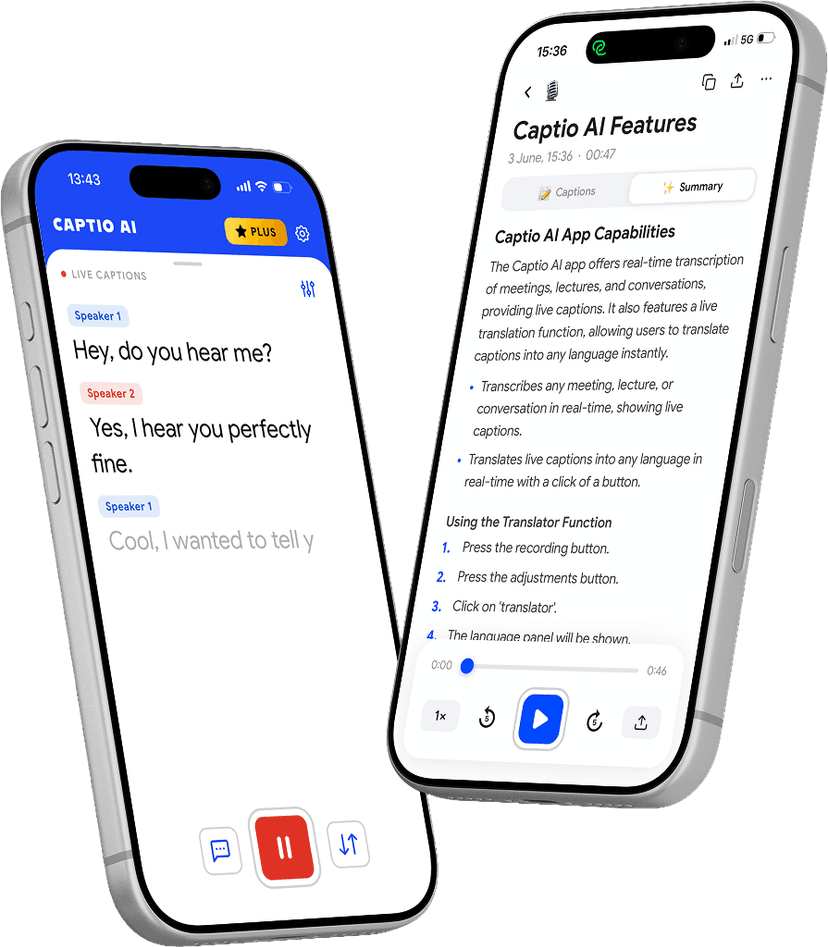
Everything you need to follow Punjabi doctor appointments
Four tools built for deaf and hard of hearing Punjabi speakers.
Follow what the doctor says in real time
- Captions appear word by word as they speak
- Handles medical terminology, drug names, and clinical language
- Place the phone on the desk — no setup needed
- Works in any consultation room, clinic, or hospital setting
When the doctor speaks another language
- Captions and translates in real time
- Follow your diagnosis in the language you understand best
- 60+ languages, no manual switching
- For foreign specialists, travel, or immigration settings
A full record of the consultation
- Record the appointment and upload it for a complete transcript
- Review instructions, drug names, and follow-up steps at home
- Share with a family member or carer if needed
- Works on any consultation recording
Key instructions extracted automatically
- Diagnosis, medication, and follow-up steps pulled from any transcript
- Organised into clear sections
- Nothing important missed or forgotten
- Works on any saved appointment recording
Download for free
Every situation covered
Designed for the real moments that matter — not just quiet controlled environments.
GP visits at a private clinic or government dispensary in Amritsar, Ludhiana, or Lahore, where the doctor covers symptoms, diagnosis, and prescription in a brief appointment and often speaks while writing.
Specialist consultations at PGIMER, Mayo Hospital, or a private specialist centre, where clinical terminology is dense and English drug names are mixed with Punjabi or Urdu explanations.
Pharmacy consultations at a dawakhana, where the pharmacist explains dosage and drug interactions quickly across a counter with no written instructions provided.
Dental appointments where the dentist works while speaking and gives aftercare instructions verbally at the end of a procedure.
Mental health consultations with a psychiatrist or counsellor, where the precise words of each clinical exchange carry weight that guessing cannot replace.
Emergency room visits at a government hospital, where staff speak fast, family members are present and speaking over each other, and the clinical information is urgent.
Most accurate and fastest models
word accuracy
independent benchmark, 2025
real-time captions
first word appears as you speak
Download for free
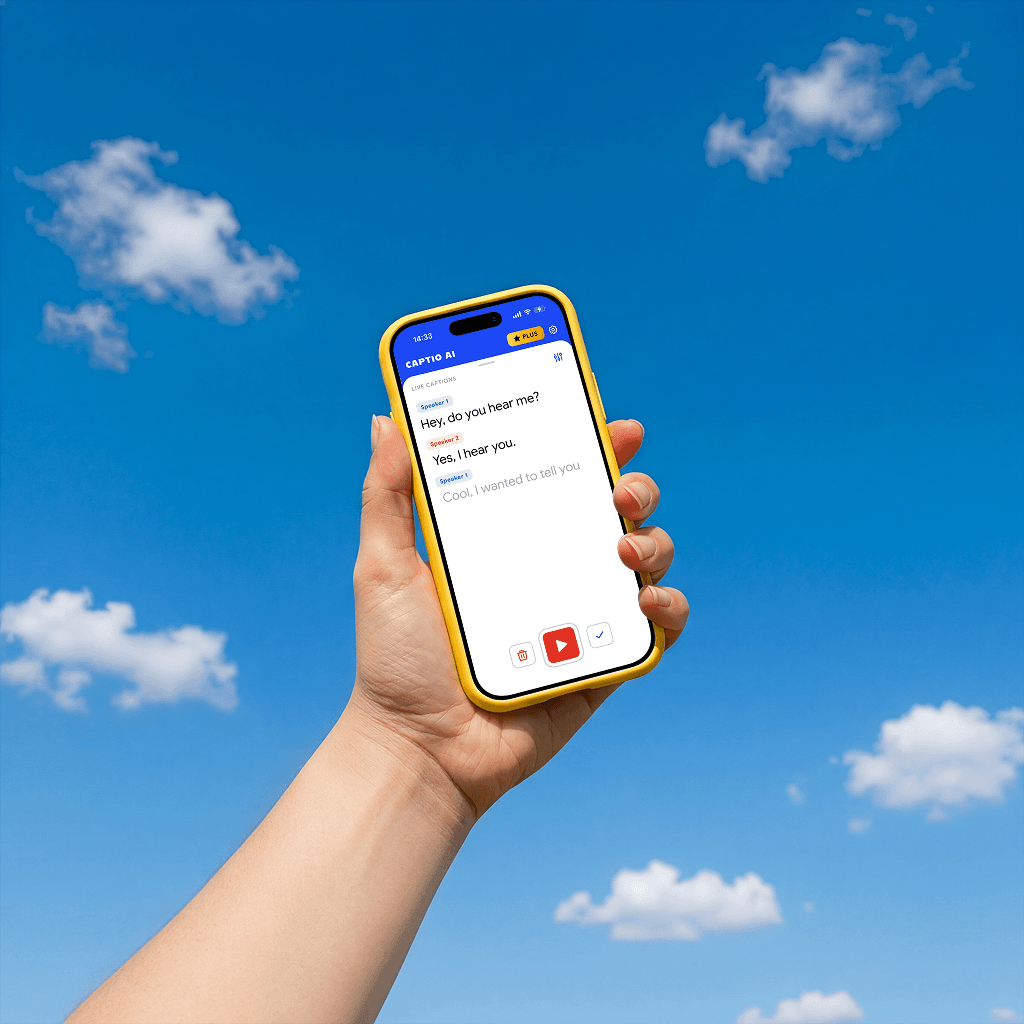
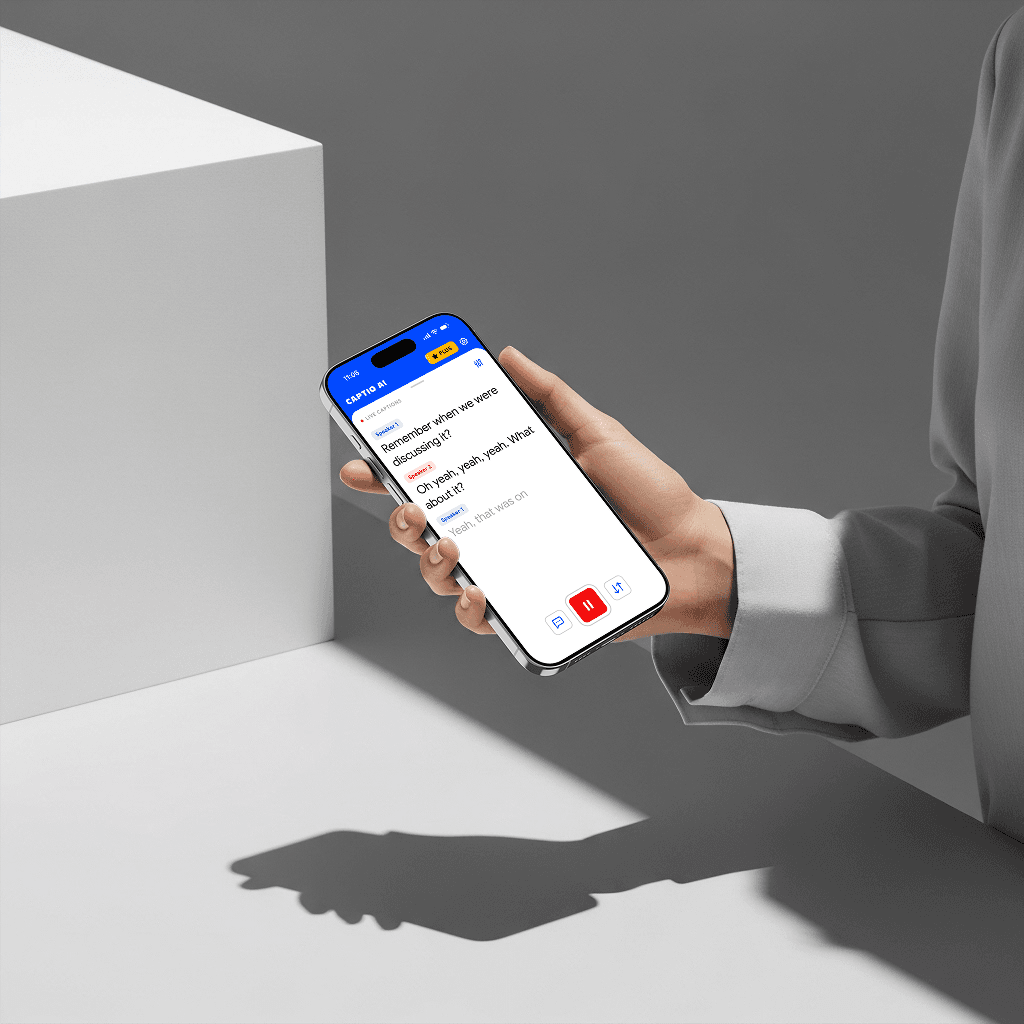
Built for the conversations where every word matters
Captions as the doctor speaks
Words appear on screen while the doctor is still talking. You read the diagnosis, drug name, or follow-up instruction at the same moment it is said — not after they have moved on.
Medical terminology handled accurately
Drug names, procedure names, clinical terms. Captio AI handles the vocabulary of a real consultation — not just everyday speech.
Review the appointment after
Record the consultation and upload it to Audio Transcription. Get a full written record of everything said — instructions, dosages, referrals — to review at home and share with a carer if needed.
Works in any clinical setting
Consultation rooms, hospital wards, A&E, dental chairs, pharmacy counters. Place the phone near the speaker and Captio AI captions whoever is talking.
Any language
For foreign-language doctors, specialists abroad, or appointments through an interpreter. Live Translator captions and translates in real time so you follow your diagnosis in the language you understand best.
100% private
Medical conversations are among the most sensitive there are. Captio AI processes audio in real time and discards it immediately. Nothing is recorded, stored, or shared.
Why Punjabi is hard to understand
Tonal language
- Punjabi's three tones change meaning and are invisible on lips
- Punjabi is the only major South Asian language with lexical tone — three distinct tones (level, rising, falling) that change word meaning completely. In a clinical consultation where a doctor distinguishes a diagnosis or medication by tone alone, a deaf or hard of hearing patient lip-reading receives no tonal information at all. Every tonal minimal pair in Punjabi is an invisible distinction that clinical accuracy depends on.
Aspiration contrasts
- Aspirated and unaspirated plosives look identical but are clinically distinct
- Punjabi has a four-way distinction in stop consonants — voiceless, voiced, aspirated, and breathy voiced. The pairs p/ph, b/bh, t/th, d/dh sound very different but look nearly identical on the lips. A doctor pronouncing a drug name or body part may use an aspirated consonant the lip-reading patient hears as the plain version — changing the word entirely.
Cross-border dialect divide
- Indian and Pakistani Punjabi diverge in vocabulary, script, and register
- Eastern (Indian) Punjabi uses the Gurmukhi script and carries Sikh-influenced vocabulary; Western (Pakistani) Punjabi uses the Shahmukhi script and carries more Urdu and Arabic influence. Clinical registers in each country bring different vocabulary choices. A deaf patient calibrated to one side of the border may be substantially lost with a clinician from the other.
Medical register mixing
- Punjabi doctors switch between Punjabi, Urdu or Hindi, and English mid-sentence
- In Indian Punjab, a consultation may move fluidly between Punjabi, Hindi, and English within a single sentence. In Pakistani Punjab, Punjabi and Urdu alternate, with drug names defaulting to English regardless of the surrounding language. A deaf patient calibrated to Punjabi faces two simultaneous challenges: the language they expected is not always what they get, and the language they get is not always what they know.
Rural speech reduction
- Rural Punjabi carries speed and elision the clinic amplifies
- Punjabi spoken in rural farming communities — where much of the population and many patients originate — is faster, more heavily reduced, and carries more archaic vocabulary than Standard Punjabi. A deaf patient from a rural district seeing a specialist in Chandigarh or Lahore encounters a different phonological register even within the same language.
Download for free
63 million with hearing impairment in India alone. A legal right that rarely reaches the clinic.
India has approximately 63 million people with significant hearing impairment — the second-largest hearing loss burden of any country globally, representing more people than the entire population of many countries. Punjab, with its large rural population and historically lower access to audiological services, carries a disproportionate burden from noise-induced hearing loss in agriculture, manufacturing, and transport. More than 27,000 children are born deaf in India each year, and neonatal screening remains inconsistent across the country.
The Rights of Persons with Disabilities Act 2016 legally recognised Indian Sign Language and mandated accessibility in healthcare facilities. In practice, the gap between legislative intent and clinical reality remains wide. A 2021 legal analysis published by the NLIU Law Review found that no rule in the RPwD Act requires ISL-trained staff in hospitals, and that state registries of certified interpreters on call for hospitals remain aspirational. In Punjab, sign language interpreters are concentrated in urban centres — Chandigarh and Amritsar — and are largely unavailable on call for rural clinics.
On the Pakistani side of Punjab, the situation is more precarious. Pakistani Sign Language is not officially recognised, and healthcare facilities carry no obligation to provide communication access for deaf patients. A deaf Punjabi-speaking patient in Lahore or Faisalabad relies on family members, written notes, or the goodwill of individual clinicians — none of which is a reliable substitute for real-time access to clinical speech. Captio AI captions Punjabi in real time — at the dawakhana, the government hospital, and the emergency room — without requiring any institutional support.
Download for free
What you hear stays with you.
Gone the moment it ends
Captio AI processes your audio in real time and discards it immediately. Nothing is recorded. Nothing is kept.
Not a product
Your conversations are not something Captio AI sells, shares, or monetizes — to anyone, for any reason.
Not used to train anything
What you say in a doctor's appointment or a job interview never ends up in a training dataset. Not ours. Not anyone else's.

Private by default
Captio AI supports 60+ languages
Download for free
Frequently asked questions
Understand your diagnosis in Punjabi.
Captio AI is free to start
Download for free