

Polish live captions and productivity tool for doctor appointments
For deaf and hard of hearing people.
Download for free

Everything you need to follow Polish doctor appointments
Four tools built for deaf and hard of hearing Polish speakers.
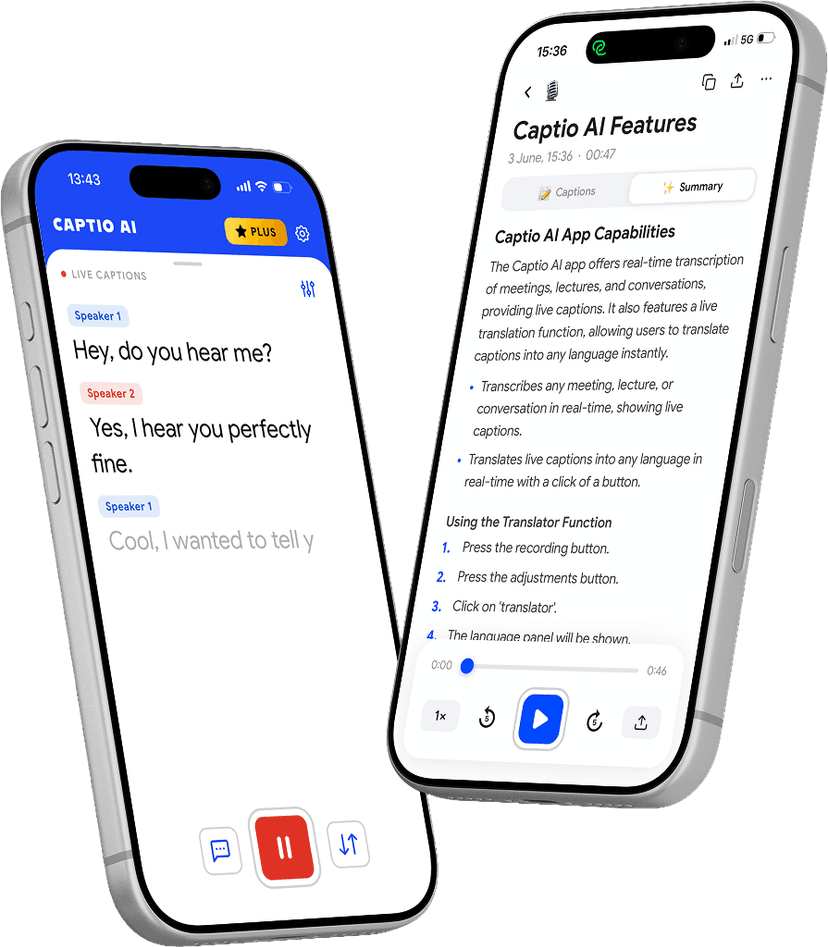
Follow what the doctor says in real time
- Captions appear word by word as they speak
- Handles medical terminology, drug names, and clinical language
- Place the phone on the desk — no setup needed
- Works in any consultation room, clinic, or hospital setting
When the doctor speaks another language
- Captions and translates in real time
- Follow your diagnosis in the language you understand best
- 60+ languages, no manual switching
- For foreign specialists, travel, or immigration settings
A full record of the consultation
- Record the appointment and upload it for a complete transcript
- Review instructions, drug names, and follow-up steps at home
- Share with a family member or carer if needed
- Works on any consultation recording
Key instructions extracted automatically
- Diagnosis, medication, and follow-up steps pulled from any transcript
- Organised into clear sections
- Nothing important missed or forgotten
- Works on any saved appointment recording
Download for free
Every situation covered
Designed for the real moments that matter — not just quiet controlled environments.
GP visits at a przychodnia or private clinic, where the doctor covers the presenting complaint, examination, and prescription in a brief appointment — often speaking quickly while writing.
Specialist consultations at a szpital or poliklinika, where clinical Latin-derived vocabulary is dense and referrals may move a patient to a different city and regional dialect.
Pharmacy consultations at an apteka, where the pharmacist explains dosage, interactions, and storage conditions verbally — often behind glass.
Dental appointments where the dentist speaks mid-procedure and gives aftercare instructions verbally when treatment ends.
Mental health consultations with a psychiatrist or psycholog, where every word of the clinical exchange carries weight that cannot be guessed.
Emergency room visits at an SOR (Szpitalny Oddział Ratunkowy), where staff speak fast, environments are noisy, and clinical instructions are urgent.
Most accurate and fastest models
word accuracy
independent benchmark, 2025
real-time captions
first word appears as you speak
Download for free
Built for the conversations where every word matters
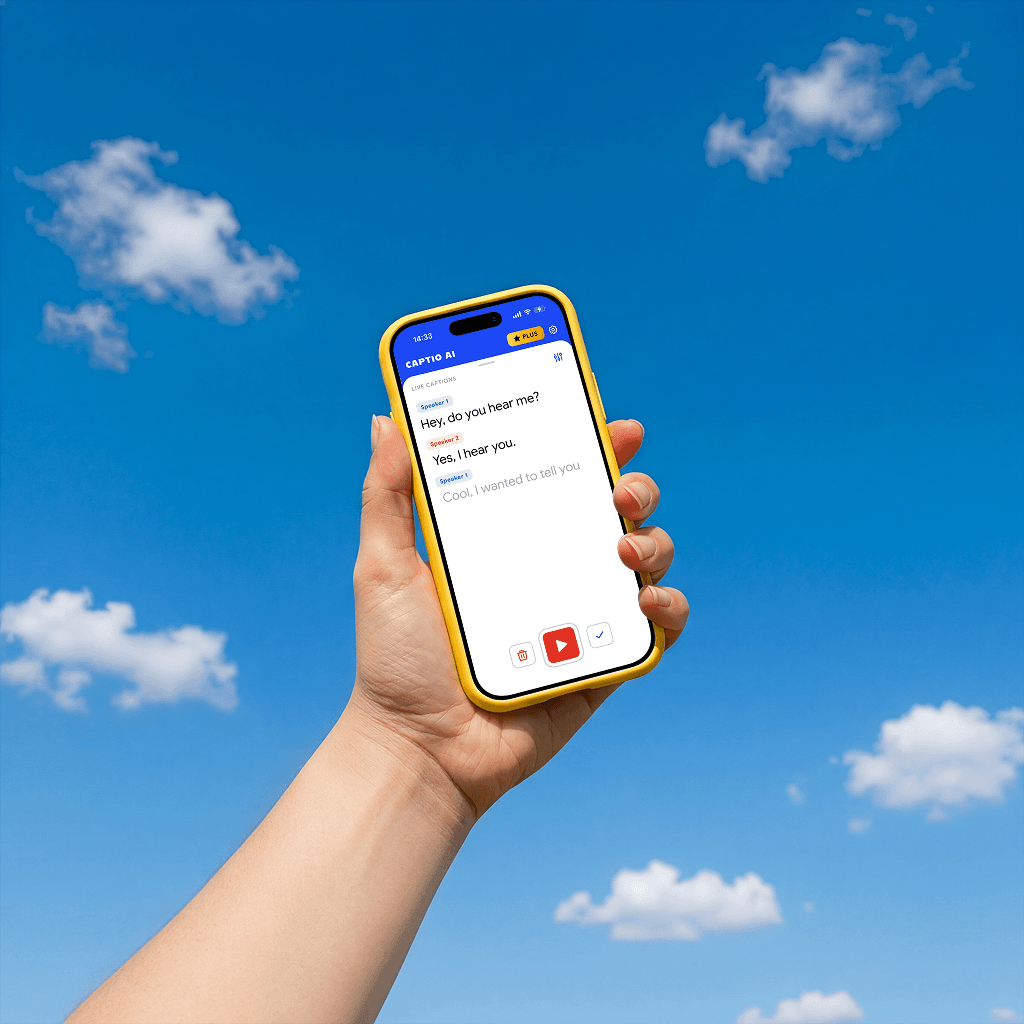
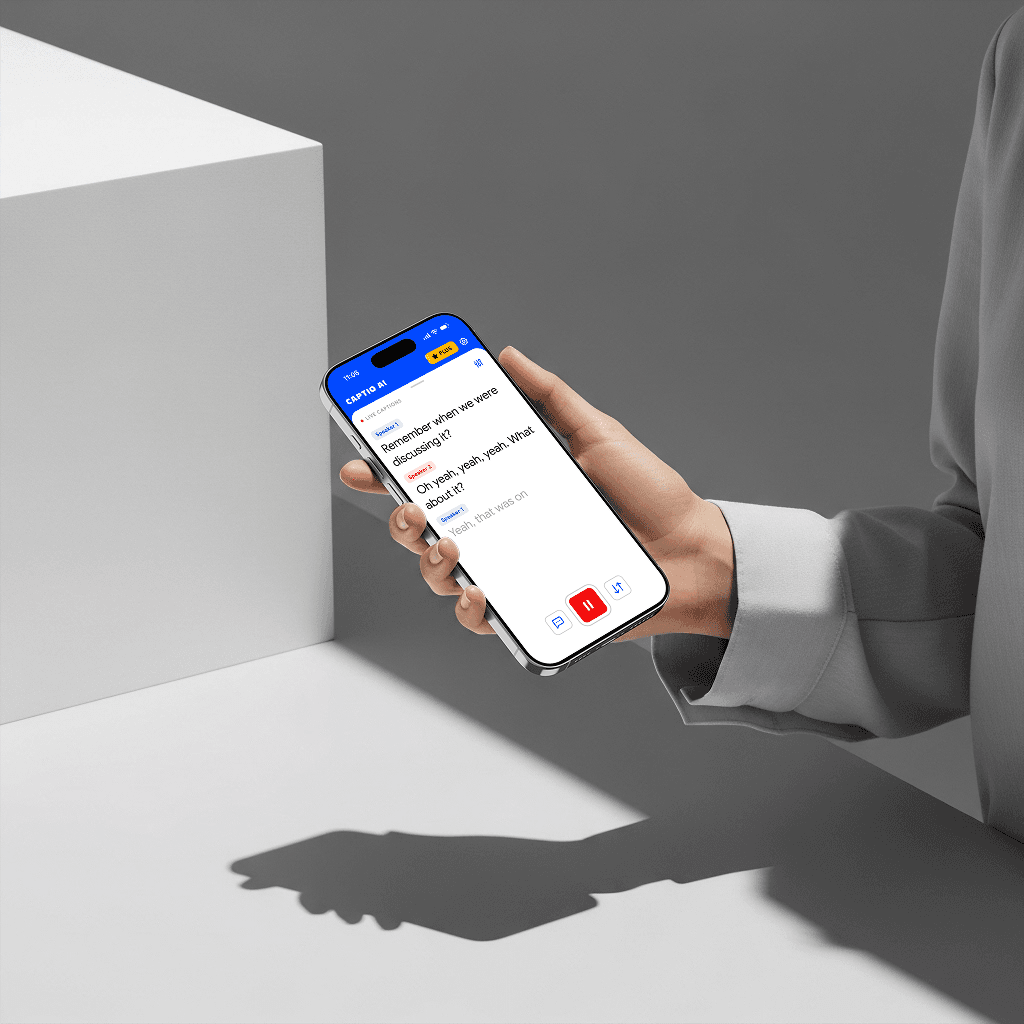
Captions as the doctor speaks
Words appear on screen while the doctor is still talking. You read the diagnosis, drug name, or follow-up instruction at the same moment it is said — not after they have moved on.
Medical terminology handled accurately
Drug names, procedure names, clinical terms. Captio AI handles the vocabulary of a real consultation — not just everyday speech.
Review the appointment after
Record the consultation and upload it to Audio Transcription. Get a full written record of everything said — instructions, dosages, referrals — to review at home and share with a carer if needed.
Works in any clinical setting
Consultation rooms, hospital wards, A&E, dental chairs, pharmacy counters. Place the phone near the speaker and Captio AI captions whoever is talking.
Any language
For foreign-language doctors, specialists abroad, or appointments through an interpreter. Live Translator captions and translates in real time so you follow your diagnosis in the language you understand best.
100% private
Medical conversations are among the most sensitive there are. Captio AI processes audio in real time and discards it immediately. Nothing is recorded, stored, or shared.
Why Polish is hard to understand
Consonant cluster density
- Polish consonant clusters are almost invisible on lips
- Polish has extremely dense consonant clusters — szcz, prz, strz, chrz — that produce rapid bursts of sound compacted into almost no visible mouth movement. Clinical words like 'chrząstka' (cartilage), 'przełyk' (oesophagus), and 'skrzywienie' (curvature) are pure cluster-sound with minimal lip movement a deaf patient can read. Among European languages, Polish sits at the extreme end of the gap between what is heard and what is seen.
Dental-palatal invisibility
- Polish's consonantal contrasts within the mouth are invisible
- Polish distinguishes dental, alveolar, palatal, and retroflex consonant series — the sz/s, cz/c, ż/z, and dż/dz pairs that are minimal pairs sounding completely different but produced at articulatory positions invisible on the lips. In clinical vocabulary — drug names, anatomical terms, diagnostic categories — these contrasts distinguish words whose visual representation is identical.
Latin medical register
- Clinical Polish uses Latin and Greek roots adapted to Polish phonology
- Polish medical vocabulary draws heavily from Latin and Greek, but these words are adapted to Polish phonological rules — producing pronunciations unlike their international equivalents. 'Zapalenie płuc' (pneumonia) and 'niedokrwistość' (anaemia) follow Polish rules that a deaf patient may not associate with the conditions they know. Doctors switch between clinical Latin-derived terms and colloquial Polish equivalents mid-sentence without warning.
Regional dialect variation
- Kashubian, Silesian, and Mazovian speech patterns affect individual doctors
- While Standard Polish is the clinical norm, regional varieties — Kashubian influence in the north, Silesian patterns in the south — affect the pronunciation of individual doctors. A deaf patient used to Warsaw Polish encountering a clinician who grew up in Silesia or Kraków faces shifted vowels and different consonant realizations in the same clinical words.
Nasal vowel reduction
- Polish nasal vowels reduce in fast speech and disappear on lips
- Polish has two nasal vowels (ą, ę) that are phonemically distinctive — but in fast colloquial speech they frequently denasalise. A doctor speaking quickly while typing notes may produce output where the nasal quality that distinguishes a pair of words has been reduced to zero — with no visual cue remaining for a deaf patient.
Download for free
15% of Poles with hearing loss. A legal right to interpretation that arrived in 2012 — with implementation still catching up.
Approximately 15.1% of people in Poland report having hearing loss, according to national survey data — representing more than 5.7 million people in a country of 37.9 million. A study of Polish school-age children from rural areas found hearing screening positive results at 16.4%, with higher rates in younger children. Poland has an ageing population and an industrial history — noise-induced hearing loss from heavy industry, mining, and manufacturing has added to the baseline prevalence across working-age adults and retirees.
In 2011, Poland passed the Act on Sign Language and Other Means of Communication, legally recognising PJM (Polski Język Migowy) as a natural language and granting deaf individuals the right to access specialist services including sign language interpreters in healthcare facilities. Since 1 April 2012, public institutions have been mandated to provide access to PJM interpretation. In practice, deaf advocacy organisations consistently note that the legislation has not fully translated into reality — particularly in smaller cities and rural areas where interpreters are not available at short notice and hospital staff are rarely trained in deaf communication.
The gap is most acute in emergency situations. A deaf patient arriving at a regional SOR cannot pre-book an interpreter and cannot wait for one to arrive. The right to interpretation is a right on paper; in the moments when clinical communication matters most, it is not available in practice. Captio AI captions Polish speech in real time — at the przychodnia, the apteka, and the SOR — without requiring any advance arrangement.
Download for free
What you hear stays with you.
Gone the moment it ends
Captio AI processes your audio in real time and discards it immediately. Nothing is recorded. Nothing is kept.
Not a product
Your conversations are not something Captio AI sells, shares, or monetizes — to anyone, for any reason.
Not used to train anything
What you say in a doctor's appointment or a job interview never ends up in a training dataset. Not ours. Not anyone else's.

Private by default
Captio AI supports 60+ languages
Download for free
Frequently asked questions
Understand your diagnosis in Polish.
Captio AI is free to start
Download for free