

Catalan live captions and productivity tool for doctor appointments
For deaf and hard of hearing people.
Download for free
Everything you need to follow Catalan doctor appointments
Four tools built for deaf and hard of hearing Catalan speakers.
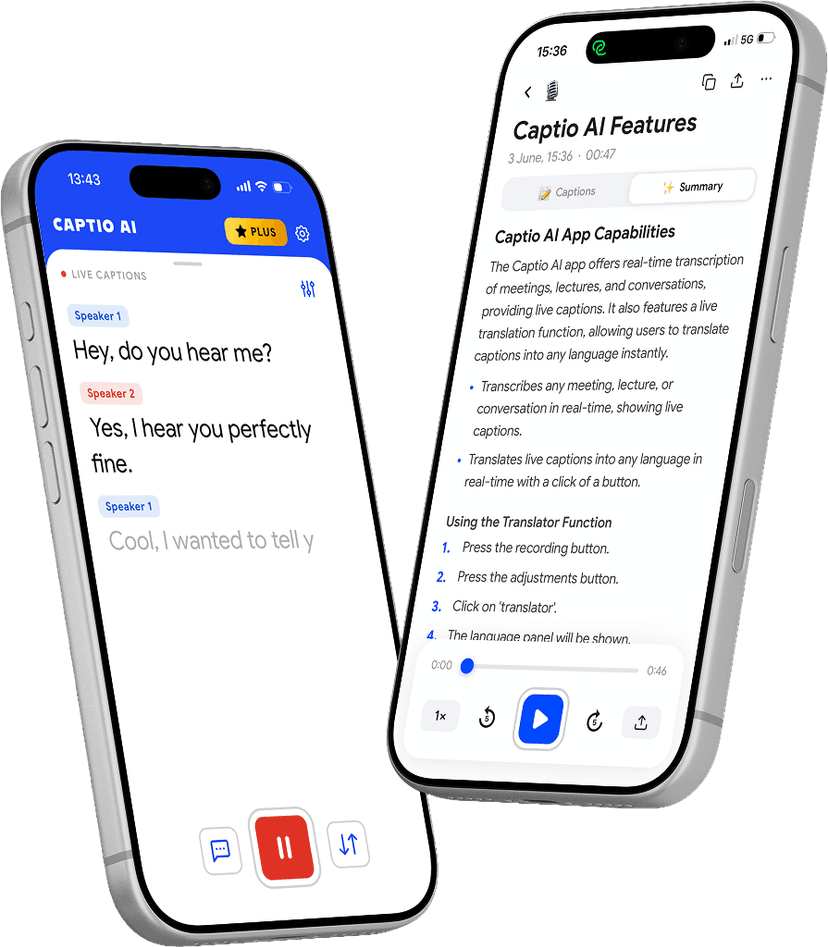
Follow what the doctor says in real time
- Captions appear word by word as they speak
- Handles medical terminology, drug names, and clinical language
- Place the phone on the desk — no setup needed
- Works in any consultation room, clinic, or hospital setting
When the doctor speaks another language
- Captions and translates in real time
- Follow your diagnosis in the language you understand best
- 60+ languages, no manual switching
- For foreign specialists, travel, or immigration settings
A full record of the consultation
- Record the appointment and upload it for a complete transcript
- Review instructions, drug names, and follow-up steps at home
- Share with a family member or carer if needed
- Works on any consultation recording
Key instructions extracted automatically
- Diagnosis, medication, and follow-up steps pulled from any transcript
- Organised into clear sections
- Nothing important missed or forgotten
- Works on any saved appointment recording
Download for free
Every situation covered
Designed for the real moments that matter — not just quiet controlled environments.
At a centre d'atenció primària (CAP — primary care centre) in Barcelona, Girona, Lleida, or a smaller municipi, your metge explains symptoms and treatment in Catalan. Captio AI captions every word in real time.
At a specialist appointment at Hospital de la Vall d'Hebron or a regional hospital, medical terminology arrives in Catalan or Spanish. Captio AI captions both in real time so you follow every detail.
At the farmàcia (pharmacy), the farmacèutic explains dosage and drug interactions quickly in Catalan. Point your phone toward them and read the instructions as they speak.
At the dentista (dental clinic), the dentist gives instructions during treatment when lip-reading is impossible. Captio AI captions from audio alone.
In a session with a psicòleg or psiquiatre, sensitive topics require full comprehension. Captio AI captions the entire session so you engage without missing context.
At urgències (the emergency department), staff speak quickly under pressure. Open Captio AI and read their instructions in real time.
Most accurate and fastest models
word accuracy
independent benchmark, 2025
real-time captions
first word appears as you speak
Download for free
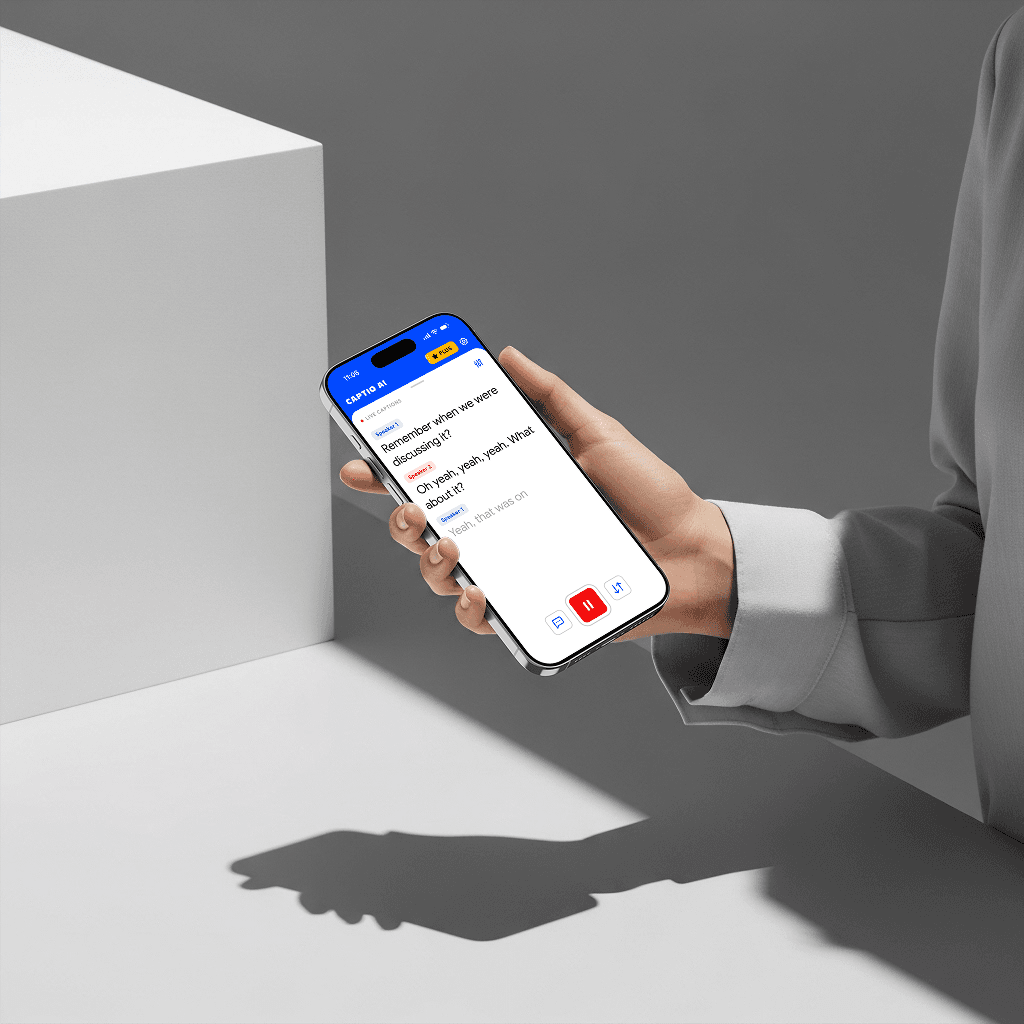
Built for the conversations where every word matters
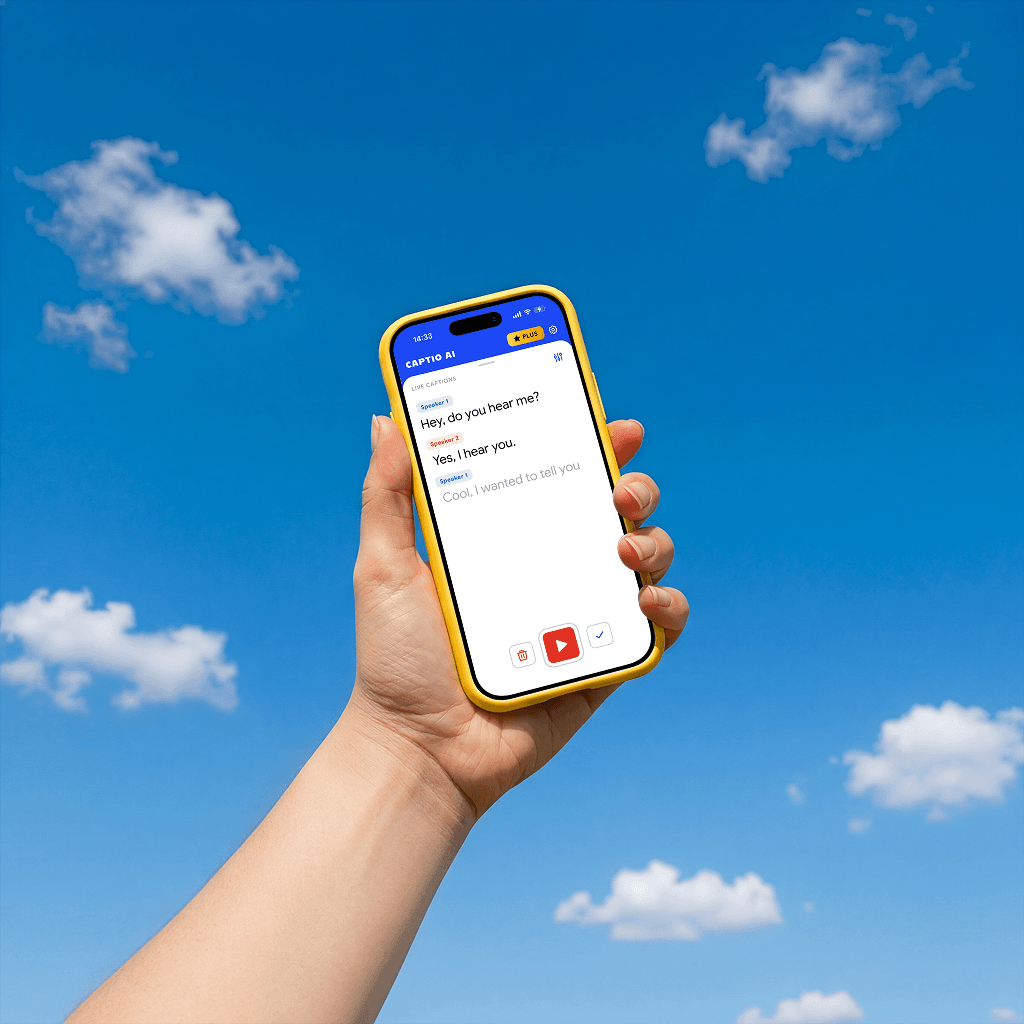
Captions as the doctor speaks
Words appear on screen while the doctor is still talking. You read the diagnosis, drug name, or follow-up instruction at the same moment it is said — not after they have moved on.
Medical terminology handled accurately
Drug names, procedure names, clinical terms. Captio AI handles the vocabulary of a real consultation — not just everyday speech.
Review the appointment after
Record the consultation and upload it to Audio Transcription. Get a full written record of everything said — instructions, dosages, referrals — to review at home and share with a carer if needed.
Works in any clinical setting
Consultation rooms, hospital wards, A&E, dental chairs, pharmacy counters. Place the phone near the speaker and Captio AI captions whoever is talking.
Any language
For foreign-language doctors, specialists abroad, or appointments through an interpreter. Live Translator captions and translates in real time so you follow your diagnosis in the language you understand best.
100% private
Medical conversations are among the most sensitive there are. Captio AI processes audio in real time and discards it immediately. Nothing is recorded, stored, or shared.
Why Catalan is hard to understand
Vowel reduction in Eastern Catalan
- Unstressed vowels neutralise and disappear in Eastern Catalan
- Eastern Catalan (spoken in and around Barcelona, the largest Catalan-speaking city) has extensive unstressed vowel reduction: /a/ and /e/ both reduce to schwa /ə/, and /o/ reduces to /u/ in unstressed position. In fast clinical speech, a Catalan doctor in Barcelona is producing a stream where many of the vowel shapes a deaf patient expects to see have merged into a single central vowel or disappeared entirely. Words that look three syllables long on paper look shorter and different on the lips.
Schwa invisibility
- The Catalan schwa produces minimal and ambiguous lip movement
- The schwa /ə/ — the most common unstressed vowel in Eastern Catalan — produces a neutral, slightly open lip shape that is nearly indistinguishable from an adjacent unstressed syllable. In clinical vocabulary where multiple unstressed syllables follow each other, a deaf patient lip-reading Eastern Catalan sees a sequence of similar neutral shapes with no visual differentiation. The content is in the audio, not on the lips.
Valencian vs Eastern Catalan gap
- Valencian and Eastern Catalan sound markedly different in the same clinical vocabulary
- Valencian — spoken in the Valencian Community south of Catalonia and recognised as a separate standard variety — preserves full vowel quality in unstressed positions, contrasting sharply with Eastern Catalan's reduction. The same medical term sounds and lip-reads differently in Valencian vs Eastern Catalan. A deaf patient trained in one variety finds clinical staff from the other speaking in a phonologically distinct system.
Balearic Catalan
- Mallorcan and Minorcan Catalan have archaic vowel distinctions
- Balearic Catalan (spoken in Mallorca, Minorca, Ibiza) preserves medieval phonological distinctions absent in Eastern and Western Catalan, including different realisation of historical /a/ vowels and archaic forms in clinical vocabulary. A deaf patient from mainland Catalonia attending a clinic in Palma encounters Mallorcan lip shapes for Catalan words they know well — different enough to require active reinterpretation.
Catalan–Spanish code-switching
- Clinical speech in Catalonia switches between Catalan and Spanish mid-sentence
- In Catalan healthcare settings — hospitals, health centres, pharmacies — code-switching between Catalan and Spanish is common, varying by doctor, by hospital, and by patient. A deaf patient who lip-reads Catalan encounters Spanish for certain clinical terms or entire sentences, with no advance signal of the switch. Tracking two phonological systems in the same appointment is a sustained cognitive load that adds to the inherent difficulty of lip-reading either language alone.
Download for free
Hearing loss in Catalonia and Spain: 1 million people, landmark recognition in 1994, and the COVID information gap
In Spain, 1,064,000 people — representing 2.3% of the population — are deaf or have a significant hearing disability. Catalonia was the first Spanish Autonomous Community to grant official status to a sign language: Catalan Sign Language (Llengua de Signes Catalana, LSC) received recognition in 1994 through regional law, 13 years before Spanish Sign Language received national legal recognition. The Catalan Federation of Deaf People (FESOCAT), founded in 1979, has been central to this advocacy. Today there are approximately 18,000 to 25,000 LSC users across the Catalan-speaking territories.
Despite this early recognition, a 2021 study published in PMC examining the impact of COVID-19 on people with hearing disabilities in Spain documented accessibility failures that the recognition framework did not prevent. During the pandemic, authorities issued critical health information — restrictions, vaccine protocols, emergency guidance — through formats that were inaccessible to deaf people. In Catalonia, public health communication that was available in Catalan and Spanish was not consistently provided in LSC. The research found that people with hearing disabilities experienced systematic violations of their right to be informed during a public health emergency — revealing how thinly the practical implementation of accessibility reaches even in the most legally developed regional framework in Spain.
In clinical settings specifically, the LSC bilingual education programme in Catalonia reached 185 deaf children in school year 2019/2020, while approximately 1,700 deaf and hard of hearing children were enrolled in oral-only programmes. This pattern — a small bilingual-signing minority and a large oral-communication majority — reflects how most deaf Catalan adults navigate the healthcare system: through spoken Catalan or Spanish, without LSC, and with the communication barriers that spoken clinical language imposes. Captio AI captions Catalan and Spanish in real time at any CAP or hospital in Catalonia or the Valencian Community, so every patient receives their doctor's words directly.
Download for free
What you hear stays with you.
Gone the moment it ends
Captio AI processes your audio in real time and discards it immediately. Nothing is recorded. Nothing is kept.
Not a product
Your conversations are not something Captio AI sells, shares, or monetizes — to anyone, for any reason.
Not used to train anything
What you say in a doctor's appointment or a job interview never ends up in a training dataset. Not ours. Not anyone else's.
Private by default
Captio AI supports 60+ languages
Download for free
Frequently asked questions
Understand your diagnosis in Catalan.
Captio AI is free to start
Download for free