

Kazakh live captions and productivity tool for doctor appointments
For deaf and hard of hearing people.
Download for free


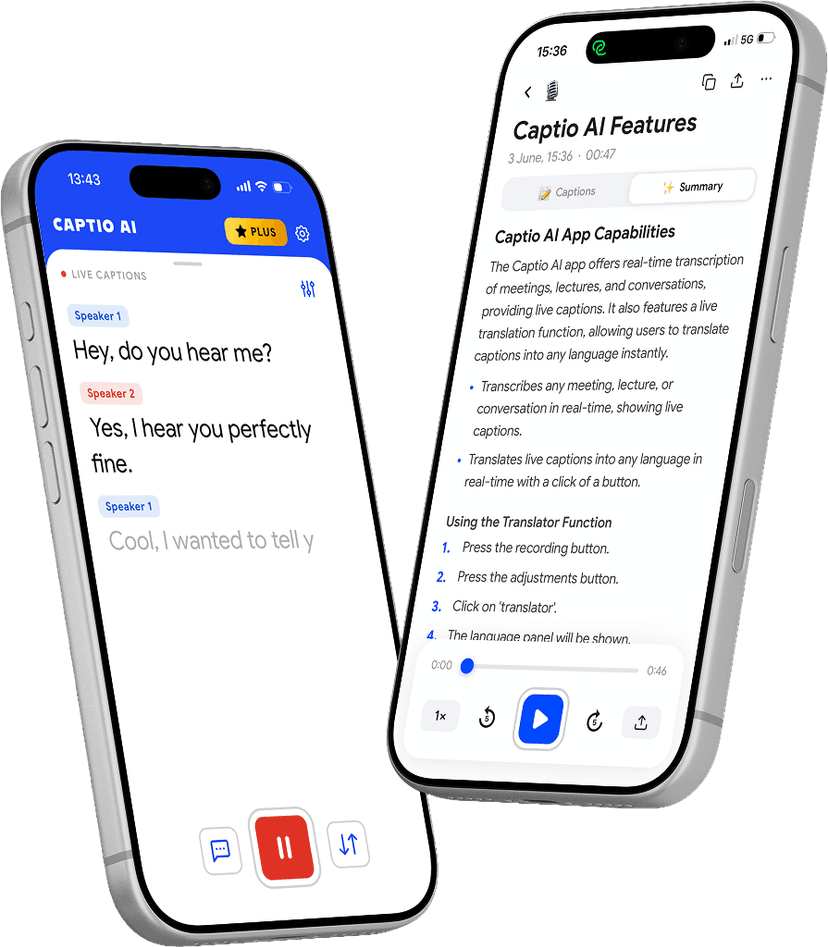
Everything you need to follow Kazakh doctor appointments
Four tools built for deaf and hard of hearing Kazakh speakers.
Follow what the doctor says in real time
- Captions appear word by word as they speak
- Handles medical terminology, drug names, and clinical language
- Place the phone on the desk — no setup needed
- Works in any consultation room, clinic, or hospital setting
When the doctor speaks another language
- Captions and translates in real time
- Follow your diagnosis in the language you understand best
- 60+ languages, no manual switching
- For foreign specialists, travel, or immigration settings
A full record of the consultation
- Record the appointment and upload it for a complete transcript
- Review instructions, drug names, and follow-up steps at home
- Share with a family member or carer if needed
- Works on any consultation recording
Key instructions extracted automatically
- Diagnosis, medication, and follow-up steps pulled from any transcript
- Organised into clear sections
- Nothing important missed or forgotten
- Works on any saved appointment recording
Download for free
Every situation covered
Designed for the real moments that matter — not just quiet controlled environments.
At a poliklinika in Almaty or Astana, your doctor switches between Kazakh and Russian while explaining a diagnosis. Captio AI captions both languages in real time so you follow every word.
At a specialist consultation at the National Medical Research Centre or a regional hospital, technical terms arrive in Russian while explanations follow in Kazakh. Captio AI keeps pace with the switch.
At the apteka (pharmacy), the pharmacist explains dosage instructions in rapid Kazakh or Russian. Point your phone toward them and read the instructions as they speak.
At a stomatologiya (dental clinic), the dentist gives instructions during treatment when you cannot see their face. Captio AI captions from audio alone so you follow every direction.
In a mental health session with a psixolog, sensitive topics require full comprehension. Captio AI captions the entire consultation so you engage without missing context.
At a skoryaya pomoshch (emergency room), staff speak quickly under pressure in both Kazakh and Russian. Open Captio AI and read their instructions as they arrive.
Most accurate and fastest models
word accuracy
independent benchmark, 2025
real-time captions
first word appears as you speak
Download for free
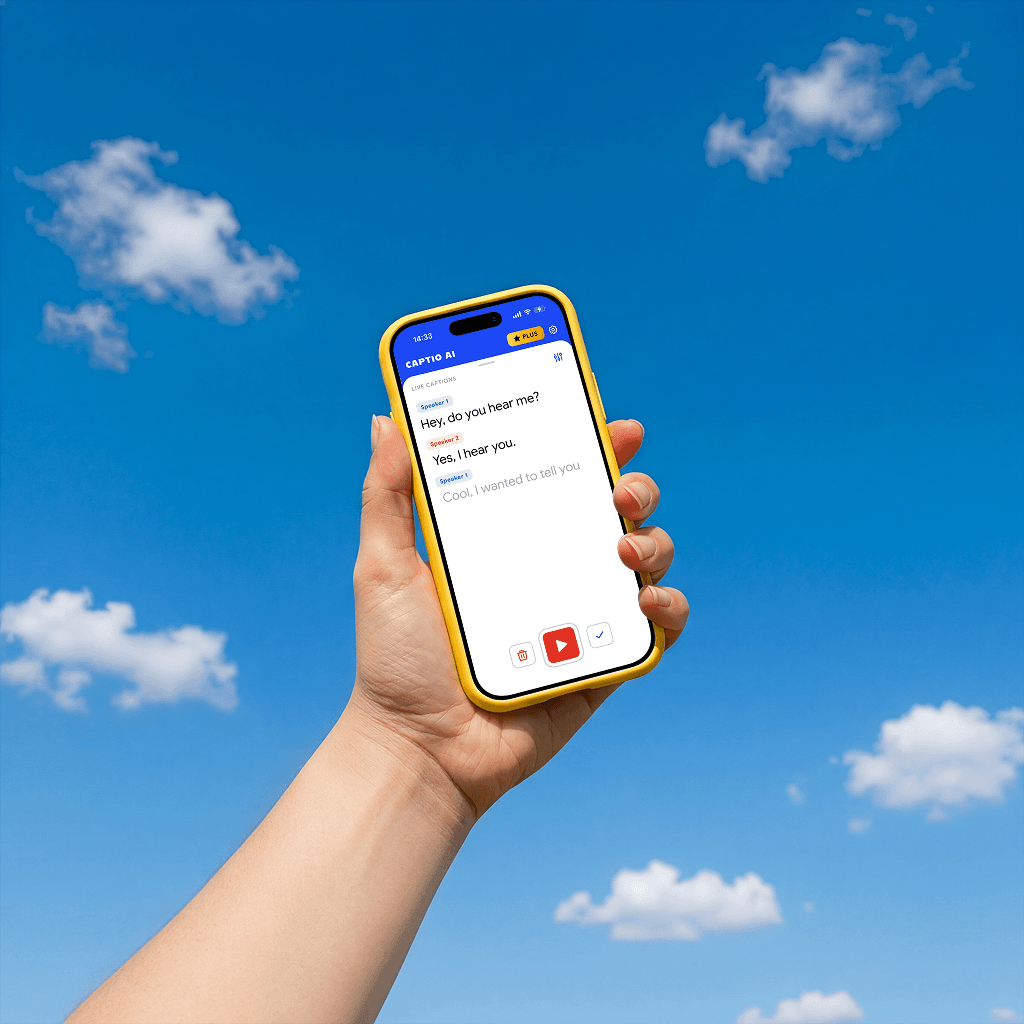
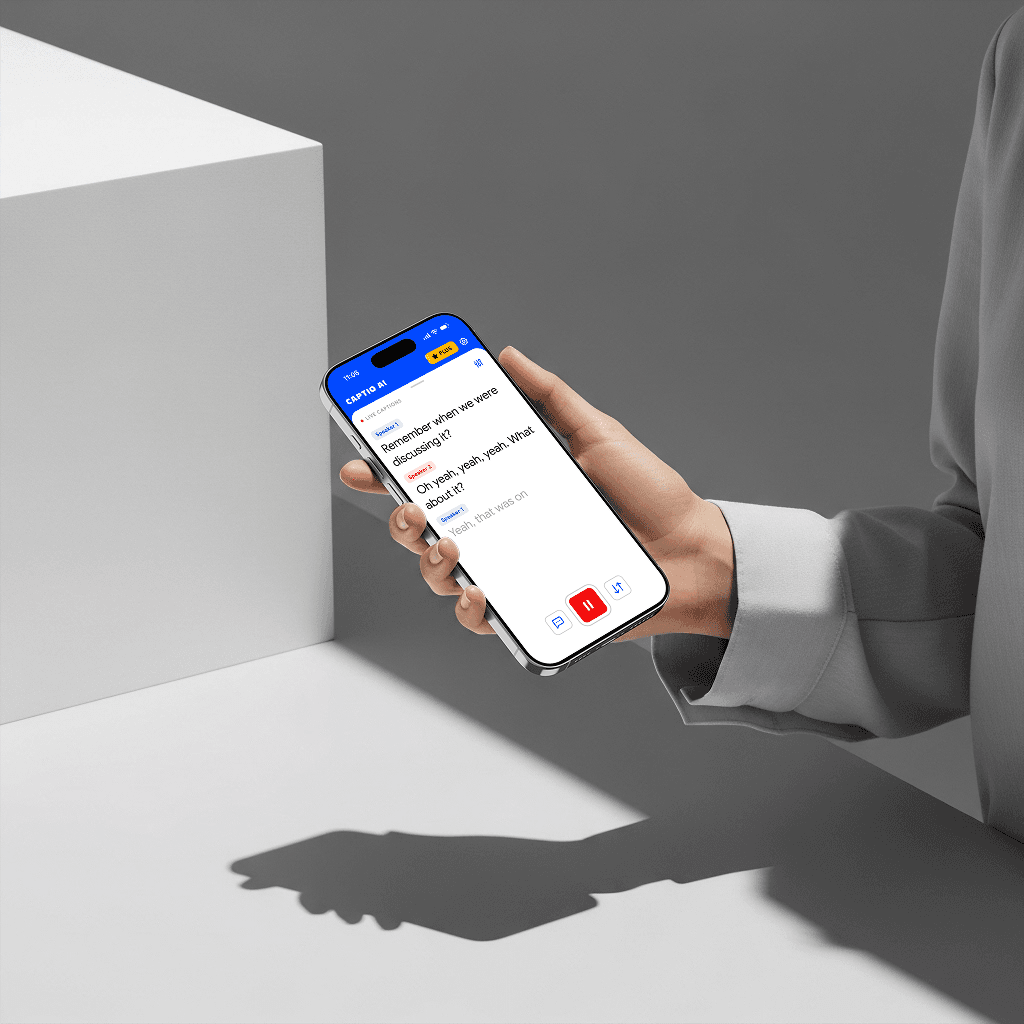
Built for the conversations where every word matters
Captions as the doctor speaks
Words appear on screen while the doctor is still talking. You read the diagnosis, drug name, or follow-up instruction at the same moment it is said — not after they have moved on.
Medical terminology handled accurately
Drug names, procedure names, clinical terms. Captio AI handles the vocabulary of a real consultation — not just everyday speech.
Review the appointment after
Record the consultation and upload it to Audio Transcription. Get a full written record of everything said — instructions, dosages, referrals — to review at home and share with a carer if needed.
Works in any clinical setting
Consultation rooms, hospital wards, A&E, dental chairs, pharmacy counters. Place the phone near the speaker and Captio AI captions whoever is talking.
Any language
For foreign-language doctors, specialists abroad, or appointments through an interpreter. Live Translator captions and translates in real time so you follow your diagnosis in the language you understand best.
100% private
Medical conversations are among the most sensitive there are. Captio AI processes audio in real time and discards it immediately. Nothing is recorded, stored, or shared.
Why Kazakh is hard to understand
Russian-Kazakh code-switching
- Doctors switch between Kazakh and Russian mid-sentence
- Kazakhstan's clinical system was built in Russian during the Soviet era, and medical education continues to use Russian extensively. Doctors in Almaty, Astana, and regional hospitals routinely name a diagnosis in Russian then explain it in Kazakh — or vice versa. A deaf or hard of hearing patient tracking lips cannot predict which language is coming next, doubling the lip-reading task.
Vowel harmony blur
- Vowel harmony makes Kazakh words look similar on the lips
- Kazakh enforces vowel harmony — all vowels in a word must share front/back and rounded/unrounded properties. For a deaf patient watching the speaker's lips, this produces long words where the vowel shapes repeat in a regular pattern, making it hard to segment where one word ends and the next begins, especially in fast clinical speech.
Dialect and regional variation
- Northeastern, Southern, and Western Kazakh differ phonologically
- Kazakh has three mutually intelligible but phonologically distinct dialect groups. A deaf patient who lip-reads Northeastern Kazakh (the prestige variety and basis for the standard language) will find Southern Kazakh — spoken near Shymkent and the Uzbek border — and Western Kazakh producing different mouth shapes for identical words.
Script transition noise
- The Cyrillic-to-Latin transition creates uncertainty in written output
- Kazakhstan is in the process of transitioning Kazakh from Cyrillic to a Latin-based script. Medical documentation, signage, and prescription notes may be in either script, meaning a deaf patient who relies on written backup notes at an appointment may encounter an unexpected script system and additional cognitive load on top of the listening effort.
Agglutinative compression
- Long suffixed word chains compress into single rapid units
- Kazakh is agglutinative — a single word carries tense, case, possession, and negation through suffix chains. In fast clinical speech these long forms are pronounced as one rapid unit. A deaf patient lip-reading Kazakh must parse a continuous stream without the natural segmentation cues that shorter word-forms provide.
Download for free
Hearing loss in Kazakhstan: scale, access gaps, and two and a half hours a month
More than 200,000 people in Kazakhstan have hearing impairment, with research pointing to multiple contributing factors: ecological pollution in industrial regions, inadequate early diagnostics, hereditary conditions, and low-quality prenatal care in socially vulnerable communities. A 2026 study published in Frontiers in Public Health found that the age-standardized prevalence of hearing loss in Kazakhstan reached 17,212 per 100,000 population in 2021 — with mild hearing loss accounting for 71.9% of cases, reflecting a large population with unaddressed moderate impairment that nonetheless struggles in clinical settings. Causes specific to Kazakhstan include elevated rates of Rhesus factor complications and pharmaceutical-related hearing damage from improperly supervised medication use.
The state-provided support structure for deaf and hard of hearing Kazakhstanis is severely underfunded relative to need. The government provides 30 hours of sign language interpretation per year for registered deaf citizens — equivalent to two and a half hours per month. This quota must cover every appointment, legal matter, employment interaction, and government service the person needs. For a deaf person navigating a chronic condition that requires multiple clinical appointments per year, the annual allocation can be consumed by a single illness episode. Outside Almaty and Astana, the interpreter infrastructure thins further — sign language books are mostly in Russian, and Kazakhstan's first electronic Kazakh Sign Language dictionary was only recently created.
The employment and social integration gap follows predictably. Deaf Kazakhstanis face daily barriers in healthcare, education, and work, with limited access to information and no structural mechanism to bridge the gap. In clinical settings, this means patients with hearing loss attend appointments at a poliklinika or regional hospital without interpreter support and without the technological tools to compensate. Captio AI captions Kazakh and Russian in real time at any poliklinika or skoryaya pomoshch in Kazakhstan, so every patient receives the doctor's words directly — without waiting for their two and a half monthly hours to be used up.
Download for free
What you hear stays with you.
Gone the moment it ends
Captio AI processes your audio in real time and discards it immediately. Nothing is recorded. Nothing is kept.
Not a product
Your conversations are not something Captio AI sells, shares, or monetizes — to anyone, for any reason.
Not used to train anything
What you say in a doctor's appointment or a job interview never ends up in a training dataset. Not ours. Not anyone else's.

Private by default
Captio AI supports 60+ languages
Download for free
Frequently asked questions
Understand your diagnosis in Kazakh.
Captio AI is free to start
Download for free