

Urdu live captions and productivity tool for doctor appointments
For deaf and hard of hearing people.
Download for free


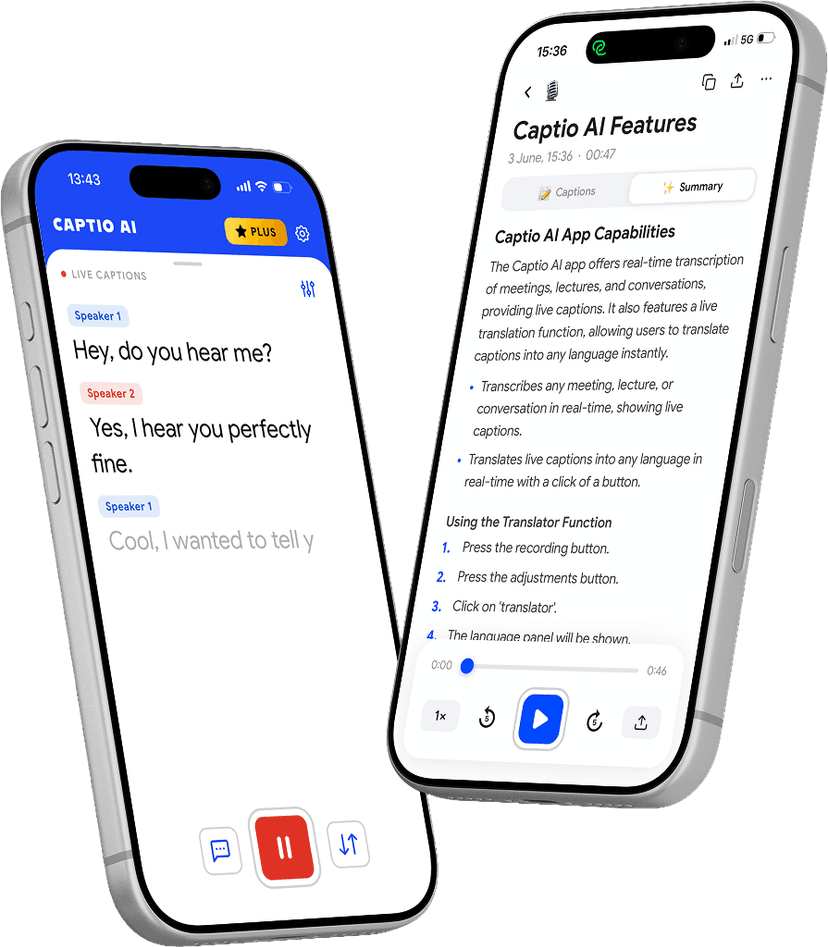
Everything you need to follow Urdu doctor appointments
Four tools built for deaf and hard of hearing Urdu speakers.
Follow what the doctor says in real time
- Captions appear word by word as they speak
- Handles medical terminology, drug names, and clinical language
- Place the phone on the desk — no setup needed
- Works in any consultation room, clinic, or hospital setting
When the doctor speaks another language
- Captions and translates in real time
- Follow your diagnosis in the language you understand best
- 60+ languages, no manual switching
- For foreign specialists, travel, or immigration settings
A full record of the consultation
- Record the appointment and upload it for a complete transcript
- Review instructions, drug names, and follow-up steps at home
- Share with a family member or carer if needed
- Works on any consultation recording
Key instructions extracted automatically
- Diagnosis, medication, and follow-up steps pulled from any transcript
- Organised into clear sections
- Nothing important missed or forgotten
- Works on any saved appointment recording
Download for free
Every situation covered
Designed for the real moments that matter — not just quiet controlled environments.
Government hospital OPD visits across Pakistan where the doctor speaks fast Urdu and switches to English for diagnoses and drug names. Captio AI captions every switch in real time.
Private specialist clinics in Lahore, Karachi, and Islamabad where cardiologists deliver dense clinical vocabulary in Urdu and English. Captio AI captions every word as the specialist speaks.
Pharmacy and دوا خانہ counter conversations where the chemist explains the prescription in Urdu. Captio AI captions the dosage instructions so nothing is missed.
Dental visits where the dentist explains the treatment in Urdu and names the procedure in English. Captio AI follows both and captures the full treatment plan.
Mental health consultations in Pakistani cities where accurate understanding of the session has real clinical consequences. Captio AI captions the clinician in real time.
Emergency room visits at government hospitals in Pakistan where triage staff speak quickly. Captio AI captions the key clinical instructions when they matter most.
Most accurate and fastest models
word accuracy
independent benchmark, 2025
real-time captions
first word appears as you speak
Download for free
Built for the conversations where every word matters
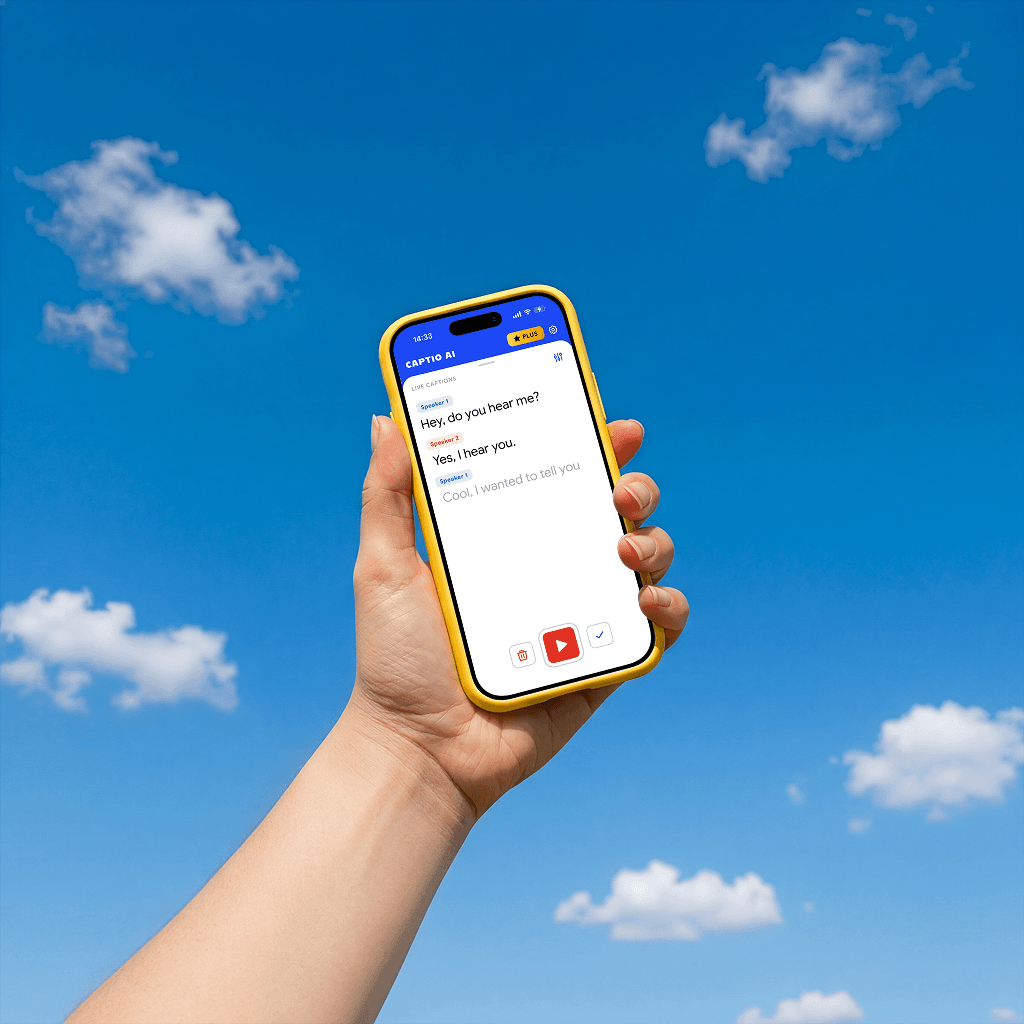
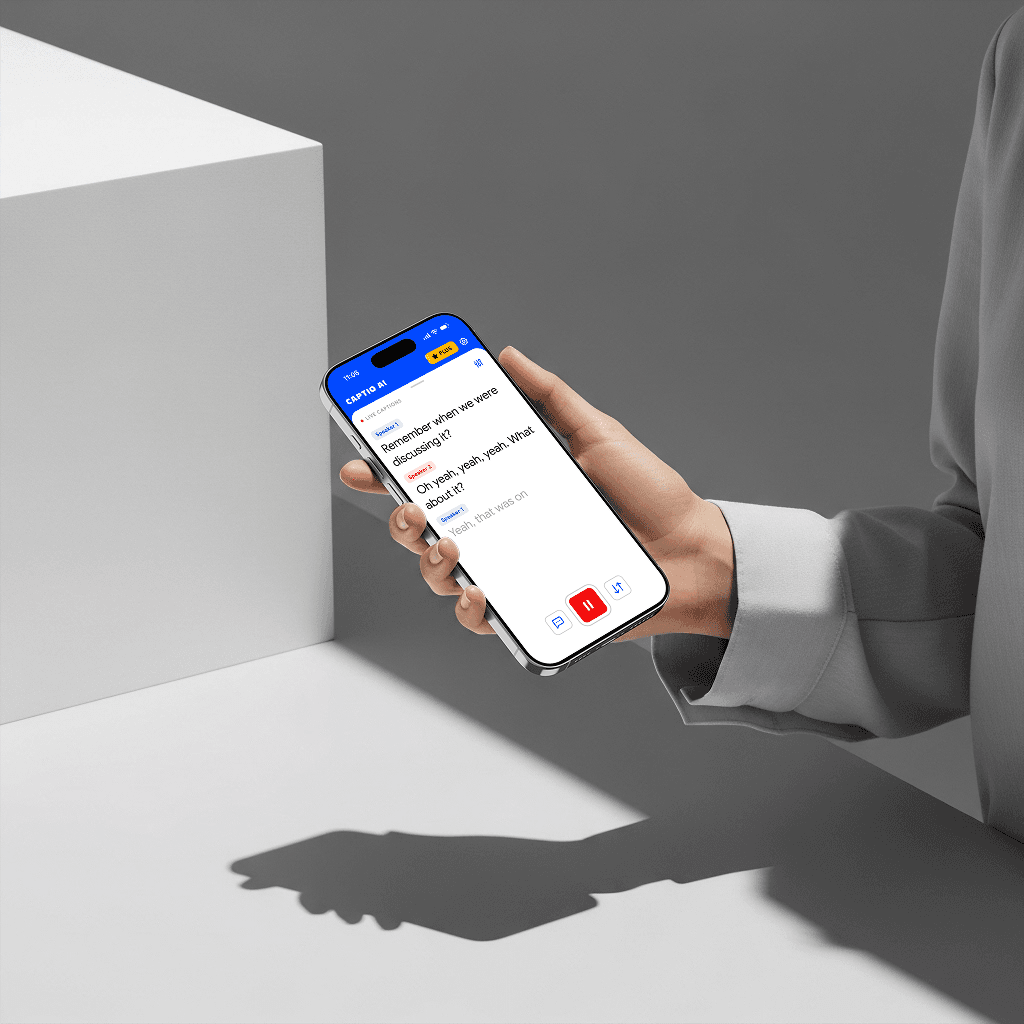
Captions as the doctor speaks
Words appear on screen while the doctor is still talking. You read the diagnosis, drug name, or follow-up instruction at the same moment it is said — not after they have moved on.
Medical terminology handled accurately
Drug names, procedure names, clinical terms. Captio AI handles the vocabulary of a real consultation — not just everyday speech.
Review the appointment after
Record the consultation and upload it to Audio Transcription. Get a full written record of everything said — instructions, dosages, referrals — to review at home and share with a carer if needed.
Works in any clinical setting
Consultation rooms, hospital wards, A&E, dental chairs, pharmacy counters. Place the phone near the speaker and Captio AI captions whoever is talking.
Any language
For foreign-language doctors, specialists abroad, or appointments through an interpreter. Live Translator captions and translates in real time so you follow your diagnosis in the language you understand best.
100% private
Medical conversations are among the most sensitive there are. Captio AI processes audio in real time and discards it immediately. Nothing is recorded, stored, or shared.
Why Urdu is hard to understand
Urdu–English code-switch at diagnosis
- Pakistani doctors explain in Urdu and deliver the diagnosis, drug name, and test in English
- Medical consultations in Pakistan almost universally involve a code-switch at the most clinical moment. A doctor takes the history in Urdu, then delivers the diagnosis and prescription in English: 'آپ کو hypertension ہے، Amlodipine شروع کریں، اور ECG کروائیں.' A deaf patient tracking Urdu loses the thread exactly when the clinical information is most specific — the diagnosis, the drug, and the investigation are all in the code the patient was not tracking.
Aspiration pairs in Urdu medical vocabulary
- Urdu's four-way consonant contrast is nearly invisible on the lips
- Urdu has four contrasting consonant series: voiceless unaspirated, voiceless aspirated, voiced unaspirated, and voiced aspirated — producing pairs like پ/پھ, ک/کھ, ت/تھ, ب/بھ. These are primarily acoustic distinctions — aspiration produces no visible change in lip position. Medical vocabulary built on these contrasts is hard to distinguish visually in fast clinical delivery, and a deaf patient relying on lip-reading cannot recover the phonemic distinction.
Urdu–Hindi register boundary
- Urdu and Hindi share phonology but diverge in medical vocabulary — creating gaps across borders
- Urdu and Hindi are mutually intelligible in everyday speech but diverge in formal vocabulary: Urdu medical terms draw from Arabic and Persian, while Hindi medical terms draw from Sanskrit. A deaf Urdu-speaking patient attending a clinic in India — or in the UK diaspora — will encounter the same phonology but different lexical choices in clinical speech. The shared surface form masks the vocabulary gap.
Fast Pakistani clinical delivery
- Pakistan's public hospitals operate under very large patient loads and very short consultations
- Government hospitals in Pakistan — including major teaching hospitals in Lahore, Karachi, and Peshawar — see enormous numbers of outpatients per day. Consultations are brief. The doctor speaks quickly, writes the prescription, and the next patient is at the door. A deaf patient attending alone cannot ask for repetition without disrupting the flow of a service under constant pressure.
Nastaliq script and on-screen reading
- Urdu's right-to-left Nastaliq script requires reading adjustment alongside audio tracking
- Urdu is written in Nastaliq script, displayed right to left. A deaf patient reading real-time Urdu captions must process right-to-left text while following the visual context of the consultation. Patients more familiar with Roman Urdu in digital contexts may find Nastaliq captions an additional adjustment.
Download for free
14.5 million Pakistanis with hearing loss. No neonatal screening. No interpreter provision in hospitals.
Pakistan has approximately 14.5 million people with hearing loss, with about 4.8% of the total population experiencing hearing problems, according to data cited by the National Health Services Pakistan. The prevalence of hearing loss in Pakistan is significantly elevated compared to global averages, driven in substantial part by a high rate of hereditary hearing loss: studies published in PMC have found that the incidence of genetic hearing loss in Pakistan is among the highest in the world, linked in part to the rate of consanguineous marriages. WHO EMRO research (2023) found that hearing impairment in Pakistan is frequently identified late in childhood because of the absence of a national neonatal hearing screening programme — and that up to 26% of mild hearing loss cases may be missed even where screening is available.
Pakistan has no mandated neonatal hearing screening programme and no national standard for sign language interpreter provision in healthcare settings. Pakistani Sign Language (PSL) has no formal legal recognition, and there are no requirements for public hospitals to offer sign language access. A deaf patient attending a government hospital in Lahore or Karachi without a hearing companion has no formal language support beyond written exchange with the doctor — which is impractical in brief, rapid consultations.
The deaf and hard of hearing Pakistani diaspora in the United Kingdom faces a different version of the same barrier. Pakistani-British deaf patients navigating NHS consultations conducted in English experience the convergence of language and hearing access barriers simultaneously. Captio AI captions Urdu in real time — across Urdu–English code-switching, aspiration contrasts invisible on the lips, and the formal medical vocabulary — so a deaf patient can read their diagnosis and prescription as the doctor speaks.
Download for free
What you hear stays with you.
Gone the moment it ends
Captio AI processes your audio in real time and discards it immediately. Nothing is recorded. Nothing is kept.
Not a product
Your conversations are not something Captio AI sells, shares, or monetizes — to anyone, for any reason.
Not used to train anything
What you say in a doctor's appointment or a job interview never ends up in a training dataset. Not ours. Not anyone else's.

Private by default
Captio AI supports 60+ languages
Download for free
Frequently asked questions
Understand your diagnosis in Urdu.
Captio AI is free to start
Download for free