

Persian live captions and productivity tool for doctor appointments
For deaf and hard of hearing people.
Download for free
Everything you need to follow Persian doctor appointments
Four tools built for deaf and hard of hearing Persian speakers.
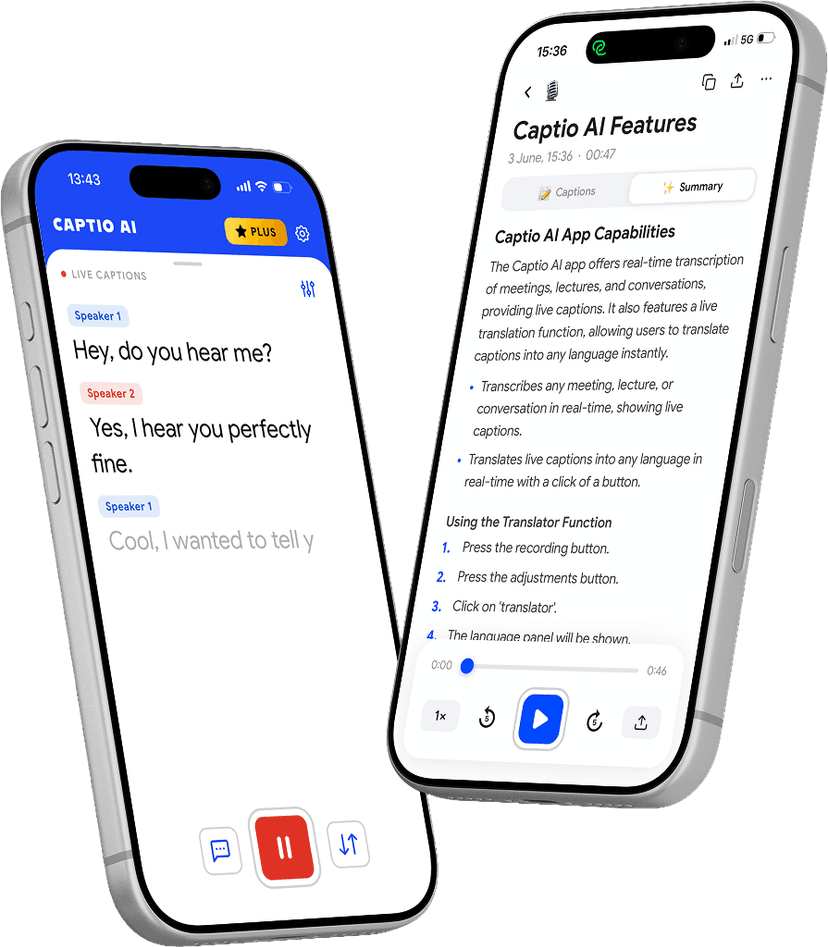
Follow what the doctor says in real time
- Captions appear word by word as they speak
- Handles medical terminology, drug names, and clinical language
- Place the phone on the desk — no setup needed
- Works in any consultation room, clinic, or hospital setting
When the doctor speaks another language
- Captions and translates in real time
- Follow your diagnosis in the language you understand best
- 60+ languages, no manual switching
- For foreign specialists, travel, or immigration settings
A full record of the consultation
- Record the appointment and upload it for a complete transcript
- Review instructions, drug names, and follow-up steps at home
- Share with a family member or carer if needed
- Works on any consultation recording
Key instructions extracted automatically
- Diagnosis, medication, and follow-up steps pulled from any transcript
- Organised into clear sections
- Nothing important missed or forgotten
- Works on any saved appointment recording
Download for free
Every situation covered
Designed for the real moments that matter — not just quiet controlled environments.
GP visits at a درمانگاه (darmangah) or private clinic, where the doctor speaks through a brief appointment looking at the computer screen and switching between formal clinical Persian and colloquial speech.
Specialist consultations at a بیمارستان (bimarestan) or polyclinic, where Arabic-derived clinical vocabulary is dense and the appointment ends before the patient has absorbed every instruction.
Pharmacy consultations at a داروخانه (daroukhane), where the pharmacist explains dosage and interactions across a counter — often behind glass, often quietly.
Dental appointments where the dentist explains the treatment plan between procedures and gives aftercare instructions that must be followed precisely.
Mental health consultations with a روانپزشک (ravan-pezeshk) or psychologist, where nuance in every clinical exchange carries direct weight.
Emergency room visits at an اورژانس (urzhanss), where staff speak fast, masks are common, and clear communication about symptoms and treatment is immediate and critical.
Most accurate and fastest models
word accuracy
independent benchmark, 2025
real-time captions
first word appears as you speak
Download for free
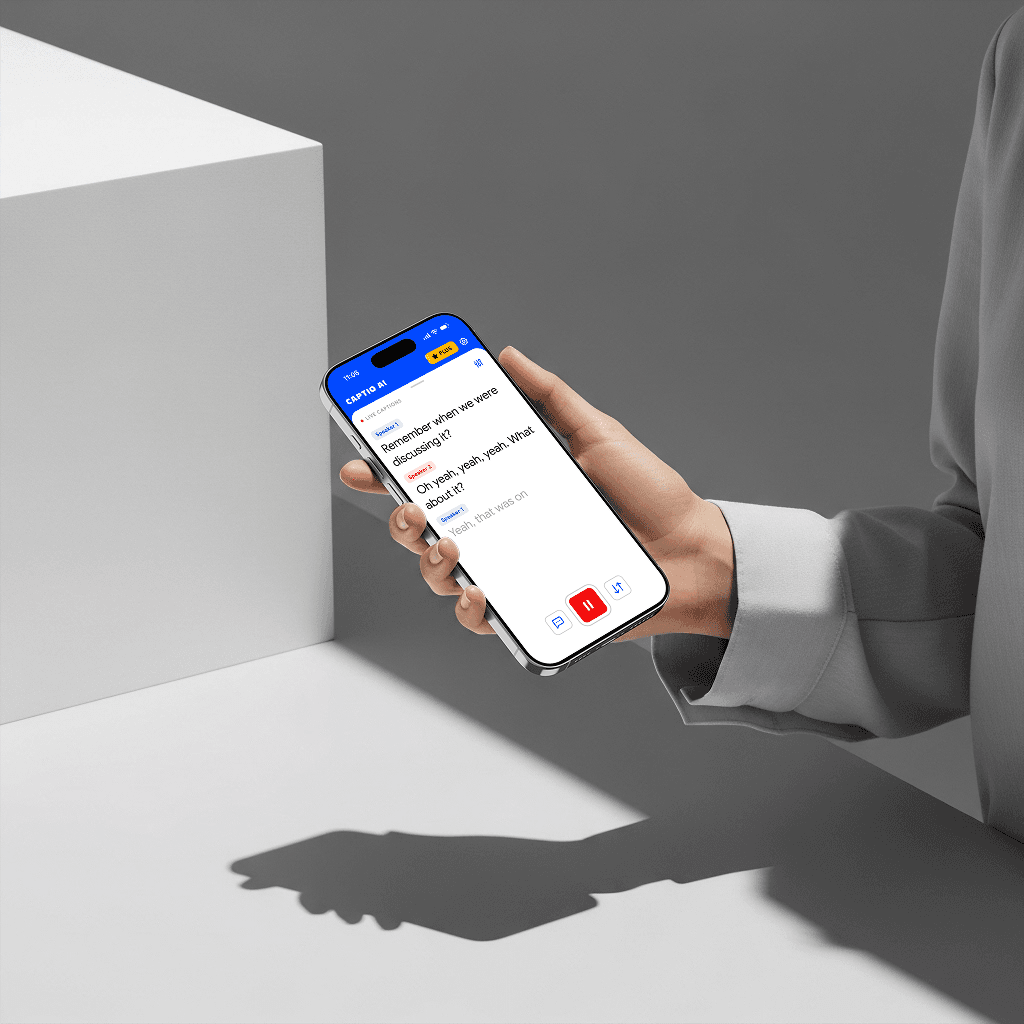
Built for the conversations where every word matters
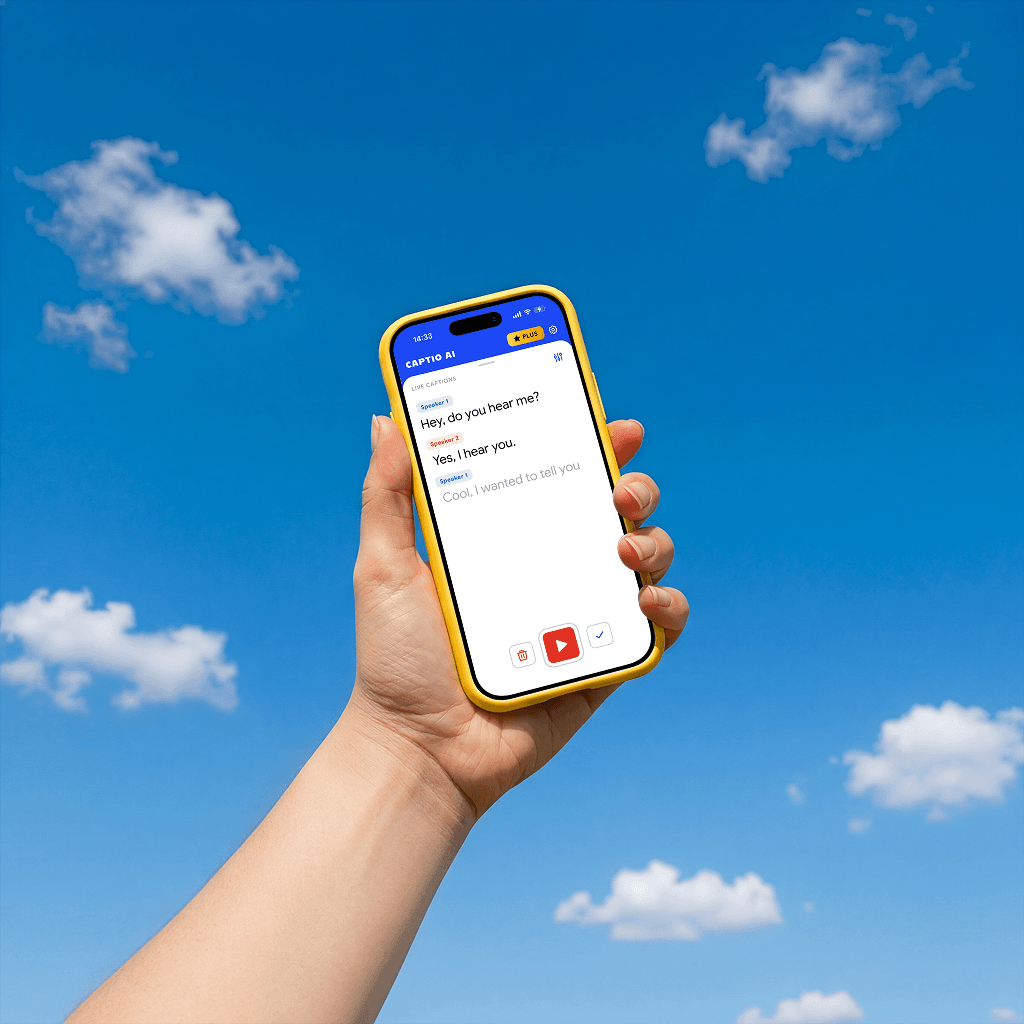
Captions as the doctor speaks
Words appear on screen while the doctor is still talking. You read the diagnosis, drug name, or follow-up instruction at the same moment it is said — not after they have moved on.
Medical terminology handled accurately
Drug names, procedure names, clinical terms. Captio AI handles the vocabulary of a real consultation — not just everyday speech.
Review the appointment after
Record the consultation and upload it to Audio Transcription. Get a full written record of everything said — instructions, dosages, referrals — to review at home and share with a carer if needed.
Works in any clinical setting
Consultation rooms, hospital wards, A&E, dental chairs, pharmacy counters. Place the phone near the speaker and Captio AI captions whoever is talking.
Any language
For foreign-language doctors, specialists abroad, or appointments through an interpreter. Live Translator captions and translates in real time so you follow your diagnosis in the language you understand best.
100% private
Medical conversations are among the most sensitive there are. Captio AI processes audio in real time and discards it immediately. Nothing is recorded, stored, or shared.
Why Persian is hard to understand
Pharyngeal invisibility
- Persian produces many sounds deep in the throat
- Persian has pharyngeal and uvular consonants — the ع (/ʕ/), ح (/ħ/), and ق (/q/) sounds — produced far back in the throat and completely invisible on the lips. These appear throughout the Arabic medical loanwords Iranian doctors use daily. A deaf patient lip-reading cannot distinguish words that differ only by a pharyngeal vs glottal consonant — yet in a dosage instruction or a diagnosis, that distinction changes the word entirely.
Short vowel reduction
- Colloquial Persian drops the vowels that distinguish clinical words
- Standard literary Persian has six vowels; colloquial Tehrani speech reduces short vowels heavily, compresses syllables, and drops unstressed sounds. A doctor speaking casually during a rushed appointment — one hand on the keyboard, eyes on the screen — produces output where vowel cues a deaf patient might catch in careful speech are gone entirely.
Arabic medical register
- Iranian clinical vocabulary is heavily Arabic-derived
- Medical terms in Iran are predominantly borrowed from Arabic — قلب (heart), کبد (liver), رحم (uterus). These words bear no phonological resemblance to their everyday Persian equivalents and follow Arabic consonantal patterns that include pharyngeals and emphatic consonants invisible on the lips. A deaf patient who learned Persian at home may not recognise the clinical name for a condition they know perfectly well in everyday language.
Formal-colloquial gap
- Doctors shift between clinical and colloquial Persian mid-consultation
- Formal written Persian and colloquial Tehrani are phonologically very different. A doctor may open with formal clinical language then shift to informal Persian to explain a treatment plan simply. Each register shift carries different vowel patterns and different word choices — each of which requires a deaf patient to recalibrate their lip-reading in real time.
Regional accent variation
- Persian-speaking doctors carry distinct regional phonological profiles
- Doctors trained in Tehran, Isfahan, Tabriz, or Mashhad each carry a distinct phonological profile — different vowel realizations, consonant strength, and speech rate. A deaf patient calibrated to Tehrani Persian may struggle substantially with an Isfahani- or Tabrizi-accented clinician encountered through a referral.
Download for free
14% of Iranians with hearing impairment. A sign language the government has not yet recognised.
A population-based study of 6,521 residents of Tehran found that 14.27% had some degree of hearing impairment — with 4.58% classified as severe and 3.27% as profound. Iran's population is approaching 90 million; if this prevalence holds nationally, more than 12 million people live with significant hearing difficulty. A 2022 situation analysis of Iran's ear and hearing care programme, published in PMC, identified critical systemic gaps: insufficient specialist audiologists, inadequate screening, and no national strategy for communication support in clinical settings.
Despite Iran ratifying the UN Convention on the Rights of Persons with Disabilities in 2008, Iranian Sign Language has not been officially recognised by law. The Center for Human Rights in Iran has documented the gap between ratification and implementation, noting that deaf and hard of hearing Iranians cannot access health services independently due to the absence of qualified interpreters. A 2018 Human Rights Watch report documented discrimination and exclusion for people with disabilities in Iran, specifically including barriers to healthcare. Iran's deaf community has campaigned publicly — a 2018 gathering of 2,000 deaf Iranians at Tehran's Milad Tower called on the government to act — but recognition remained incomplete at time of research.
The COVID-19 pandemic made the consequence concrete: with masks mandatory in Iranian clinical settings and sign language interpreters absent, deaf Iranians lost access to health information at the moment it mattered most. Article 19 documented cases of deaf people in Iran being unable to access critical pandemic guidance. Captio AI captions Persian speech in real time — at the درمانگاه, the داروخانه, and the اورژانس — without requiring any interpreter or advance booking.
Download for free
What you hear stays with you.
Gone the moment it ends
Captio AI processes your audio in real time and discards it immediately. Nothing is recorded. Nothing is kept.
Not a product
Your conversations are not something Captio AI sells, shares, or monetizes — to anyone, for any reason.
Not used to train anything
What you say in a doctor's appointment or a job interview never ends up in a training dataset. Not ours. Not anyone else's.
Private by default
Captio AI supports 60+ languages
Download for free
Frequently asked questions
Understand your diagnosis in Persian.
Captio AI is free to start
Download for free