

French live captions and productivity tool for doctor appointments
For deaf and hard of hearing people.
Download for free
Everything you need to follow French doctor appointments
Four tools built for deaf and hard of hearing French speakers.
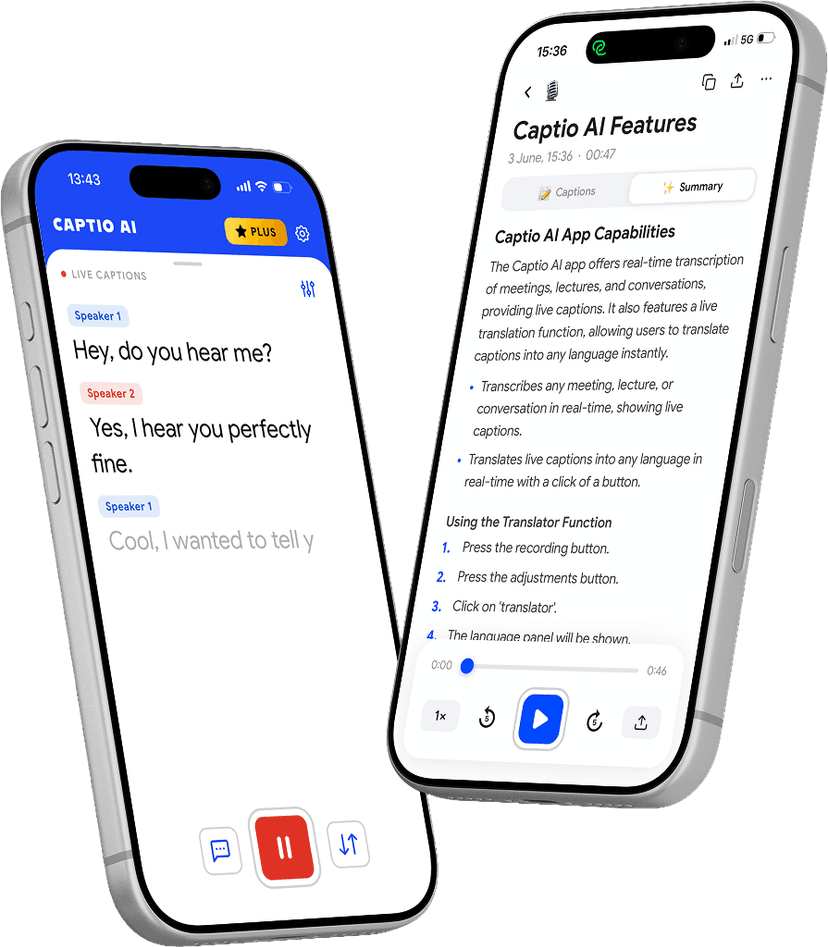
Follow what the doctor says in real time
- Captions appear word by word as they speak
- Handles medical terminology, drug names, and clinical language
- Place the phone on the desk — no setup needed
- Works in any consultation room, clinic, or hospital setting
When the doctor speaks another language
- Captions and translates in real time
- Follow your diagnosis in the language you understand best
- 60+ languages, no manual switching
- For foreign specialists, travel, or immigration settings
A full record of the consultation
- Record the appointment and upload it for a complete transcript
- Review instructions, drug names, and follow-up steps at home
- Share with a family member or carer if needed
- Works on any consultation recording
Key instructions extracted automatically
- Diagnosis, medication, and follow-up steps pulled from any transcript
- Organised into clear sections
- Nothing important missed or forgotten
- Works on any saved appointment recording
Download for free
Every situation covered
Designed for the real moments that matter — not just quiet controlled environments.
Médecin généraliste (GP) consultations in France, where appointment slots are fifteen minutes and the doctor speaks quickly while typing on a computer.
Specialist consultations at a hôpital public or CHU (university hospital), where medical terminology is dense and patient turnover is high.
Pharmacy consultations at a pharmacie, where the pharmacist explains dosage instructions verbally and quickly to the next person in the queue.
Dental appointments, where the dentist continues speaking during treatment and the patient cannot turn to lip-read.
Psychiatry or psychologie consultations, where emotional register and follow-up questions are central.
Emergency consultations at an urgences department, where staff communicate at speed and the environment is noisy.
Most accurate and fastest models
word accuracy
independent benchmark, 2025
real-time captions
first word appears as you speak
Download for free
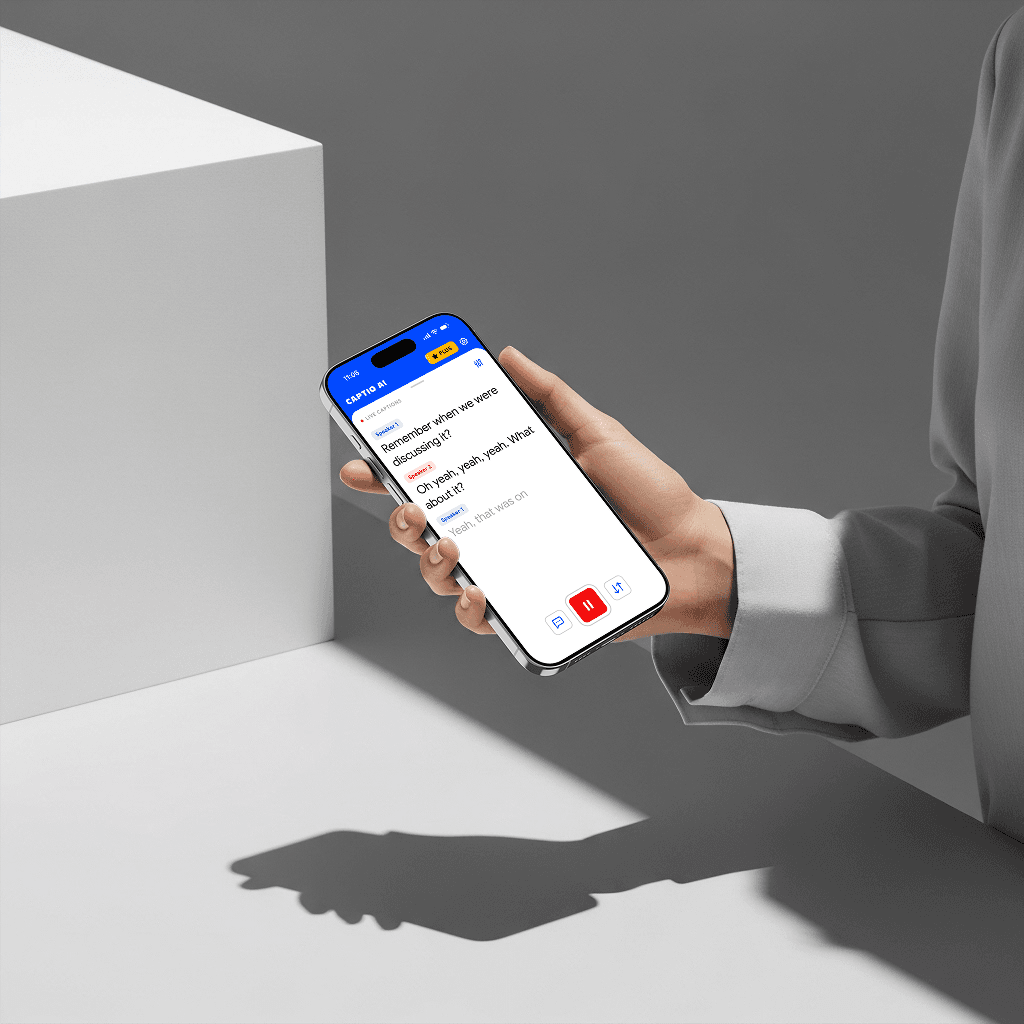
Built for the conversations where every word matters
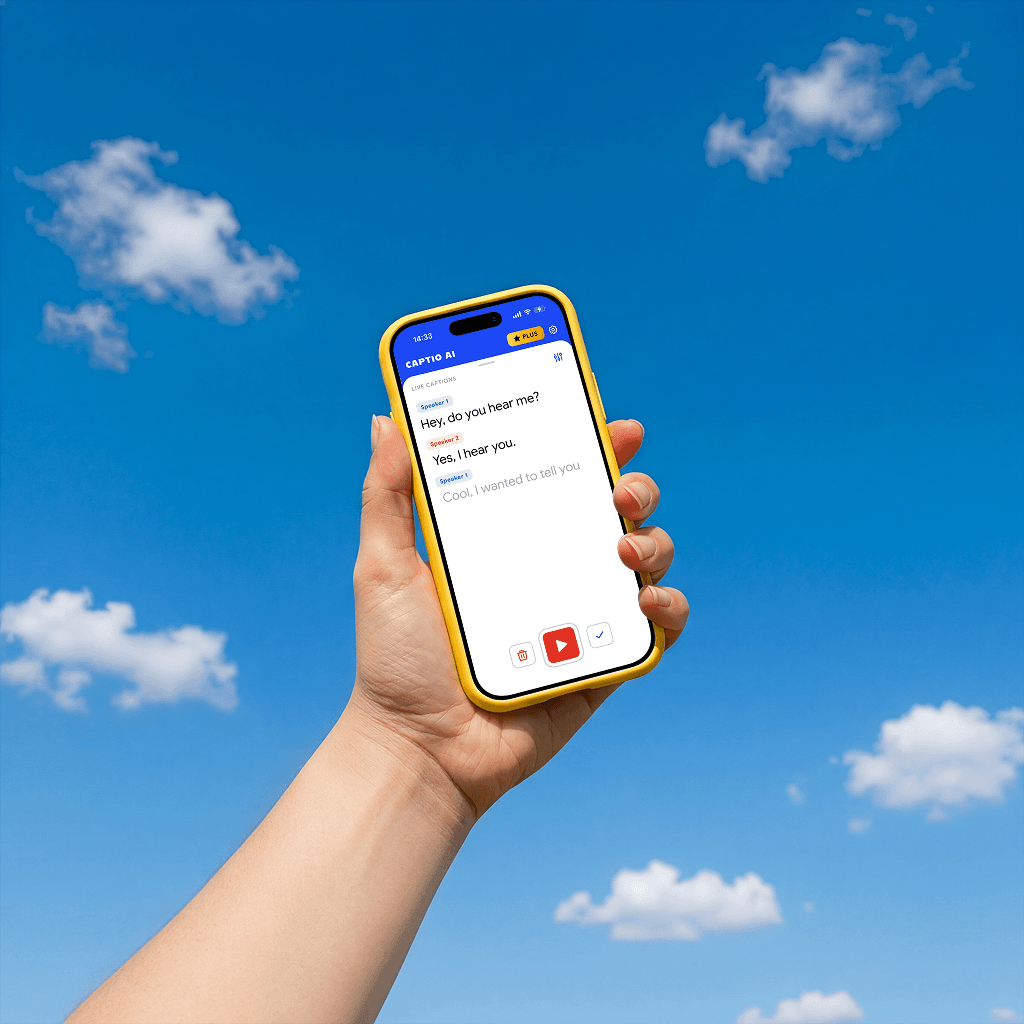
Captions as the doctor speaks
Words appear on screen while the doctor is still talking. You read the diagnosis, drug name, or follow-up instruction at the same moment it is said — not after they have moved on.
Medical terminology handled accurately
Drug names, procedure names, clinical terms. Captio AI handles the vocabulary of a real consultation — not just everyday speech.
Review the appointment after
Record the consultation and upload it to Audio Transcription. Get a full written record of everything said — instructions, dosages, referrals — to review at home and share with a carer if needed.
Works in any clinical setting
Consultation rooms, hospital wards, A&E, dental chairs, pharmacy counters. Place the phone near the speaker and Captio AI captions whoever is talking.
Any language
For foreign-language doctors, specialists abroad, or appointments through an interpreter. Live Translator captions and translates in real time so you follow your diagnosis in the language you understand best.
100% private
Medical conversations are among the most sensitive there are. Captio AI processes audio in real time and discards it immediately. Nothing is recorded, stored, or shared.
Why French is hard to understand
Nasal vowels invisible
- French nasal vowels happen entirely inside the nose
- French has four distinct nasal vowels — /ɑ̃/, /ɛ̃/, /ɔ̃/, /œ̃/ — that appear in common words and clinical terms alike. Nasalization occurs in the velum and nasal cavity, leaving the lips in a position nearly identical to their non-nasal counterparts. For a deaf patient watching a doctor's face, 'bon' and 'beau', or 'plan' and 'plat', are visually indistinguishable — yet clinically, these differences can carry different meaning.
Liaison blurs word boundaries
- Words run together through liaison
- French liaison links a final consonant of one word to the initial vowel of the next, making phrases sound like single continuous streams. 'Les enfants' sounds like 'lezenfants', 'vous avez' like 'vouzavez'. In a medical consultation, dosage instructions like 'prenez-en deux' become a single visual blur, making it impossible for a lip-reader to locate where one instruction ends and another begins.
Silent final consonants
- Most French words end in sounds that are not pronounced
- French written forms regularly show final consonants that are never spoken. A deaf patient who has learned to match written words to lip patterns finds clinical terms look different from how they are said. 'Diagnostic' ends in a 'c' that disappears; 'traitement' loses the final consonants on the lips. Reading words from a prescription and matching them to what the doctor just said requires an extra cognitive step.
Québécois vs Metropolitan French
- Quebec French and Parisian French sound distinctly different
- Québécois French has retained features of 17th-century Norman and Parisian French while developing unique vowel shifts, affricate consonants (ti/di becoming /tsi/dzi/), and different intonation patterns. A deaf francophone from Montreal attending a consultation in Paris — or vice versa — encounters different lip patterns for the same words. In countries like Belgium and Switzerland, the phonological gap is narrower but still present.
Latinate medical register
- Medical French uses a formal Latin vocabulary with different pronunciation
- Clinical French is dominated by Latin-derived terminology — 'prescripteur', 'pathologie', 'symptomatologie' — that sounds unlike everyday French words. A deaf patient familiar with standard French vocabulary finds the register shift in a medical consultation creates a new visual vocabulary they have not encountered in daily life.
Download for free
6 million people in France. Only 37% of those with disabling hearing loss use a hearing aid.
Hearing loss affects approximately 10% of the French population — over 6 million people — according to research published in the CONSTANCES cohort study. A quarter of French adults aged 18–75 have some form of hearing loss, and 4% have disabling hearing loss. Yet only 37% of people with disabling hearing loss in France report using a hearing aid, despite the Reste à Charge Zéro reform in 2021 that eliminated out-of-pocket costs for hearing aids under the French health insurance system. The gap between access and uptake reflects social stigma, late diagnosis, and low awareness — not just cost.
For deaf and hard of hearing people in France, discrimination in public services is documented and persistent. A 2024 report found that 22% of all discrimination cases in France involved people with disabilities, and 39% of deaf people reported experiencing discrimination in dealings with public authorities or services. In healthcare specifically, sign language interpreters are not routinely available in French hospitals and clinics. French Sign Language (LSF) has been legally recognised since 2005, but the right to communication access has not translated into interpreter provision in clinical settings.
The European Disability Forum has documented that deaf patients across Europe, including in France, consistently face barriers in accessing clear and efficient communication in the healthcare system. This deprives them of critical information and quality care. Pandemic conditions — masks, screens, rushed consultations — intensified barriers that already existed for the 6 million French people navigating hearing loss.
Download for free
What you hear stays with you.
Gone the moment it ends
Captio AI processes your audio in real time and discards it immediately. Nothing is recorded. Nothing is kept.
Not a product
Your conversations are not something Captio AI sells, shares, or monetizes — to anyone, for any reason.
Not used to train anything
What you say in a doctor's appointment or a job interview never ends up in a training dataset. Not ours. Not anyone else's.

Private by default
Captio AI supports 60+ languages
Download for free
Frequently asked questions
Understand your diagnosis in French.
Captio AI is free to start
Download for free