

Bosnian live captions and productivity tool for doctor appointments
For deaf and hard of hearing people.
Download for free


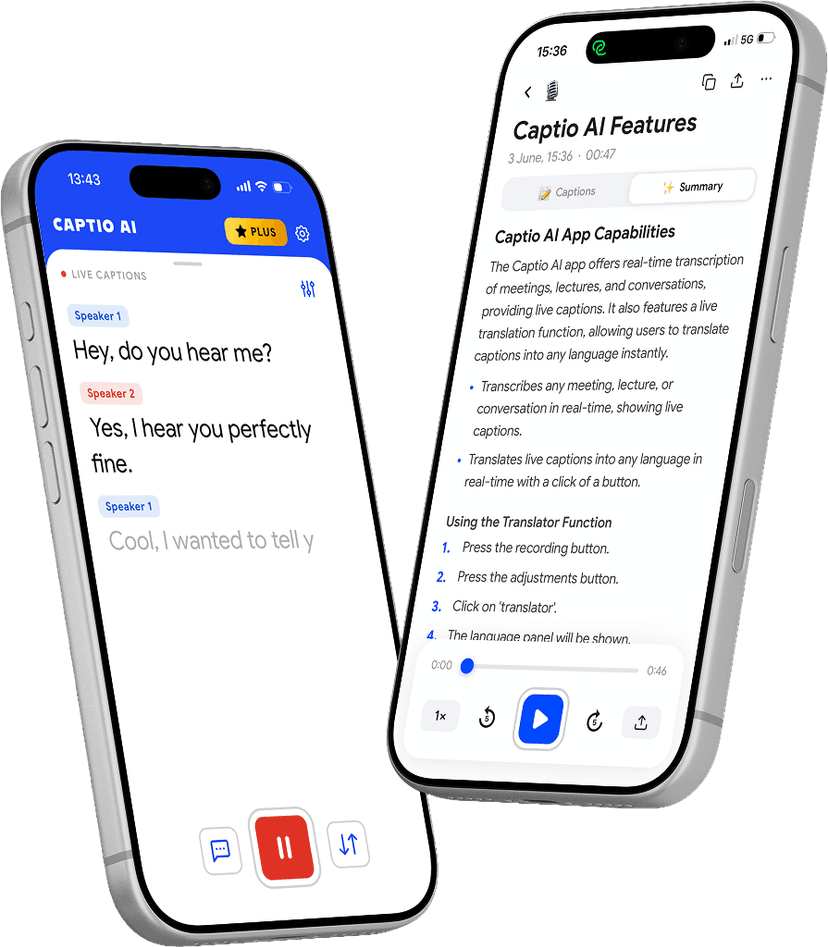
Everything you need to follow Bosnian doctor appointments
Four tools built for deaf and hard of hearing Bosnian speakers.
Follow what the doctor says in real time
- Captions appear word by word as they speak
- Handles medical terminology, drug names, and clinical language
- Place the phone on the desk — no setup needed
- Works in any consultation room, clinic, or hospital setting
When the doctor speaks another language
- Captions and translates in real time
- Follow your diagnosis in the language you understand best
- 60+ languages, no manual switching
- For foreign specialists, travel, or immigration settings
A full record of the consultation
- Record the appointment and upload it for a complete transcript
- Review instructions, drug names, and follow-up steps at home
- Share with a family member or carer if needed
- Works on any consultation recording
Key instructions extracted automatically
- Diagnosis, medication, and follow-up steps pulled from any transcript
- Organised into clear sections
- Nothing important missed or forgotten
- Works on any saved appointment recording
Download for free
Every situation covered
Designed for the real moments that matter — not just quiet controlled environments.
At a dom zdravlja (health centre) in Sarajevo, Mostar, or a smaller grad, your doktor explains symptoms and treatment in Bosnian. Captio AI captions every word so you follow the full consultation.
At a specialist appointment at Klinički centar Univerziteta u Sarajevu or a regional bolnica, medical terms arrive in Bosnian mixed with Latinate vocabulary. Captio AI captions both in real time.
At the apoteka (pharmacy), the farmaceut explains dosage and drug interactions quickly. Point your phone toward them and read the instructions as they speak.
At the zubar (dental clinic), the dentist gives instructions during treatment when lip-reading is impossible. Captio AI captions from audio alone.
In a session with a psiholog or psihijatar, sensitive conversations require full comprehension. Captio AI captions the full session so you engage without gaps.
At the hitna pomoć (emergency department), staff speak quickly under pressure. Open Captio AI and read their instructions in real time.
Most accurate and fastest models
word accuracy
independent benchmark, 2025
real-time captions
first word appears as you speak
Download for free
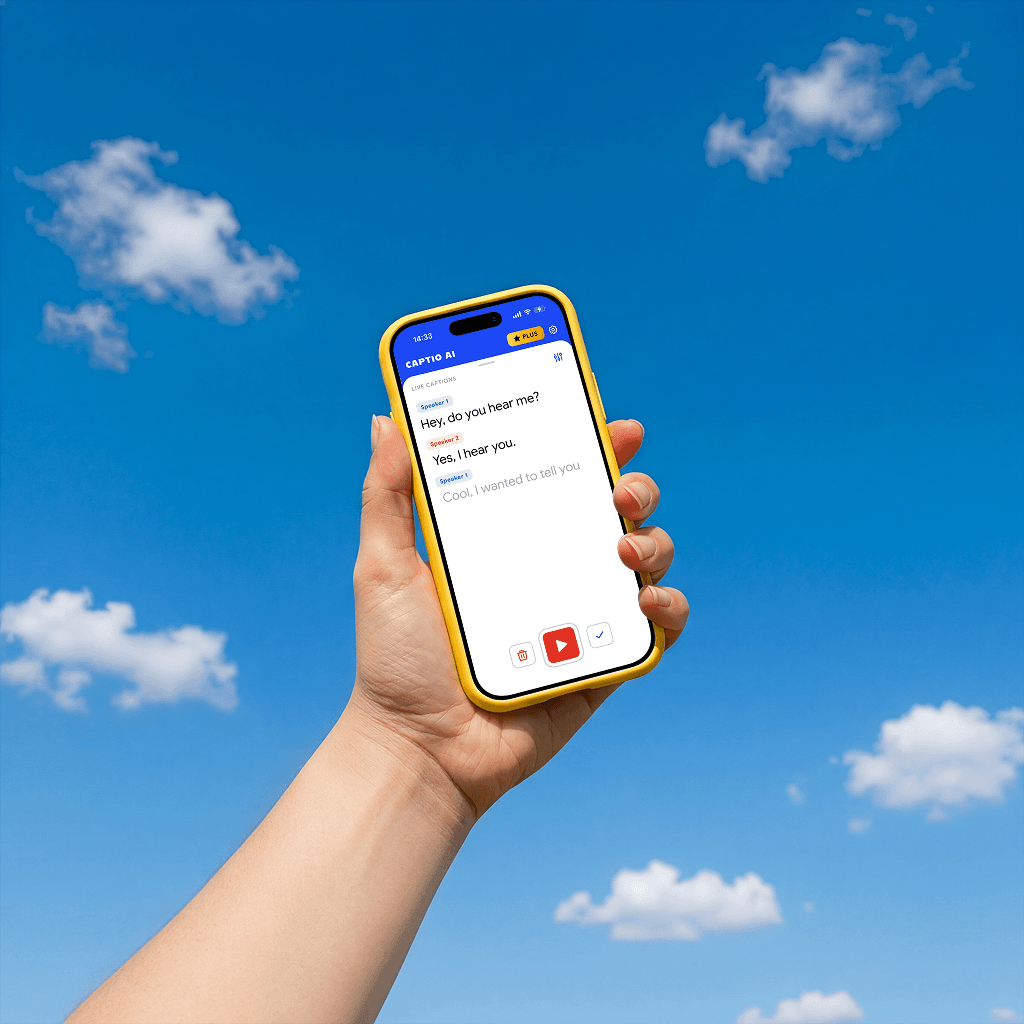
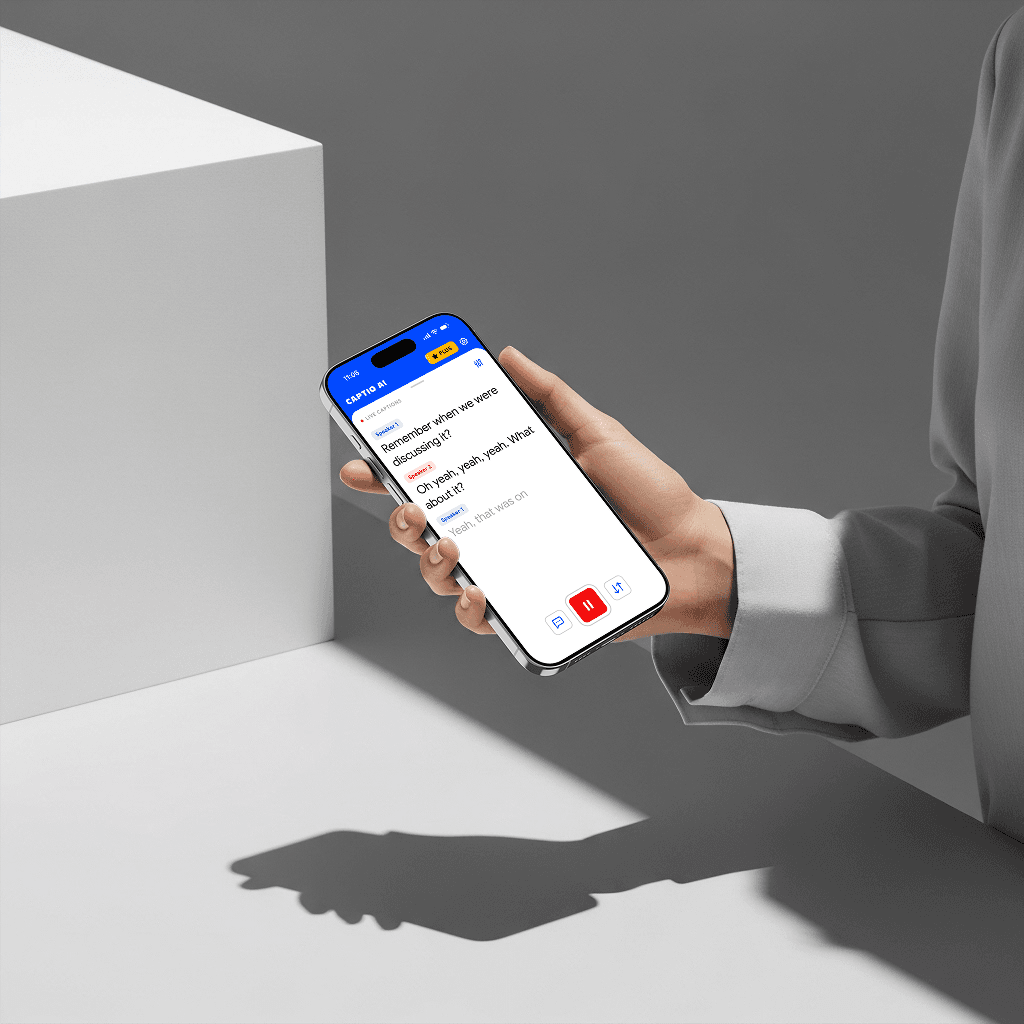
Built for the conversations where every word matters
Captions as the doctor speaks
Words appear on screen while the doctor is still talking. You read the diagnosis, drug name, or follow-up instruction at the same moment it is said — not after they have moved on.
Medical terminology handled accurately
Drug names, procedure names, clinical terms. Captio AI handles the vocabulary of a real consultation — not just everyday speech.
Review the appointment after
Record the consultation and upload it to Audio Transcription. Get a full written record of everything said — instructions, dosages, referrals — to review at home and share with a carer if needed.
Works in any clinical setting
Consultation rooms, hospital wards, A&E, dental chairs, pharmacy counters. Place the phone near the speaker and Captio AI captions whoever is talking.
Any language
For foreign-language doctors, specialists abroad, or appointments through an interpreter. Live Translator captions and translates in real time so you follow your diagnosis in the language you understand best.
100% private
Medical conversations are among the most sensitive there are. Captio AI processes audio in real time and discards it immediately. Nothing is recorded, stored, or shared.
Why Bosnian is hard to understand
Four-tone pitch accent
- Bosnian's four pitch tones change meaning but are invisible on the lips
- Bosnian shares the Serbo-Croatian pitch accent system — four tones: short falling, short rising, long falling, and long rising. These tones are phonemically significant throughout clinical vocabulary, and none produce any visible lip movement difference. For a deaf or hard of hearing patient lip-reading a Bosnian doctor, the tonal layer that distinguishes meaning simply does not appear on the speaker's face.
Ijekavian pronunciation
- Bosnian Ijekavian forms differ from other ex-Yugoslav varieties
- Standard Bosnian uses Ijekavian pronunciation — the historical yat vowel realises as 'ije' or 'je': 'mlijeko' (milk), 'liječnik' (doctor). This distinguishes Bosnian from Serbian Ekavian forms and creates different lip shapes for identical clinical concepts. A deaf patient familiar with Serbian Ekavian or accustomed to Croatian Ijekavian (which differs from Bosnian Ijekavian in subtle but audible ways) faces an additional layer of phonological uncertainty at a Bosnian clinical appointment.
Ottoman medical loanwords
- Turkish and Arabic loanwords appear in Bosnian clinical speech
- Bosnian has a significant Ottoman heritage in its vocabulary — Turkish and Arabic loanwords that appear less frequently in Croatian or Serbian. In informal clinical speech in Bosnia, patients and some older medical staff may use Turkish-origin words for body parts, ailments, and remedies alongside the formal Latinate clinical vocabulary. A deaf patient must lip-read across a more diverse vocabulary pool than in closely related languages.
Distinctive h phoneme
- Bosnian preserves the /h/ phoneme where Serbian drops it
- One of the distinguishing features of Bosnian pronunciation is the preservation of the /h/ phoneme in words where Serbian and Croatian speakers often drop it colloquially. 'Kahva' (coffee), 'lahko' (easy) — the h is pronounced in Bosnian. In clinical speech, this means words that a deaf patient recognises from Serbian or Croatian lip-shapes appear with an additional consonant in Bosnian that changes the expected visual pattern.
Fast casual register
- Bosnian informal clinical speech compresses and elides at high speed
- In conversational post-diagnosis speech — the part where a doctor explains what happens next informally — Bosnian speech rate increases, unstressed syllables reduce, and words merge across boundaries. A doctor who was deliberate during the formal diagnosis becomes faster and less distinct once the clinical vocabulary gives way to procedural instructions. This shift from formal to informal register is where a deaf patient following lip shapes is most likely to lose the thread.
Download for free
Hearing loss in Bosnia and Herzegovina: recognition in 2009, access still thin on the ground
Bosnia and Herzegovina formally recognised sign language rights in 2009 — granting deaf people the same language rights with sign language as hearing people have with oral language, mandating government provision of interpreters for dealings with public bodies, and requiring government television broadcasts to be translated into sign language. This recognition, documented by the World Federation of the Deaf, was a significant legal step. In practice, the implementation of these rights reflects the broader governance challenge of a country divided into two administratively separate entities — the Federation of Bosnia and Herzegovina and Republika Srpska — each with its own institutions and varying levels of implementation capacity.
A study of 1,044 hard of hearing and deaf persons in Bosnia and Herzegovina found 455 registered at employment offices and 589 receiving financial aid from social care centres — a picture of a community heavily dependent on state welfare support with limited employment integration. Professional rehabilitation programmes have been proposed to improve the situation, but deaf Bosnians continue to face the same structural barriers seen across the former Yugoslav space: small interpreter workforces, limited sign language education availability outside major urban centres, and healthcare settings where communication support is not systematically provided.
In clinical settings in Bosnia and Herzegovina, the experience of a deaf patient at a dom zdravlja in a smaller town means attending without an interpreter and navigating a medical consultation in a language with a pitch accent system that is invisible on the lips, Ottoman-heritage vocabulary that widens the lexical range beyond Latinate norms, and a Ijekavian pronunciation that may differ from whatever Serbian or Croatian forms the patient previously encountered. Captio AI captions Bosnian in real time at any dom zdravlja or klinički centar across both entities, so every patient receives their doctor's words directly.
Download for free
What you hear stays with you.
Gone the moment it ends
Captio AI processes your audio in real time and discards it immediately. Nothing is recorded. Nothing is kept.
Not a product
Your conversations are not something Captio AI sells, shares, or monetizes — to anyone, for any reason.
Not used to train anything
What you say in a doctor's appointment or a job interview never ends up in a training dataset. Not ours. Not anyone else's.

Private by default
Captio AI supports 60+ languages
Download for free
Frequently asked questions
Understand your diagnosis in Bosnian.
Captio AI is free to start
Download for free