

English live captions and productivity tool for doctor appointments
For deaf and hard of hearing people.
Download for free


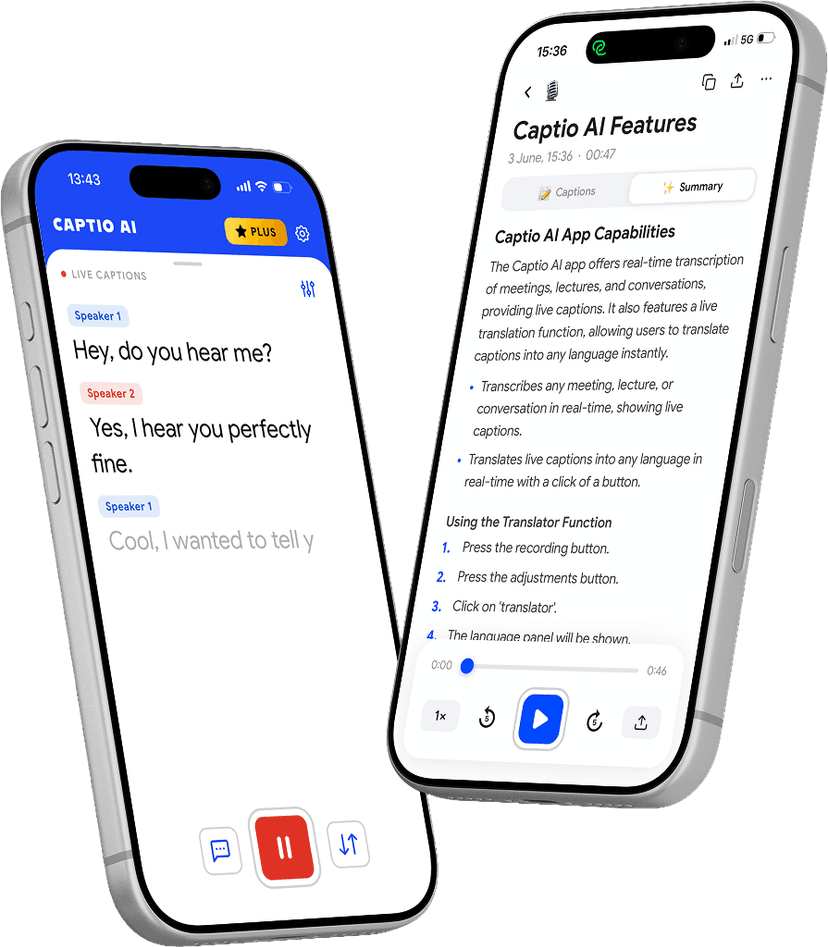
Everything you need to follow English doctor appointments
Four tools built for deaf and hard of hearing English speakers.
Follow what the doctor says in real time
- Captions appear word by word as they speak
- Handles medical terminology, drug names, and clinical language
- Place the phone on the desk — no setup needed
- Works in any consultation room, clinic, or hospital setting
When the doctor speaks another language
- Captions and translates in real time
- Follow your diagnosis in the language you understand best
- 60+ languages, no manual switching
- For foreign specialists, travel, or immigration settings
A full record of the consultation
- Record the appointment and upload it for a complete transcript
- Review instructions, drug names, and follow-up steps at home
- Share with a family member or carer if needed
- Works on any consultation recording
Key instructions extracted automatically
- Diagnosis, medication, and follow-up steps pulled from any transcript
- Organised into clear sections
- Nothing important missed or forgotten
- Works on any saved appointment recording
Download for free
Every situation covered
Designed for the real moments that matter — not just quiet controlled environments.
GP appointments at NHS surgeries and US primary care clinics where the doctor covers a lot of ground in a short time. Captio AI captions every word in real time so the diagnosis, prescription, and follow-up are clear before you leave.
Specialist consultations — cardiologist, neurologist, oncologist — where clinical vocabulary is dense and the stakes of a missed word are high. Captio AI captions the consultant's speech in full.
Pharmacy conversations at the counter where the pharmacist explains dosage, side effects, and interactions. Captio AI captions the instructions so you leave understanding every detail of the prescription.
Dental appointments where the dentist speaks while working and explains the treatment plan between procedures. Captio AI captures the explanation so you understand the treatment fully.
Therapy, psychiatry, and counselling sessions where every word of the clinician's response matters. Captio AI captions the session in real time so you can focus on the conversation, not on following it.
A&E and urgent care visits where triage staff speak quickly and the environment is loud. Captio AI captions the questions, instructions, and discharge advice in the moments when understanding is most critical.
Most accurate and fastest models
word accuracy
independent benchmark, 2025
real-time captions
first word appears as you speak
Download for free
Built for the conversations where every word matters
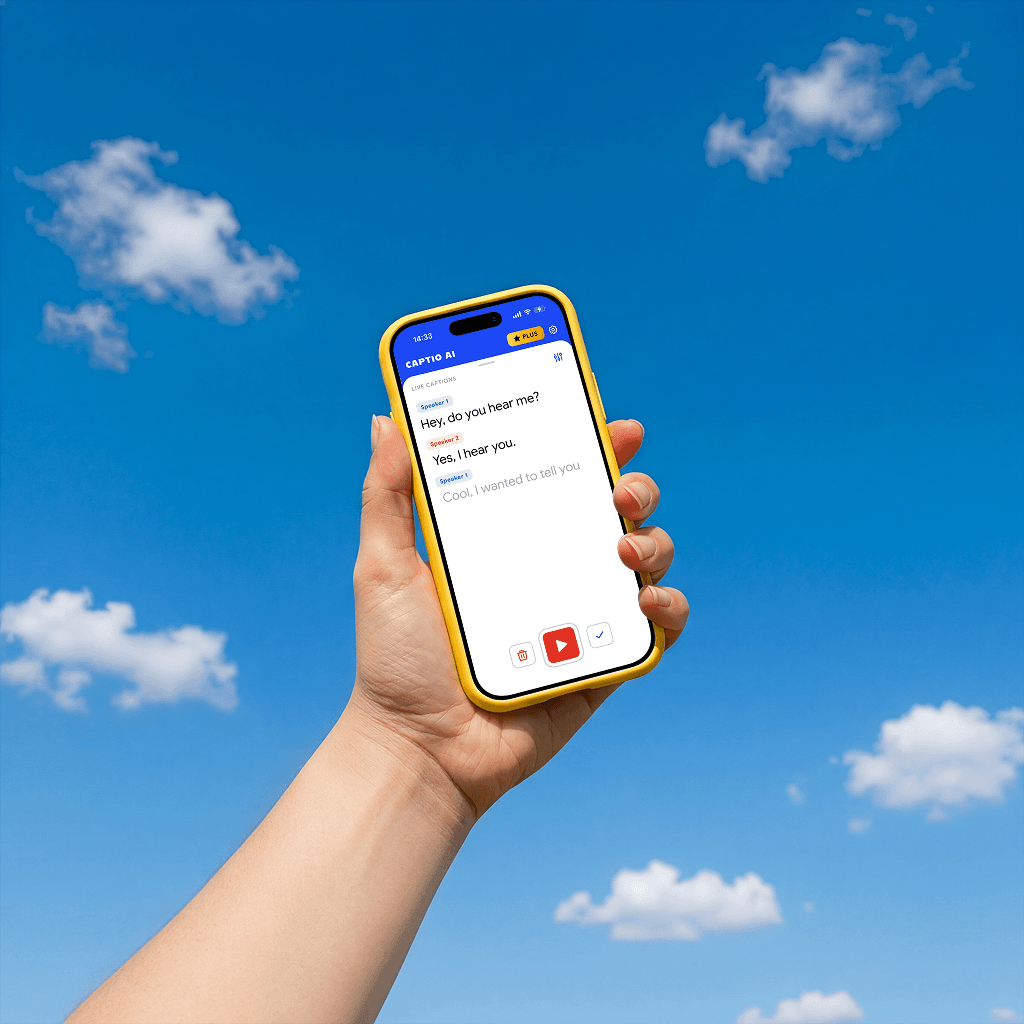
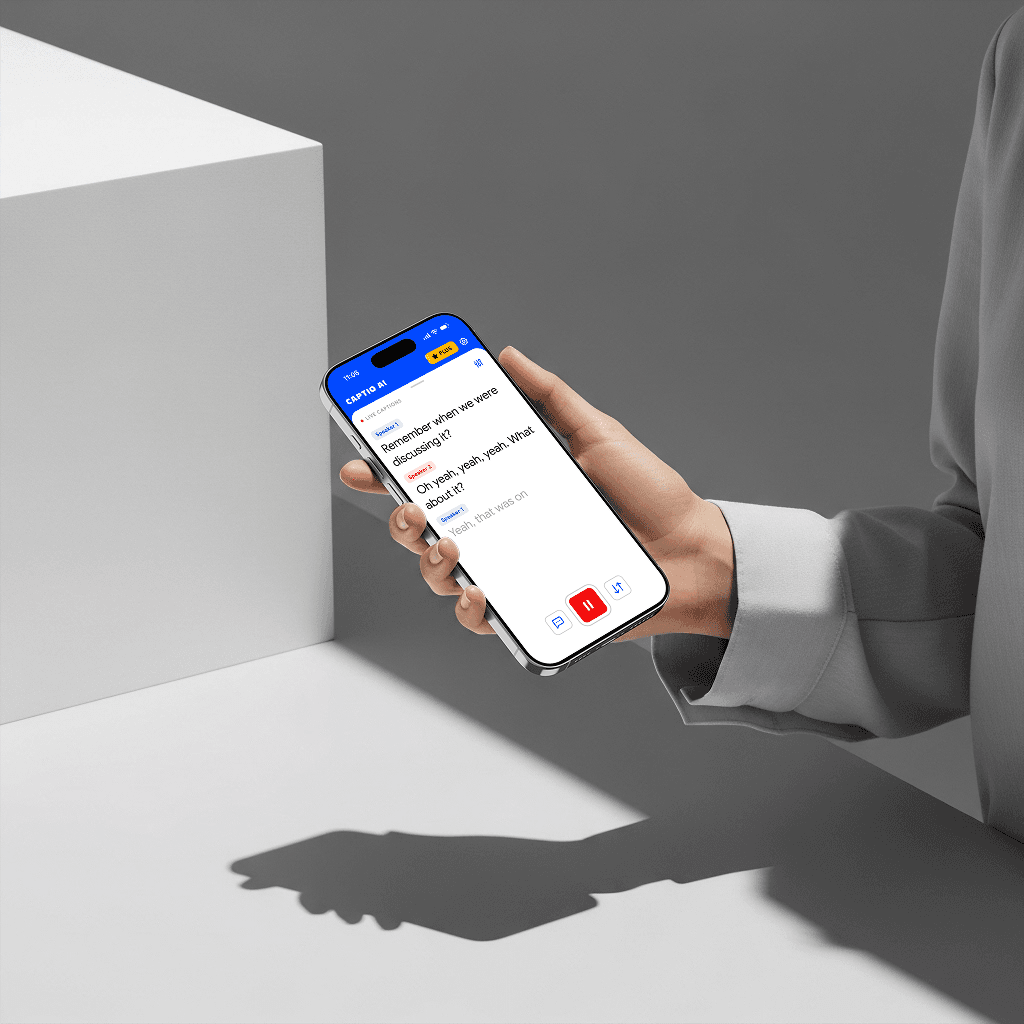
Captions as the doctor speaks
Words appear on screen while the doctor is still talking. You read the diagnosis, drug name, or follow-up instruction at the same moment it is said — not after they have moved on.
Medical terminology handled accurately
Drug names, procedure names, clinical terms. Captio AI handles the vocabulary of a real consultation — not just everyday speech.
Review the appointment after
Record the consultation and upload it to Audio Transcription. Get a full written record of everything said — instructions, dosages, referrals — to review at home and share with a carer if needed.
Works in any clinical setting
Consultation rooms, hospital wards, A&E, dental chairs, pharmacy counters. Place the phone near the speaker and Captio AI captions whoever is talking.
Any language
For foreign-language doctors, specialists abroad, or appointments through an interpreter. Live Translator captions and translates in real time so you follow your diagnosis in the language you understand best.
100% private
Medical conversations are among the most sensitive there are. Captio AI processes audio in real time and discards it immediately. Nothing is recorded, stored, or shared.
Why English is hard to understand
Masks in clinical settings
- Face masks eliminate lip-reading in the setting where it matters most
- Face masks became the default in UK and US clinical settings during the pandemic and remain widespread in NHS hospitals, GP surgeries, and many US healthcare facilities. A mask eliminates the partial lip-reading that deaf and hard of hearing patients use to supplement what they cannot hear. In a doctor's surgery or hospital consultation room — where the conversation is fast, important, and not repeated — the loss of visual speech information is most consequential.
Medical homophones
- English medical terms that sound alike carry very different clinical meanings
- English has a specific problem in medical contexts: words and phrases that sound similar but carry opposite or different meanings. 'Can't prescribe this' and 'can prescribe this' differ by one consonant cluster. 'Statin' and 'satin.' 'Ileum' and 'ilium.' 'Allergic' and 'analgesia.' In a consultation where the specific word is the diagnosis or the contraindication, a misheard consonant carries clinical consequences.
Short appointment pressure
- NHS GP appointments average under 10 minutes — no time to ask again
- GP appointments in England averaged 9.2 minutes pre-pandemic and have remained under similar pressure since. In that window, a doctor covers the presenting complaint, examination, diagnosis, prescription, and follow-up. A deaf patient who misses a sentence and asks for it to be repeated loses a disproportionate share of an already brief appointment, and many do not ask at all rather than feel like a burden.
Diverse clinical accents
- NHS clinical teams bring accents from across the world into one consultation room
- The NHS and US healthcare systems draw clinicians from many countries. A deaf patient calibrated to standard British English may encounter a consultant from South Asia, a nurse from West Africa, a registrar from Eastern Europe, and a pharmacist from the Caribbean in a single hospital visit — each with a distinct phonological profile. Each calibration failure means missed clinical information.
Drug name unpredictability
- Proprietary drug names follow no phonological pattern a lip-reader can predict
- Pharmaceutical brand names — Metformin, Atorvastatin, Sertraline, Omeprazole — are phonologically dense, acoustically similar to other drug names, and carry no visual cue that distinguishes them from similar-sounding terms. A deaf patient who mishears a drug name during a prescription explanation leaves the surgery with the wrong understanding of what they have been given and why.
Download for free
11 million people with hearing loss in the UK. Healthcare built around the assumption that everyone can hear.
Approximately 11 million people in the United Kingdom have some degree of hearing loss according to RNID, and in the United States 48 million adults have some degree of hearing difficulty. In both countries, research consistently shows that deaf and hard of hearing people avoid medical appointments at higher rates than hearing adults — not because they have fewer health needs, but because the appointment itself is inaccessible. A study published in PMC (2023) found that 57% of deaf and hard of hearing adults deliberately avoided visiting a doctor even when they had symptoms, and that 93% who disclosed their hearing loss to a healthcare provider reported that no accommodation was made as a result.
In the UK, NHS Trusts are legally required to make reasonable adjustments for disabled patients under the Equality Act 2010, but there is no mandated minimum standard for communication support in clinical settings. Signed language interpreters are requested on a case-by-case basis and are frequently unavailable at short notice. RNID surveys consistently find that many deaf people experience healthcare appointments where the clinician makes no adjustment after being told about hearing loss — continuing to speak at the same pace, continuing to wear a mask, and not facing the patient when speaking.
The consequences are concrete. Poor patient–clinician communication is associated with medication errors, misdiagnosis, lower treatment adherence, and reduced willingness to seek follow-up care. For deaf and hard of hearing patients in English-speaking healthcare systems, this gap is structural and persistent. Captio AI captions the doctor's speech in real time — across accents, clinical registers, and masked consultations — so the GP appointment, the specialist referral, and the pharmacy conversation are no longer settings a deaf patient has to navigate alone.
Download for free
What you hear stays with you.
Gone the moment it ends
Captio AI processes your audio in real time and discards it immediately. Nothing is recorded. Nothing is kept.
Not a product
Your conversations are not something Captio AI sells, shares, or monetizes — to anyone, for any reason.
Not used to train anything
What you say in a doctor's appointment or a job interview never ends up in a training dataset. Not ours. Not anyone else's.

Private by default
Captio AI supports 60+ languages
Download for free
Frequently asked questions
Understand your diagnosis in English.
Captio AI is free to start
Download for free