

Malayalam live captions and productivity tool for doctor appointments
For deaf and hard of hearing people.
Download for free


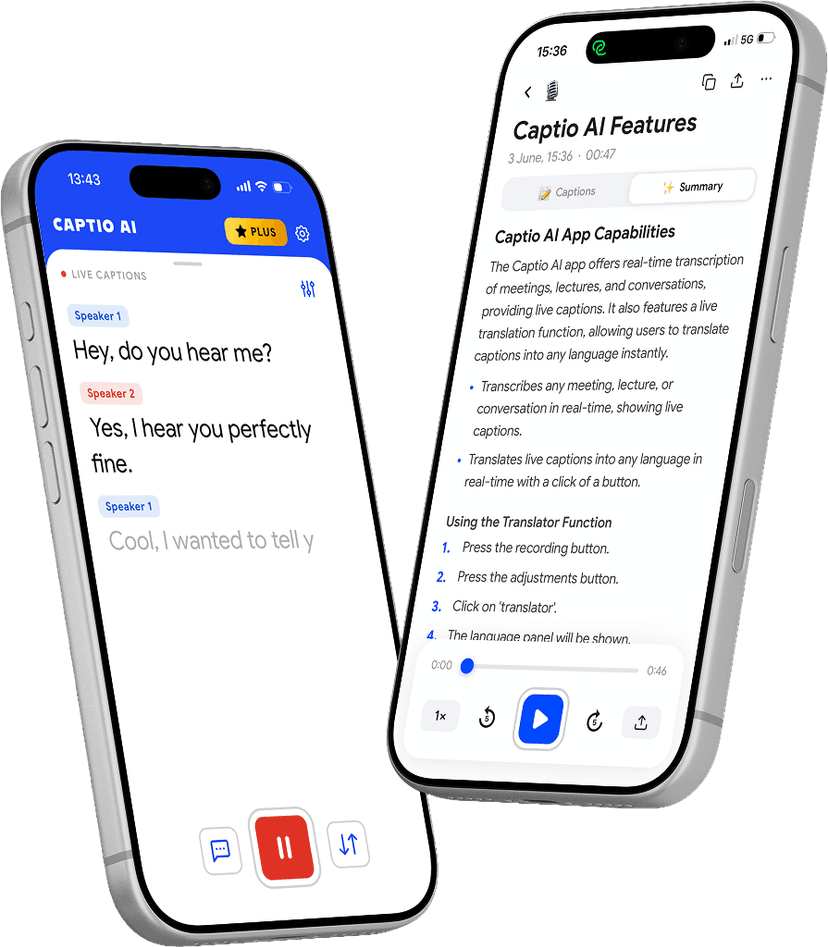
Everything you need to follow Malayalam doctor appointments
Four tools built for deaf and hard of hearing Malayalam speakers.
Follow what the doctor says in real time
- Captions appear word by word as they speak
- Handles medical terminology, drug names, and clinical language
- Place the phone on the desk — no setup needed
- Works in any consultation room, clinic, or hospital setting
When the doctor speaks another language
- Captions and translates in real time
- Follow your diagnosis in the language you understand best
- 60+ languages, no manual switching
- For foreign specialists, travel, or immigration settings
A full record of the consultation
- Record the appointment and upload it for a complete transcript
- Review instructions, drug names, and follow-up steps at home
- Share with a family member or carer if needed
- Works on any consultation recording
Key instructions extracted automatically
- Diagnosis, medication, and follow-up steps pulled from any transcript
- Organised into clear sections
- Nothing important missed or forgotten
- Works on any saved appointment recording
Download for free
Every situation covered
Designed for the real moments that matter — not just quiet controlled environments.
GP and family physician visits at a clinic or government hospital, where the doctor speaks quickly in formal Malayalam mixed with English medical terms.
Specialist consultations at Kerala's large private hospital chains (Amrita, Aster, Lakeshore) or government medical colleges, where clinical terminology is dense and appointments are brief.
Pharmacy consultations at a medical shop, where the pharmacist explains dosage, interactions, and storage verbally in rapid Malayalam.
Dental appointments where the dentist explains the procedure and gives aftercare instructions that must be followed precisely.
Mental health consultations with a psychiatrist or psychologist, where every precise exchange carries direct clinical weight.
Emergency room visits at a government medical college hospital or private hospital, where staff speak fast in mixed Malayalam and English and masks are common.
Most accurate and fastest models
word accuracy
independent benchmark, 2025
real-time captions
first word appears as you speak
Download for free
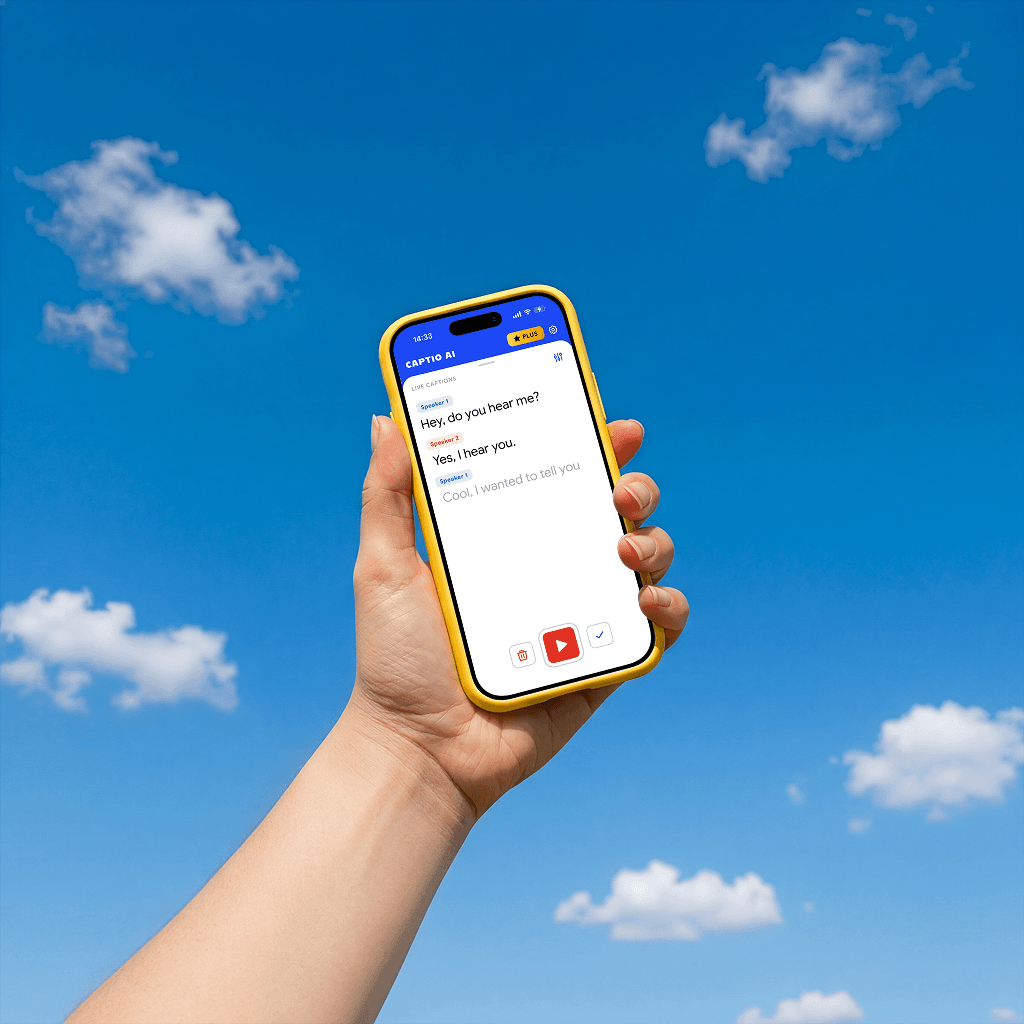
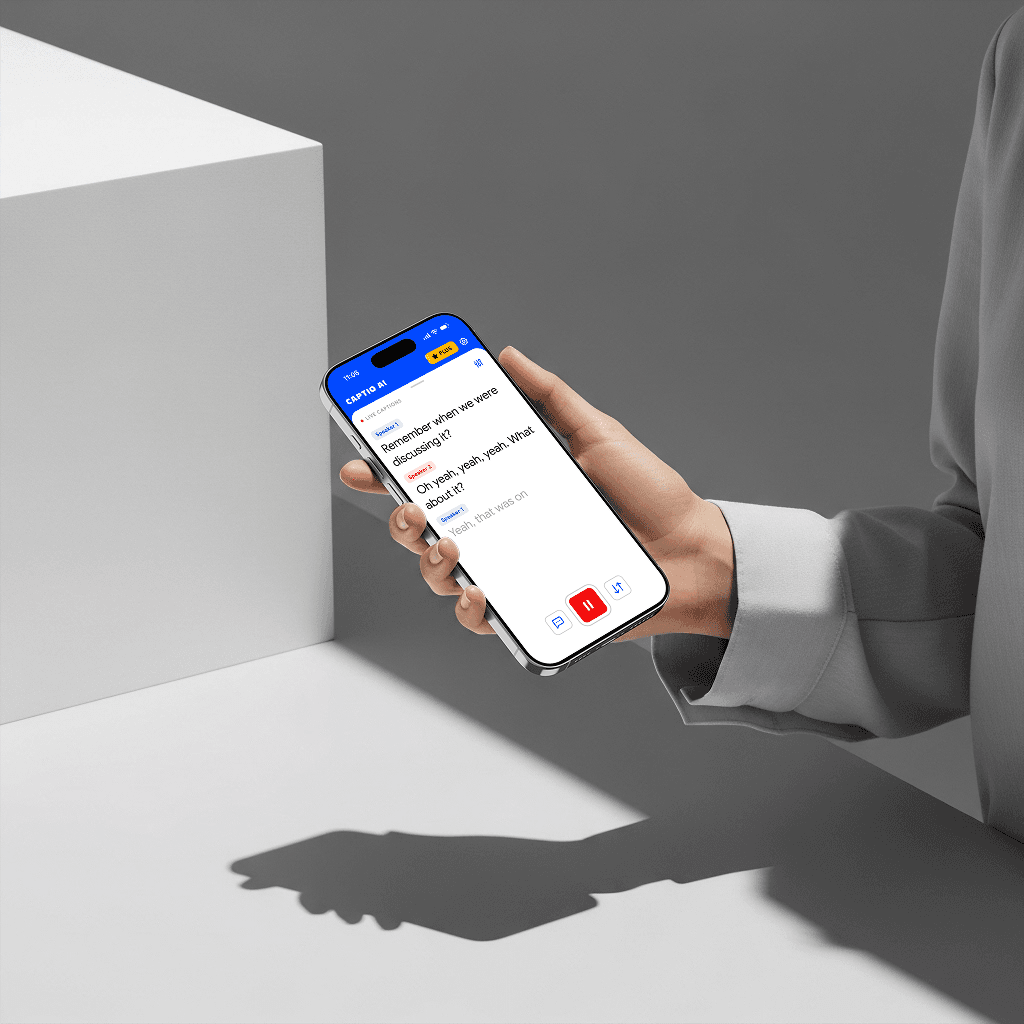
Built for the conversations where every word matters
Captions as the doctor speaks
Words appear on screen while the doctor is still talking. You read the diagnosis, drug name, or follow-up instruction at the same moment it is said — not after they have moved on.
Medical terminology handled accurately
Drug names, procedure names, clinical terms. Captio AI handles the vocabulary of a real consultation — not just everyday speech.
Review the appointment after
Record the consultation and upload it to Audio Transcription. Get a full written record of everything said — instructions, dosages, referrals — to review at home and share with a carer if needed.
Works in any clinical setting
Consultation rooms, hospital wards, A&E, dental chairs, pharmacy counters. Place the phone near the speaker and Captio AI captions whoever is talking.
Any language
For foreign-language doctors, specialists abroad, or appointments through an interpreter. Live Translator captions and translates in real time so you follow your diagnosis in the language you understand best.
100% private
Medical conversations are among the most sensitive there are. Captio AI processes audio in real time and discards it immediately. Nothing is recorded, stored, or shared.
Why Malayalam is hard to understand
Agglutinative word length
- Malayalam clinical words compound into long strings invisible on lips
- Malayalam is highly agglutinative — verbs, nouns, and clinical terms compound into long words that run multiple morphemes together into a single phonological unit. Clinical terms like 'parisodhikkunnathu' (examination) and 'rogaprathirodham' (immunity) are extended words that compress rapidly in speech. A deaf patient trying to lip-read these long agglutinated forms has almost no way to segment them visually into units they recognise.
Three-series consonant contrasts
- Malayalam's dental, alveolar, and retroflex series are invisible distinctions
- Malayalam has one of the most complex consonant inventories of any language — with distinct dental, alveolar, and retroflex series for stops, nasals, and laterals. The difference between 'l', 'ḷ', and 'ḻ' — three distinct lateral sounds — is entirely in the tongue position on the palate, with no visible lip movement at all. In clinical speech, these distinctions separate different words for conditions, body parts, and procedures.
Formal-colloquial diglossia
- Clinical Malayalam uses a formal register deaf patients may not have grown up with
- Malayalam has a wide formal-colloquial divide (granthabhasha vs vyavaharika). Clinical settings use formal literary vocabulary for medical concepts — terms that are substantially different from everyday colloquial forms. A deaf patient who learned Malayalam at home in everyday speech may not recognise the formal clinical equivalent a doctor uses for the same condition.
Code-switching in Kerala clinics
- Kerala doctors switch between Malayalam, English, and Hindi mid-consultation
- In Kerala's healthcare settings — including the large private hospital sector — consultations routinely switch between Malayalam for context, English for drug names and diagnosis terms, and sometimes Hindi. A deaf patient calibrated to Malayalam loses the clinical term when the language switches to English, and gains nothing from the Hindi that follows.
Regional accent variation
- Malabar, Kochi, and Trivandrum Malayalam sound different in the clinic
- Malayalam shows regional variation across its three broad dialect zones — Malabar (north), Central (Kochi/Ernakulam), and Southern (Thiruvananthapuram). Vowel realizations, prosody, and vocabulary choices differ enough that a deaf patient raised on Central Malayalam may struggle with the Northern variety of a clinician trained in Kozhikode.
Download for free
63 million with hearing impairment across India. Kerala's deaf community navigating the gap between one of India's best healthcare systems and its deaf patients.
India has approximately 63 million people with significant hearing impairment — roughly 6.3% of the national population. Kerala, despite its reputation for high literacy, high life expectancy, and one of India's strongest public health systems, has no special provision for deaf access within that system. More than 27,000 children are born deaf across India each year, and Kerala's ageing population — with one of India's highest proportions of elderly residents — carries a growing audiological burden that the state's healthcare infrastructure was not designed to serve with communication support.
The Rights of Persons with Disabilities Act 2016 recognised Indian Sign Language and placed obligations on healthcare providers to ensure accessibility. In Kerala, however, ISL is not the primary language of the state's deaf community — Kerala uses its own distinct sign language variety, and ISL-trained interpreters are rare. A 2021 legal analysis by the NLIU Law Review found no rule in the RPwD Act requiring ISL-trained staff in hospitals, and that directives for state interpreter registries remain aspirational. A deaf patient at a government medical college in Thiruvananthapuram or Kozhikode navigates a dense clinical consultation with no institutional communication support.
The consequence is systematic: deaf patients in India with communication barriers are less likely to understand their diagnosis, more likely to make medication errors, and more likely to delay follow-up care. A deaf Kerala patient at a major private hospital — among the best-resourced in Asia — is in the same position as a deaf patient at a rural dispensary when it comes to real-time access to what the doctor is saying. Captio AI captions Malayalam speech in real time — at the medical shop, the outpatient department, and the emergency room — without requiring any institutional arrangement.
Download for free
What you hear stays with you.
Gone the moment it ends
Captio AI processes your audio in real time and discards it immediately. Nothing is recorded. Nothing is kept.
Not a product
Your conversations are not something Captio AI sells, shares, or monetizes — to anyone, for any reason.
Not used to train anything
What you say in a doctor's appointment or a job interview never ends up in a training dataset. Not ours. Not anyone else's.

Private by default
Captio AI supports 60+ languages
Download for free
Frequently asked questions
Understand your diagnosis in Malayalam.
Captio AI is free to start
Download for free