

German live captions and productivity tool for doctor appointments
For deaf and hard of hearing people.
Download for free


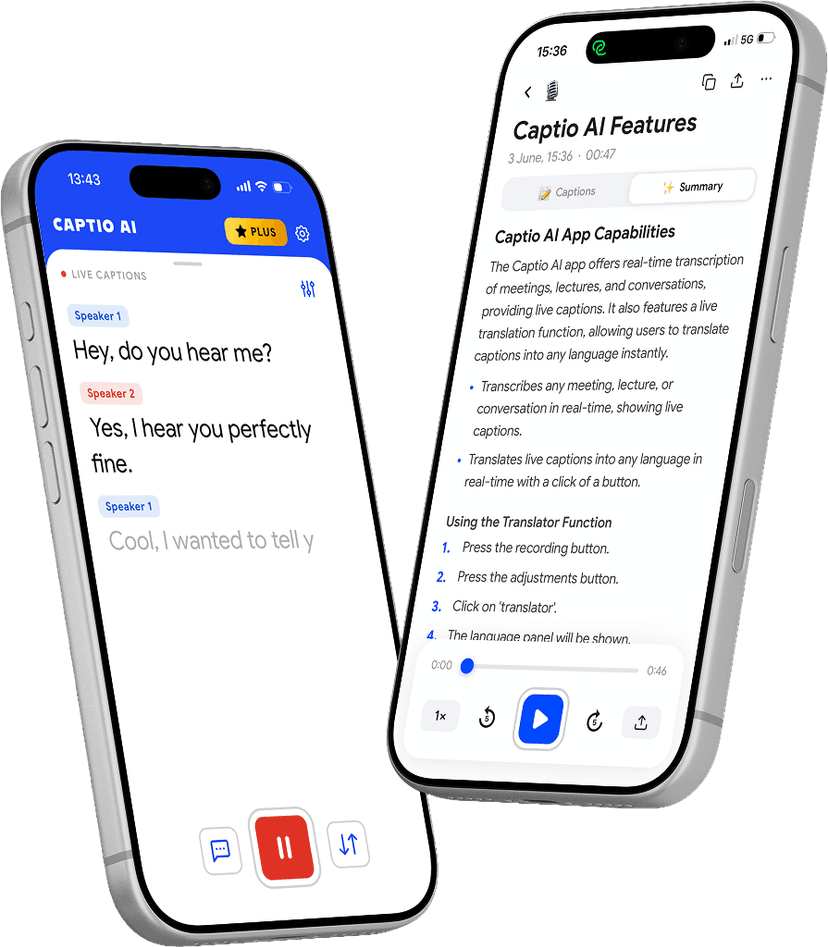
Everything you need to follow German doctor appointments
Four tools built for deaf and hard of hearing German speakers.
Follow what the doctor says in real time
- Captions appear word by word as they speak
- Handles medical terminology, drug names, and clinical language
- Place the phone on the desk — no setup needed
- Works in any consultation room, clinic, or hospital setting
When the doctor speaks another language
- Captions and translates in real time
- Follow your diagnosis in the language you understand best
- 60+ languages, no manual switching
- For foreign specialists, travel, or immigration settings
A full record of the consultation
- Record the appointment and upload it for a complete transcript
- Review instructions, drug names, and follow-up steps at home
- Share with a family member or carer if needed
- Works on any consultation recording
Key instructions extracted automatically
- Diagnosis, medication, and follow-up steps pulled from any transcript
- Organised into clear sections
- Nothing important missed or forgotten
- Works on any saved appointment recording
Download for free
Every situation covered
Designed for the real moments that matter — not just quiet controlled environments.
GP visits at an Allgemeinarzt practice, where appointments are short and the doctor often speaks while looking at the screen or typing notes.
Specialist consultations at a Facharzt clinic or Krankenhaus, where medical terminology is dense and referrals may take patients to a different region with a distinct dialect.
Pharmacy consultations at an Apotheke, where the pharmacist explains dosage, interactions, and side effects verbally — often behind a glass partition.
Dental appointments at a Zahnarzt, where the patient cannot see the dentist's face during treatment and verbal instructions continue throughout.
Mental health consultations at a Psychiater or Psychotherapeut, where the precision of nuance in questions and answers carries clinical weight.
Emergency room visits at a Notaufnahme, where staff move fast, speak at speed, and face masks remain standard in most German hospitals.
Most accurate and fastest models
word accuracy
independent benchmark, 2025
real-time captions
first word appears as you speak
Download for free
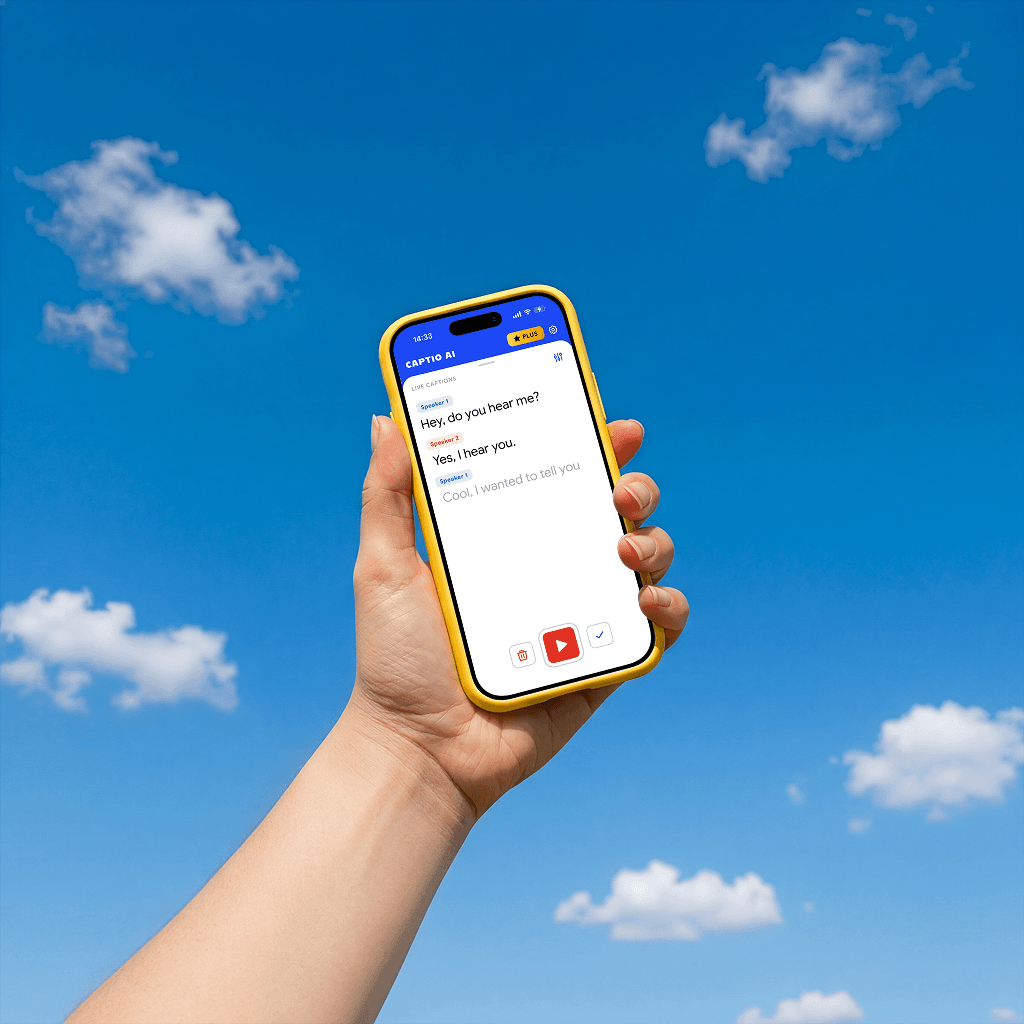
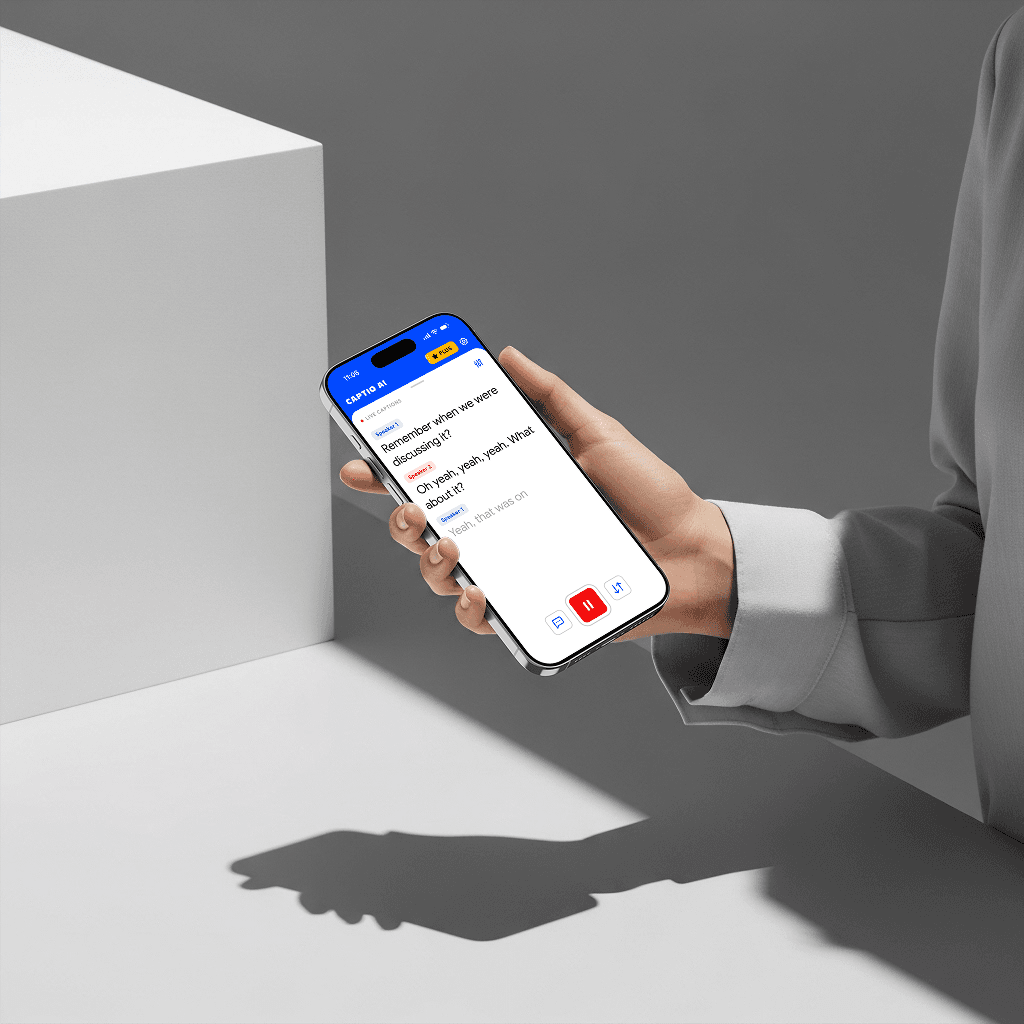
Built for the conversations where every word matters
Captions as the doctor speaks
Words appear on screen while the doctor is still talking. You read the diagnosis, drug name, or follow-up instruction at the same moment it is said — not after they have moved on.
Medical terminology handled accurately
Drug names, procedure names, clinical terms. Captio AI handles the vocabulary of a real consultation — not just everyday speech.
Review the appointment after
Record the consultation and upload it to Audio Transcription. Get a full written record of everything said — instructions, dosages, referrals — to review at home and share with a carer if needed.
Works in any clinical setting
Consultation rooms, hospital wards, A&E, dental chairs, pharmacy counters. Place the phone near the speaker and Captio AI captions whoever is talking.
Any language
For foreign-language doctors, specialists abroad, or appointments through an interpreter. Live Translator captions and translates in real time so you follow your diagnosis in the language you understand best.
100% private
Medical conversations are among the most sensitive there are. Captio AI processes audio in real time and discards it immediately. Nothing is recorded, stored, or shared.
Why German is hard to understand
Invisible consonants
- German produces many sounds at the back of the throat
- Velar and uvular consonants — the /k/, /g/, /x/ in words like 'Bauch' and the uvular /r/ — are produced deep in the throat and are completely invisible on the lips. A 2022 PMC study on German visual speech perception confirmed that deaf and hard of hearing patients recover significantly less from German lip-reading than from languages with more frontal articulation. In a clinical setting where medication names and dosages depend on these exact sounds, the gap is not a minor inconvenience.
Fortis-lenis collapse
- Medication names that look identical on lips can mean different things
- German distinguishes fortis/lenis consonant pairs — p/b, t/d, k/g, s/z — that are visually near-identical. A doctor naming a drug or dosage ('Tablette' vs 'Dablet', 'Blut' vs 'Plut') produces output the lip-reading patient cannot reliably distinguish. In a consultation where the specific word is the diagnosis or the contraindication, a misread of a medication name carries real health consequences.
Dialect divergence
- A Bavarian GP, a Saxon specialist, and a Swabian pharmacist sound completely different
- German's major regional varieties — Bavarian, Swabian, Saxon, and Low German — shift vowels, consonants, and prosody so dramatically that deaf patients calibrated to one dialect are often lost with another. The German referral system routinely moves patients across federal states. A deaf patient accustomed to their local GP's dialect may be completely disoriented by a specialist two regions away.
Fast speech compression
- Doctors speaking quickly drop vowels and consonant clusters
- German connected speech at consultation pace undergoes heavy segmental reduction — vowel length contrasts collapse, unstressed syllables are dropped, and consonant clusters assimilate. Research on fast speech in German shows the long/short vowel duration ratio drops substantially at speed. A doctor explaining a procedure while typing notes produces speech a hard of hearing patient can barely parse even with hearing aids.
Register switching
- Clinical vocabulary switches unpredictably between Latin terms and colloquial German
- German doctors switch between technical Latin/Greek terms ('Hypertonie', 'Gastritis', 'Dyspnoe') and their colloquial German equivalents ('Bluthochdruck', 'Magenentzündung', 'Atemnot') mid-sentence and without warning. A deaf patient who has learned standard vocabulary may not recognise the same condition being named twice in the same consultation in two different registers.
Download for free
11 million people. A legal right that stops at the hospital door.
An estimated 11.1 million people in Germany — approximately 16.2% of the adult population — live with hearing impairment meeting WHO criteria, making it one of the largest disability groups in the country. Of the 9.24 million who self-report hearing loss in Germany, fewer than half have been fitted with hearing aids, leaving the majority without any assistive support. Approximately 235,000 people are deaf or severely hard of hearing. They live in every city, visit every practice, and need every consultation explained.
A 2023 peer-reviewed study by researchers at the Charité in Berlin found that deaf and hard of hearing patients in Germany deliberately avoid doctor visits because of communication barriers — postponing appointments, arriving with hearing family members, or relying on written notes that never fully capture what was said. The avoidance is sharpest in emergency and acute situations, where there is no time to arrange a sign language interpreter. DGS (Deutsche Gebärdensprache) was legally recognised in 2002 under the Behindertengleichstellungsgesetz and the 2016 reform strengthened interpreter rights — but the legal obligation covers only interactions with federal authorities. Private practices, hospitals, and pharmacies carry no requirement to provide a DGS interpreter.
The gap between policy and daily reality is not abstract. Germany does not maintain a central registry of certified DGS interpreters, and same-day clinical interpretation remains aspirational rather than routine. A deaf patient in Bavaria referred to a specialist in Saxony faces not only the communication barrier but an unfamiliar dialect that their prior lip-reading calibration cannot handle. The result is a population that systematically receives less information about its own health — not by design, but because the distance between legal intent and everyday clinical practice has never been closed. Captio AI captions the doctor, pharmacist, and discharge nurse in real time — at the Allgemeinarzt, the Facharzt, and the Notaufnahme — without requiring any advance arrangement.
[1]PMC6426811 — Systematic review: hearing impairment prevalence in Germany
[2]BMC Public Health 2023 — Deaf/HoH patients avoid German healthcare (Charité, Berlin)
[3]PMC10583338 — Full text: DHH patients unsatisfied with German health care
[4]Unspoken Language Services — Deaf rights in Germany and the BGG
Download for free
What you hear stays with you.
Gone the moment it ends
Captio AI processes your audio in real time and discards it immediately. Nothing is recorded. Nothing is kept.
Not a product
Your conversations are not something Captio AI sells, shares, or monetizes — to anyone, for any reason.
Not used to train anything
What you say in a doctor's appointment or a job interview never ends up in a training dataset. Not ours. Not anyone else's.

Private by default
Captio AI supports 60+ languages
Download for free
Frequently asked questions
Understand your diagnosis in German.
Captio AI is free to start
Download for free