

Galician live captions and productivity tool for doctor appointments
For deaf and hard of hearing people.
Download for free


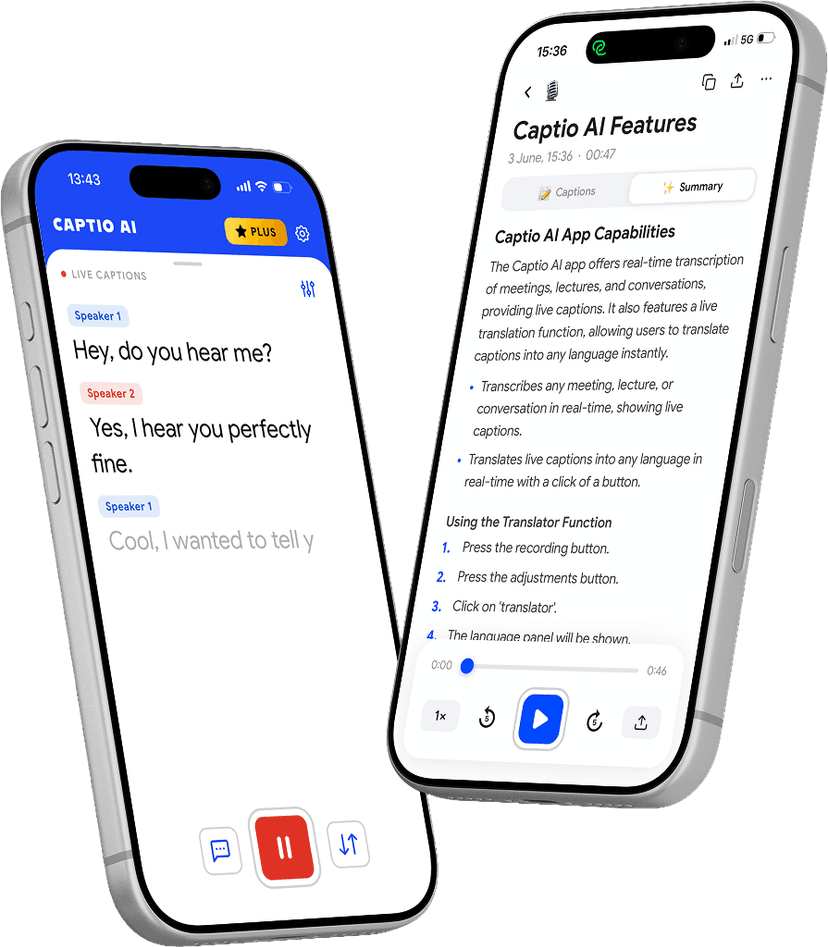
Everything you need to follow Galician doctor appointments
Four tools built for deaf and hard of hearing Galician speakers.
Follow what the doctor says in real time
- Captions appear word by word as they speak
- Handles medical terminology, drug names, and clinical language
- Place the phone on the desk — no setup needed
- Works in any consultation room, clinic, or hospital setting
When the doctor speaks another language
- Captions and translates in real time
- Follow your diagnosis in the language you understand best
- 60+ languages, no manual switching
- For foreign specialists, travel, or immigration settings
A full record of the consultation
- Record the appointment and upload it for a complete transcript
- Review instructions, drug names, and follow-up steps at home
- Share with a family member or carer if needed
- Works on any consultation recording
Key instructions extracted automatically
- Diagnosis, medication, and follow-up steps pulled from any transcript
- Organised into clear sections
- Nothing important missed or forgotten
- Works on any saved appointment recording
Download for free
Every situation covered
Designed for the real moments that matter — not just quiet controlled environments.
At a centro de saúde (health centre) in Santiago de Compostela, Vigo, or a smaller concello, your médico explains symptoms and treatment in Galician. Captio AI captions every word in real time.
At a specialist appointment at Hospital Clínico Universitario de Santiago or a Complexo Hospitalario, medical terms arrive in Galician or Spanish. Captio AI captions both in real time.
At the farmacia (pharmacy), the farmacéutico explains dosage and drug interactions in Galician or Spanish. Point your phone toward them and read the instructions as they speak.
At the dentista (dental clinic), the dentist gives instructions during treatment when lip-reading is impossible. Captio AI captions from audio alone.
In a session with a psicólogo or psiquiatra, sensitive conversations require full comprehension. Captio AI captions the full session so you engage without gaps.
At the urxencias (emergency department), staff speak quickly under pressure. Open Captio AI and read their instructions in real time.
Most accurate and fastest models
word accuracy
independent benchmark, 2025
real-time captions
first word appears as you speak
Download for free
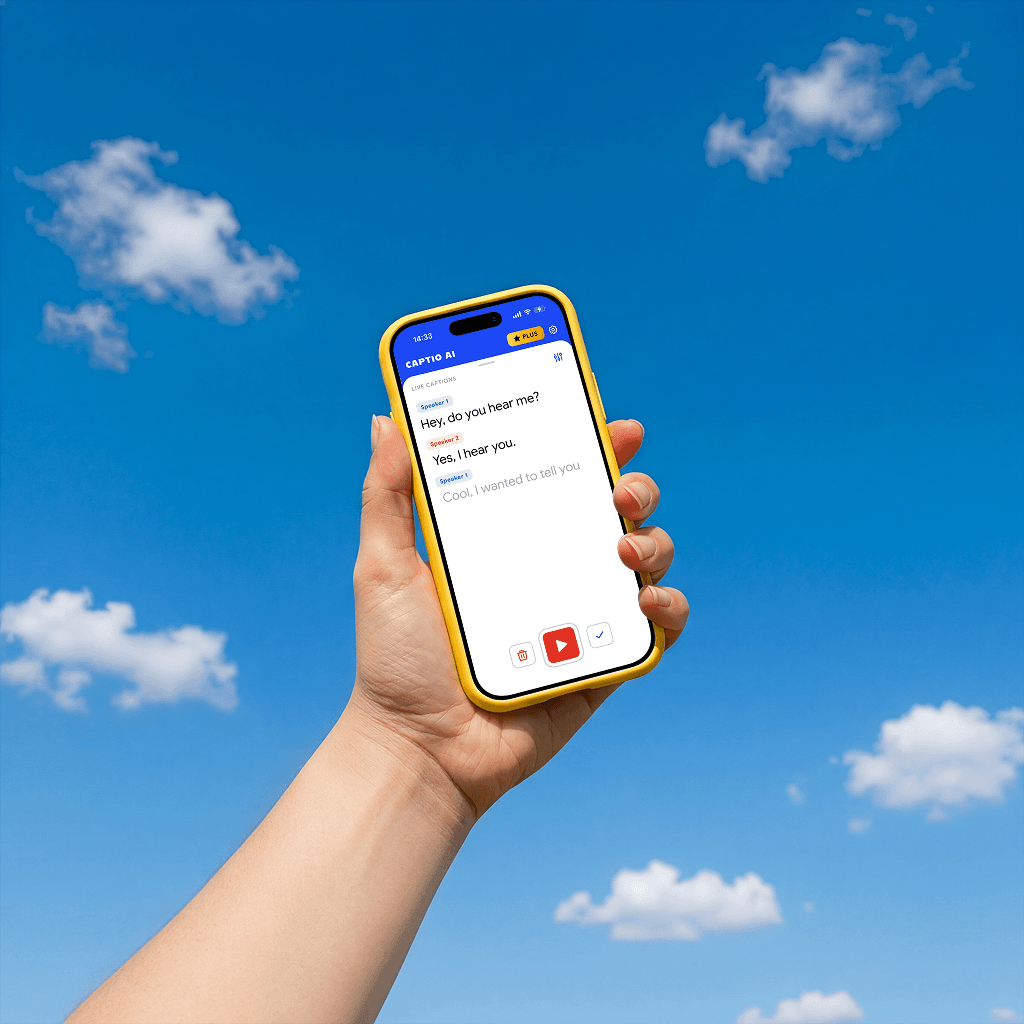
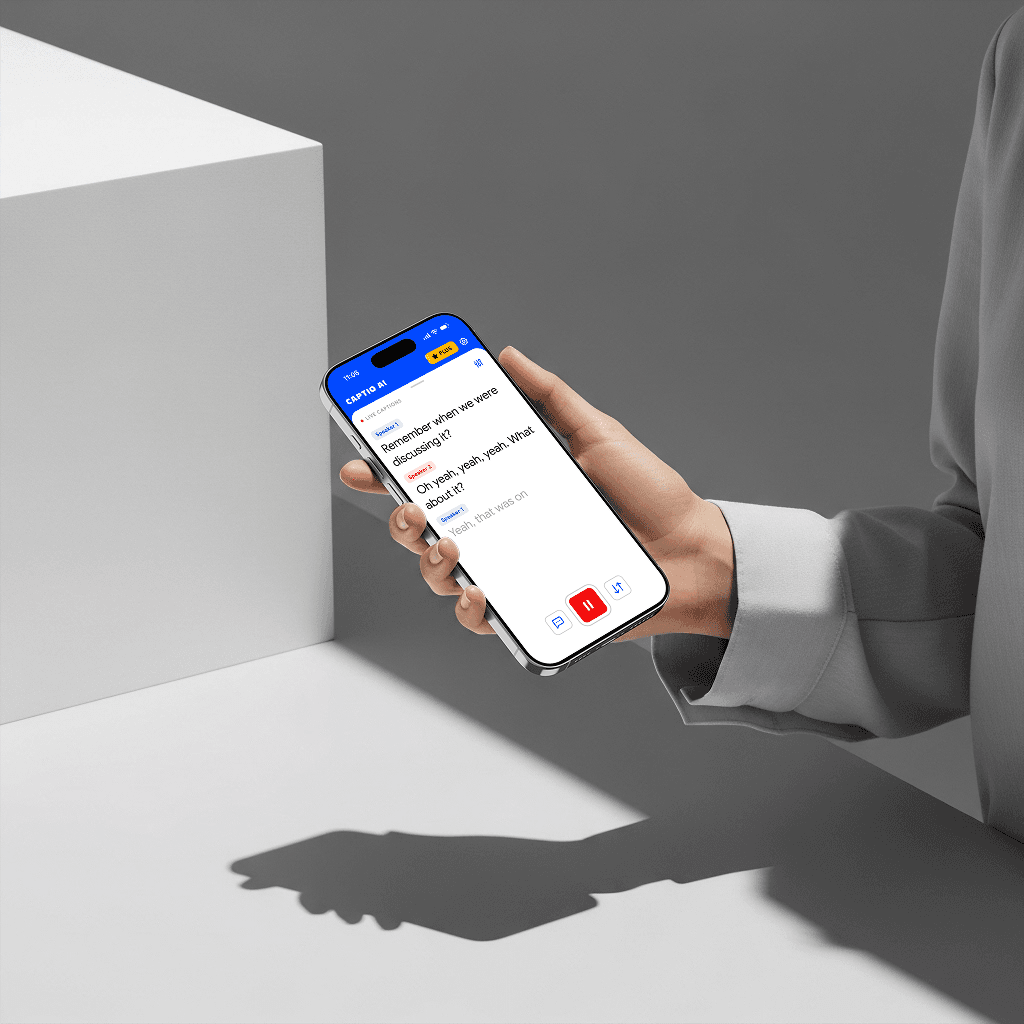
Built for the conversations where every word matters
Captions as the doctor speaks
Words appear on screen while the doctor is still talking. You read the diagnosis, drug name, or follow-up instruction at the same moment it is said — not after they have moved on.
Medical terminology handled accurately
Drug names, procedure names, clinical terms. Captio AI handles the vocabulary of a real consultation — not just everyday speech.
Review the appointment after
Record the consultation and upload it to Audio Transcription. Get a full written record of everything said — instructions, dosages, referrals — to review at home and share with a carer if needed.
Works in any clinical setting
Consultation rooms, hospital wards, A&E, dental chairs, pharmacy counters. Place the phone near the speaker and Captio AI captions whoever is talking.
Any language
For foreign-language doctors, specialists abroad, or appointments through an interpreter. Live Translator captions and translates in real time so you follow your diagnosis in the language you understand best.
100% private
Medical conversations are among the most sensitive there are. Captio AI processes audio in real time and discards it immediately. Nothing is recorded, stored, or shared.
Why Galician is hard to understand
Gheada
- The Galician gheada turns g into an aspirated h — invisible on the lips
- In large parts of Galicia — particularly the western coast and rural areas — speakers use gheada: the pronunciation of the /g/ phoneme as a soft aspirated /h/ sound. Medical vocabulary is dense with g-initial words (galego, gripe, garganta), and in gheada speech all of these words begin with a sound produced deep in the throat with no lip movement. A deaf patient lip-reading gheada Galician misses the initial consonant of a significant portion of the clinical vocabulary.
Seseo
- Seseo merges c/z and s — removing a visual distinction that exists in Castilian Spanish
- Seseo is a feature of many Galician varieties in which the phonemic distinction between /s/ and /θ/ (the Spanish 'c/z' sound) is neutralised — both sounds merge into /s/. For a deaf patient who lip-reads Castilian Spanish as well as Galician, this removes a consonant distinction they might otherwise use to disambiguate similar-looking words. In clinical vocabulary, where terms like 'cerumen' and 'suero' share sounds that become identical under seseo, lip-reading accuracy drops.
Galician–Spanish code-switching
- Clinical appointments switch between Galician and Spanish unpredictably
- In Galician healthcare settings, code-switching between Galician and Spanish (Castilian) is common — doctors may use Spanish for formal clinical vocabulary and Galician for explanations, or vice versa. Urban doctors may speak predominantly Spanish with Galician turns for specific terms. A deaf patient who lip-reads one language encounters a different phonological system mid-consultation without any visual signal of the switch.
Portuguese proximity confusion
- Galician shares sounds with Portuguese that differ from Castilian Spanish
- Galician is historically close to Portuguese — sharing nasal vowels, palatal consonants, and vocabulary absent in Spanish. In informal clinical speech, a Galician-speaking doctor's vowel nasal patterns and palatal /ʎ/ and /ɲ/ sounds produce lip shapes that differ from the Castilian Spanish a patient may be more practised in reading. The phonological overlap between Galician and Portuguese creates ambiguity for patients expecting Spanish-like lip patterns.
Fast rural Galician
- Rural and older Galician speakers use faster, more reduced speech
- Informal and rural Galician spoken by older patients or in fast-paced clinical contexts compresses vowels, elides intervocalic consonants, and merges word boundaries in ways that differ from the Standard Galician (galego estándar) taught in schools. A deaf patient lip-reading standard Galician encounters a doctor from a rural county near Lugo or Ourense speaking at a pace and in a variety where expected lip shapes simply do not appear.
Download for free
Hearing loss in Galicia: Spain's numbers, a regional language, and a sign language law that does not cover it
Spain has approximately 1,064,000 people who are deaf or have a significant hearing disability — 2.3% of the population. The EuroTrak survey found that around 10% of people in Spain have some degree of hearing loss, representing five million Spaniards. In Galicia — a community of approximately 2.7 million people in Spain's northwest — the elderly demographic skew is pronounced: Galicia has one of Spain's oldest populations, and age-related hearing loss is correspondingly prevalent. For Galician-speaking deaf and hard of hearing residents, the language dimension adds a specific complication: Spain's 2007 sign language law (Law 27/2007) recognises Spanish Sign Language but does not separately address Galician Sign Language, meaning that deaf Galicians who seek sign language support typically receive Spanish Sign Language interpretation even if Galician is their preferred spoken language.
In practice, the sign language interpreter workforce available in Galicia is small relative to the population needing support. Deaf Galicians attending healthcare appointments at a centro de saúde or Complexo Hospitalario face the same interpreter availability constraints found across Spain — insufficient interpreter numbers for routine appointments, no guarantee of interpreter presence for urgent care, and a system where the formal legal right to sign language access is not matched by the infrastructure to deliver it. COVID-19 research published in PMC found that Spanish people with hearing disabilities reported systematic inaccessibility of public health communication during the pandemic, with Galicia — operating largely in Galician — experiencing a double layer of inaccessibility for Galician-preferring deaf people.
The linguistic dimension is important because clinical appointments in Galicia may be conducted in Galician, in Spanish, or in a mixture of both — and the phonological features of Galician (gheada, seseo, Portuguese-influenced sounds) differ enough from Castilian Spanish that a deaf patient who lip-reads Spanish does not automatically lip-read Galician well. Captio AI captions Galician and Spanish in real time at any centro de saúde or hospital in Galicia, so every patient — regardless of which language their doctor uses — receives the words directly.
Download for free
What you hear stays with you.
Gone the moment it ends
Captio AI processes your audio in real time and discards it immediately. Nothing is recorded. Nothing is kept.
Not a product
Your conversations are not something Captio AI sells, shares, or monetizes — to anyone, for any reason.
Not used to train anything
What you say in a doctor's appointment or a job interview never ends up in a training dataset. Not ours. Not anyone else's.

Private by default
Captio AI supports 60+ languages
Download for free
Frequently asked questions
Understand your diagnosis in Galician.
Captio AI is free to start
Download for free