

Ukrainian live captions and productivity tool for doctor appointments
For deaf and hard of hearing people.
Download for free

Everything you need to follow Ukrainian doctor appointments
Four tools built for deaf and hard of hearing Ukrainian speakers.
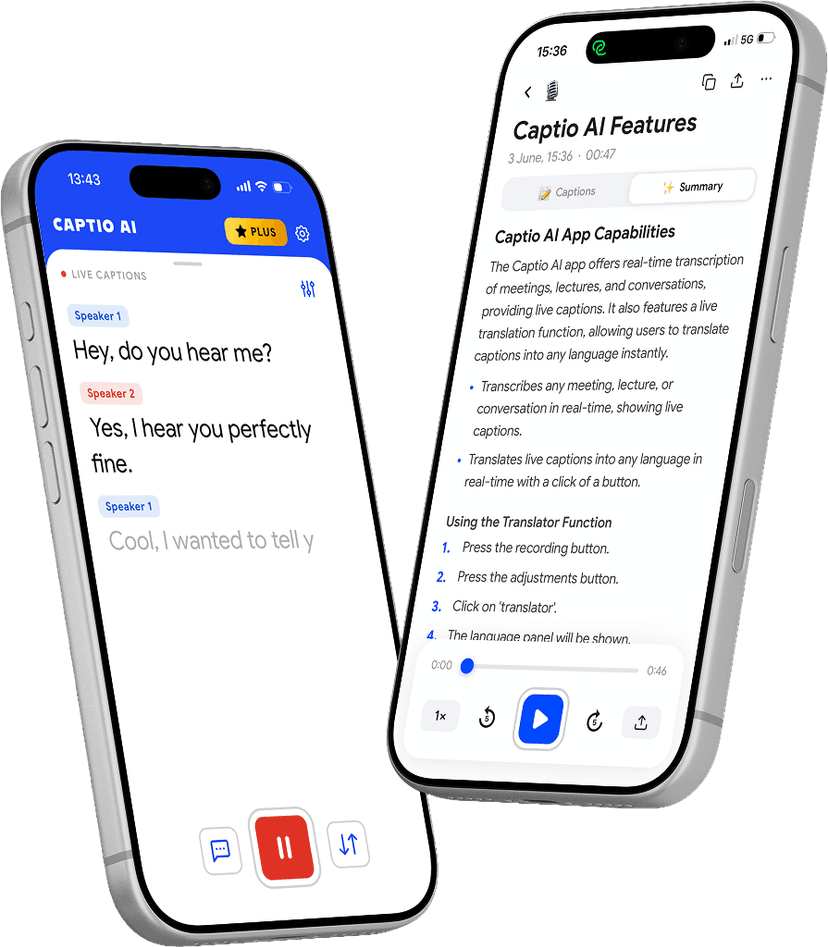
Follow what the doctor says in real time
- Captions appear word by word as they speak
- Handles medical terminology, drug names, and clinical language
- Place the phone on the desk — no setup needed
- Works in any consultation room, clinic, or hospital setting
When the doctor speaks another language
- Captions and translates in real time
- Follow your diagnosis in the language you understand best
- 60+ languages, no manual switching
- For foreign specialists, travel, or immigration settings
A full record of the consultation
- Record the appointment and upload it for a complete transcript
- Review instructions, drug names, and follow-up steps at home
- Share with a family member or carer if needed
- Works on any consultation recording
Key instructions extracted automatically
- Diagnosis, medication, and follow-up steps pulled from any transcript
- Organised into clear sections
- Nothing important missed or forgotten
- Works on any saved appointment recording
Download for free
Every situation covered
Designed for the real moments that matter — not just quiet controlled environments.
GP visits at a поліклініка or family doctor's practice, where appointments are brief and the doctor may speak Surzhyk or a regional Ukrainian variety different from the patient's home dialect.
Specialist consultations at a лікарня or specialist centre, where clinical Soviet-legacy terminology is dense and appointments move fast.
Pharmacy consultations at an аптека, where the pharmacist explains dosage and interactions verbally — with drug names potentially in Ukrainian, Russian, or English depending on the product.
Dental appointments where the dentist explains the treatment plan between procedures and gives aftercare instructions before the patient fully absorbs them.
Mental health consultations with a психіатр or психолог, where precise understanding of each question and response carries direct clinical weight — and where displacement trauma makes the stakes especially high.
Emergency room visits at a швидка допомога or hospital casualty, where staff speak fast in mixed language and the clinical information cannot wait.
Most accurate and fastest models
word accuracy
independent benchmark, 2025
real-time captions
first word appears as you speak
Download for free
Built for the conversations where every word matters
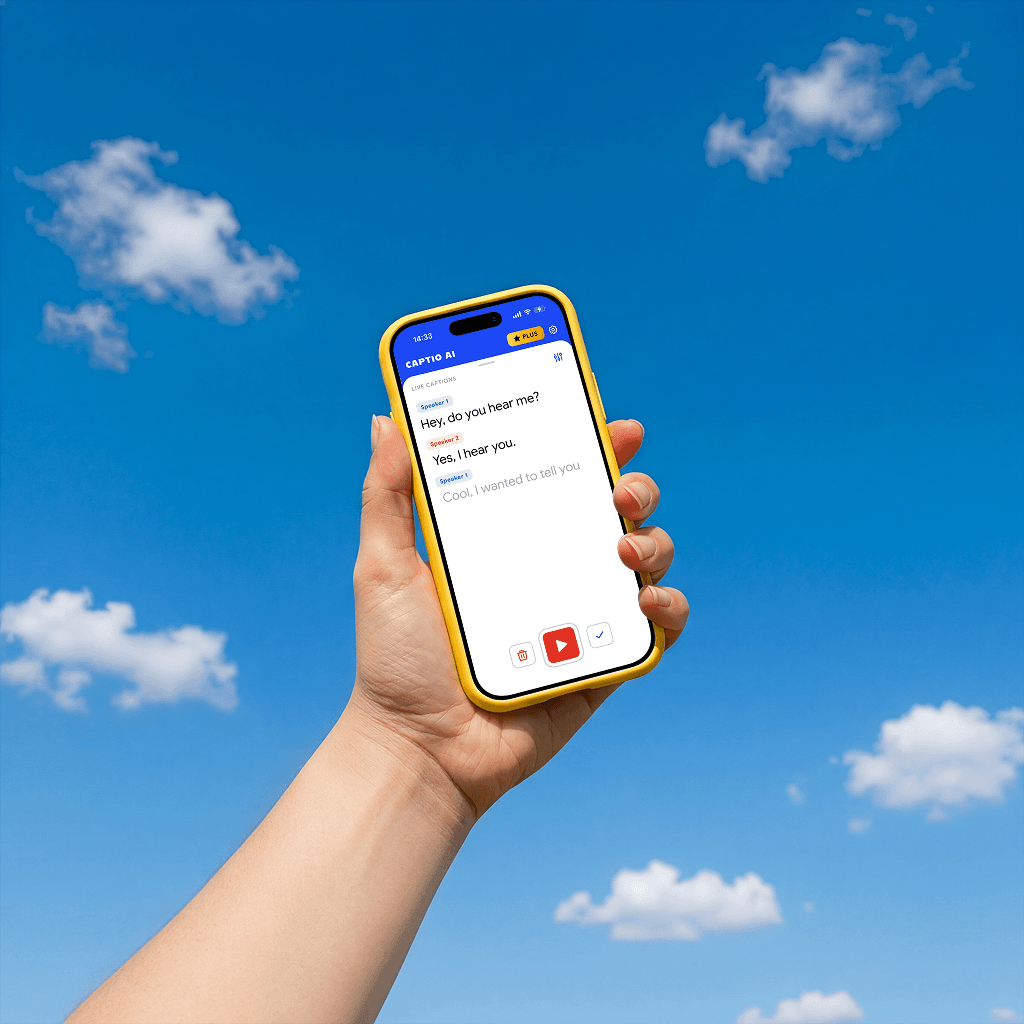
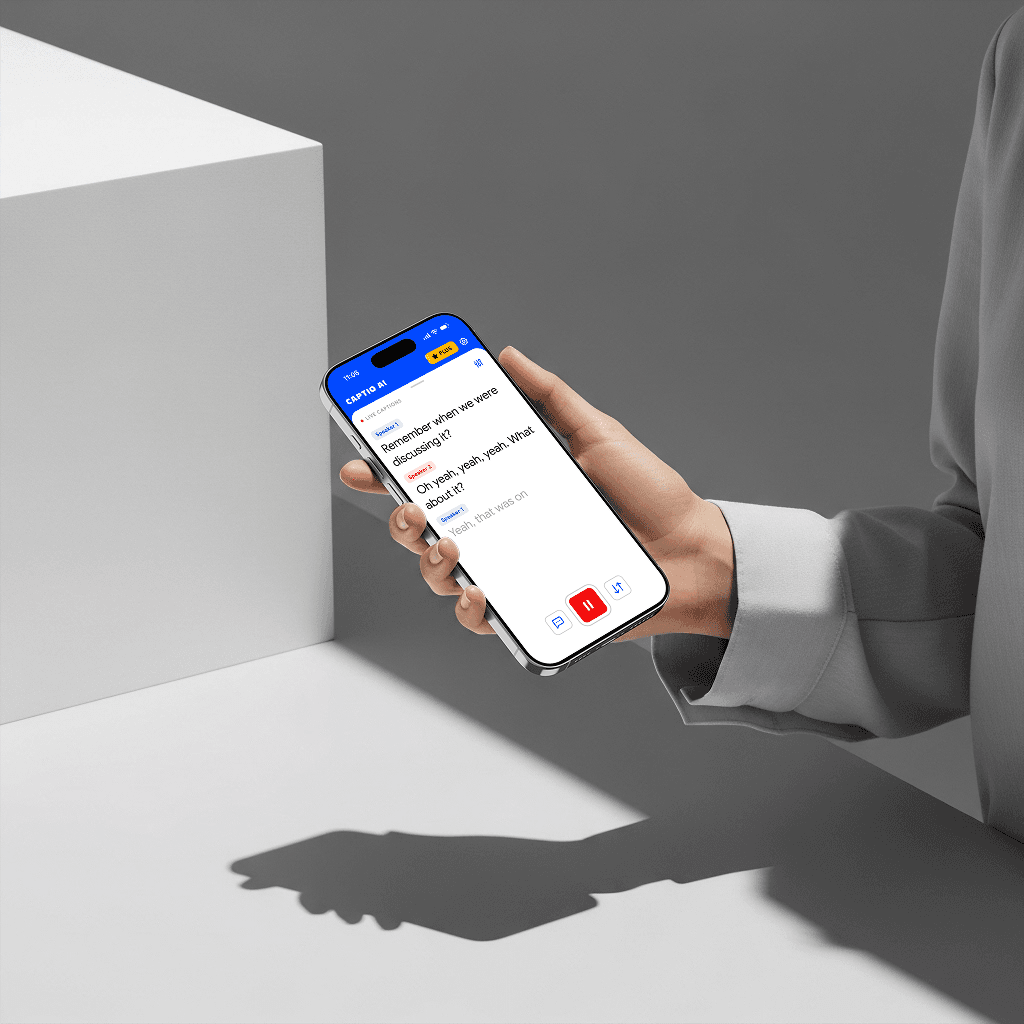
Captions as the doctor speaks
Words appear on screen while the doctor is still talking. You read the diagnosis, drug name, or follow-up instruction at the same moment it is said — not after they have moved on.
Medical terminology handled accurately
Drug names, procedure names, clinical terms. Captio AI handles the vocabulary of a real consultation — not just everyday speech.
Review the appointment after
Record the consultation and upload it to Audio Transcription. Get a full written record of everything said — instructions, dosages, referrals — to review at home and share with a carer if needed.
Works in any clinical setting
Consultation rooms, hospital wards, A&E, dental chairs, pharmacy counters. Place the phone near the speaker and Captio AI captions whoever is talking.
Any language
For foreign-language doctors, specialists abroad, or appointments through an interpreter. Live Translator captions and translates in real time so you follow your diagnosis in the language you understand best.
100% private
Medical conversations are among the most sensitive there are. Captio AI processes audio in real time and discards it immediately. Nothing is recorded, stored, or shared.
Why Ukrainian is hard to understand
Surzhyk code-switching
- East Ukrainian clinical settings often mix Ukrainian and Russian mid-sentence
- Surzhyk — the Ukrainian-Russian mixed speech predominant in eastern and central Ukraine — is widely spoken by clinicians who grew up in Russian-dominant environments. A deaf patient calibrated to Standard Ukrainian encounters a doctor who alternates between Ukrainian grammar, Russian vocabulary, and mixed phonological patterns mid-sentence. Each switch requires a complete recalibration of the language being lip-read — and in a clinical setting, the missed word during recalibration may be the diagnosis.
Galician-Eastern divergence
- Western and Eastern Ukrainian sound different on the lips
- Ukrainian dialects diverge markedly between west and east. Western (Galician/Lviv) Ukrainian preserves older phonological forms, Polish-influenced vocabulary, and different prosody; Eastern Ukrainian is more influenced by Russian. A deaf patient who grew up in Lviv seeing a specialist in Kharkiv — or a displaced person following Russia's 2022 invasion — faces a phonological register substantially different from what they lip-read at home.
Palatal consonant clusters
- Ukrainian consonant clusters create rapid bursts with little visible movement
- Ukrainian uses extensive palatalisation — soft consonants formed high on the palate that produce sounds at articulation points invisible on the lips. Clinical words like 'вприскування' (injection) and 'стетоскоп' (stethoscope) involve consonant sequences where the visible distinction between alternative words is minimal.
Soviet medical register legacy
- Ukrainian clinical settings still use Soviet-era Russian-derived medical terms
- Ukrainian hospitals still frequently use medical terms derived from Soviet-era Russian rather than revived Ukrainian alternatives — terms for procedures, medications, and diagnoses may be Russian-origin words phonologically adapted to Ukrainian, or simply Russian words used unchanged. A deaf patient who learned Standard Ukrainian medical vocabulary may not recognise the Soviet-legacy term a doctor uses.
War displacement variation
- Displaced patients and doctors bring new regional phonological variation into the clinic
- Since 2022, millions of Ukrainians have been displaced internally and across Europe. Clinical settings in Lviv, Warsaw, Berlin, and London now see patients and doctors whose phonological profiles span all regions. A deaf patient navigating healthcare in displacement faces not only the clinical language barrier but also uncertainty about which Ukrainian variety the clinician in front of them speaks.
Download for free
2 million with hearing impairment in Ukraine. A community the war has made more vulnerable than ever.
Before Russia's full-scale invasion in 2022, Ukraine was estimated to have more than 2 million people with hearing impairment, of whom approximately 31,000 lived with complete hearing loss and around 400,000 communicated primarily through Ukrainian Sign Language. The Ukrainian Society of the Deaf served as the central advocacy body for this community. The healthcare infrastructure available to deaf Ukrainians — already inadequate by European standards, with an aspirational rather than operational system of sign language interpretation — was severely disrupted by the invasion.
Ukrainian Sign Language itself has a contested history. It developed in the Soviet era as a pan-Soviet language, and the transition to a distinctly Ukrainian variety has been incomplete — deaf Ukrainians in different regions continue to use varieties shaped by Soviet standardisation, creating a fragmented linguistic landscape for a community already underserved. A 2023 report documented that most schools for the deaf in Ukraine continue to emphasise oral Ukrainian proficiency over sign language, leaving many deaf graduates dependent on lip-reading and written communication in clinical settings.
The war created immediate life-safety risks — air raid sirens are audio-only, and deaf people in affected regions could not hear warnings to take shelter. The humanitarian consequences extend to healthcare: displaced deaf Ukrainians in Polish, German, and Czech hospitals face clinical settings where neither the language nor the communication support is familiar. Captio AI captions Ukrainian in real time — at the поліклініка in Kyiv, the лікарня in Lviv, or an urgent care clinic anywhere a Ukrainian-speaking patient now lives.
Download for free
What you hear stays with you.
Gone the moment it ends
Captio AI processes your audio in real time and discards it immediately. Nothing is recorded. Nothing is kept.
Not a product
Your conversations are not something Captio AI sells, shares, or monetizes — to anyone, for any reason.
Not used to train anything
What you say in a doctor's appointment or a job interview never ends up in a training dataset. Not ours. Not anyone else's.

Private by default
Captio AI supports 60+ languages
Download for free
Frequently asked questions
Understand your diagnosis in Ukrainian.
Captio AI is free to start
Download for free