

Russian live captions and productivity tool for doctor appointments
For deaf and hard of hearing people.
Download for free


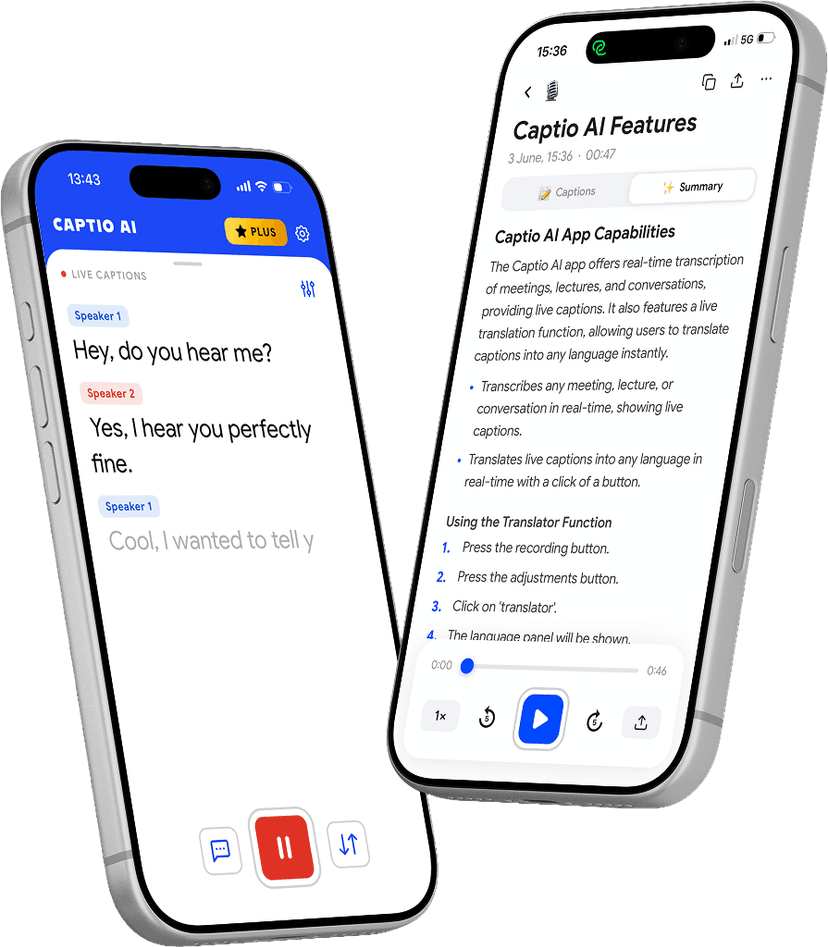
Everything you need to follow Russian doctor appointments
Four tools built for deaf and hard of hearing Russian speakers.
Follow what the doctor says in real time
- Captions appear word by word as they speak
- Handles medical terminology, drug names, and clinical language
- Place the phone on the desk — no setup needed
- Works in any consultation room, clinic, or hospital setting
When the doctor speaks another language
- Captions and translates in real time
- Follow your diagnosis in the language you understand best
- 60+ languages, no manual switching
- For foreign specialists, travel, or immigration settings
A full record of the consultation
- Record the appointment and upload it for a complete transcript
- Review instructions, drug names, and follow-up steps at home
- Share with a family member or carer if needed
- Works on any consultation recording
Key instructions extracted automatically
- Diagnosis, medication, and follow-up steps pulled from any transcript
- Organised into clear sections
- Nothing important missed or forgotten
- Works on any saved appointment recording
Download for free
Every situation covered
Designed for the real moments that matter — not just quiet controlled environments.
Районная поликлиника and hospital outpatient visits in Russia where the doctor speaks quickly in formal Russian and the consultation is brief. Captio AI captions the diagnosis and prescription in real time.
Specialist consultations — cardiologist, neurologist, oncologist — in Russian medical vocabulary at pace. Captio AI captions every term as the specialist delivers it.
Аптека conversations where the pharmacist explains dosage, interactions, and storage quickly. Captio AI captions the instructions so nothing is missed at the pharmacy counter.
Dental visits where the dentist explains the treatment plan in Russian and uses clinical vocabulary for the procedure. Captio AI captures the full explanation.
Psychiatry and mental health consultations at Russian clinics where accurate understanding of the session matters. Captio AI captions the clinician in real time.
Emergency room visits at Russian hospitals where staff speak fast in a loud environment. Captio AI captions the key clinical instructions in real time.
Most accurate and fastest models
word accuracy
independent benchmark, 2025
real-time captions
first word appears as you speak
Download for free
Built for the conversations where every word matters
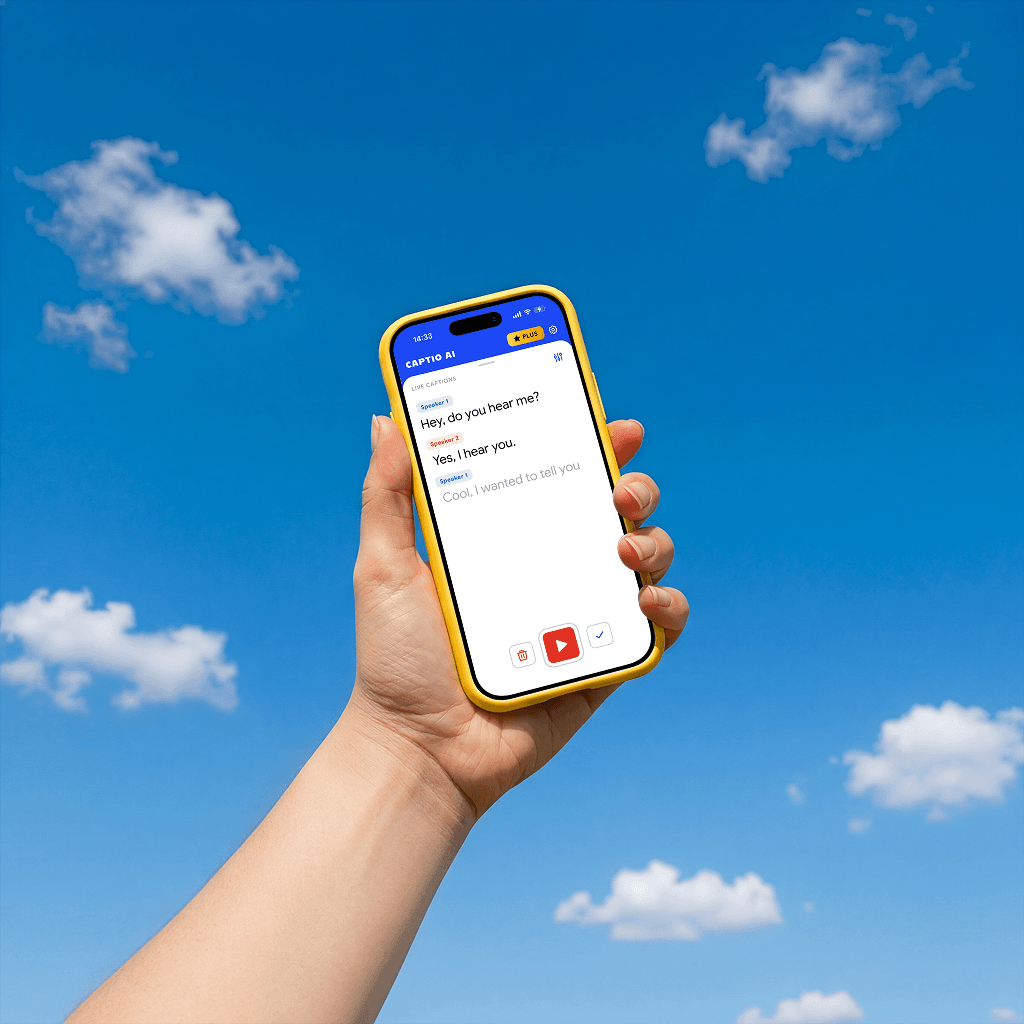
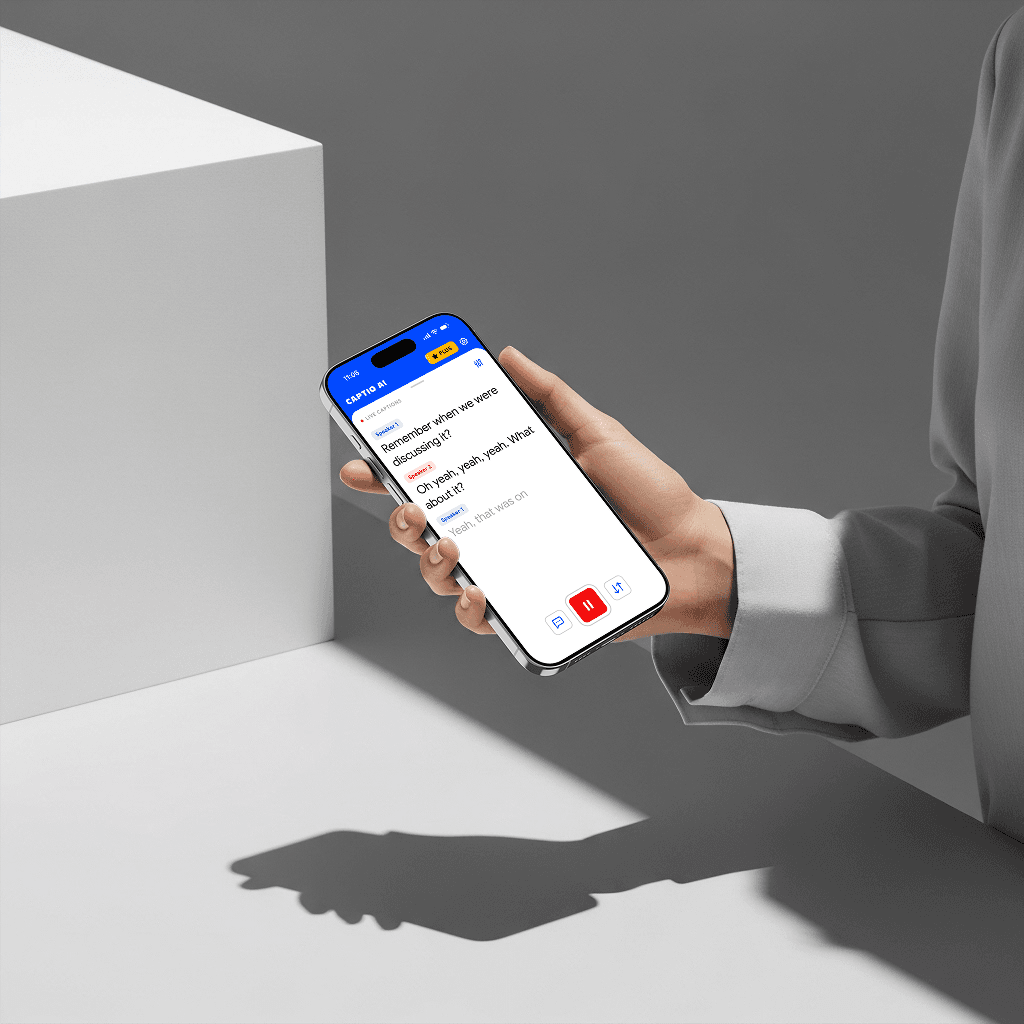
Captions as the doctor speaks
Words appear on screen while the doctor is still talking. You read the diagnosis, drug name, or follow-up instruction at the same moment it is said — not after they have moved on.
Medical terminology handled accurately
Drug names, procedure names, clinical terms. Captio AI handles the vocabulary of a real consultation — not just everyday speech.
Review the appointment after
Record the consultation and upload it to Audio Transcription. Get a full written record of everything said — instructions, dosages, referrals — to review at home and share with a carer if needed.
Works in any clinical setting
Consultation rooms, hospital wards, A&E, dental chairs, pharmacy counters. Place the phone near the speaker and Captio AI captions whoever is talking.
Any language
For foreign-language doctors, specialists abroad, or appointments through an interpreter. Live Translator captions and translates in real time so you follow your diagnosis in the language you understand best.
100% private
Medical conversations are among the most sensitive there are. Captio AI processes audio in real time and discards it immediately. Nothing is recorded, stored, or shared.
Why Russian is hard to understand
Unstressed vowel reduction
- Russian unstressed vowels collapse in fast clinical speech
- Russian dramatically reduces unstressed vowels: unstressed 'о' becomes [ə] or [ʌ], and multiple unstressed vowels can merge. In a polyclinic consultation at pace, the full vowel forms of medical terms — болезнь, операция, диагноз, лекарство — compress significantly. A deaf patient who has learned the word from a written form may not recognize the reduced spoken form delivered by a doctor writing the prescription simultaneously.
Latin medical roots in Russian phonology
- International medical terms sound completely different in Russian clinical delivery
- Russian medicine uses the same Latin and Greek roots as international medical vocabulary — cardio-, nephro-, hepato-, pneumo- — but they are pronounced with Russian phonology, Russian stress, and Russian vowel reduction. Кардиомиопатия, нефролитиаз, гепатит — spoken at Russian clinical speed — share almost no acoustic properties with their English cognates. A deaf patient with some familiarity with these roots from English will not recognize them in a Russian doctor's delivery.
Palatalization pairs
- Russian soft and hard consonants look identical on the lips
- Russian contrasts hard (plain) and soft (palatalized) consonants: т vs. ть, с vs. сь, н vs. нь. These distinctions produce no visible difference in lip position. Medical terms distinguished by palatalization are visually indistinguishable. In a consultation where the difference between two clinical words matters, a deaf patient relying on visual cues cannot recover the distinction.
Polyclinic pace
- Russian municipal polyclinics see large patient loads and run short consultations
- Municipal polyclinics (районные поликлиники) in Russian cities operate under significant patient load. Consultations are brief, doctors write while speaking, and they often do not face the patient directly when delivering the diagnosis. A deaf patient who asks for repetition may be shown the prescription rather than having the doctor repeat the spoken words.
Formal bureaucratic medical register
- Russian medical speech uses an older formal register absent from everyday conversation
- Russian medical speech uses a formal register with passive constructions and archaic vocabulary: поставлен диагноз (the diagnosis was established), пациенту назначено (the patient was prescribed), выявлено (it was found). These forms differ substantially from everyday Russian. A deaf patient who has learned to follow casual Russian encounters a distinct register in the clinic that requires additional processing.
Download for free
9 million Russians with disabling hearing loss. 98% of those who need hearing aids do not have one.
Russia has approximately 9 million people aged 15 and older with disabling hearing loss, according to estimates from the Global Burden of Disease Study 2019 — substantially higher than official Russian health statistics, which reflect only those formally diagnosed and registered as disabled. A national survey study published in PMC (2023) found that 22.2% of Russian adults reported some trouble with hearing, but only 2.2% of those individuals used a hearing aid. This represents an unmet need rate of approximately 98% — among the highest of any country with available data.
The gap between official registration and actual prevalence reflects a systemic undercount. National census data in Russia does not collect information on hearing health, and there are no large-scale population-based studies on adult hearing loss prevalence. The PMC 2023 study authors noted explicitly that Russian national hearing statistics are unreliable and that the true burden significantly exceeds official figures. For a deaf or hard of hearing person in Russia, this statistical invisibility has practical consequences: healthcare systems plan services around the registered population, not the actual one.
In clinical settings, sign language interpreters are not a standard provision in Russian polyclinics or hospitals. RSL (Russian Sign Language) has no formal legal recognition that mandates interpreter access in public services. A deaf patient attending a Russian medical appointment without a hearing companion typically relies on written exchange with the doctor — feasible for simple interactions but insufficient for the pace and density of a clinical consultation. Captio AI captions Russian speech in real time — including the Latinized vocabulary of Russian medical delivery, unstressed vowel reduction, and the formal bureaucratic register of clinical speech — so a deaf patient can read their diagnosis and prescription as the doctor speaks.
Download for free
What you hear stays with you.
Gone the moment it ends
Captio AI processes your audio in real time and discards it immediately. Nothing is recorded. Nothing is kept.
Not a product
Your conversations are not something Captio AI sells, shares, or monetizes — to anyone, for any reason.
Not used to train anything
What you say in a doctor's appointment or a job interview never ends up in a training dataset. Not ours. Not anyone else's.

Private by default
Captio AI supports 60+ languages
Download for free
Frequently asked questions
Understand your diagnosis in Russian.
Captio AI is free to start
Download for free