

Chinese live captions and productivity tool for doctor appointments
For deaf and hard of hearing people.
Download for free


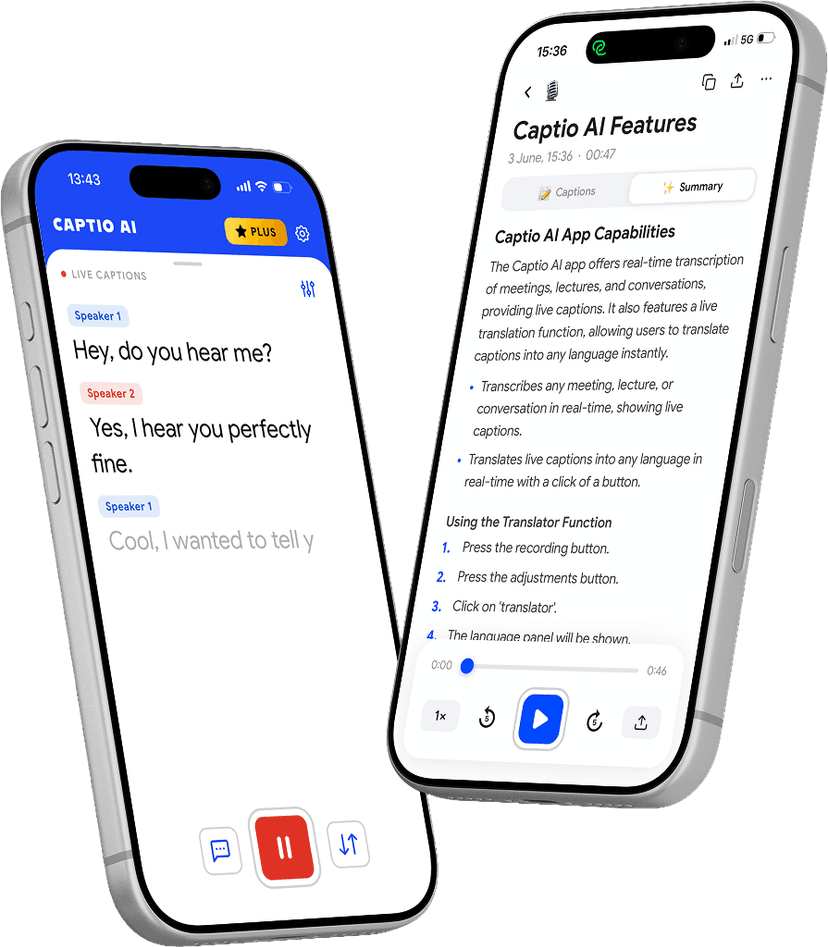
Everything you need to follow Chinese doctor appointments
Four tools built for deaf and hard of hearing Chinese speakers.
Follow what the doctor says in real time
- Captions appear word by word as they speak
- Handles medical terminology, drug names, and clinical language
- Place the phone on the desk — no setup needed
- Works in any consultation room, clinic, or hospital setting
When the doctor speaks another language
- Captions and translates in real time
- Follow your diagnosis in the language you understand best
- 60+ languages, no manual switching
- For foreign specialists, travel, or immigration settings
A full record of the consultation
- Record the appointment and upload it for a complete transcript
- Review instructions, drug names, and follow-up steps at home
- Share with a family member or carer if needed
- Works on any consultation recording
Key instructions extracted automatically
- Diagnosis, medication, and follow-up steps pulled from any transcript
- Organised into clear sections
- Nothing important missed or forgotten
- Works on any saved appointment recording
Download for free
Every situation covered
Designed for the real moments that matter — not just quiet controlled environments.
Community health centre and hospital OPD visits in China where the doctor speaks fast Mandarin and the consultation lasts a few minutes. Captio AI captions the diagnosis and prescription in real time before the appointment is over.
Specialist consultations at major Chinese hospitals — 三甲医院 — where cardiologists, neurologists, and oncologists deliver dense clinical vocabulary at speed. Captio AI captures every term as it is spoken.
Pharmacy counter conversations where the 药师 explains dosage, side effects, and interactions quickly in Mandarin. Captio AI captions the instructions so nothing is missed before you leave the counter.
Dental visits where the dentist speaks through a mask in Mandarin and explains the treatment while working. Captio AI captures what is said when they step back to explain the procedure.
Psychiatry and counselling appointments in Chinese cities, where accurate understanding of the session has real clinical stakes and misunderstandings carry consequences. Captio AI captions the clinician in real time.
Emergency room visits at Chinese hospitals where triage nurses speak fast and the environment is loud. Captio AI captions the key instructions and diagnostic information in the moments when they matter most.
Most accurate and fastest models
character accuracy
independent benchmark, 2025
real-time captions
first word appears as you speak
Download for free
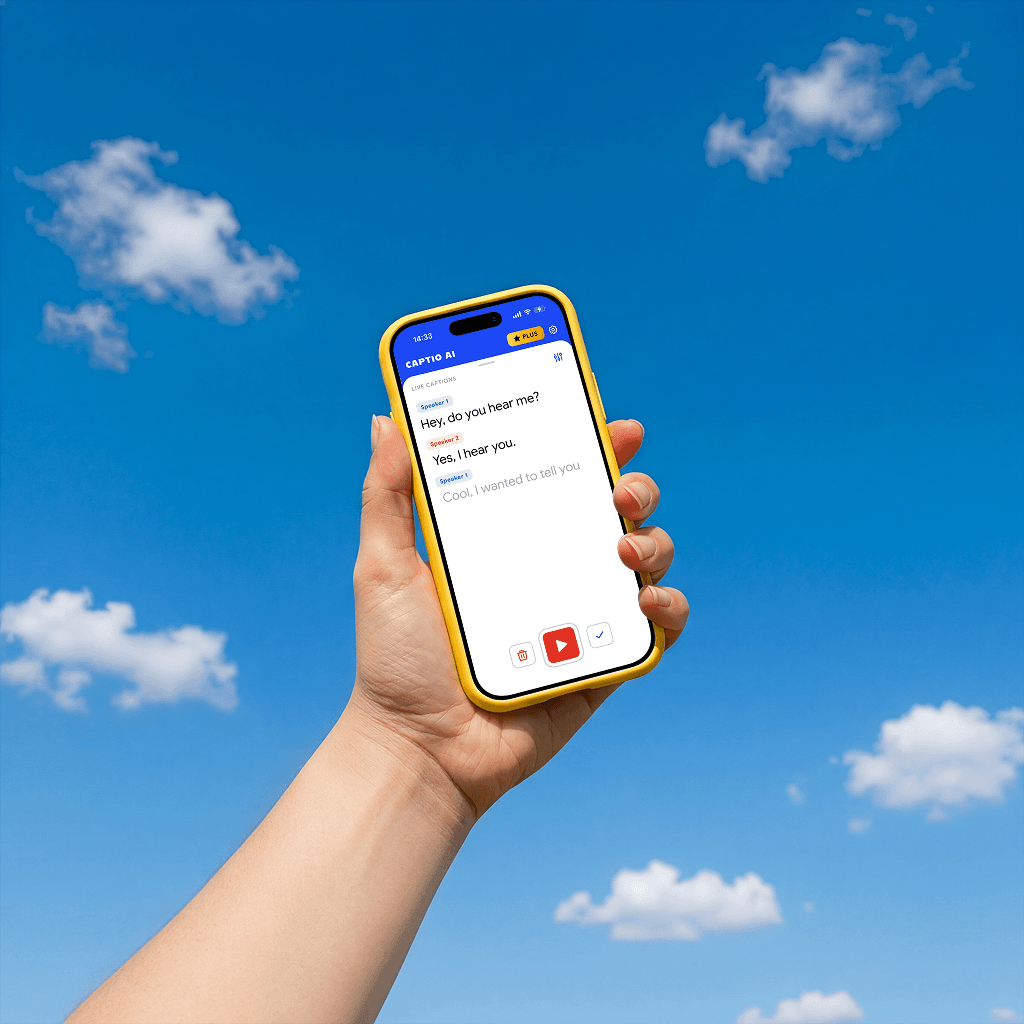
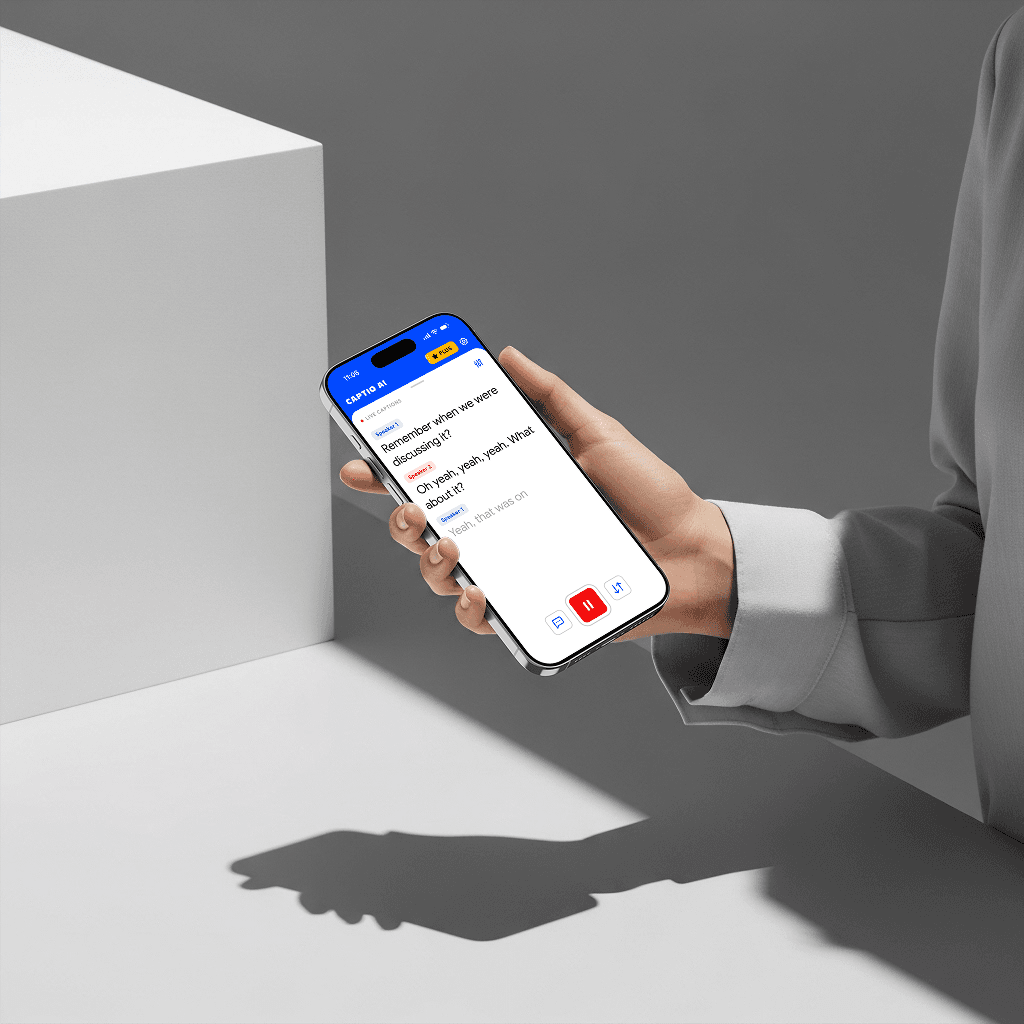
Built for the conversations where every word matters
Captions as the doctor speaks
Words appear on screen while the doctor is still talking. You read the diagnosis, drug name, or follow-up instruction at the same moment it is said — not after they have moved on.
Medical terminology handled accurately
Drug names, procedure names, clinical terms. Captio AI handles the vocabulary of a real consultation — not just everyday speech.
Review the appointment after
Record the consultation and upload it to Audio Transcription. Get a full written record of everything said — instructions, dosages, referrals — to review at home and share with a carer if needed.
Works in any clinical setting
Consultation rooms, hospital wards, A&E, dental chairs, pharmacy counters. Place the phone near the speaker and Captio AI captions whoever is talking.
Any language
For foreign-language doctors, specialists abroad, or appointments through an interpreter. Live Translator captions and translates in real time so you follow your diagnosis in the language you understand best.
100% private
Medical conversations are among the most sensitive there are. Captio AI processes audio in real time and discards it immediately. Nothing is recorded, stored, or shared.
Why Chinese is hard to understand
Tonal collapse under mask
- Mandarin tones disappear behind a surgical mask in a clinical setting
- Mandarin's four tones distinguish meaning — 妈/麻/马/骂 (mā/má/mǎ/mà) are four different words on the same syllable. In a consultation room, lip-reading is already limited; add a surgical mask — standard in Chinese healthcare — and tonal disambiguation from visual cues is eliminated entirely. A drug name, a diagnosis word, or a follow-up instruction built on a tonal distinction becomes opaque the moment the mask goes on.
Cantonese–Mandarin split
- Deaf patients from southern China face a double barrier in Mandarin-speaking hospitals
- A Cantonese-speaking deaf patient from Guangdong or Hong Kong attending a hospital where the doctor speaks Putonghua faces a completely different phonological landscape. The two languages share characters but not pronunciation, and in a clinical setting — where the patient cannot ask for a sign language interpreter — the deaf Cantonese speaker is navigating a language that is not their own while simultaneously trying to understand medical content.
Medical register vs everyday Chinese
- Clinical Mandarin uses formal vocabulary the ear rarely encounters outside the hospital
- Chinese medical consultations use a formal register with classical-derived terminology: 脑血管意外 (stroke), 心肌梗死 (myocardial infarction), 高血压 (hypertension). Colloquial equivalents differ significantly. A deaf patient familiar with everyday Mandarin but not medical register will not recognize these terms on the page or the lip, and the doctor is unlikely to provide both the formal and colloquial forms without being asked.
English drug names in Chinese
- Prescriptions in Chinese hospitals mix English brand names into Mandarin speech
- In major Chinese hospitals, particularly urban centres, doctors routinely name drugs by their English trade names or transliterations — 阿司匹林 (aspirin), 布洛芬 (ibuprofen), 他汀 (statin) — while explaining in Mandarin. The phonological switch from Mandarin to English or transliterated English is abrupt and carries the most specific clinical content of the consultation.
Brief consultation pace
- Consultation times in Chinese hospitals leave no room for repetition
- Large Chinese hospitals operate under enormous patient load. Outpatient consultations in the public system can run just a few minutes per patient. The doctor speaks quickly, writes the prescription, and moves to the next patient before a deaf person has time to ask for clarification. The pace of Chinese clinical speech combined with short appointment times creates the most compressed communication environment in the healthcare system.
Download for free
27.8 million people. A healthcare system not built for them.
China has 27.8 million people with hearing and speech disabilities according to national registry data — the largest such population in absolute numbers of any country. During the COVID-19 pandemic, a qualitative study published in PMC (2021) found that deaf and hard of hearing older adults in China faced cascading barriers to healthcare: they could not read temperature measurement results without assistance, could not communicate with healthcare workers wearing full PPE, and could not access emergency health information broadcast in audio-only formats. Mask requirements — which persisted in Chinese healthcare settings beyond the acute pandemic phase — eliminated the partial lip-reading that many relied on as their primary communication strategy.
Chinese law does not formally recognise Chinese Sign Language (CSL) as a national language, and there is no legal mandate requiring hospitals to provide sign language interpreters for deaf patients. The absence of interpreter standards in clinical settings means that a deaf patient who attends a hospital appointment alone has no formal language support beyond writing notes, which is rarely feasible during a fast-paced consultation under significant patient-load pressure.
Hearing loss prevalence in China rose significantly between 1990 and 2021, with a provincial-level analysis published in the Chinese Medical Journal (2025) finding that the burden of hearing loss is unevenly distributed across provinces, with rural and western regions showing substantially higher rates and lower access to rehabilitation services. China's ageing population is accelerating this burden: older adults in rural areas face both the highest prevalence of hearing loss and the longest distances to specialist audiological care. Captio AI captions Mandarin in real time — across formal clinical register, regional-accented speech, and the brief consultation windows of a busy Chinese hospital — so a deaf patient can follow their own medical appointment without relying on a family member to translate.
Download for free
What you hear stays with you.
Gone the moment it ends
Captio AI processes your audio in real time and discards it immediately. Nothing is recorded. Nothing is kept.
Not a product
Your conversations are not something Captio AI sells, shares, or monetizes — to anyone, for any reason.
Not used to train anything
What you say in a doctor's appointment or a job interview never ends up in a training dataset. Not ours. Not anyone else's.

Private by default
Captio AI supports 60+ languages
Download for free
Frequently asked questions
Understand your diagnosis in Chinese.
Captio AI is free to start
Download for free