

Hindi live captions and productivity tool for doctor appointments
For deaf and hard of hearing people.
Download for free


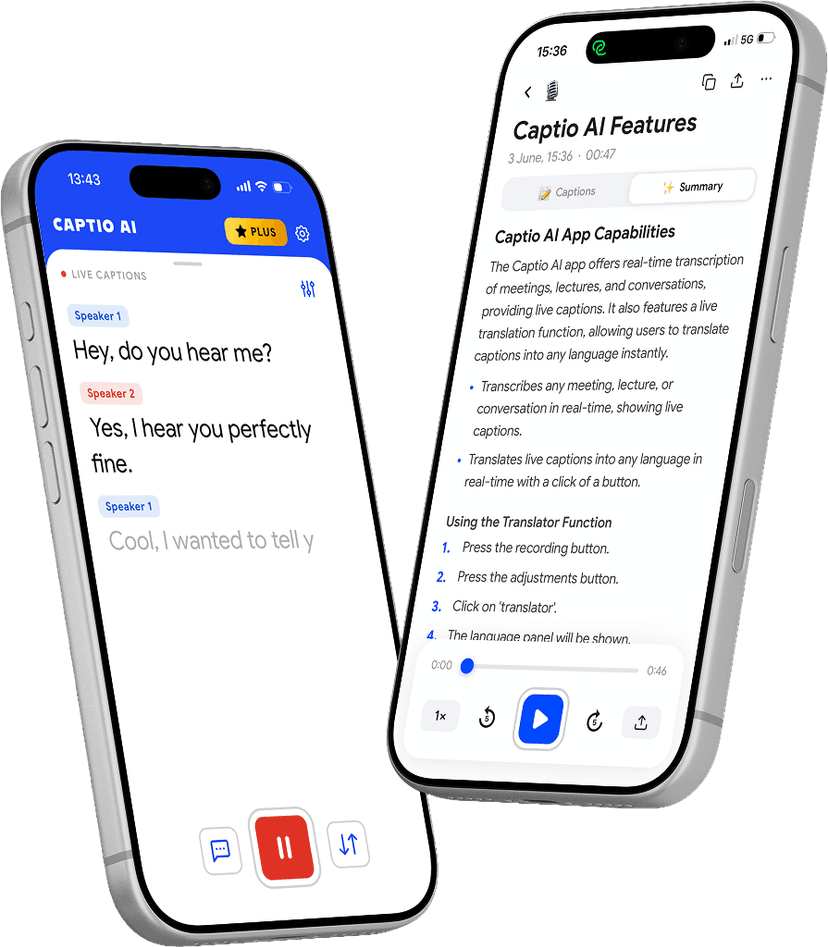
Everything you need to follow Hindi doctor appointments
Four tools built for deaf and hard of hearing Hindi speakers.
Follow what the doctor says in real time
- Captions appear word by word as they speak
- Handles medical terminology, drug names, and clinical language
- Place the phone on the desk — no setup needed
- Works in any consultation room, clinic, or hospital setting
When the doctor speaks another language
- Captions and translates in real time
- Follow your diagnosis in the language you understand best
- 60+ languages, no manual switching
- For foreign specialists, travel, or immigration settings
A full record of the consultation
- Record the appointment and upload it for a complete transcript
- Review instructions, drug names, and follow-up steps at home
- Share with a family member or carer if needed
- Works on any consultation recording
Key instructions extracted automatically
- Diagnosis, medication, and follow-up steps pulled from any transcript
- Organised into clear sections
- Nothing important missed or forgotten
- Works on any saved appointment recording
Download for free
Every situation covered
Designed for the real moments that matter — not just quiet controlled environments.
Government hospital OPD visits across Hindi-speaking India where the doctor sees many patients per hour and consultations are brief. Captio AI captions the diagnosis, prescription, and follow-up in real time before the appointment is over.
Private specialist clinics in Delhi, Lucknow, and Bhopal where cardiologists and neurologists speak fast Hindi mixed with English clinical terms. Captio AI captions every word as the specialist delivers the diagnosis.
Medical store and pharmacy counter conversations in Hindi where the chemist explains the prescription and dosage quickly. Captio AI captions the instructions at the counter so nothing is missed.
Dental visits where the dentist explains treatment in Hindi, often switching to English for procedure names. Captio AI follows both and captures the full treatment plan.
Psychiatry and mental health consultations in Indian cities where accurate understanding of the session has real clinical consequences. Captio AI captions the clinician in real time.
Emergency room visits at government hospitals in Hindi-speaking states where triage moves fast and instructions are spoken quickly. Captio AI captions the key clinical information when it matters most.
Most accurate and fastest models
word accuracy
independent benchmark, 2025
real-time captions
first word appears as you speak
Download for free
Built for the conversations where every word matters
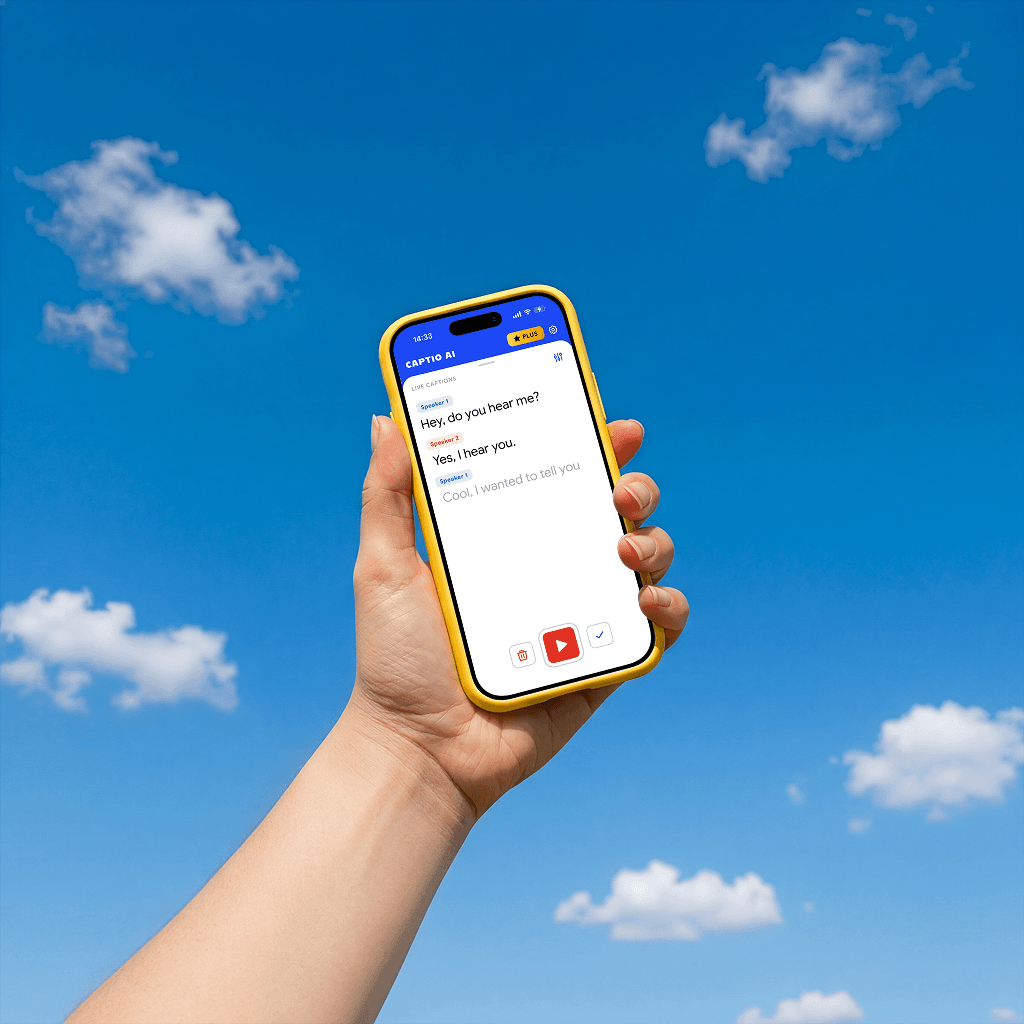
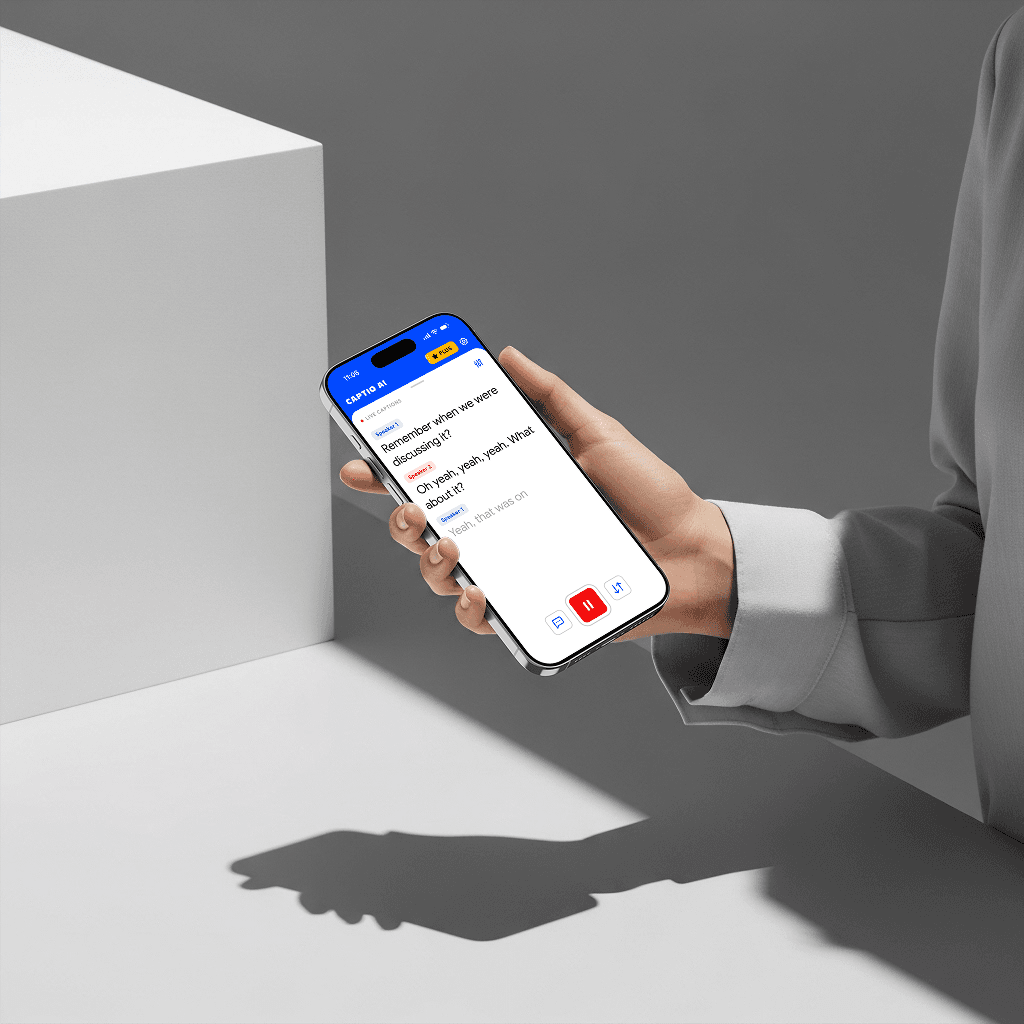
Captions as the doctor speaks
Words appear on screen while the doctor is still talking. You read the diagnosis, drug name, or follow-up instruction at the same moment it is said — not after they have moved on.
Medical terminology handled accurately
Drug names, procedure names, clinical terms. Captio AI handles the vocabulary of a real consultation — not just everyday speech.
Review the appointment after
Record the consultation and upload it to Audio Transcription. Get a full written record of everything said — instructions, dosages, referrals — to review at home and share with a carer if needed.
Works in any clinical setting
Consultation rooms, hospital wards, A&E, dental chairs, pharmacy counters. Place the phone near the speaker and Captio AI captions whoever is talking.
Any language
For foreign-language doctors, specialists abroad, or appointments through an interpreter. Live Translator captions and translates in real time so you follow your diagnosis in the language you understand best.
100% private
Medical conversations are among the most sensitive there are. Captio AI processes audio in real time and discards it immediately. Nothing is recorded, stored, or shared.
Why Hindi is hard to understand
Hindi–English code-switch at diagnosis
- Indian doctors explain in Hindi but deliver the diagnosis in English
- Medical consultations in India routinely move between Hindi and English. A doctor explains the complaint and context in Hindi, then switches to English for the specific diagnosis, test name, or drug name — the most critical content of the appointment. A deaf patient tracking Hindi loses the thread exactly when the clinical information is most specific: 'यह ECG normal है, लेकिन आपको Echocardiography करानी होगी.' The Hindi part is understood; the investigation names in English are missed.
Retroflex invisibility
- Hindi's retroflex consonants are produced deep in the mouth and nearly invisible
- Hindi has retroflex consonants — ट, ड, ठ, ढ, ण — produced with the tongue curled back against the palate, far from the lips. These produce almost no visible movement at the mouth. Medical vocabulary built on retroflex consonants — दवाई (medicine), दर्द (pain), दिल (heart) — is nearly impossible to distinguish from dental counterparts by lip-reading alone, particularly in fast clinical speech.
Indian English accent diversity
- Hindi-medium doctors carry regional phonology into their English medical terms
- Indian doctors trained in different regions carry the phonology of their native area into their English-medium clinical vocabulary. A deaf patient calibrated to one variety of Indian English may not recognize drug names or diagnoses when spoken by a doctor from a different Hindi belt region. This compounds in a high-stakes consultation where every clinical term must be understood.
Fast OPD delivery
- Hindi OPD consultations are among the briefest in any healthcare system
- Government hospitals in India operate under enormous patient load. Outpatient department consultations in busy hospitals can last one to two minutes per patient. The doctor speaks quickly in Hindi, writes a prescription, and moves to the next patient. A deaf patient attending alone has no opportunity to ask for repetition without disrupting the queue.
Medical Hindi register
- Formal Hindi medical vocabulary is Sanskrit-derived and unfamiliar from daily life
- Formal medical Hindi uses Sanskrit-derived vocabulary: रक्तचाप (blood pressure) vs. BP, हृदयरोग (heart disease) vs. दिल की बीमारी, मूत्रमार्ग (urinary tract) vs. पेशाब की नली. A deaf patient who knows the colloquial Hindi terms will not recognize the formal medical form spoken by a doctor in a clinical register, and vice versa.
Download for free
63 million people with significant hearing loss in India. Healthcare costs that make access impossible for most.
India has approximately 63 million people with significant hearing loss — roughly 6.3% of the population — according to data published in the National Medical Journal of India. Four in every 1,000 children are born with severe or profound hearing loss, and more than 100,000 babies are born with hearing deficiency every year. Despite this scale, hearing loss remains chronically under-resourced. There is no national neonatal hearing screening programme comparable to those in Europe or North America, and most cases are diagnosed late.
The cost of hearing aids is the primary structural barrier. Basic digital hearing aids in India range from ₹20,000 to ₹50,000; advanced models can exceed ₹2,00,000; cochlear implants including surgery cost upward of ₹12,00,000. Most Indian health insurance plans offer no coverage for assistive listening devices. Government subsidy programmes exist but reach is limited, and access to audiological rehabilitation in rural areas — where most of India's deaf population lives — is minimal.
In clinical settings, sign language interpreters are not available in the overwhelming majority of Indian government hospitals, and there is no legal mandate for healthcare providers to offer one. Hindi-speaking deaf patients attending government OPDs routinely rely on written notes exchanged with the doctor — which is rarely feasible in a one-to-two-minute consultation — or on a hearing family member. Captio AI captions Hindi medical speech in real time — including code-switching to English for diagnoses and drug names — so a deaf patient can follow their own consultation without relying on a companion.
Download for free
What you hear stays with you.
Gone the moment it ends
Captio AI processes your audio in real time and discards it immediately. Nothing is recorded. Nothing is kept.
Not a product
Your conversations are not something Captio AI sells, shares, or monetizes — to anyone, for any reason.
Not used to train anything
What you say in a doctor's appointment or a job interview never ends up in a training dataset. Not ours. Not anyone else's.

Private by default
Captio AI supports 60+ languages
Download for free
Frequently asked questions
Understand your diagnosis in Hindi.
Captio AI is free to start
Download for free