

Ukrainian live captions and productivity tool for phone & video calls
For deaf and hard of hearing people.
Download for free


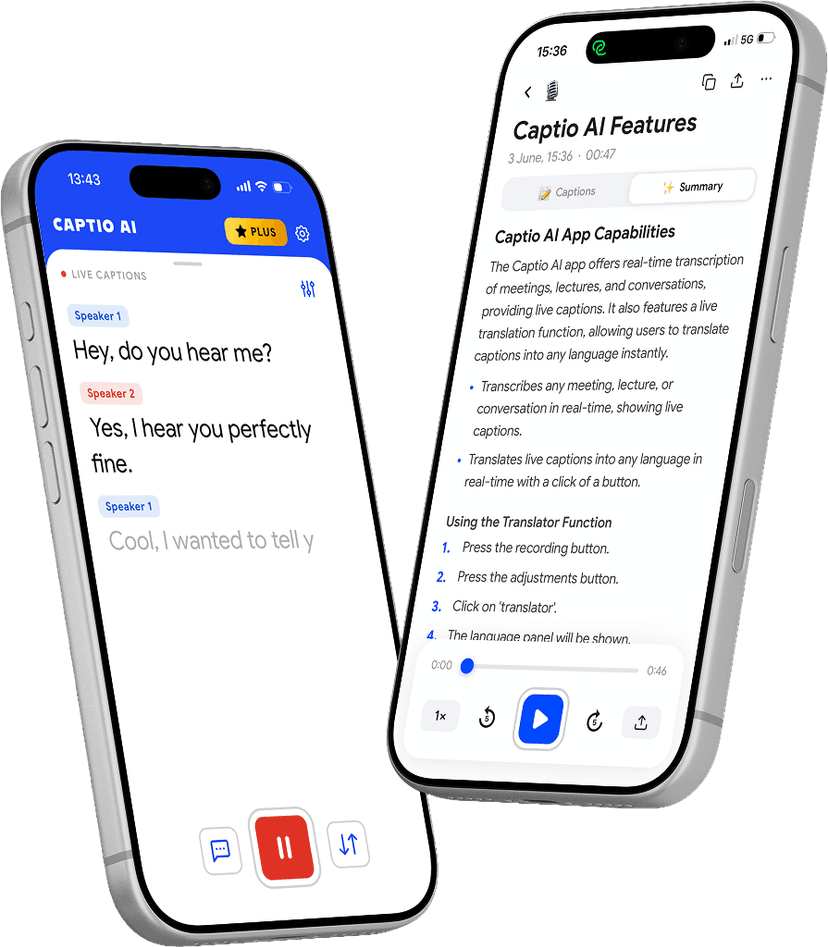
Everything you need to follow Ukrainian phone & video calls
Four tools built for deaf and hard of hearing Ukrainian speakers.
Follow the call in real time
- Captions appear word by word as the other person speaks
- Works on any call — no app integration required
- Put the call on speaker and point the microphone toward it
- Handles compressed call audio accurately
International and foreign-language calls
- They speak their language — you read in yours
- Translates in real time as they speak
- 60+ languages, no setup
- For family abroad, international business, or travel
Transcribe any call recording
- Record the call and upload for a complete written transcript
- Review instructions, information, and decisions after
- Organised by speaker
- Works on any call recording
Key information extracted from any call
- Important points pulled from any call transcript
- Useful for medical calls, customer service, and work calls
- Organised into clear sections
- Works on any saved recording
Download for free
Every situation covered
Designed for the real moments that matter — not just quiet controlled environments.
A video call with family still in Ukraine — in Kyiv, Lviv, or Odesa — where fast informal Ukrainian flows through a sometimes unstable connection.
A work call with Ukrainian-speaking colleagues where surzhyk or regional accents from eastern Ukraine shape the speech.
A telemedicine call or callback from a doctor speaking formal medical Ukrainian.
A call to a utility provider or government helpline where Standard Ukrainian is used in automated menus but the agent speaks differently.
A call from family members who have relocated to Germany, Poland, or the Czech Republic and mix Ukrainian with their new language.
A WhatsApp or Viber video call with family in Ukraine where connection quality fluctuates and family members speak simultaneously.
Most accurate and fastest models
word accuracy
independent benchmark, 2025
real-time captions
first word appears as you speak
Download for free
Built for the calls you have been avoiding
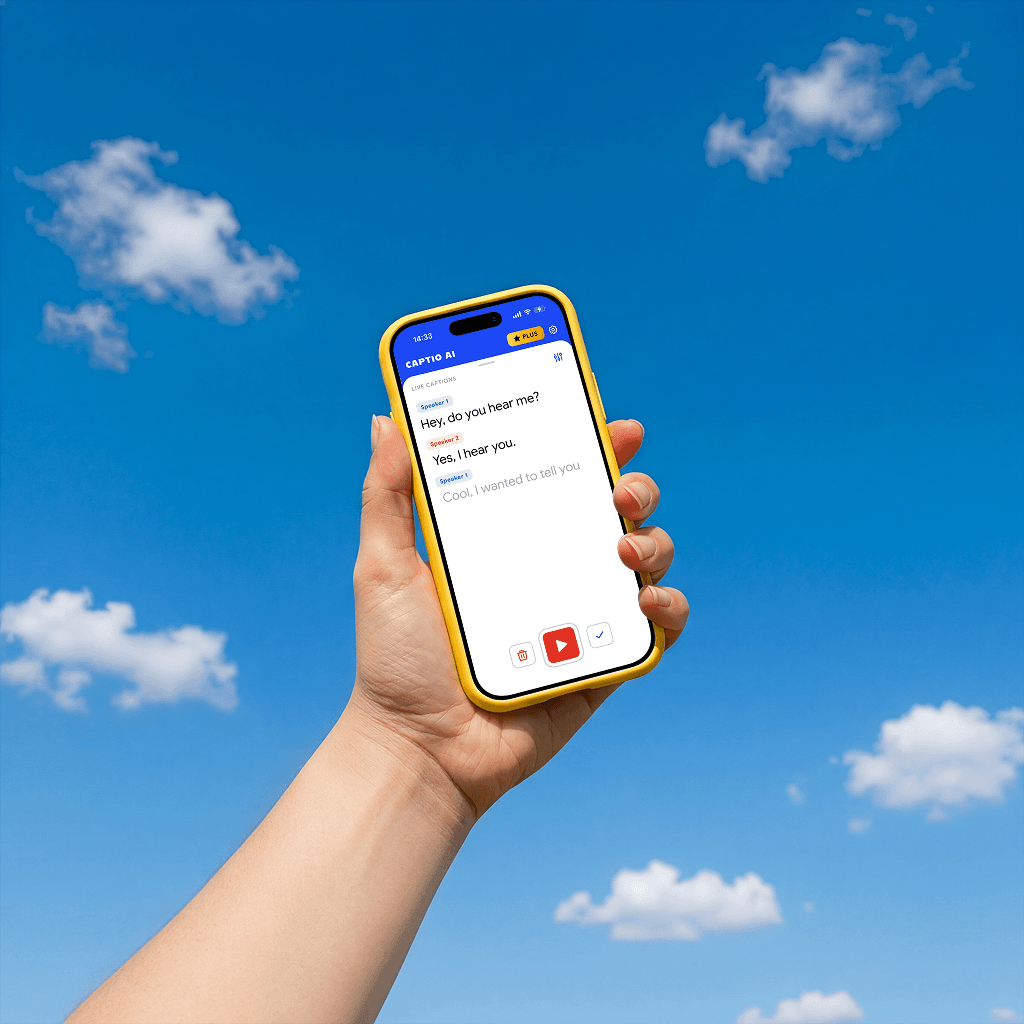
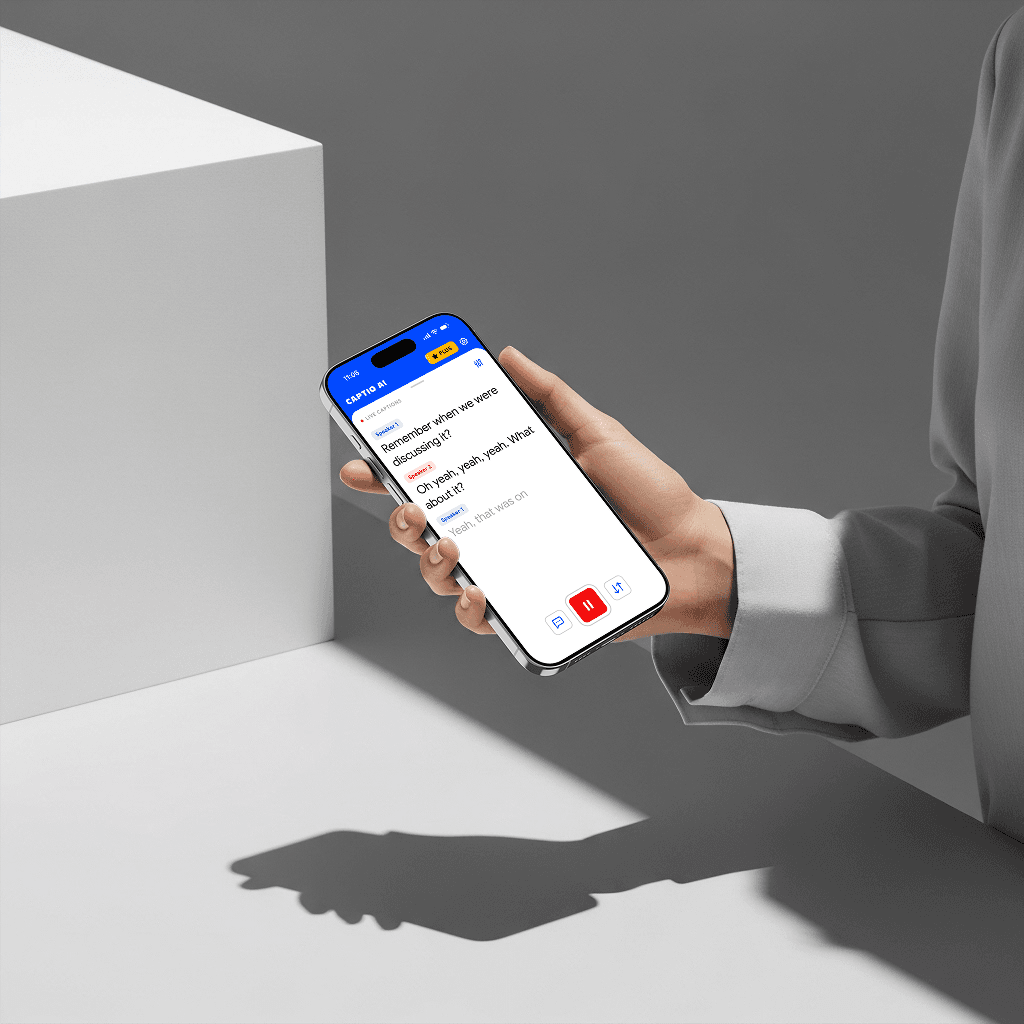
Captions as they speak
Words appear on screen word by word while the other person is still talking. You read what they say at the same pace everyone else hears it — no delay, no reconstruction.
Works on any call app
Captio AI does not need to integrate with any platform. Put the call on speaker, point the microphone toward the audio, and read the captions. It works the same way for any app on any device.
No more asking for repeats
Every word is on screen as it is said. If you missed something, glance at the caption rather than interrupting the call — the full sentence is there.
Handles call audio accurately
Compressed phone audio is less clean than in-person speech. Captio AI is built for real-world audio conditions, including the reduced quality of standard phone and VoIP calls.
Any language
For calls with family abroad, international colleagues, or foreign-language customer service. Live Translator captions and translates in real time with no manual setup.
Record and review after
Record any call and upload it to Audio Transcription. Get a full written record of everything said — useful for medical instructions, work decisions, and anything worth having in writing.
Why Ukrainian is hard to understand
Soft-hard consonant pairs
- Palatalization changes meaning inside the mouth, not on the lips
- Ukrainian phonemically contrasts hard and soft (palatalized) versions of most consonants. The palatalization is realized inside the mouth, not on the lips. On a video call, a deaf caller sees no visible difference between the two sets — but the word meaning can change entirely.
Ukrainian g-sound distinction
- Two back-of-throat consonants that look identical on screen
- Ukrainian uniquely contrasts a voiced velar fricative (the g in 'hora') with a velar stop (as in borrowed words) — a distinction that sets Ukrainian apart from Russian. Both are articulated at the back of the throat with the mouth open and the lips uninvolved. On a video call, they are visually identical — yet choosing the wrong one changes the word.
Four-dialect speed gap
- Northern, southwestern, southeastern, and Transcarpathian Ukrainian all sound different
- Ukrainian has four main dialect groups with distinct vowel systems and prosody. A video call between someone from Lviv (southwestern) and someone from Kharkiv (southeastern) involves different vowel timings and consonantal assimilation patterns — all without any visual cue for the deaf caller to signal the switch.
Vowel reduction in fast speech
- Unstressed vowels narrow at conversational pace
- In casual and fast Ukrainian, unstressed vowels reduce toward central realizations. On a video call in informal register, the mouth shapes for these reduced vowels narrow — a signal that helps hearing listeners track words through acoustic change but that a deaf caller reading lips cannot use.
Surzhyk code-switching
- Ukrainian and Russian mix mid-sentence without visual warning
- In many everyday contexts, particularly in eastern and central Ukraine, speakers move between Ukrainian and Russian (surzhyk) — mixing vocabularies and phonologies mid-sentence. A deaf caller learns one phonological system but must navigate two simultaneously, with no visual cue to signal when the switch happens.
Download for free
Two million Ukrainians with impaired hearing — and a war that made communication access a matter of survival
Before the full-scale invasion of February 2022, Ukraine had more than 2 million people living with impaired hearing, with approximately 31,000 experiencing complete hearing loss, according to World Health Organization estimates. These figures make Ukrainians with hearing loss one of the country's largest disability communities. The WHO's global hearing loss data places Eastern Europe among regions where hearing disability contributes disproportionately to years lived with disability relative to healthcare access — a pattern that played out visibly in Ukraine's underfunded audiology infrastructure.
The conflict compounded the everyday barriers facing deaf and hard-of-hearing Ukrainians in acute and urgent ways: many could not hear air-raid sirens and lacked independent warning systems to reach bomb shelters in time. The Ukrainian Society of the Deaf — a non-governmental organisation that has supported Ukrainians with impaired hearing since 1933 — worked to ensure that emergency updates, evacuation instructions, and displacement information reached deaf communities in Ukrainian Sign Language. This effort exposed how poorly public emergency infrastructure had historically accounted for hearing-impaired citizens, and how critical accessible communication is in crisis conditions.
Captio AI captions every Ukrainian call in real time — so a deaf person displaced abroad can follow a WhatsApp video call with family in Kyiv or Lviv, and a deaf person inside Ukraine can follow a telemedicine call or government helpline without needing an interpreter on the line.
Download for free
What you hear stays with you.
Gone the moment it ends
Captio AI processes your audio in real time and discards it immediately. Nothing is recorded. Nothing is kept.
Not a product
Your conversations are not something Captio AI sells, shares, or monetizes — to anyone, for any reason.
Not used to train anything
What you say in a doctor's appointment or a job interview never ends up in a training dataset. Not ours. Not anyone else's.

Private by default
Captio AI supports 60+ languages
Download for free
Frequently asked questions
Follow every call in Ukrainian.
Captio AI is free to start
Download for free