

Tagalog live captions and productivity tool for phone & video calls
For deaf and hard of hearing people.
Download for free


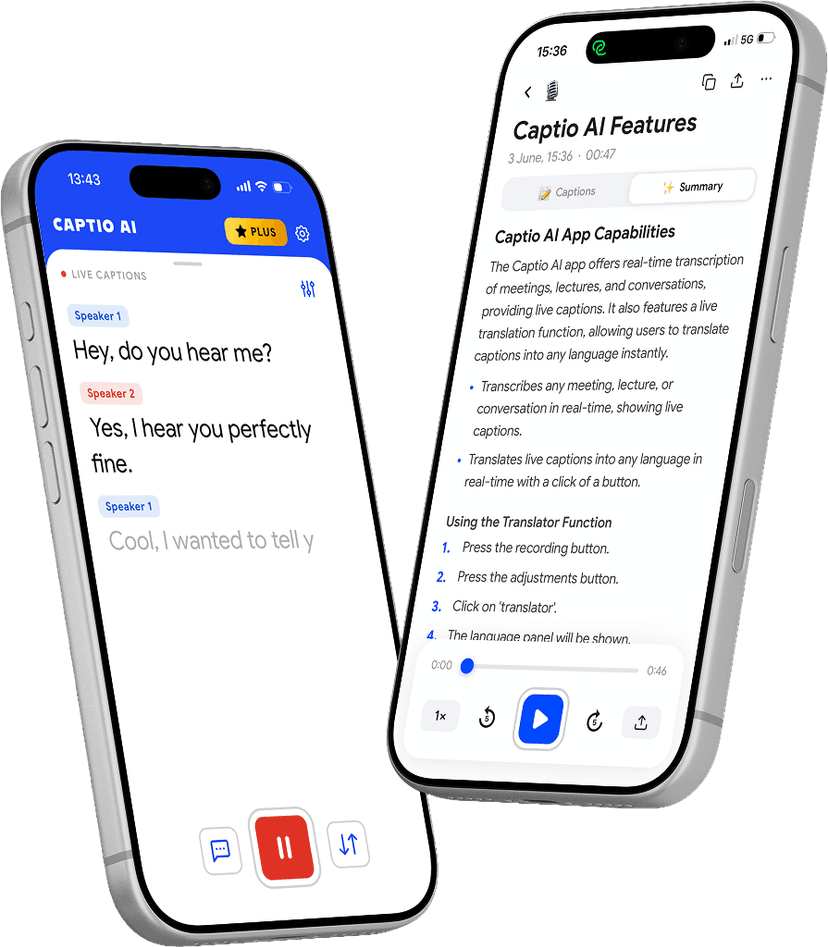
Everything you need to follow Tagalog phone & video calls
Four tools built for deaf and hard of hearing Tagalog speakers.
Follow the call in real time
- Captions appear word by word as the other person speaks
- Works on any call — no app integration required
- Put the call on speaker and point the microphone toward it
- Handles compressed call audio accurately
International and foreign-language calls
- They speak their language — you read in yours
- Translates in real time as they speak
- 60+ languages, no setup
- For family abroad, international business, or travel
Transcribe any call recording
- Record the call and upload for a complete written transcript
- Review instructions, information, and decisions after
- Organised by speaker
- Works on any call recording
Key information extracted from any call
- Important points pulled from any call transcript
- Useful for medical calls, customer service, and work calls
- Organised into clear sections
- Works on any saved recording
Download for free
Every situation covered
Designed for the real moments that matter — not just quiet controlled environments.
A call with family in Manila, Cebu, or Davao where informal Filipino moves fast and mixes Tagalog, English, and local language in the same breath.
A work call or video meeting where Taglish is the natural register — half the sentence in Tagalog, half in English, all at full speed.
A callback from a Philippine General Hospital or clinic where a doctor delivers results and prescription instructions in formal Filipino.
A call to a BDO branch, PLDT helpline, or Meralco customer service where automated menus are in Filipino and agents switch to English mid-sentence.
A call from family in the OFW diaspora in Saudi Arabia, Hong Kong, or Italy who mix Tagalog with the local language.
A Messenger or WhatsApp video call with family in the Philippines where connection quality varies by region and everyone talks at the same time.
Most accurate and fastest models
word accuracy
independent benchmark, 2025
real-time captions
first word appears as you speak
Download for free
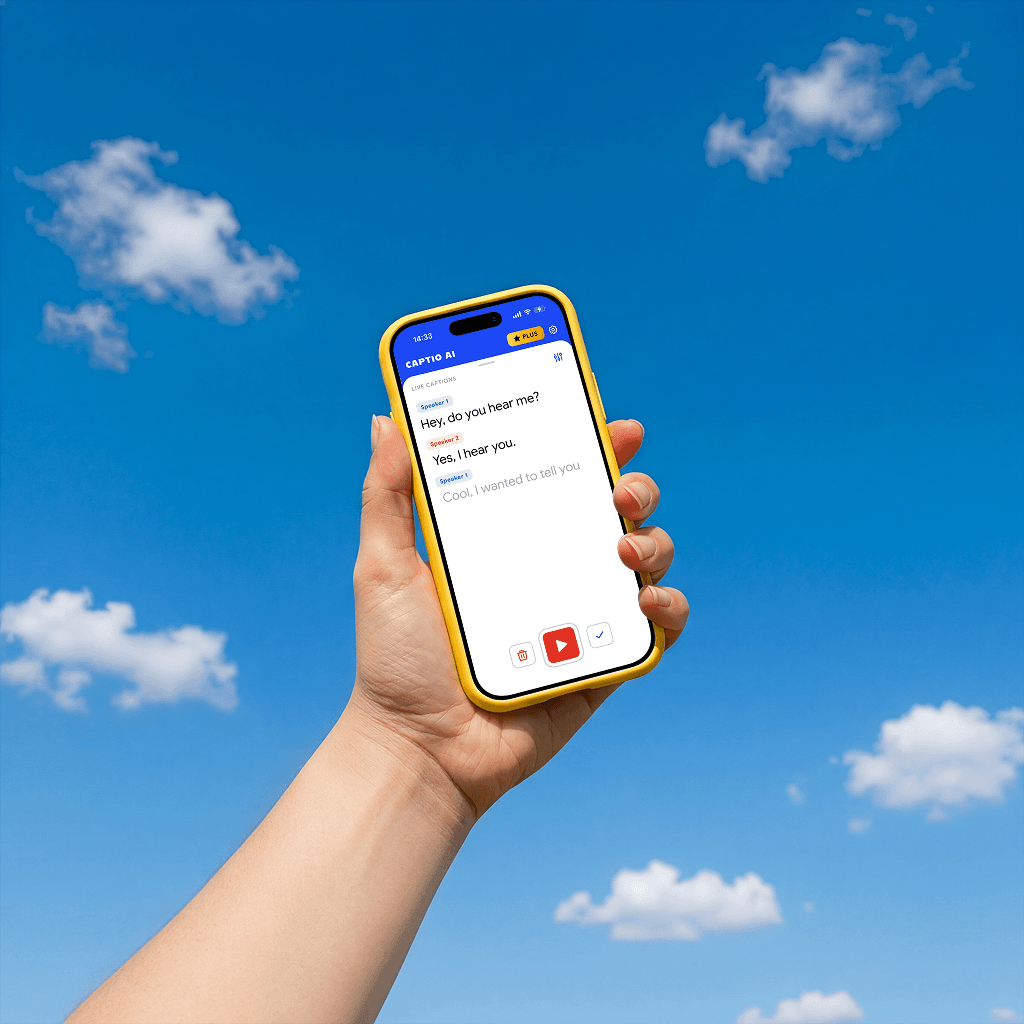
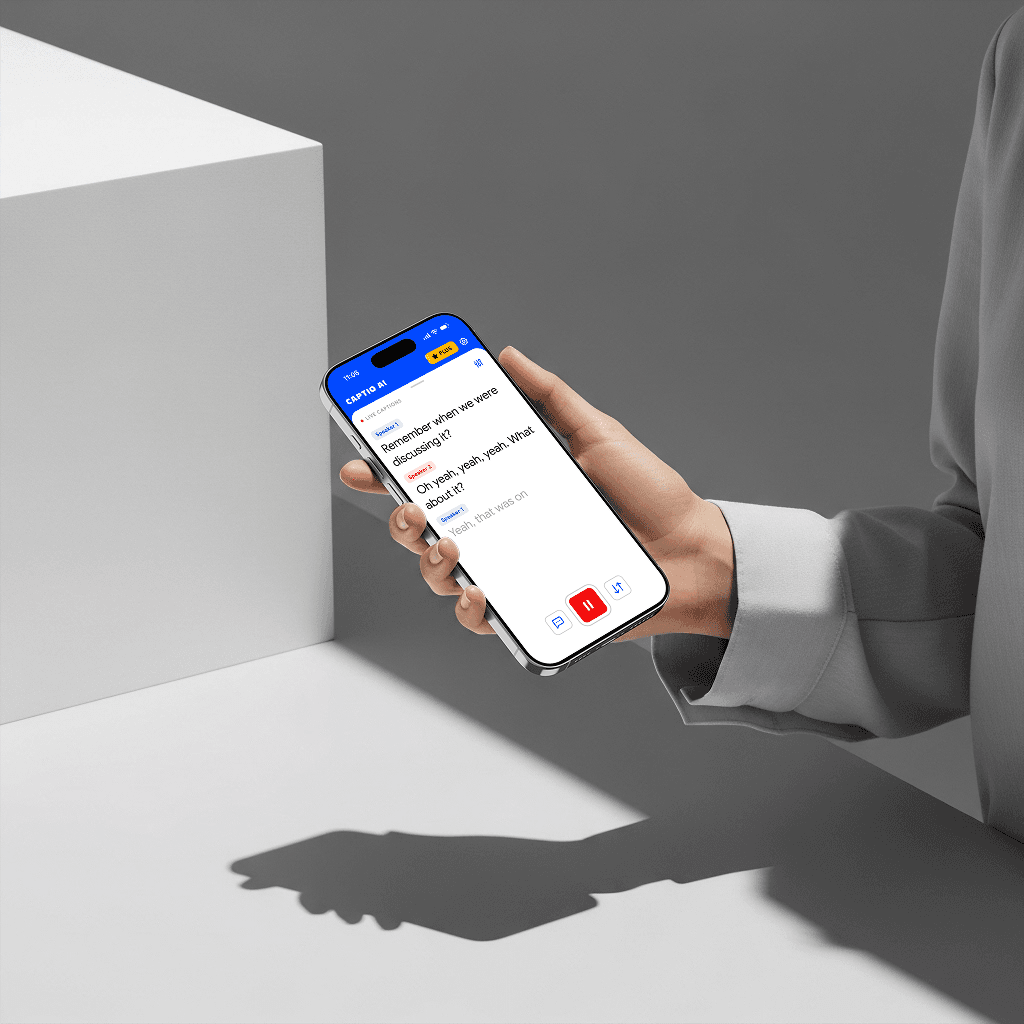
Built for the calls you have been avoiding
Captions as they speak
Words appear on screen word by word while the other person is still talking. You read what they say at the same pace everyone else hears it — no delay, no reconstruction.
Works on any call app
Captio AI does not need to integrate with any platform. Put the call on speaker, point the microphone toward the audio, and read the captions. It works the same way for any app on any device.
No more asking for repeats
Every word is on screen as it is said. If you missed something, glance at the caption rather than interrupting the call — the full sentence is there.
Handles call audio accurately
Compressed phone audio is less clean than in-person speech. Captio AI is built for real-world audio conditions, including the reduced quality of standard phone and VoIP calls.
Any language
For calls with family abroad, international colleagues, or foreign-language customer service. Live Translator captions and translates in real time with no manual setup.
Record and review after
Record any call and upload it to Audio Transcription. Get a full written record of everything said — useful for medical instructions, work decisions, and anything worth having in writing.
Why Tagalog is hard to understand
Phonemic glottal stop
- The glottal stop distinguishes words but leaves no visual trace
- Tagalog has a phonemic glottal stop that distinguishes many minimal pairs. The glottal stop is produced in the throat with no lip movement whatsoever. On a phone or video call, it is entirely invisible. A deaf caller reading lips sees the same vowel sequence for two words that a hearing caller distinguishes instantly.
Phonemic stress
- Word stress is meaning-bearing but lives in the voice
- Tagalog stress is phonemically distinctive — two otherwise identical words can differ only in stress position, changing their grammatical function. Stress is realized through pitch and duration in the voice. On a video call, a deaf caller sees the same mouth shapes for both words. The entire lexical stress system is auditory-only.
Taglish code-switching
- Filipino phone calls pivot between Tagalog and English without warning
- Filipino phone calls — especially among younger urban speakers in Metro Manila — switch between Tagalog and English within a single sentence. When the code switches, the phonological system resets: English vowels, consonant clusters, and prosody arrive without visual warning. A deaf caller tracking Tagalog lip shapes is suddenly reading English ones.
Regional language variation
- Many callers speak Tagalog as a second language with first-language phonology
- The Philippines has over 170 languages. Many callers use Tagalog as a second language, speaking it with the phonological patterns of Cebuano, Ilocano, Hiligaynon, or Waray. On a phone call, the same Tagalog words arrive with different vowel qualities and consonant treatments depending on the caller's origin — without any visual cue for the deaf caller.
Affix segmentation
- Long affixed words blur boundaries at phone call speed
- Tagalog uses many prefixes and infixes that attach to roots, creating long concatenated words where syllable boundaries fall in non-obvious places. In fast phone speech, these boundaries blur further. A deaf caller parsing words from lip shapes encounters a continuous flow with ambiguous segmentation points.
Download for free
Nine million Filipinos living with disabling hearing loss — and a healthcare system still catching up with the scale of need
Disabling hearing loss affects 8.8% of the population in the Philippines — at least 9 million people who require medical attention or rehabilitation. A national survey found that 15% of Filipinos have moderate or worse hearing loss, making hearing impairment one of the most prevalent conditions in the country. The burden is distributed across age groups: 7.5% in children, 14.7% in working-age adults between 18 and 65, and 49.1% in adults aged 65 and over. The Philippine Statistics Authority estimated 1,784,690 individuals had hearing difficulties in the 2020 census. The prevalence of severe to profound hearing loss is also comparatively higher in the Philippines than in high-income countries, partly linked to rates of middle ear disease and limited access to early intervention.
Survey findings on the scale of hearing loss in the Philippines were used to advocate for landmark policies including a Universal Newborn Hearing Screening Law and a government benefit package for children with hearing impairment. However, access to audiological rehabilitation remains uneven — services are concentrated in Metro Manila and major provincial cities, while rural and island communities face significant gaps. For the approximately 10 million Overseas Filipino Workers whose families depend on phone and video calls for daily communication, a deaf or hard-of-hearing family member navigating those calls without support faces a daily exclusion that is largely invisible to policymakers.
Captio AI captions every Tagalog call in real time — so a deaf family member in Manila, Cebu, or anywhere in the Filipino diaspora can follow a video call without asking the caller to slow down or switch to text.
Download for free
What you hear stays with you.
Gone the moment it ends
Captio AI processes your audio in real time and discards it immediately. Nothing is recorded. Nothing is kept.
Not a product
Your conversations are not something Captio AI sells, shares, or monetizes — to anyone, for any reason.
Not used to train anything
What you say in a doctor's appointment or a job interview never ends up in a training dataset. Not ours. Not anyone else's.

Private by default
Captio AI supports 60+ languages
Download for free
Frequently asked questions
Follow every call in Tagalog.
Captio AI is free to start
Download for free