

Japanese live captions and productivity tool for phone & video calls
For deaf and hard of hearing people.
Download for free


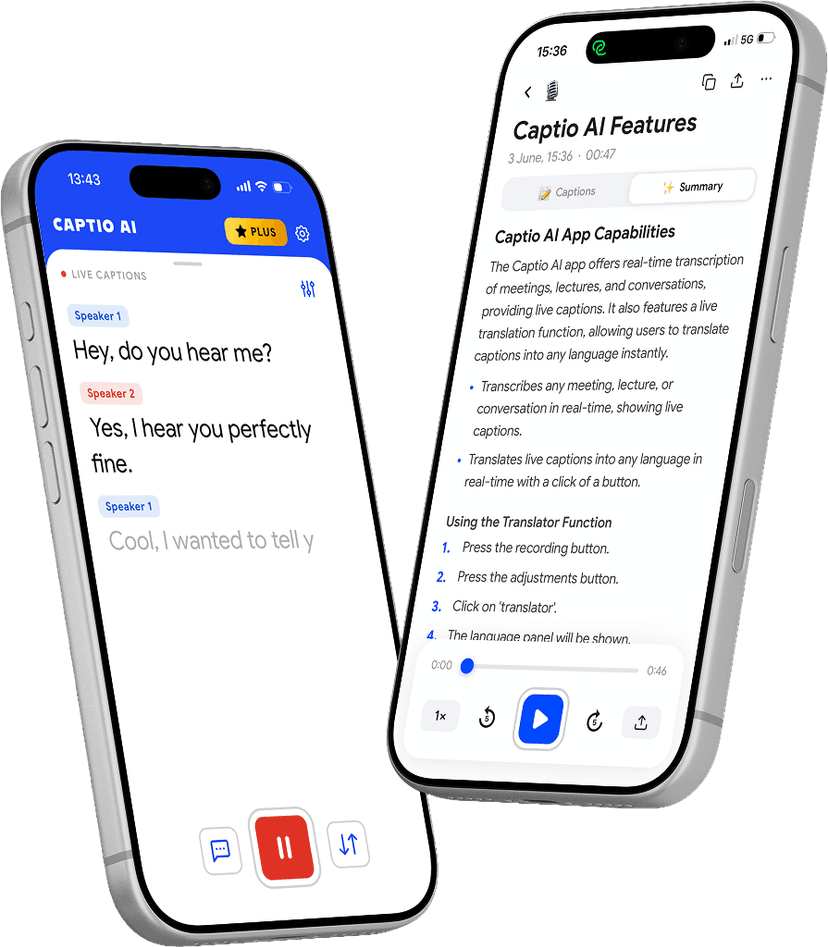
Everything you need to follow Japanese phone & video calls
Four tools built for deaf and hard of hearing Japanese speakers.
Follow the call in real time
- Captions appear word by word as the other person speaks
- Works on any call — no app integration required
- Put the call on speaker and point the microphone toward it
- Handles compressed call audio accurately
International and foreign-language calls
- They speak their language — you read in yours
- Translates in real time as they speak
- 60+ languages, no setup
- For family abroad, international business, or travel
Transcribe any call recording
- Record the call and upload for a complete written transcript
- Review instructions, information, and decisions after
- Organised by speaker
- Works on any call recording
Key information extracted from any call
- Important points pulled from any call transcript
- Useful for medical calls, customer service, and work calls
- Organised into clear sections
- Works on any saved recording
Download for free
Every situation covered
Designed for the real moments that matter — not just quiet controlled environments.
A call with parents in Tokyo or grandparents in Kyoto. Family conversations carry fast pitch changes, regional accents, and the shorthand of people who know each other well. Captio AI captions everything said, at full speed.
A Zoom meeting with Japanese colleagues or a client video call run in business Japanese. Keigo forms, company-specific vocabulary, and formal suffix stacking — all captured in text as the speaker talks.
A callback from a Japanese clinic or hospital. Medical Japanese uses a formal keigo register and technical vocabulary. Captio AI shows the full message — diagnosis, instructions, and follow-up — in real time.
A Japan Post Bank automated IVR, a Docomo customer service call, or a utility billing query in Japanese. Automated menus run at fixed speed. Captio AI captions each option as it is read aloud.
A call from a family member in Hawaii or the Japanese diaspora in Brazil or the US. Japanese spoken abroad carries local influence on pitch patterns and vocabulary. Captio AI keeps up with it.
A LINE video call with family in Osaka or Kyushu, or a Zoom meeting with a Japanese team. All video call apps work the same way — put the call on speaker, open Captio AI, read the captions.
Most accurate and fastest models
character accuracy
independent benchmark, 2025
real-time captions
first word appears as you speak
Download for free
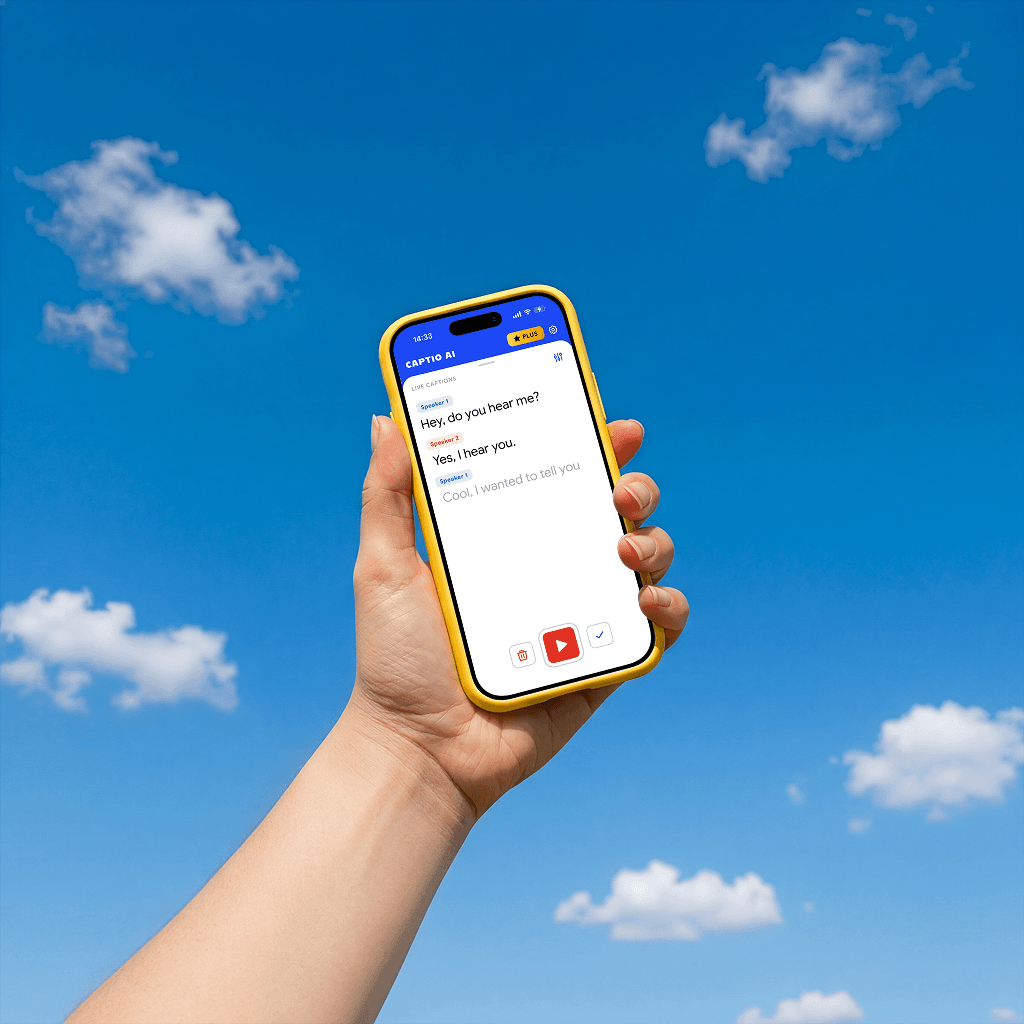
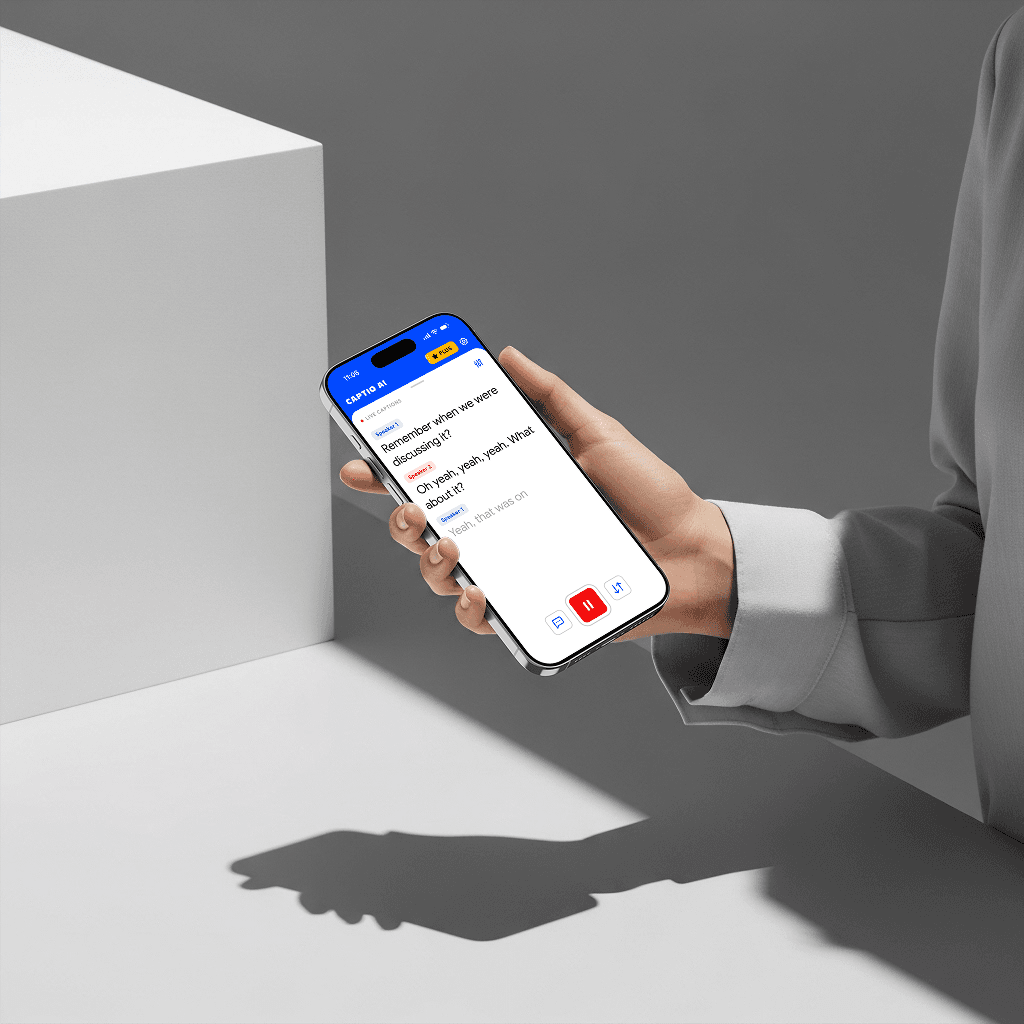
Built for the calls you have been avoiding
Captions as they speak
Words appear on screen word by word while the other person is still talking. You read what they say at the same pace everyone else hears it — no delay, no reconstruction.
Works on any call app
Captio AI does not need to integrate with any platform. Put the call on speaker, point the microphone toward the audio, and read the captions. It works the same way for any app on any device.
No more asking for repeats
Every word is on screen as it is said. If you missed something, glance at the caption rather than interrupting the call — the full sentence is there.
Handles call audio accurately
Compressed phone audio is less clean than in-person speech. Captio AI is built for real-world audio conditions, including the reduced quality of standard phone and VoIP calls.
Any language
For calls with family abroad, international colleagues, or foreign-language customer service. Live Translator captions and translates in real time with no manual setup.
Record and review after
Record any call and upload it to Audio Transcription. Get a full written record of everything said — useful for medical instructions, work decisions, and anything worth having in writing.
Why Japanese is hard to understand
Pitch accent invisibility
- Japanese tone lives in voice pitch alone
- Japanese pitch accent — the high-low patterns that distinguish 橋 (bridge) from 端 (chopstick) — is encoded entirely in voice pitch with no lip movement difference. On a compressed phone call where you cannot hear, pairs of words that differ only in pitch pattern are completely indistinguishable, and Japanese has hundreds of such pairs.
Minimal lip movement
- Japanese speakers naturally articulate with less lip movement
- Neuroimaging research has found that native Japanese speakers show weaker brain coupling between auditory and visual speech areas than English speakers — a direct result of less lip movement in natural Japanese articulation. Phone audio compression compounds this: the lip information that does exist is already minimal.
Vowel length collapse
- Short and long vowels merge on a compressed call
- Japanese is mora-timed and distinguishes short from long vowels phonemically: きって (stamp) vs. きて (come), おじさん (uncle) vs. おじいさん (grandfather). Phone codecs compress audio in ways that shorten vowel duration, merging these pairs in exactly the frequency range where Japanese length contrasts live.
Fricative and affricate blur
- Japanese sibilants disappear in phone compression
- Japanese sibilants (し/シ, す/ス, つ/ツ, ち/チ) and the flap /r/ are articulated in the mid-palate region with minimal lip involvement. Phone codecs that compress high-mid frequencies degrade precisely the spectral range these sounds occupy, making し, す, and ち nearly indistinguishable in compressed audio.
Keigo register gap
- Formal polite speech uses a completely different lexicon
- Professional and medical calls in Japanese use keigo — a formal register with entirely different verb forms and vocabulary. 食べる (taberu, eat) becomes 召し上がる (meshiagaru) in polite speech. For a deaf caller, this is not just phonological difficulty but a parallel vocabulary system that may not match everyday conversational Japanese.
Download for free
Sixteen million Japanese people with hearing impairment, and a phone system built for the rest
Japan is one of the world's most rapidly aging societies, and hearing loss rises sharply with age. A 2024 study published in the JMA Journal found the prevalence of bilateral high-frequency hearing loss reaches 46.5% in Japanese men and 20.2% in Japanese women by their 70s. Population estimates from the National Institute for Longevity Sciences placed the number of hearing-impaired people over 65 in Japan at 16.55 million — a figure that continues to grow as the over-65 population expands.
Japanese Sign Language (Nihon Shuwa, 日本手話) received legal recognition under Japan's Disabled Persons Rights Act in 2011 and under municipal sign language ordinances in many cities since. Despite this, JSL interpreters remain concentrated in Tokyo and major urban centres. Real-time caption telephone services (字幕電話) exist through NTT but require a specific subscription and are not available through WhatsApp, LINE, Zoom, or standard VoIP platforms. A deaf person in Sapporo or Naha who receives a medical callback or bank notification call has no accessible real-time option on their smartphone.
Captio AI is built for exactly those calls: the LINE video call with family in Kyushu, the Mizuho bank menu, the hospital specialist callback. Put the call on speaker, open the app, and read every word — including pitch-accented pairs and keigo forms — as captions in real time.
Download for free
What you hear stays with you.
Gone the moment it ends
Captio AI processes your audio in real time and discards it immediately. Nothing is recorded. Nothing is kept.
Not a product
Your conversations are not something Captio AI sells, shares, or monetizes — to anyone, for any reason.
Not used to train anything
What you say in a doctor's appointment or a job interview never ends up in a training dataset. Not ours. Not anyone else's.

Private by default
Captio AI supports 60+ languages
Download for free
Frequently asked questions
Follow every call in Japanese.
Captio AI is free to start
Download for free